 Add to Chrome
 Add to Firefox
 Add to Edge
XPolicyLab: A Unified Standard and Open Ecosystem for Robot Policy Evaluation and Deployment
Aug 11, 2026
Robot policy evaluation and deployment remain fragmented by model-specific software dependencies, data representations, and runtime interfaces, so that connecting N policies to M evaluation environments requires O(NM) separate integrations. We present XPolicyLab, a unified standard and open ecosystem that reduces this cost to O(N+M). XPolicyLab specifies common observation, action, and trajectory schemas together with a minimal adapter interface for observation updates, action prediction, batched execution, and episode reset, while a dependency-isolated client/server architecture separates policy inference from environment execution, so that each side retains its native software stack and may run locally or remotely. The ecosystem integrates 42 robot policies and standardizes their installation, debugging, serving, and evaluation workflows. Across these adapters, model-specific code varies by an order of magnitude while the environment-facing loop stays within a few lines of a fixed reference, confirming that the contract confines heterogeneity to the policy side. In a controlled study, conforming to the standard reduces the integration effort of a representative policy from over five hours to two hours, and packaged agent skills reduce it further to thirty minutes. The same adapters serve RoboTwin, RoboDojo simulation, and standardized real-robot evaluation through one interface. XPolicyLab is released as shared infrastructure for reproducible policy comparison and standardized deployment across simulation and physical platforms. Project website: https://xpolicylab.github.io/.

InternVLA-A1.5: Unifying Understanding, Latent Foresight, and Action for Compositional Generalization
Jul 06, 2026Unified models for robot manipulation aim to equip one policy with both the semantic priors of pretrained VLMs and the physical dynamics learned through future prediction. In practice, existing designs tend to erode the semantics of the pretrained backbone, suffer interference among heterogeneous objectives, and learn future prediction from scratch in pixel space, leaving the dynamics priors of pretrained video generators unexploited. We present InternVLA-A1.5, which builds the policy on a native VLM backbone that keeps training on VQA and subtask prediction, and attaches a lightweight unified expert for continuous action generation. Future prediction is recast as a latent-querying problem, where a small set of learnable foresight tokens condenses the task-relevant future into a compact latent code under the supervision of a frozen pretrained video generation model, so the policy inherits world-model dynamics priors without ever learning pixel-level generation. The video branch is discarded at inference, keeping real-time control. Pretrained on 1.2M robot episodes and 3M multimodal samples, InternVLA-A1.5 achieves the best overall results on all six simulation benchmarks. In the real world, the preserved semantics deliver the strongest compositional generalization on held-out instruction bindings, and the two designs together sustain long-horizon execution.
EBench: Elemental Diagnosis of Generalist Mobile Manipulation Policies
Jun 16, 2026We present EBench, a simulation benchmark that diagnoses generalist mobile manipulation policies beyond a single success-rate scalar. EBench comprises 26 diverse and challenging manipulation tasks annotated along 5 capability dimensions and 4 generalization dimensions. We evaluate state-of-the-art generalist manipulation models including $π_0$, $π_{0.5}$, XVLA, and InternVLA-A1, and reveal that models with near success rates exhibit strikingly different capability profiles: $π_{0.5}$ achieves the highest test success rate and the best train--test retention, whereas InternVLA-A1 dominates mobile manipulation but collapses on dexterous tasks, and XVLA exhibits strengths on a disjoint set of atomic skills compared to other policies. Beyond capability profiling, EBench analyzes the generalization ability from 4 representative perspectives, identifying the impact of different distribution shift factors. The results reveal strengths and weaknesses of models behind an overall score. We hope this benchmark offers a broad set of diagnostic signals to guide iteration on generalist manipulation models.
HeavySkill: Heavy Thinking as the Inner Skill in Agentic Harness
May 04, 2026Recent advances in agentic harness with orchestration frameworks that coordinate multiple agents with memory, skills, and tool use have achieved remarkable success in complex reasoning tasks. However, the underlying mechanism that truly drives performance remains obscured behind intricate system designs. In this paper, we propose HeavySkill, a perspective that views heavy thinking not only as a minimal execution unit in orchestration harness but also as an inner skill internalized within the model's parameters that drives the orchestrator to solve complex tasks. We identify this skill as a two-stage pipeline, i.e., parallel reasoning then summarization, which can operate beneath any agentic harness. We present a systematic empirical study of HeavySkill across diverse domains. Our results show that this inner skill consistently outperforms traditional Best-of-N (BoN) strategies; notably, stronger LLMs can even approach Pass@N performance. Crucially, we demonstrate that the depth and width of heavy thinking, as a learnable skill, can be further scaled via reinforcement learning, offering a promising path toward self-evolving LLMs that internalize complex reasoning without relying on brittle orchestration layers.
EruDiff: Refactoring Knowledge in Diffusion Models for Advanced Text-to-Image Synthesis
Mar 21, 2026Text-to-image diffusion models have achieved remarkable fidelity in synthesizing images from explicit text prompts, yet exhibit a critical deficiency in processing implicit prompts that require deep-level world knowledge, ranging from natural sciences to cultural commonsense, resulting in counter-factual synthesis. This paper traces the root of this limitation to a fundamental dislocation of the underlying knowledge structures, manifesting as a chaotic organization of implicit prompts compared to their explicit counterparts. In this paper, we propose EruDiff, which aims to refactor the knowledge within diffusion models. Specifically, we develop the Diffusion Knowledge Distribution Matching (DK-DM) to register the knowledge distribution of intractable implicit prompts with that of well-defined explicit anchors. Furthermore, to rectify the inherent biases in explicit prompt rendering, we employ the Negative-Only Reinforcement Learning (NO-RL) strategy for fine-grained correction. Rigorous empirical evaluations demonstrate that our method significantly enhances the performance of leading diffusion models, including FLUX and Qwen-Image, across both the scientific knowledge benchmark (i.e., Science-T2I) and the world knowledge benchmark (i.e., WISE), underscoring the effectiveness and generalizability. Our code is available at https://github.com/xiefan-guo/erudiff.
GraspLDP: Towards Generalizable Grasping Policy via Latent Diffusion
Feb 26, 2026This paper focuses on enhancing the grasping precision and generalization of manipulation policies learned via imitation learning. Diffusion-based policy learning methods have recently become the mainstream approach for robotic manipulation tasks. As grasping is a critical subtask in manipulation, the ability of imitation-learned policies to execute precise and generalizable grasps merits particular attention. Existing imitation learning techniques for grasping often suffer from imprecise grasp executions, limited spatial generalization, and poor object generalization. To address these challenges, we incorporate grasp prior knowledge into the diffusion policy framework. In particular, we employ a latent diffusion policy to guide action chunk decoding with grasp pose prior, ensuring that generated motion trajectories adhere closely to feasible grasp configurations. Furthermore, we introduce a self-supervised reconstruction objective during diffusion to embed the graspness prior: at each reverse diffusion step, we reconstruct wrist-camera images back-projected the graspness from the intermediate representations. Both simulation and real robot experiments demonstrate that our approach significantly outperforms baseline methods and exhibits strong dynamic grasping capabilities.
LongCat-Flash-Thinking-2601 Technical Report
Jan 23, 2026We introduce LongCat-Flash-Thinking-2601, a 560-billion-parameter open-source Mixture-of-Experts (MoE) reasoning model with superior agentic reasoning capability. LongCat-Flash-Thinking-2601 achieves state-of-the-art performance among open-source models on a wide range of agentic benchmarks, including agentic search, agentic tool use, and tool-integrated reasoning. Beyond benchmark performance, the model demonstrates strong generalization to complex tool interactions and robust behavior under noisy real-world environments. Its advanced capability stems from a unified training framework that combines domain-parallel expert training with subsequent fusion, together with an end-to-end co-design of data construction, environments, algorithms, and infrastructure spanning from pre-training to post-training. In particular, the model's strong generalization capability in complex tool-use are driven by our in-depth exploration of environment scaling and principled task construction. To optimize long-tailed, skewed generation and multi-turn agentic interactions, and to enable stable training across over 10,000 environments spanning more than 20 domains, we systematically extend our asynchronous reinforcement learning framework, DORA, for stable and efficient large-scale multi-environment training. Furthermore, recognizing that real-world tasks are inherently noisy, we conduct a systematic analysis and decomposition of real-world noise patterns, and design targeted training procedures to explicitly incorporate such imperfections into the training process, resulting in improved robustness for real-world applications. To further enhance performance on complex reasoning tasks, we introduce a Heavy Thinking mode that enables effective test-time scaling by jointly expanding reasoning depth and width through intensive parallel thinking.
InternVLA-A1: Unifying Understanding, Generation and Action for Robotic Manipulation
Jan 05, 2026Prevalent Vision-Language-Action (VLA) models are typically built upon Multimodal Large Language Models (MLLMs) and demonstrate exceptional proficiency in semantic understanding, but they inherently lack the capability to deduce physical world dynamics. Consequently, recent approaches have shifted toward World Models, typically formulated via video prediction; however, these methods often suffer from a lack of semantic grounding and exhibit brittleness when handling prediction errors. To synergize semantic understanding with dynamic predictive capabilities, we present InternVLA-A1. This model employs a unified Mixture-of-Transformers architecture, coordinating three experts for scene understanding, visual foresight generation, and action execution. These components interact seamlessly through a unified masked self-attention mechanism. Building upon InternVL3 and Qwen3-VL, we instantiate InternVLA-A1 at 2B and 3B parameter scales. We pre-train these models on hybrid synthetic-real datasets spanning InternData-A1 and Agibot-World, covering over 533M frames. This hybrid training strategy effectively harnesses the diversity of synthetic simulation data while minimizing the sim-to-real gap. We evaluated InternVLA-A1 across 12 real-world robotic tasks and simulation benchmark. It significantly outperforms leading models like pi0 and GR00T N1.5, achieving a 14.5\% improvement in daily tasks and a 40\%-73.3\% boost in dynamic settings, such as conveyor belt sorting.
Robust Reward Design for Markov Decision Processes
Jun 07, 2024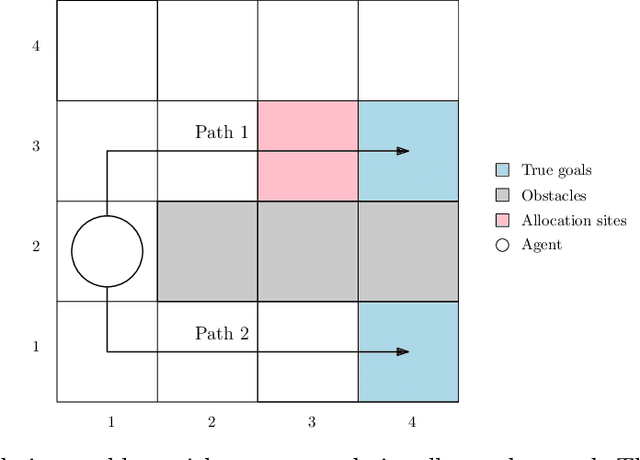


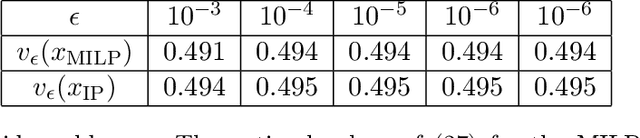
The problem of reward design examines the interaction between a leader and a follower, where the leader aims to shape the follower's behavior to maximize the leader's payoff by modifying the follower's reward function. Current approaches to reward design rely on an accurate model of how the follower responds to reward modifications, which can be sensitive to modeling inaccuracies. To address this issue of sensitivity, we present a solution that offers robustness against uncertainties in modeling the follower, including 1) how the follower breaks ties in the presence of nonunique best responses, 2) inexact knowledge of how the follower perceives reward modifications, and 3) bounded rationality of the follower. Our robust solution is guaranteed to exist under mild conditions and can be obtained numerically by solving a mixed-integer linear program. Numerical experiments on multiple test cases demonstrate that our solution improves robustness compared to the standard approach without incurring significant additional computing costs.
Generalizing 6-DoF Grasp Detection via Domain Prior Knowledge
Apr 02, 2024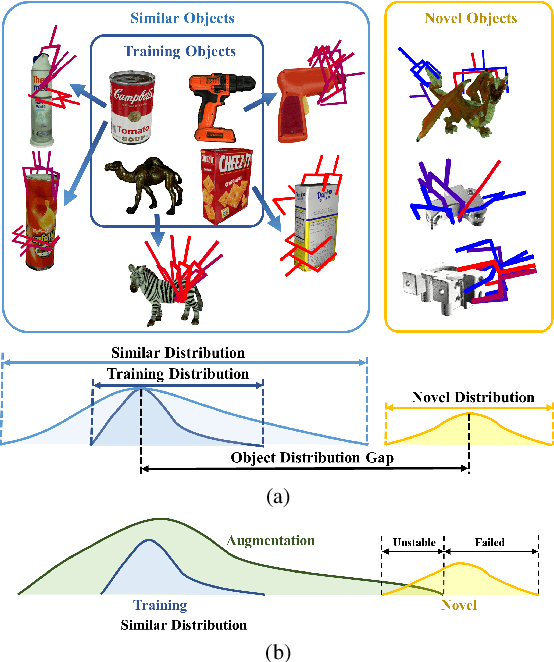
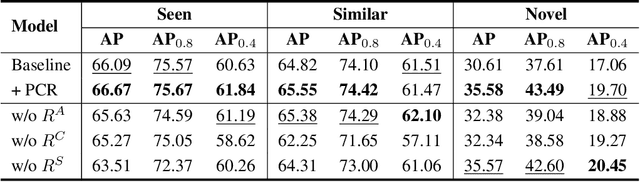
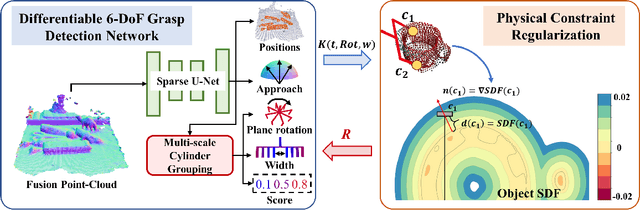
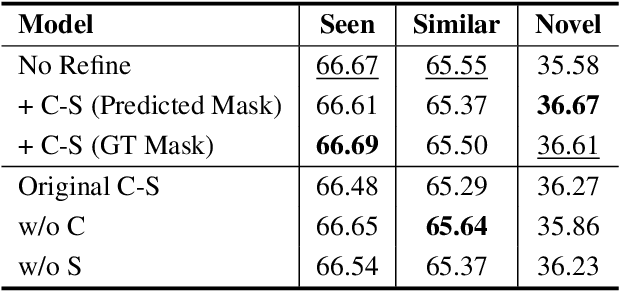
We focus on the generalization ability of the 6-DoF grasp detection method in this paper. While learning-based grasp detection methods can predict grasp poses for unseen objects using the grasp distribution learned from the training set, they often exhibit a significant performance drop when encountering objects with diverse shapes and structures. To enhance the grasp detection methods' generalization ability, we incorporate domain prior knowledge of robotic grasping, enabling better adaptation to objects with significant shape and structure differences. More specifically, we employ the physical constraint regularization during the training phase to guide the model towards predicting grasps that comply with the physical rule on grasping. For the unstable grasp poses predicted on novel objects, we design a contact-score joint optimization using the projection contact map to refine these poses in cluttered scenarios. Extensive experiments conducted on the GraspNet-1billion benchmark demonstrate a substantial performance gain on the novel object set and the real-world grasping experiments also demonstrate the effectiveness of our generalizing 6-DoF grasp detection method.