 Add to Chrome
 Add to Firefox
 Add to Edge
EBench: Elemental Diagnosis of Generalist Mobile Manipulation Policies
Jun 16, 2026
We present EBench, a simulation benchmark that diagnoses generalist mobile manipulation policies beyond a single success-rate scalar. EBench comprises 26 diverse and challenging manipulation tasks annotated along 5 capability dimensions and 4 generalization dimensions. We evaluate state-of-the-art generalist manipulation models including $π_0$, $π_{0.5}$, XVLA, and InternVLA-A1, and reveal that models with near success rates exhibit strikingly different capability profiles: $π_{0.5}$ achieves the highest test success rate and the best train--test retention, whereas InternVLA-A1 dominates mobile manipulation but collapses on dexterous tasks, and XVLA exhibits strengths on a disjoint set of atomic skills compared to other policies. Beyond capability profiling, EBench analyzes the generalization ability from 4 representative perspectives, identifying the impact of different distribution shift factors. The results reveal strengths and weaknesses of models behind an overall score. We hope this benchmark offers a broad set of diagnostic signals to guide iteration on generalist manipulation models.

EgoSim: Egocentric World Simulator for Embodied Interaction Generation
Apr 01, 2026We introduce EgoSim, a closed-loop egocentric world simulator that generates spatially consistent interaction videos and persistently updates the underlying 3D scene state for continuous simulation. Existing egocentric simulators either lack explicit 3D grounding, causing structural drift under viewpoint changes, or treat the scene as static, failing to update world states across multi-stage interactions. EgoSim addresses both limitations by modeling 3D scenes as updatable world states. We generate embodiment interactions via a Geometry-action-aware Observation Simulation model, with spatial consistency from an Interaction-aware State Updating module. To overcome the critical data bottleneck posed by the difficulty in acquiring densely aligned scene-interaction training pairs, we design a scalable pipeline that extracts static point clouds, camera trajectories, and embodiment actions from in-the-wild large-scale monocular egocentric videos. We further introduce EgoCap, a capture system that enables low-cost real-world data collection with uncalibrated smartphones. Extensive experiments demonstrate that EgoSim significantly outperforms existing methods in terms of visual quality, spatial consistency, and generalization to complex scenes and in-the-wild dexterous interactions, while supporting cross-embodiment transfer to robotic manipulation. Codes and datasets will be open soon. The project page is at egosimulator.github.io.
Explicit Temporal-Semantic Modeling for Dense Video Captioning via Context-Aware Cross-Modal Interaction
Nov 13, 2025Dense video captioning jointly localizes and captions salient events in untrimmed videos. Recent methods primarily focus on leveraging additional prior knowledge and advanced multi-task architectures to achieve competitive performance. However, these pipelines rely on implicit modeling that uses frame-level or fragmented video features, failing to capture the temporal coherence across event sequences and comprehensive semantics within visual contexts. To address this, we propose an explicit temporal-semantic modeling framework called Context-Aware Cross-Modal Interaction (CACMI), which leverages both latent temporal characteristics within videos and linguistic semantics from text corpus. Specifically, our model consists of two core components: Cross-modal Frame Aggregation aggregates relevant frames to extract temporally coherent, event-aligned textual features through cross-modal retrieval; and Context-aware Feature Enhancement utilizes query-guided attention to integrate visual dynamics with pseudo-event semantics. Extensive experiments on the ActivityNet Captions and YouCook2 datasets demonstrate that CACMI achieves the state-of-the-art performance on dense video captioning task.
ContextHOI: Spatial Context Learning for Human-Object Interaction Detection
Dec 12, 2024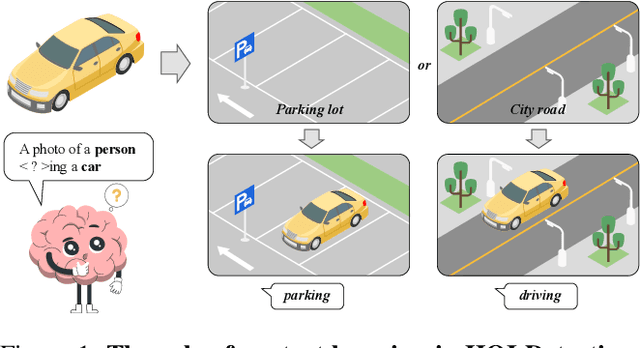
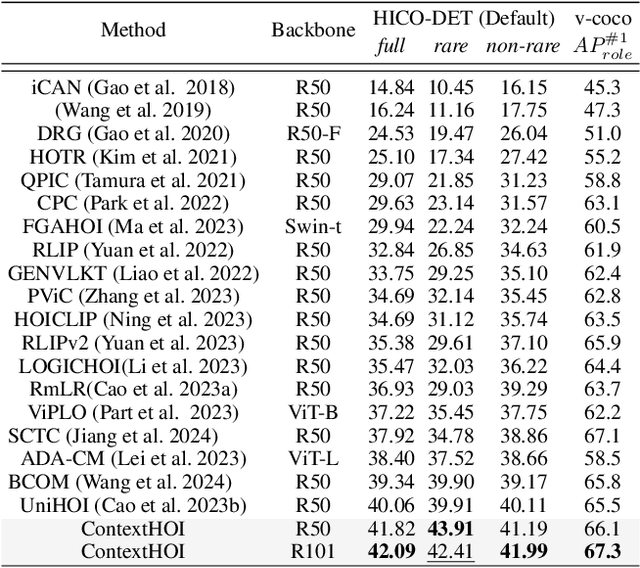
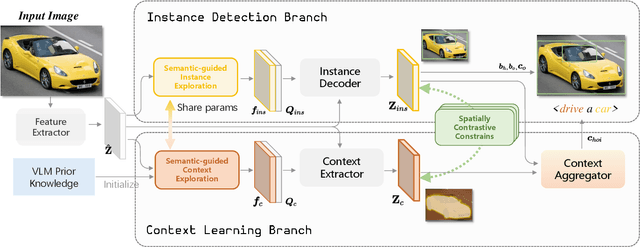
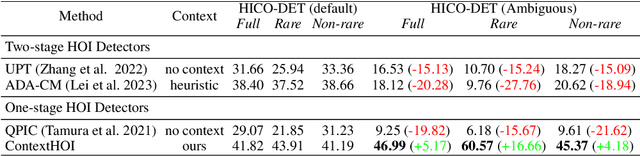
Spatial contexts, such as the backgrounds and surroundings, are considered critical in Human-Object Interaction (HOI) recognition, especially when the instance-centric foreground is blurred or occluded. Recent advancements in HOI detectors are usually built upon detection transformer pipelines. While such an object-detection-oriented paradigm shows promise in localizing objects, its exploration of spatial context is often insufficient for accurately recognizing human actions. To enhance the capabilities of object detectors for HOI detection, we present a dual-branch framework named ContextHOI, which efficiently captures both object detection features and spatial contexts. In the context branch, we train the model to extract informative spatial context without requiring additional hand-craft background labels. Furthermore, we introduce context-aware spatial and semantic supervision to the context branch to filter out irrelevant noise and capture informative contexts. ContextHOI achieves state-of-the-art performance on the HICO-DET and v-coco benchmarks. For further validation, we construct a novel benchmark, HICO-ambiguous, which is a subset of HICO-DET that contains images with occluded or impaired instance cues. Extensive experiments across all benchmarks, complemented by visualizations, underscore the enhancements provided by ContextHOI, especially in recognizing interactions involving occluded or blurred instances.
Orchestrating the Symphony of Prompt Distribution Learning for Human-Object Interaction Detection
Dec 11, 2024Human-object interaction (HOI) detectors with popular query-transformer architecture have achieved promising performance. However, accurately identifying uncommon visual patterns and distinguishing between ambiguous HOIs continue to be difficult for them. We observe that these difficulties may arise from the limited capacity of traditional detector queries in representing diverse intra-category patterns and inter-category dependencies. To address this, we introduce the Interaction Prompt Distribution Learning (InterProDa) approach. InterProDa learns multiple sets of soft prompts and estimates category distributions from various prompts. It then incorporates HOI queries with category distributions, making them capable of representing near-infinite intra-category dynamics and universal cross-category relationships. Our InterProDa detector demonstrates competitive performance on HICO-DET and vcoco benchmarks. Additionally, our method can be integrated into most transformer-based HOI detectors, significantly enhancing their performance with minimal additional parameters.