 Add to Chrome
 Add to Firefox
 Add to Edge
Collusion with Competitive Marginals: Price-Level Audits Are Blind by Construction
Jul 29, 2026
Empirical work on algorithmic collusion asks one question of the data: are prices supracompetitive? We show this can be answered "no" by a conspiracy that is nonetheless profitable. Consider bidding agents that couple only through the joint distribution of their unexplained bid components, leaving every agent's own bid law exactly at the competitive law. Any test whose input is a single agent's price or bid history then has power exactly equal to its false-positive rate, for every coupling strength up to comonotonicity. The published detection methodology is therefore blind to this conduct by construction rather than underpowered, and no sample size repairs it. Three empirical results follow. First, the mechanism appears in real language-model agents: twenty models from nineteen independent developers, three deployment prompts each, show residual correlation of $+0.053$ between two deployments of one model against $+0.0001$ across models, with a 95% interval clustered by developer of $[0.030, 0.078]$, under an auditor that sees every order feature and is fitted out of sample. Second, the coupling falls monotonically as sampling temperature rises ($p=0.002$), turning a deployment parameter into a candidate mitigation. Third, on 24 days of Ethereum block-building auction data covering 77,684 bids from 39 bidders, the honest population of bidder pairs is itself so dependent that a screen held at a 5% false-positive rate must sit above a floor of $+0.50$ to $+0.81$, which is 20 to 32 times the family-wise sampling threshold and does not fall as the audit window grows. Since lawful multi-identity operation and conspiracy are behaviourally indistinguishable here, the tractable regulatory target is not detection but counting: resolving 40 bidding identities into 23 operators raises the Herfindahl index by 247.5%, and adding behavioural clusters from public bid streams reaches 324.5%.

ClothTransformer: Unified Latent-Space Transformers for Scalable Cloth Simulation
May 27, 2026Unified and scalable Transformers have recently achieved remarkable success in modeling diverse phenomena traditionally associated with computer graphics, such as 3D visual effects, rendering processes, and motion in videos. In this work, we take a step further by investigating whether modern Transformer techniques can tackle the challenging task of cloth simulation. To this end, we present ClothTransformer, a framework that reformulates cloth simulation as autoregressive sequence modeling in a learned latent space. Existing neural cloth simulators are largely specialized to single scenarios, intrinsically coupled to the mesh discretization, and lack robust collision handling. Our approach addresses these limitations through three contributions: (1) a unified Transformer architecture that handles diverse scenarios -- body-driven garments, robotic manipulation, and free-fall collisions -- under a single model and achieves approximately $4$--$9{\times}$ lower error than prior state-of-the-art methods across all scenarios; (2) a scalable latent-space formulation that compresses arbitrary-resolution meshes into a fixed-size set of latent tokens, making temporal dynamics computation independent of mesh resolution; and (3) a diverse-scenario high-fidelity penetration-free dataset of ${\sim}$493.4k frames spanning all three settings, which enables a differentiable Continuous Collision Detection (CCD) module to suppress penetration artifacts.
Predicting tongue motion in unlabeled ultrasound videos using convolutional LSTM neural network
Feb 19, 2019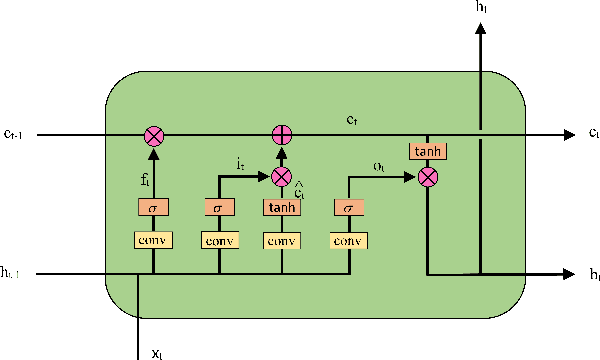
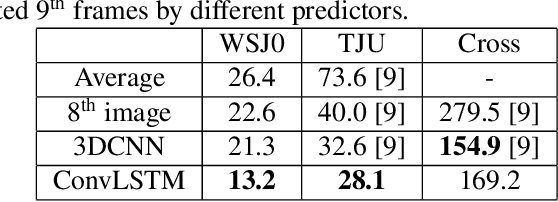
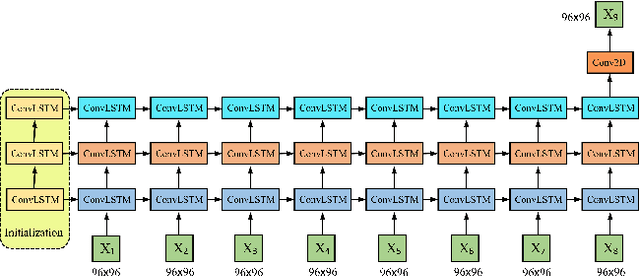
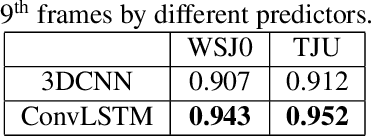
A challenge in speech production research is to predict future tongue movements based on a short period of past tongue movements. This study tackles speaker-dependent tongue motion prediction problem in unlabeled ultrasound videos with convolutional long short-term memory (ConvLSTM) networks. The model has been tested on two different ultrasound corpora. ConvLSTM outperforms 3-dimensional convolutional neural network (3DCNN) in predicting the 9\textsuperscript{th} frames based on 8 preceding frames, and also demonstrates good capacity to predict only the tongue contours in future frames. Further tests reveal that ConvLSTM can also learn to predict tongue movements in more distant frames beyond the immediately following frames. Our codes are available at: https://github.com/shuiliwanwu/ConvLstm-ultrasound-videos.