 Add to Chrome
 Add to Firefox
 Add to Edge
XPolicyLab: A Unified Standard and Open Ecosystem for Robot Policy Evaluation and Deployment
Aug 11, 2026
Robot policy evaluation and deployment remain fragmented by model-specific software dependencies, data representations, and runtime interfaces, so that connecting N policies to M evaluation environments requires O(NM) separate integrations. We present XPolicyLab, a unified standard and open ecosystem that reduces this cost to O(N+M). XPolicyLab specifies common observation, action, and trajectory schemas together with a minimal adapter interface for observation updates, action prediction, batched execution, and episode reset, while a dependency-isolated client/server architecture separates policy inference from environment execution, so that each side retains its native software stack and may run locally or remotely. The ecosystem integrates 42 robot policies and standardizes their installation, debugging, serving, and evaluation workflows. Across these adapters, model-specific code varies by an order of magnitude while the environment-facing loop stays within a few lines of a fixed reference, confirming that the contract confines heterogeneity to the policy side. In a controlled study, conforming to the standard reduces the integration effort of a representative policy from over five hours to two hours, and packaged agent skills reduce it further to thirty minutes. The same adapters serve RoboTwin, RoboDojo simulation, and standardized real-robot evaluation through one interface. XPolicyLab is released as shared infrastructure for reproducible policy comparison and standardized deployment across simulation and physical platforms. Project website: https://xpolicylab.github.io/.

Towards Trustworthy Embodied Intelligence: A Systems Framework and Graded Trustworthiness Levels
Jul 28, 2026Embodied intelligence integrates learned perception and decision making with real-time computation, control, and physical interaction. Because failures can cause immediate physical or operational harm, task completion alone does not establish trustworthiness. We define trustworthy embodied intelligence as the sustained capacity to execute specified tasks reliably under environmental and system variation while maintaining risk within acceptable bounds. We term this objective sustained safe success. Its supporting mechanisms are organized into four interdependent layers. The model layer generates task-competent action proposals with calibrated uncertainty and explicit safety preferences. The system layer realizes authorized actions dependably through integrated sensing, computation, control, hardware safeguards, fault containment, and fallback. The evidence layer substantiates bounded claims through evaluation, verification, validation, traceability, and structured assurance arguments. The deployment layer maintains claim validity through runtime monitoring, authority management, intervention, incident response, and controlled updates. Because assumptions and failures propagate across these layers, neither model capability, isolated safeguards, nor benchmark performance alone can establish end-to-end trustworthiness. Drawing on embodied AI, robotics, control, dependable computing, distributed systems, and autonomous driving, we further propose a non-normative hierarchy of trustworthiness levels. This hierarchy grades the strength of bounded deployment claims across task capability, safety, system assurance, operational governance, and supporting evidence, providing a basis for bounded deployment, comparative evaluation, research prioritization, and future standardization.
EBench: Elemental Diagnosis of Generalist Mobile Manipulation Policies
Jun 16, 2026We present EBench, a simulation benchmark that diagnoses generalist mobile manipulation policies beyond a single success-rate scalar. EBench comprises 26 diverse and challenging manipulation tasks annotated along 5 capability dimensions and 4 generalization dimensions. We evaluate state-of-the-art generalist manipulation models including $π_0$, $π_{0.5}$, XVLA, and InternVLA-A1, and reveal that models with near success rates exhibit strikingly different capability profiles: $π_{0.5}$ achieves the highest test success rate and the best train--test retention, whereas InternVLA-A1 dominates mobile manipulation but collapses on dexterous tasks, and XVLA exhibits strengths on a disjoint set of atomic skills compared to other policies. Beyond capability profiling, EBench analyzes the generalization ability from 4 representative perspectives, identifying the impact of different distribution shift factors. The results reveal strengths and weaknesses of models behind an overall score. We hope this benchmark offers a broad set of diagnostic signals to guide iteration on generalist manipulation models.
SynManDex: Synthesizing Human-like Dexterous Grasps from Synthetic Human Pre-Grasps
Jun 08, 2026Human hand-object interactions encode functional intent, but direct transfer to robotic hands often fails under morphology, contact, and reachability constraints. We present SynManDex, a synthetic pipeline that uses generated human pre-grasps as affordance-aware proposals and resolves the final contacts with robot-native optimization. SynManDex samples object-conditioned digital human pre-grasps, retargets them to dexterous robotic hand poses, optimizes force-closure contacts on the target embodiment, and admits trajectories that pass checks from each step. The resulting keyframes support both grasp-and-lift demonstrations and various prehensile manipulation tasks such as tea pouring, photo taking, and flute playing, designed via VLM agents. As a result, SynManDex combines high grasp quality (86.4\% grasp stability) with 4.67/5 human-likeness (93.4\%). It achieves 80.7\% successes in simulation and 25/30 (83.3\%) real-robot successes when applied to a 36-DOF bimanual dexterous robotic platform.
PhysForge: Generating Physics-Grounded 3D Assets for Interactive Virtual World
May 06, 2026Synthesizing physics-grounded 3D assets is a critical bottleneck for interactive virtual worlds and embodied AI. Existing methods predominantly focus on static geometry, overlooking the functional properties essential for interaction. We propose that interactive asset generation must be rooted in functional logic and hierarchical physics. To bridge this gap, we introduce PhysForge, a decoupled two-stage framework supported by PhysDB, a large-scale dataset of 150,000 assets with four-tier physical annotations. First, a VLM acts as a "physical architect" to plan a "Hierarchical Physical Blueprint" defining material, functional, and kinematic constraints. Second, a physics-grounded diffusion model realizes this blueprint by synthesizing high-fidelity geometry alongside precise kinematic parameters via a novel KineVoxel Injection (KVI) mechanism. Experiments demonstrate that PhysForge produces functionally plausible, simulation-ready assets, providing a robust data engine for interactive 3D content and embodied agents.
HiVLA: A Visual-Grounded-Centric Hierarchical Embodied Manipulation System
Apr 15, 2026While end-to-end Vision-Language-Action (VLA) models offer a promising paradigm for robotic manipulation, fine-tuning them on narrow control data often compromises the profound reasoning capabilities inherited from their base Vision-Language Models (VLMs). To resolve this fundamental trade-off, we propose HiVLA, a visual-grounded-centric hierarchical framework that explicitly decouples high-level semantic planning from low-level motor control. In high-level part, a VLM planner first performs task decomposition and visual grounding to generate structured plans, comprising a subtask instruction and a precise target bounding box. Then, to translate this plan into physical actions, we introduce a flow-matching Diffusion Transformer (DiT) action expert in low-level part equipped with a novel cascaded cross-attention mechanism. This design sequentially fuses global context, high-resolution object-centric crops and skill semantics, enabling the DiT to focus purely on robust execution. Our decoupled architecture preserves the VLM's zero-shot reasoning while allowing independent improvement of both components. Extensive experiments in simulation and the real world demonstrate that HiVLA significantly outperforms state-of-the-art end-to-end baselines, particularly excelling in long-horizon skill composition and the fine-grained manipulation of small objects in cluttered scenes.
G3Flow: Generative 3D Semantic Flow for Pose-aware and Generalizable Object Manipulation
Nov 27, 2024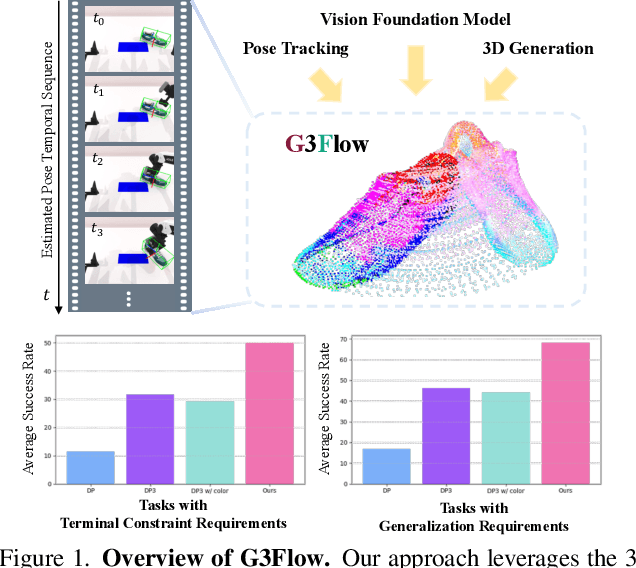

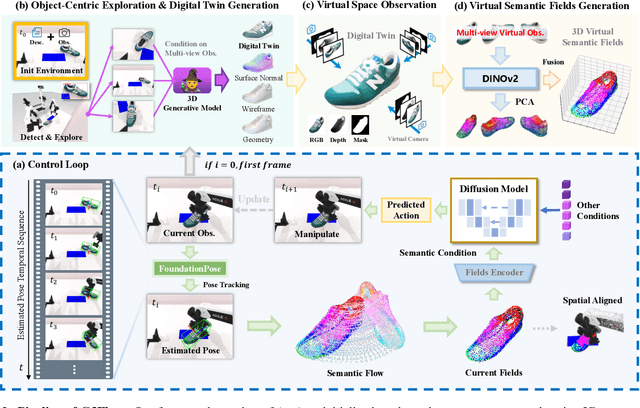
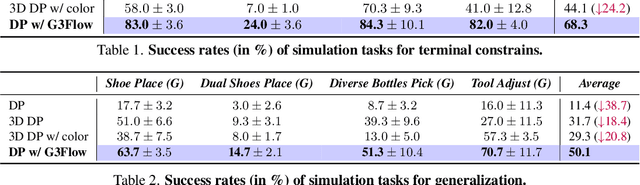
Recent advances in imitation learning for 3D robotic manipulation have shown promising results with diffusion-based policies. However, achieving human-level dexterity requires seamless integration of geometric precision and semantic understanding. We present G3Flow, a novel framework that constructs real-time semantic flow, a dynamic, object-centric 3D semantic representation by leveraging foundation models. Our approach uniquely combines 3D generative models for digital twin creation, vision foundation models for semantic feature extraction, and robust pose tracking for continuous semantic flow updates. This integration enables complete semantic understanding even under occlusions while eliminating manual annotation requirements. By incorporating semantic flow into diffusion policies, we demonstrate significant improvements in both terminal-constrained manipulation and cross-object generalization. Extensive experiments across five simulation tasks show that G3Flow consistently outperforms existing approaches, achieving up to 68.3% and 50.1% average success rates on terminal-constrained manipulation and cross-object generalization tasks respectively. Our results demonstrate the effectiveness of G3Flow in enhancing real-time dynamic semantic feature understanding for robotic manipulation policies.
Articulated Object Manipulation using Online Axis Estimation with SAM2-Based Tracking
Sep 24, 2024Articulated object manipulation requires precise object interaction, where the object's axis must be carefully considered. Previous research employed interactive perception for manipulating articulated objects, but typically, open-loop approaches often suffer from overlooking the interaction dynamics. To address this limitation, we present a closed-loop pipeline integrating interactive perception with online axis estimation from segmented 3D point clouds. Our method leverages any interactive perception technique as a foundation for interactive perception, inducing slight object movement to generate point cloud frames of the evolving dynamic scene. These point clouds are then segmented using Segment Anything Model 2 (SAM2), after which the moving part of the object is masked for accurate motion online axis estimation, guiding subsequent robotic actions. Our approach significantly enhances the precision and efficiency of manipulation tasks involving articulated objects. Experiments in simulated environments demonstrate that our method outperforms baseline approaches, especially in tasks that demand precise axis-based control. Project Page: https://hytidel.github.io/video-tracking-for-axis-estimation/.
RoboTwin: Dual-Arm Robot Benchmark with Generative Digital Twins (early version)
Sep 04, 2024


Effective collaboration of dual-arm robots and their tool use capabilities are increasingly important areas in the advancement of robotics. These skills play a significant role in expanding robots' ability to operate in diverse real-world environments. However, progress is impeded by the scarcity of specialized training data. This paper introduces RoboTwin, a novel benchmark dataset combining real-world teleoperated data with synthetic data from digital twins, designed for dual-arm robotic scenarios. Using the COBOT Magic platform, we have collected diverse data on tool usage and human-robot interaction. We present a innovative approach to creating digital twins using AI-generated content, transforming 2D images into detailed 3D models. Furthermore, we utilize large language models to generate expert-level training data and task-specific pose sequences oriented toward functionality. Our key contributions are: 1) the RoboTwin benchmark dataset, 2) an efficient real-to-simulation pipeline, and 3) the use of language models for automatic expert-level data generation. These advancements are designed to address the shortage of robotic training data, potentially accelerating the development of more capable and versatile robotic systems for a wide range of real-world applications. The project page is available at https://robotwin-benchmark.github.io/early-version/