 Add to Chrome
 Add to Firefox
 Add to Edge
LSVOS Challenge Report: Large-scale Complex and Long Video Object Segmentation
Sep 09, 2024


Despite the promising performance of current video segmentation models on existing benchmarks, these models still struggle with complex scenes. In this paper, we introduce the 6th Large-scale Video Object Segmentation (LSVOS) challenge in conjunction with ECCV 2024 workshop. This year's challenge includes two tasks: Video Object Segmentation (VOS) and Referring Video Object Segmentation (RVOS). In this year, we replace the classic YouTube-VOS and YouTube-RVOS benchmark with latest datasets MOSE, LVOS, and MeViS to assess VOS under more challenging complex environments. This year's challenge attracted 129 registered teams from more than 20 institutes across over 8 countries. This report include the challenge and dataset introduction, and the methods used by top 7 teams in two tracks. More details can be found in our homepage https://lsvos.github.io/.

Video-based Analysis Reveals Atypical Social Gaze in People with Autism Spectrum Disorder
Sep 01, 2024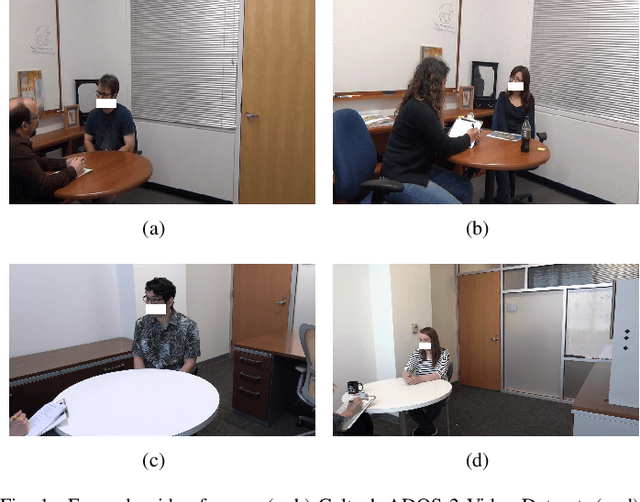
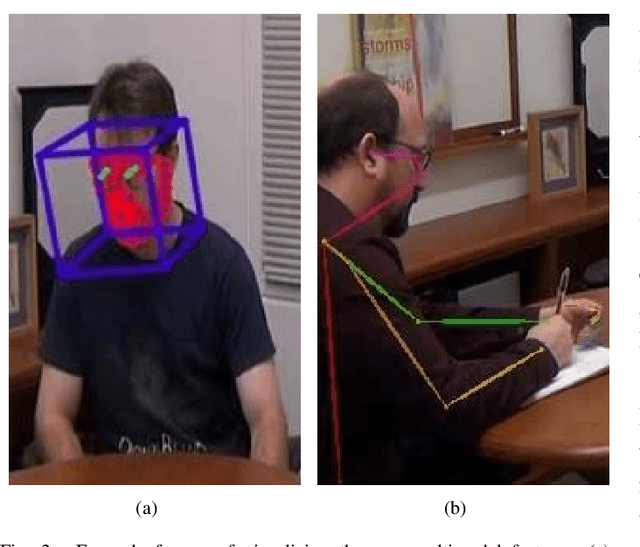
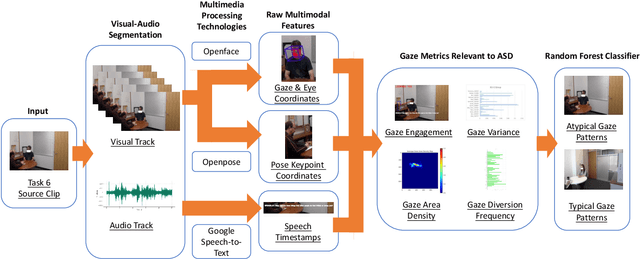

In this study, we present a quantitative and comprehensive analysis of social gaze in people with autism spectrum disorder (ASD). Diverging from traditional first-person camera perspectives based on eye-tracking technologies, this study utilizes a third-person perspective database from the Autism Diagnostic Observation Schedule, 2nd Edition (ADOS-2) interview videos, encompassing ASD participants and neurotypical individuals as a reference group. Employing computational models, we extracted and processed gaze-related features from the videos of both participants and examiners. The experimental samples were divided into three groups based on the presence of social gaze abnormalities and ASD diagnosis. This study quantitatively analyzed four gaze features: gaze engagement, gaze variance, gaze density map, and gaze diversion frequency. Furthermore, we developed a classifier trained on these features to identify gaze abnormalities in ASD participants. Together, we demonstrated the effectiveness of analyzing social gaze in people with ASD in naturalistic settings, showcasing the potential of third-person video perspectives in enhancing ASD diagnosis through gaze analysis.
Discriminative Spatial-Semantic VOS Solution: 1st Place Solution for 6th LSVOS
Aug 29, 2024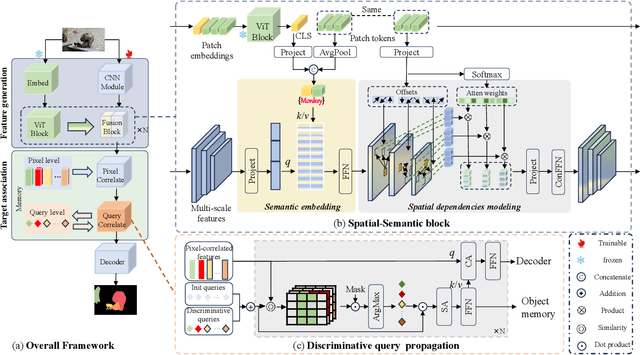
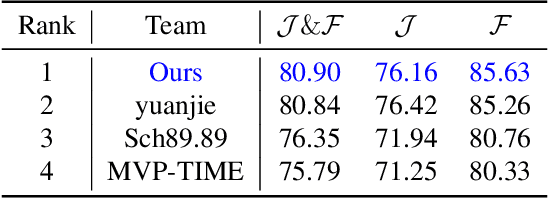
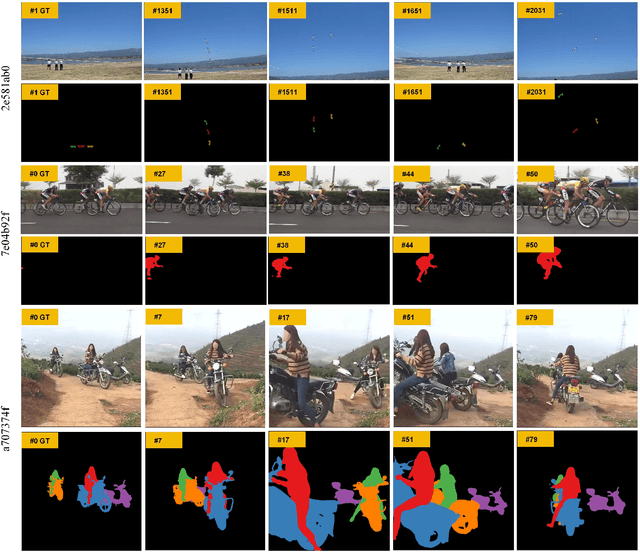
Video object segmentation (VOS) is a crucial task in computer vision, but current VOS methods struggle with complex scenes and prolonged object motions. To address these challenges, the MOSE dataset aims to enhance object recognition and differentiation in complex environments, while the LVOS dataset focuses on segmenting objects exhibiting long-term, intricate movements. This report introduces a discriminative spatial-temporal VOS model that utilizes discriminative object features as query representations. The semantic understanding of spatial-semantic modules enables it to recognize object parts, while salient features highlight more distinctive object characteristics. Our model, trained on extensive VOS datasets, achieved first place (\textbf{80.90\%} $\mathcal{J \& F}$) on the test set of the 6th LSVOS challenge in the VOS Track, demonstrating its effectiveness in tackling the aforementioned challenges. The code will be available at \href{https://github.com/yahooo-m/VOS-Solution}{code}.
Scalable Autoregressive Image Generation with Mamba
Aug 22, 2024We introduce AiM, an autoregressive (AR) image generative model based on Mamba architecture. AiM employs Mamba, a novel state-space model characterized by its exceptional performance for long-sequence modeling with linear time complexity, to supplant the commonly utilized Transformers in AR image generation models, aiming to achieve both superior generation quality and enhanced inference speed. Unlike existing methods that adapt Mamba to handle two-dimensional signals via multi-directional scan, AiM directly utilizes the next-token prediction paradigm for autoregressive image generation. This approach circumvents the need for extensive modifications to enable Mamba to learn 2D spatial representations. By implementing straightforward yet strategically targeted modifications for visual generative tasks, we preserve Mamba's core structure, fully exploiting its efficient long-sequence modeling capabilities and scalability. We provide AiM models in various scales, with parameter counts ranging from 148M to 1.3B. On the ImageNet1K 256*256 benchmark, our best AiM model achieves a FID of 2.21, surpassing all existing AR models of comparable parameter counts and demonstrating significant competitiveness against diffusion models, with 2 to 10 times faster inference speed. Code is available at https://github.com/hp-l33/AiM
MambaCSR: Dual-Interleaved Scanning for Compressed Image Super-Resolution With SSMs
Aug 21, 2024We present MambaCSR, a simple but effective framework based on Mamba for the challenging compressed image super-resolution (CSR) task. Particularly, the scanning strategies of Mamba are crucial for effective contextual knowledge modeling in the restoration process despite it relying on selective state space modeling for all tokens. In this work, we propose an efficient dual-interleaved scanning paradigm (DIS) for CSR, which is composed of two scanning strategies: (i) hierarchical interleaved scanning is designed to comprehensively capture and utilize the most potential contextual information within an image by simultaneously taking advantage of the local window-based and sequential scanning methods; (ii) horizontal-to-vertical interleaved scanning is proposed to reduce the computational cost by leaving the redundancy between the scanning of different directions. To overcome the non-uniform compression artifacts, we also propose position-aligned cross-scale scanning to model multi-scale contextual information. Experimental results on multiple benchmarks have shown the great performance of our MambaCSR in the compressed image super-resolution task. The code will be soon available in~\textcolor{magenta}{\url{https://github.com/renyulin-f/MambaCSR}}.
OC3D: Weakly Supervised Outdoor 3D Object Detection with Only Coarse Click Annotation
Aug 15, 2024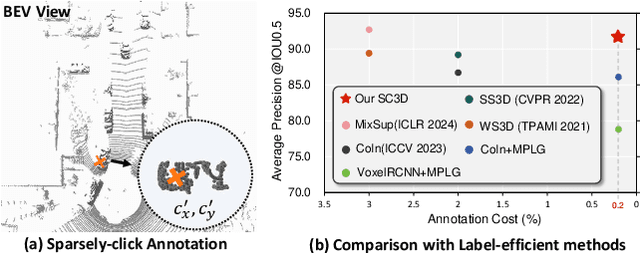
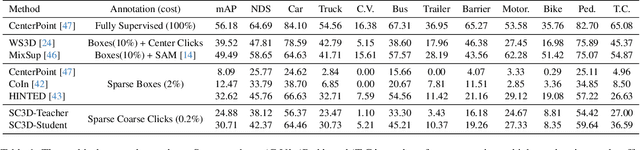
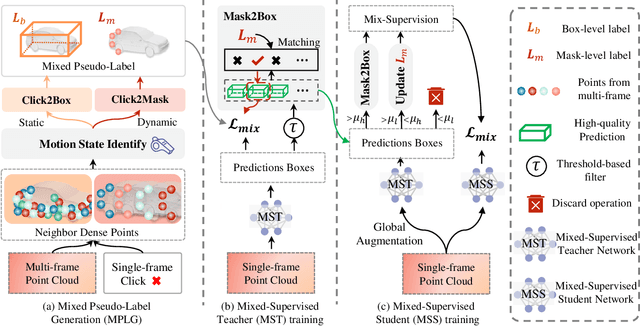
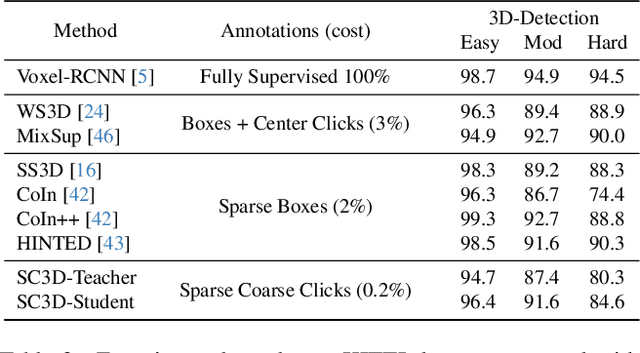
LiDAR-based outdoor 3D object detection has received widespread attention. However, training 3D detectors from the LiDAR point cloud typically relies on expensive bounding box annotations. This paper presents OC3D, an innovative weakly supervised method requiring only coarse clicks on the bird' s eye view of the 3D point cloud. A key challenge here is the absence of complete geometric descriptions of the target objects from such simple click annotations. To address this problem, our proposed OC3D adopts a two-stage strategy. In the first stage, we initially design a novel dynamic and static classification strategy and then propose the Click2Box and Click2Mask modules to generate box-level and mask-level pseudo-labels for static and dynamic instances, respectively. In the second stage, we design a Mask2Box module, leveraging the learning capabilities of neural networks to update mask-level pseudo-labels, which contain less information, to box level pseudo-labels. Experimental results on the widely used KITTI and nuScenes datasets demonstrate that our OC3D with only coarse clicks achieves state-of-the-art performance compared to weakly-supervised 3D detection methods. Combining OC3D with a missing click mining strategy, we propose a OC3D++ pipeline, which requires only 0.2% annotation cost in the KITTI dataset to achieve performance comparable to fully supervised methods.
DriveArena: A Closed-loop Generative Simulation Platform for Autonomous Driving
Aug 01, 2024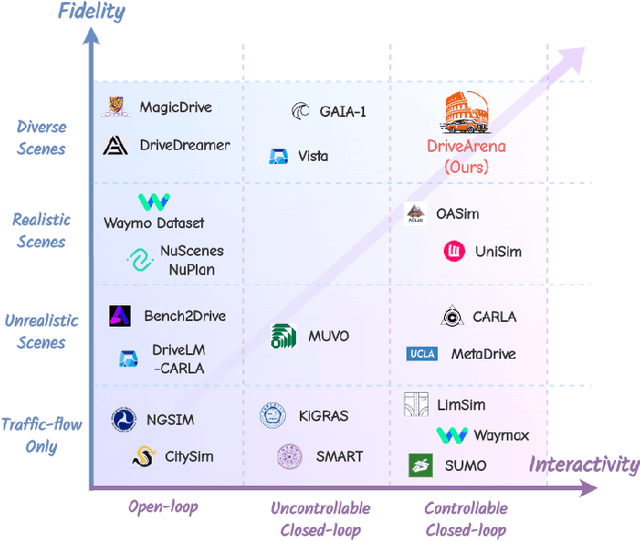


This paper presented DriveArena, the first high-fidelity closed-loop simulation system designed for driving agents navigating in real scenarios. DriveArena features a flexible, modular architecture, allowing for the seamless interchange of its core components: Traffic Manager, a traffic simulator capable of generating realistic traffic flow on any worldwide street map, and World Dreamer, a high-fidelity conditional generative model with infinite autoregression. This powerful synergy empowers any driving agent capable of processing real-world images to navigate in DriveArena's simulated environment. The agent perceives its surroundings through images generated by World Dreamer and output trajectories. These trajectories are fed into Traffic Manager, achieving realistic interactions with other vehicles and producing a new scene layout. Finally, the latest scene layout is relayed back into World Dreamer, perpetuating the simulation cycle. This iterative process fosters closed-loop exploration within a highly realistic environment, providing a valuable platform for developing and evaluating driving agents across diverse and challenging scenarios. DriveArena signifies a substantial leap forward in leveraging generative image data for the driving simulation platform, opening insights for closed-loop autonomous driving. Code will be available soon on GitHub: https://github.com/PJLab-ADG/DriveArena
SeaLLMs 3: Open Foundation and Chat Multilingual Large Language Models for Southeast Asian Languages
Jul 29, 2024


Large Language Models (LLMs) have shown remarkable abilities across various tasks, yet their development has predominantly centered on high-resource languages like English and Chinese, leaving low-resource languages underserved. To address this disparity, we present SeaLLMs 3, the latest iteration of the SeaLLMs model family, tailored for Southeast Asian languages. This region, characterized by its rich linguistic diversity, has lacked adequate language technology support. SeaLLMs 3 aims to bridge this gap by covering a comprehensive range of languages spoken in this region, including English, Chinese, Indonesian, Vietnamese, Thai, Tagalog, Malay, Burmese, Khmer, Lao, Tamil, and Javanese. Leveraging efficient language enhancement techniques and a specially constructed instruction tuning dataset, SeaLLMs 3 significantly reduces training costs while maintaining high performance and versatility. Our model excels in tasks such as world knowledge, mathematical reasoning, translation, and instruction following, achieving state-of-the-art performance among similarly sized models. Additionally, we prioritized safety and reliability by addressing both general and culture-specific considerations and incorporated mechanisms to reduce hallucinations. This work underscores the importance of inclusive AI, showing that advanced LLM capabilities can benefit underserved linguistic and cultural communities.
Progressive Domain Adaptation for Thermal Infrared Object Tracking
Jul 28, 2024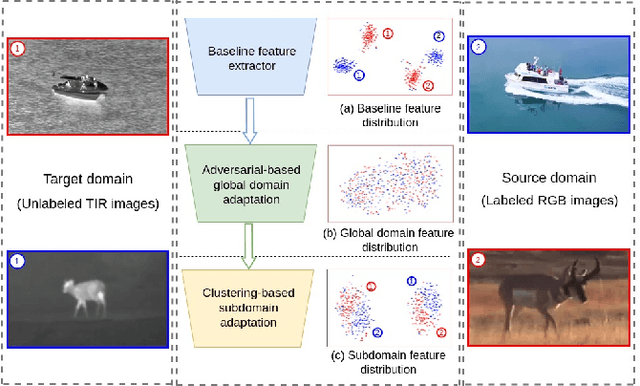
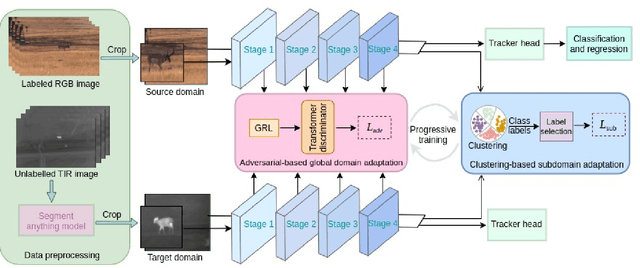
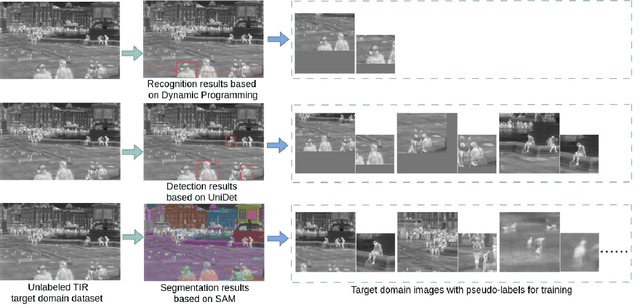
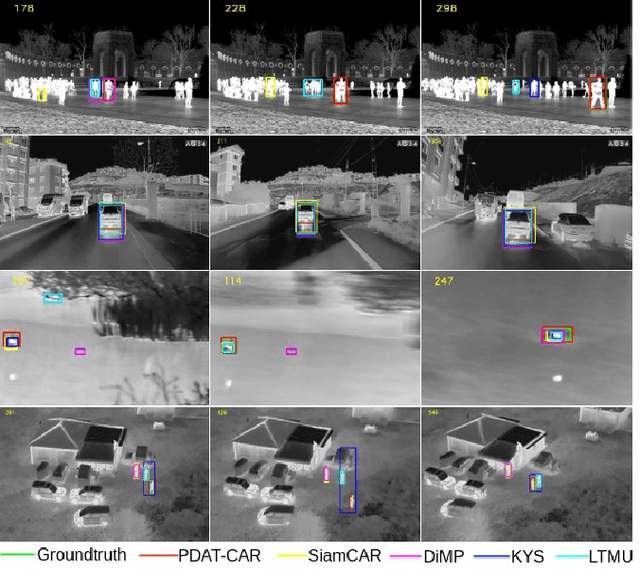
Due to the lack of large-scale labeled Thermal InfraRed (TIR) training datasets, most existing TIR trackers are trained directly on RGB datasets. However, tracking methods trained on RGB datasets suffer a significant drop-off in TIR data due to the domain shift issue. To this end, in this work, we propose a Progressive Domain Adaptation framework for TIR Tracking (PDAT), which transfers useful knowledge learned from RGB tracking to TIR tracking. The framework makes full use of large-scale labeled RGB datasets without requiring time-consuming and labor-intensive labeling of large-scale TIR data. Specifically, we first propose an adversarial-based global domain adaptation module to reduce domain gap on the feature level coarsely. Second, we design a clustering-based subdomain adaptation method to further align the feature distributions of the RGB and TIR datasets finely. These two domain adaptation modules gradually eliminate the discrepancy between the two domains, and thus learn domain-invariant fine-grained features through progressive training. Additionally, we collect a largescale TIR dataset with over 1.48 million unlabeled TIR images for training the proposed domain adaptation framework. Experimental results on five TIR tracking benchmarks show that the proposed method gains a nearly 6% success rate, demonstrating its effectiveness.
Raindrop Clarity: A Dual-Focused Dataset for Day and Night Raindrop Removal
Jul 24, 2024


Existing raindrop removal datasets have two shortcomings. First, they consist of images captured by cameras with a focus on the background, leading to the presence of blurry raindrops. To our knowledge, none of these datasets include images where the focus is specifically on raindrops, which results in a blurry background. Second, these datasets predominantly consist of daytime images, thereby lacking nighttime raindrop scenarios. Consequently, algorithms trained on these datasets may struggle to perform effectively in raindrop-focused or nighttime scenarios. The absence of datasets specifically designed for raindrop-focused and nighttime raindrops constrains research in this area. In this paper, we introduce a large-scale, real-world raindrop removal dataset called Raindrop Clarity. Raindrop Clarity comprises 15,186 high-quality pairs/triplets (raindrops, blur, and background) of images with raindrops and the corresponding clear background images. There are 5,442 daytime raindrop images and 9,744 nighttime raindrop images. Specifically, the 5,442 daytime images include 3,606 raindrop- and 1,836 background-focused images. While the 9,744 nighttime images contain 4,838 raindrop- and 4,906 background-focused images. Our dataset will enable the community to explore background-focused and raindrop-focused images, including challenges unique to daytime and nighttime conditions. Our data and code are available at: \url{https://github.com/jinyeying/RaindropClarity}