 Add to Chrome
 Add to Firefox
 Add to Edge
LightLoc++: Sensor-Robust Representation Learning for Efficient Outdoor LiDAR Localization
Aug 15, 2026
Scene coordinate regression (SCR) achieves strong performance in outdoor LiDAR localization, but it usually requires scene-specific training that can take days, limiting practical deployment. Recent works improve training efficiency by decoupling SCR into a scene-agnostic backbone and scene-specific prediction heads, where the backbone is pretrained on source datasets and frozen for new scenes, and only lightweight heads are optimized. However, we find that this paradigm heavily depends on the pretrained backbone. Existing decoupled methods can match conventional SCR methods fully optimized for each new scene when LiDAR configurations are similar to those used during backbone pretraining, but their accuracy drops noticeably on datasets collected with different LiDAR sensors. This suggests that efficient LiDAR localization requires representations that capture stable scene geometry across LiDAR configurations. Motivated by this observation, we propose LightLoc++, a sensor-robust and efficient outdoor LiDAR localization framework. To support sensor-robust representation learning, we introduce SULID, a synchronized urban multi-LiDAR dataset with representative 32-, 64-, and 128-beam rotating LiDARs, extensive cross-sensor overlap, and diverse urban scenes. Using SULID, we pretrain a sensor-robust backbone through cross-sensor consistency learning. LightLoc++ further preserves efficient new-scene learning by incorporating sample classification guidance and redundant sample downsampling, which reduce regression ambiguity and computational redundancy in large-scale outdoor scenes. Extensive experiments on multiple outdoor LiDAR localization benchmarks demonstrate that LightLoc++ achieves state-of-the-art localization performance with the lowest new-scene training cost among compared methods. Code and dataset will be made available at https://github.com/liw95/LightLoc-PlusPlus.

C2E: Boosting Ego-Only 3D Object Detection via Multi-Teacher Contrastive Knowledge Distillation
Jul 02, 2026LiDAR-based 3D object detection is essential for autonomous driving systems. However, traditional Ego-only Perception (Eo-Perception) suffers from limited perspective and occlusions in a complex outdoor environment, leading to performance bottlenecks. Recently, research on multi-agent Collaborative Perception (Co-Perception) has demonstrated excellent performance, but high communication costs and accumulated pose error hinder its application. To address this, we explore a novel C2E (Co-Perception to Eo-Perception) paradigm through the Multi-to-Single (M2S) agent contrastive knowledge distillation framework. Our M2S framework first designs Multi-Level Feature Enhancement module to provide more stable features, and introduces Auxiliary Point Cloud Reconstruction and Multi-Teacher Contrastive Distillation mechanisms to mitigate domain gaps in point cloud and feature distributions within the C2E paradigm. Benefiting from this, our M2S can retain the excellent performance of collaborative perception while effectively avoiding the drawbacks, such as communication delays and positioning errors. Extensive experiments on the V2XSet, V2V4Real and DAIR-V2X datasets show the effectiveness and generalizability of our M2S framework when combined with the state-of-the-art CoSDH model and other excellent 3D detectors. Our M2S framework can deliver up to a 8.64% improvement in 3D mAP performance without introducing any communication costs.
* 18 pages, 8figures
V2U4Real: A Real-world Large-scale Dataset for Vehicle-to-UAV Cooperative Perception
Mar 26, 2026Modern autonomous vehicle perception systems are often constrained by occlusions, blind spots, and limited sensing range. While existing cooperative perception paradigms, such as Vehicle-to-Vehicle (V2V) and Vehicle-to-Infrastructure (V2I), have demonstrated their effectiveness in mitigating these challenges, they remain limited to ground-level collaboration and cannot fully address large-scale occlusions or long-range perception in complex environments. To advance research in cross-view cooperative perception, we present V2U4Real, the first large-scale real-world multi-modal dataset for Vehicle-to-UAV (V2U) cooperative object perception. V2U4Real is collected by a ground vehicle and a UAV equipped with multi-view LiDARs and RGB cameras. The dataset covers urban streets, university campuses, and rural roads under diverse traffic scenarios, comprising over 56K LiDAR frames, 56K multi-view camera images, and 700K annotated 3D bounding boxes across four classes. To support a wide range of research tasks, we establish benchmarks for single-agent 3D object detection, cooperative 3D object detection, and object tracking. Comprehensive evaluations of several state-of-the-art models demonstrate the effectiveness of V2U cooperation in enhancing perception robustness and long-range awareness. The V2U4Real dataset and codebase is available at https://github.com/VjiaLi/V2U4Real.
CoLC: Communication-Efficient Collaborative Perception with LiDAR Completion
Feb 28, 2026Collaborative perception empowers autonomous agents to share complementary information and overcome perception limitations. While early fusion offers more perceptual complementarity and is inherently robust to model heterogeneity, its high communication cost has limited its practical deployment, prompting most existing works to favor intermediate or late fusion. To address this, we propose a communication-efficient early Collaborative perception framework that incorporates LiDAR Completion to restore scene completeness under sparse transmission, dubbed as CoLC. Specifically, the CoLC integrates three complementary designs. First, each neighbor agent applies Foreground-Aware Point Sampling (FAPS) to selectively transmit informative points that retain essential structural and contextual cues under bandwidth constraints. The ego agent then employs Completion-Enhanced Early Fusion (CEEF) to reconstruct dense pillars from the received sparse inputs and adaptively fuse them with its own observations, thereby restoring spatial completeness. Finally, the Dense-Guided Dual Alignment (DGDA) strategy enforces semantic and geometric consistency between the enhanced and dense pillars during training, ensuring consistent and robust feature learning. Experiments on both simulated and real-world datasets demonstrate that CoLC achieves superior perception-communication trade-offs and remains robust under heterogeneous model settings. The code is available at https://github.com/CatOneTwo/CoLC.
V2VLoc: Robust GNSS-Free Collaborative Perception via LiDAR Localization
Nov 18, 2025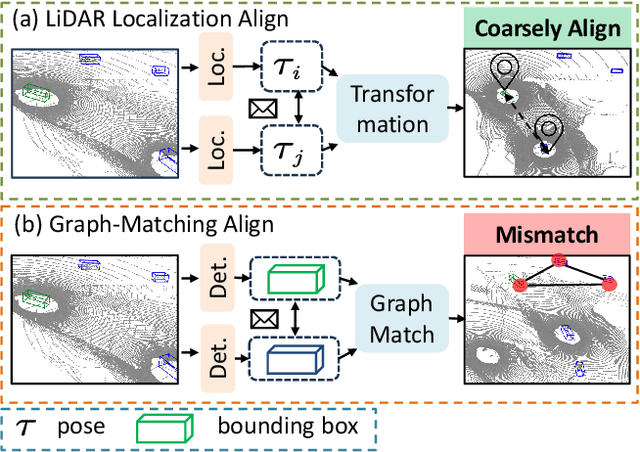
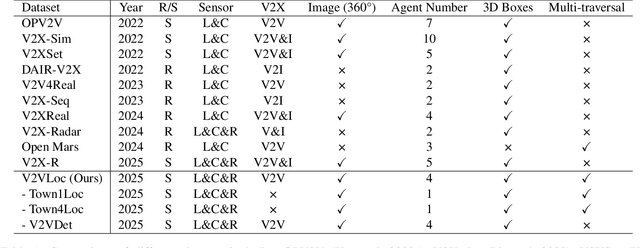
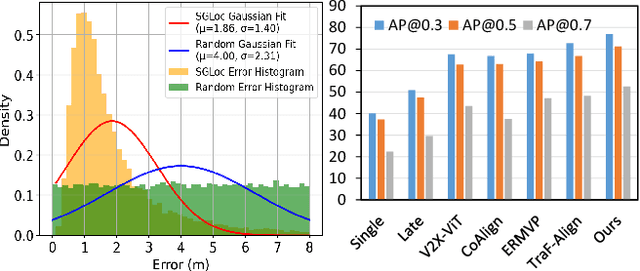
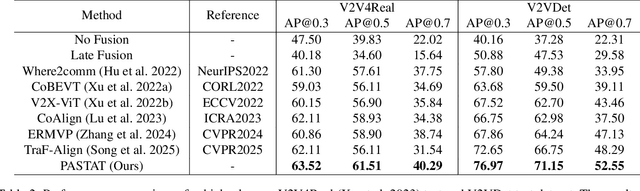
Multi-agents rely on accurate poses to share and align observations, enabling a collaborative perception of the environment. However, traditional GNSS-based localization often fails in GNSS-denied environments, making consistent feature alignment difficult in collaboration. To tackle this challenge, we propose a robust GNSS-free collaborative perception framework based on LiDAR localization. Specifically, we propose a lightweight Pose Generator with Confidence (PGC) to estimate compact pose and confidence representations. To alleviate the effects of localization errors, we further develop the Pose-Aware Spatio-Temporal Alignment Transformer (PASTAT), which performs confidence-aware spatial alignment while capturing essential temporal context. Additionally, we present a new simulation dataset, V2VLoc, which can be adapted for both LiDAR localization and collaborative detection tasks. V2VLoc comprises three subsets: Town1Loc, Town4Loc, and V2VDet. Town1Loc and Town4Loc offer multi-traversal sequences for training in localization tasks, whereas V2VDet is specifically intended for the collaborative detection task. Extensive experiments conducted on the V2VLoc dataset demonstrate that our approach achieves state-of-the-art performance under GNSS-denied conditions. We further conduct extended experiments on the real-world V2V4Real dataset to validate the effectiveness and generalizability of PASTAT.
WinMamba: Multi-Scale Shifted Windows in State Space Model for 3D Object Detection
Nov 17, 2025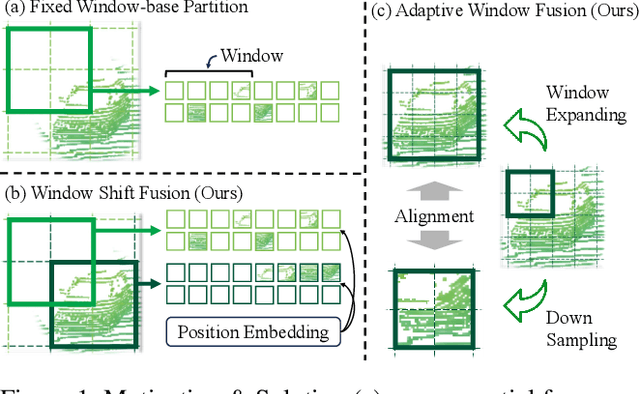
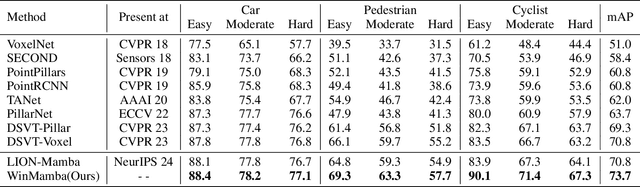
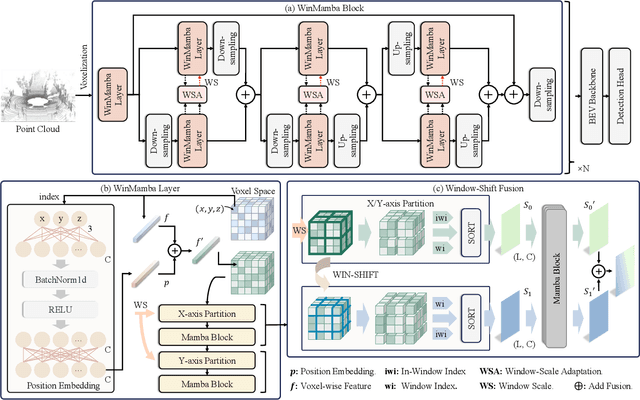
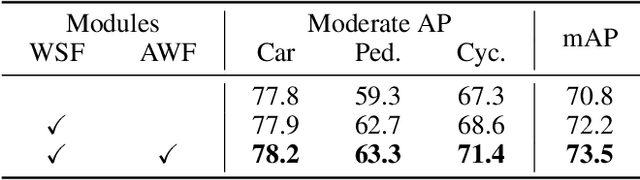
3D object detection is critical for autonomous driving, yet it remains fundamentally challenging to simultaneously maximize computational efficiency and capture long-range spatial dependencies. We observed that Mamba-based models, with their linear state-space design, capture long-range dependencies at lower cost, offering a promising balance between efficiency and accuracy. However, existing methods rely on axis-aligned scanning within a fixed window, inevitably discarding spatial information. To address this problem, we propose WinMamba, a novel Mamba-based 3D feature-encoding backbone composed of stacked WinMamba blocks. To enhance the backbone with robust multi-scale representation, the WinMamba block incorporates a window-scale-adaptive module that compensates voxel features across varying resolutions during sampling. Meanwhile, to obtain rich contextual cues within the linear state space, we equip the WinMamba layer with a learnable positional encoding and a window-shift strategy. Extensive experiments on the KITTI and Waymo datasets demonstrate that WinMamba significantly outperforms the baseline. Ablation studies further validate the individual contributions of the WSF and AWF modules in improving detection accuracy. The code will be made publicly available.
DGFusion: Dual-guided Fusion for Robust Multi-Modal 3D Object Detection
Nov 13, 2025As a critical task in autonomous driving perception systems, 3D object detection is used to identify and track key objects, such as vehicles and pedestrians. However, detecting distant, small, or occluded objects (hard instances) remains a challenge, which directly compromises the safety of autonomous driving systems. We observe that existing multi-modal 3D object detection methods often follow a single-guided paradigm, failing to account for the differences in information density of hard instances between modalities. In this work, we propose DGFusion, based on the Dual-guided paradigm, which fully inherits the advantages of the Point-guide-Image paradigm and integrates the Image-guide-Point paradigm to address the limitations of the single paradigms. The core of DGFusion, the Difficulty-aware Instance Pair Matcher (DIPM), performs instance-level feature matching based on difficulty to generate easy and hard instance pairs, while the Dual-guided Modules exploit the advantages of both pair types to enable effective multi-modal feature fusion. Experimental results demonstrate that our DGFusion outperforms the baseline methods, with respective improvements of +1.0\% mAP, +0.8\% NDS, and +1.3\% average recall on nuScenes. Extensive experiments demonstrate consistent robustness gains for hard instance detection across ego-distance, size, visibility, and small-scale training scenarios.
Seg2Box: 3D Object Detection by Point-Wise Semantics Supervision
Mar 21, 2025


LiDAR-based 3D object detection and semantic segmentation are critical tasks in 3D scene understanding. Traditional detection and segmentation methods supervise their models through bounding box labels and semantic mask labels. However, these two independent labels inherently contain significant redundancy. This paper aims to eliminate the redundancy by supervising 3D object detection using only semantic labels. However, the challenge arises due to the incomplete geometry structure and boundary ambiguity of point-cloud instances, leading to inaccurate pseudo labels and poor detection results. To address these challenges, we propose a novel method, named Seg2Box. We first introduce a Multi-Frame Multi-Scale Clustering (MFMS-C) module, which leverages the spatio-temporal consistency of point clouds to generate accurate box-level pseudo-labels. Additionally, the Semantic?Guiding Iterative-Mining Self-Training (SGIM-ST) module is proposed to enhance the performance by progressively refining the pseudo-labels and mining the instances without generating pseudo-labels. Experiments on the Waymo Open Dataset and nuScenes Dataset show that our method significantly outperforms other competitive methods by 23.7\% and 10.3\% in mAP, respectively. The results demonstrate the great label-efficient potential and advancement of our method.
Learning to Detect Objects from Multi-Agent LiDAR Scans without Manual Labels
Mar 13, 2025Unsupervised 3D object detection serves as an important solution for offline 3D object annotation. However, due to the data sparsity and limited views, the clustering-based label fitting in unsupervised object detection often generates low-quality pseudo-labels. Multi-agent collaborative dataset, which involves the sharing of complementary observations among agents, holds the potential to break through this bottleneck. In this paper, we introduce a novel unsupervised method that learns to Detect Objects from Multi-Agent LiDAR scans, termed DOtA, without using labels from external. DOtA first uses the internally shared ego-pose and ego-shape of collaborative agents to initialize the detector, leveraging the generalization performance of neural networks to infer preliminary labels. Subsequently,DOtA uses the complementary observations between agents to perform multi-scale encoding on preliminary labels, then decodes high-quality and low-quality labels. These labels are further used as prompts to guide a correct feature learning process, thereby enhancing the performance of the unsupervised object detection task. Extensive experiments on the V2V4Real and OPV2V datasets show that our DOtA outperforms state-of-the-art unsupervised 3D object detection methods. Additionally, we also validate the effectiveness of the DOtA labels under various collaborative perception frameworks.The code is available at https://github.com/xmuqimingxia/DOtA.
SP3D: Boosting Sparsely-Supervised 3D Object Detection via Accurate Cross-Modal Semantic Prompts
Mar 09, 2025


Recently, sparsely-supervised 3D object detection has gained great attention, achieving performance close to fully-supervised 3D objectors while requiring only a few annotated instances. Nevertheless, these methods suffer challenges when accurate labels are extremely absent. In this paper, we propose a boosting strategy, termed SP3D, explicitly utilizing the cross-modal semantic prompts generated from Large Multimodal Models (LMMs) to boost the 3D detector with robust feature discrimination capability under sparse annotation settings. Specifically, we first develop a Confident Points Semantic Transfer (CPST) module that generates accurate cross-modal semantic prompts through boundary-constrained center cluster selection. Based on these accurate semantic prompts, which we treat as seed points, we introduce a Dynamic Cluster Pseudo-label Generation (DCPG) module to yield pseudo-supervision signals from the geometry shape of multi-scale neighbor points. Additionally, we design a Distribution Shape score (DS score) that chooses high-quality supervision signals for the initial training of the 3D detector. Experiments on the KITTI dataset and Waymo Open Dataset (WOD) have validated that SP3D can enhance the performance of sparsely supervised detectors by a large margin under meager labeling conditions. Moreover, we verified SP3D in the zero-shot setting, where its performance exceeded that of the state-of-the-art methods. The code is available at https://github.com/xmuqimingxia/SP3D.