 Add to Chrome
 Add to Firefox
 Add to Edge
Semantic Steering for Controllable Generation: Tuning-Free Concept Erasure in Multimodal Diffusion Transformers
Aug 13, 2026
Multimodal Diffusion Transformers (MM-DiTs) have demonstrated remarkable text-to-image generation performance, surpassing traditional U-Net-based diffusion models. Nevertheless, their powerful generative capabilities also raise significant safety concerns, as they may generate sensitive or inappropriate content. While existing concept erasure methods aim to mitigate such risks, most require modifying model parameters, which are often architecture-specific and impractical for deployed larger models. Several tuning-free approaches face challenges when applied to advanced large-scale MM-DiTs due to their deeply embedded knowledge, broad semantic space, and context-dependent text encoders. To address these challenges, we propose to erase concepts by directly manipulating the model's internal representations. Our key insight, derived from an in-depth analysis of MM-DiT's block-wise generative roles, is that text-conditioned semantic representations are most salient in the middle blocks of MM-DiTs. Based on this, we extract representations of an unwanted concept and a desirable safe one from the middle block, construct a steering vector from their difference, and inject this single vector into consecutive early and middle blocks. By operating exclusively on the sparse text-branch tokens and leveraging the straight sampling trajectory of rectified flow, our method achieves effective concept erasure with negligible overhead and without any training. Extensive experiments across MM-DiT models demonstrate that our method achieves state-of-the-art performance in erasing diverse concepts, enables effective control over the final output, and remains robust to adversarial attacks.

Erase but Preserve: Controllable Removal of Copyrighted Animation Characters via Optimized Semantic Anchors
Aug 13, 2026The exceptional generation capabilities of text-to-image diffusion models have raised copyright concerns, particularly the unauthorized reproduction of animation characters. Existing concept erasure methods fall short for animation character erasure: model modification methods struggle to identify suitable anchors for diverse, highly distinctive characters; prompt-based steering methods lack fine-grained control for precise intervention. These approaches often yield incomplete erasure and degraded image fidelity, hindering real-world deployment. In this paper, we propose a controllable method operating on the model's continuous textual representation to erase target characters during generation. We optimizes an anchor embedding via structural and detailed constraints to serve as a character surrogate, then replaces target-related embeddings with the anchor via a structure-aware adaptive strategy. Experiments show that our method achieves state-of-the-art erasure effectiveness and image fidelity preservation, while supporting controllable erasure degree, multi-target removal, and model transferability. Moreover, our optimized anchors are plug-and-play with current model modification baselines to improve their erasure performance.
Safe Remediation as Risk-Constrained Intervention Decision in Microservice Systems
Jul 22, 2026In modern IT operations (IT-Ops), the cost of an incorrect repair often exceeds the cost of no action at all. Yet existing automated remediation systems are designed to generate actions rather than to decide whether intervention is warranted, leaving safety as an afterthought enforced by manual approval. This paper makes three contributions to close this gap: (i) we reformulate safe remediation as a risk-constrained intervention decision problem and cast it as a Constrained Markov Decision Process (CMDP), in which the agent maximizes repair success subject to a bounded false remediation rate (FRR); (ii) we introduce a three-dimensional risk decomposition comprising blast radius, reversibility, and epistemic uncertainty, providing operators with an interpretable per-action safety interface; and (iii) we design a context-adaptive human-in-the-loop (HITL) gate that turns escalation from a binary failsafe into a bandwidth-aware control layer responsive to on-call load and business criticality. The full policy is learned offline from historical incident logs, enabling explicit control of the expected FRR. Experiments on the Train Ticket microservice benchmark with Chaos Mesh fault injection and an RCAEval-aligned fault taxonomy show that our framework reduces FRR by 39% while improving repair success by 2.5 points over a strong runbook baseline, and reduces on-call escalation load by 17% relative to a fixed-threshold variant.
GeoGuide: Hierarchical Geometric Guidance for Open-Vocabulary 3D Semantic Segmentation
Mar 27, 2026Open-vocabulary 3D semantic segmentation aims to segment arbitrary categories beyond the training set. Existing methods predominantly rely on distilling knowledge from 2D open-vocabulary models. However, aligning 3D features to the 2D representation space restricts intrinsic 3D geometric learning and inherits errors from 2D predictions. To address these limitations, we propose GeoGuide, a novel framework that leverages pretrained 3D models to integrate hierarchical geometry-semantic consistency for open-vocabulary 3D segmentation. Specifically, we introduce an Uncertainty-based Superpoint Distillation module to fuse geometric and semantic features for estimating per-point uncertainty, adaptively weighting 2D features within superpoints to suppress noise while preserving discriminative information to enhance local semantic consistency. Furthermore, our Instance-level Mask Reconstruction module leverages geometric priors to enforce semantic consistency within instances by reconstructing complete instance masks. Additionally, our Inter-Instance Relation Consistency module aligns geometric and semantic similarity matrices to calibrate cross-instance consistency for same-category objects, mitigating viewpoint-induced semantic drift. Extensive experiments on ScanNet v2, Matterport3D, and nuScenes demonstrate the superior performance of GeoGuide.
Detection of Chagas Disease from the ECG: The George B. Moody PhysioNet Challenge 2025
Oct 02, 2025Objective: Chagas disease is a parasitic infection that is endemic to South America, Central America, and, more recently, the U.S., primarily transmitted by insects. Chronic Chagas disease can cause cardiovascular diseases and digestive problems. Serological testing capacities for Chagas disease are limited, but Chagas cardiomyopathy often manifests in ECGs, providing an opportunity to prioritize patients for testing and treatment. Approach: The George B. Moody PhysioNet Challenge 2025 invites teams to develop algorithmic approaches for identifying Chagas disease from electrocardiograms (ECGs). Main results: This Challenge provides multiple innovations. First, we leveraged several datasets with labels from patient reports and serological testing, provided a large dataset with weak labels and smaller datasets with strong labels. Second, we augmented the data to support model robustness and generalizability to unseen data sources. Third, we applied an evaluation metric that captured the local serological testing capacity for Chagas disease to frame the machine learning problem as a triage task. Significance: Over 630 participants from 111 teams submitted over 1300 entries during the Challenge, representing diverse approaches from academia and industry worldwide.
InstInfer: In-Storage Attention Offloading for Cost-Effective Long-Context LLM Inference
Sep 08, 2024


The widespread of Large Language Models (LLMs) marks a significant milestone in generative AI. Nevertheless, the increasing context length and batch size in offline LLM inference escalate the memory requirement of the key-value (KV) cache, which imposes a huge burden on the GPU VRAM, especially for resource-constraint scenarios (e.g., edge computing and personal devices). Several cost-effective solutions leverage host memory or SSDs to reduce storage costs for offline inference scenarios and improve the throughput. Nevertheless, they suffer from significant performance penalties imposed by intensive KV cache accesses due to limited PCIe bandwidth. To address these issues, we propose InstInfer, a novel LLM inference system that offloads the most performance-critical computation (i.e., attention in decoding phase) and data (i.e., KV cache) parts to Computational Storage Drives (CSDs), which minimize the enormous KV transfer overheads. InstInfer designs a dedicated flash-aware in-storage attention engine with KV cache management mechanisms to exploit the high internal bandwidths of CSDs instead of being limited by the PCIe bandwidth. The optimized P2P transmission between GPU and CSDs further reduces data migration overheads. Experimental results demonstrate that for a 13B model using an NVIDIA A6000 GPU, InstInfer improves throughput for long-sequence inference by up to 11.1$\times$, compared to existing SSD-based solutions such as FlexGen.
Privacy-preserving Universal Adversarial Defense for Black-box Models
Aug 20, 2024


Deep neural networks (DNNs) are increasingly used in critical applications such as identity authentication and autonomous driving, where robustness against adversarial attacks is crucial. These attacks can exploit minor perturbations to cause significant prediction errors, making it essential to enhance the resilience of DNNs. Traditional defense methods often rely on access to detailed model information, which raises privacy concerns, as model owners may be reluctant to share such data. In contrast, existing black-box defense methods fail to offer a universal defense against various types of adversarial attacks. To address these challenges, we introduce DUCD, a universal black-box defense method that does not require access to the target model's parameters or architecture. Our approach involves distilling the target model by querying it with data, creating a white-box surrogate while preserving data privacy. We further enhance this surrogate model using a certified defense based on randomized smoothing and optimized noise selection, enabling robust defense against a broad range of adversarial attacks. Comparative evaluations between the certified defenses of the surrogate and target models demonstrate the effectiveness of our approach. Experiments on multiple image classification datasets show that DUCD not only outperforms existing black-box defenses but also matches the accuracy of white-box defenses, all while enhancing data privacy and reducing the success rate of membership inference attacks.
Progressive Domain Adaptation for Thermal Infrared Object Tracking
Jul 28, 2024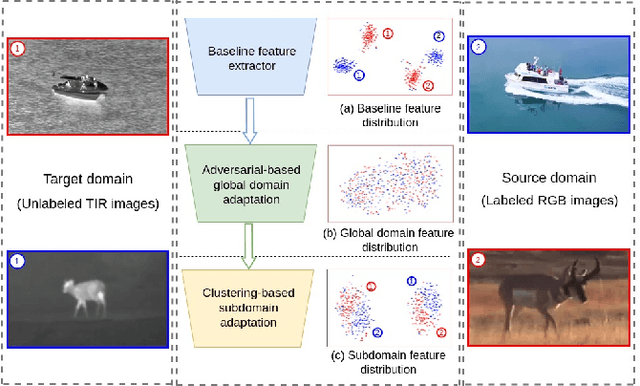
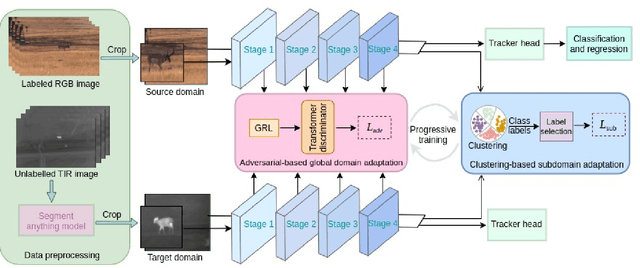
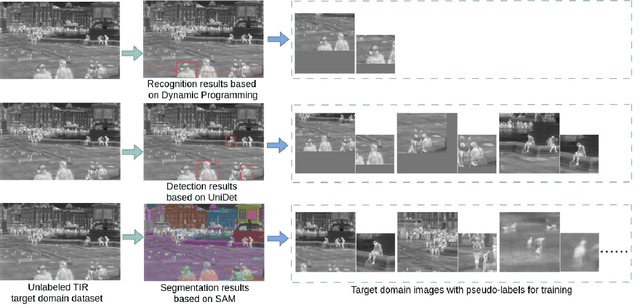
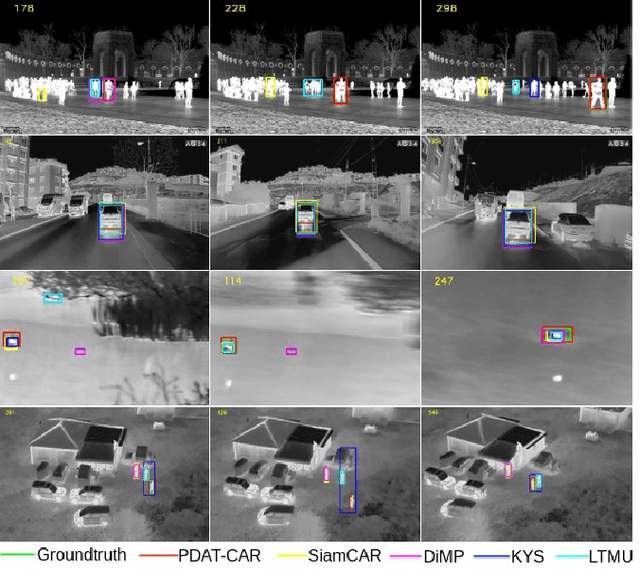
Due to the lack of large-scale labeled Thermal InfraRed (TIR) training datasets, most existing TIR trackers are trained directly on RGB datasets. However, tracking methods trained on RGB datasets suffer a significant drop-off in TIR data due to the domain shift issue. To this end, in this work, we propose a Progressive Domain Adaptation framework for TIR Tracking (PDAT), which transfers useful knowledge learned from RGB tracking to TIR tracking. The framework makes full use of large-scale labeled RGB datasets without requiring time-consuming and labor-intensive labeling of large-scale TIR data. Specifically, we first propose an adversarial-based global domain adaptation module to reduce domain gap on the feature level coarsely. Second, we design a clustering-based subdomain adaptation method to further align the feature distributions of the RGB and TIR datasets finely. These two domain adaptation modules gradually eliminate the discrepancy between the two domains, and thus learn domain-invariant fine-grained features through progressive training. Additionally, we collect a largescale TIR dataset with over 1.48 million unlabeled TIR images for training the proposed domain adaptation framework. Experimental results on five TIR tracking benchmarks show that the proposed method gains a nearly 6% success rate, demonstrating its effectiveness.
Unveiling Structural Memorization: Structural Membership Inference Attack for Text-to-Image Diffusion Models
Jul 18, 2024With the rapid advancements of large-scale text-to-image diffusion models, various practical applications have emerged, bringing significant convenience to society. However, model developers may misuse the unauthorized data to train diffusion models. These data are at risk of being memorized by the models, thus potentially violating citizens' privacy rights. Therefore, in order to judge whether a specific image is utilized as a member of a model's training set, Membership Inference Attack (MIA) is proposed to serve as a tool for privacy protection. Current MIA methods predominantly utilize pixel-wise comparisons as distinguishing clues, considering the pixel-level memorization characteristic of diffusion models. However, it is practically impossible for text-to-image models to memorize all the pixel-level information in massive training sets. Therefore, we move to the more advanced structure-level memorization. Observations on the diffusion process show that the structures of members are better preserved compared to those of nonmembers, indicating that diffusion models possess the capability to remember the structures of member images from training sets. Drawing on these insights, we propose a simple yet effective MIA method tailored for text-to-image diffusion models. Extensive experimental results validate the efficacy of our approach. Compared to current pixel-level baselines, our approach not only achieves state-of-the-art performance but also demonstrates remarkable robustness against various distortions.
Model Will Tell: Training Membership Inference for Diffusion Models
Mar 13, 2024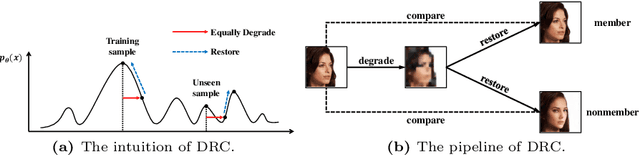
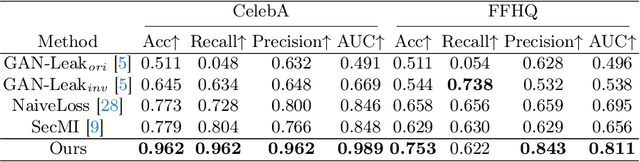
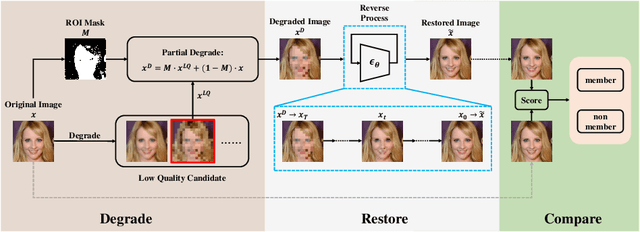
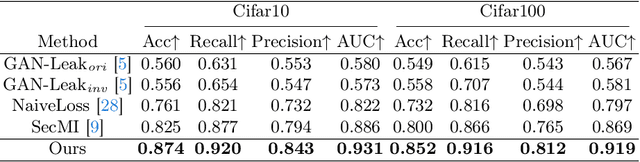
Diffusion models pose risks of privacy breaches and copyright disputes, primarily stemming from the potential utilization of unauthorized data during the training phase. The Training Membership Inference (TMI) task aims to determine whether a specific sample has been used in the training process of a target model, representing a critical tool for privacy violation verification. However, the increased stochasticity inherent in diffusion renders traditional shadow-model-based or metric-based methods ineffective when applied to diffusion models. Moreover, existing methods only yield binary classification labels which lack necessary comprehensibility in practical applications. In this paper, we explore a novel perspective for the TMI task by leveraging the intrinsic generative priors within the diffusion model. Compared with unseen samples, training samples exhibit stronger generative priors within the diffusion model, enabling the successful reconstruction of substantially degraded training images. Consequently, we propose the Degrade Restore Compare (DRC) framework. In this framework, an image undergoes sequential degradation and restoration, and its membership is determined by comparing it with the restored counterpart. Experimental results verify that our approach not only significantly outperforms existing methods in terms of accuracy but also provides comprehensible decision criteria, offering evidence for potential privacy violations.