 Add to Chrome
 Add to Firefox
 Add to Edge
From Imitation to Alignment: Human-Preference Flow Policies for Long-Horizon Sidewalk Navigation
Jun 10, 2026
Autonomous long-horizon sidewalk navigation is essential for micro-mobility applications such as robotic food delivery and assistive electronic wheelchairs. Unlike autonomous driving on the road, long-horizon sidewalk navigation requires precise maneuvering through unpredictable sidewalk terrains and pedestrians, with a lightweight perception stack as minimal as a single monocular RGB camera. While imitation learning (IL) from demonstrations offers a practical solution, the resulting autopilot policy often suffers from compounding errors, a lack of social compliance on sidewalks, and deficiencies in counterfactual reasoning to handle complex situations. To address these challenges, we introduce FlowPilot, a mapless navigation policy that achieves robust and efficient long-horizon navigation performance using only a monocular RGB camera. We first propose to use anchored flow matching as an action representation for policy pre-training on large-scale robot fleet data and to capture the diverse, complex, multimodal distribution of sidewalk navigation behaviors. To bridge the gap between imitation and alignment, we further design a human-in-the-loop preference learning scheme to tune the policy on a small amount of human intervention data. It strengthens the model's counterfactual reasoning and social compliance on sidewalks. We evaluate FlowPilot through extensive simulation and real-world experiments in diverse sidewalk environments. FlowPilot achieves 42% success rate and 66% route completion in simulation, while FlowPilot-HP further improves real-world robustness and social compliance, reducing IR by 40.0% and NIR by 52.1% relative to the base model.

VEOcc: Voxel-Centric Online Semantic Occupancy Prediction For Embodied Scene Understanding
May 28, 2026Crucial for autonomous exploration, online 3D occupancy prediction and mapping incrementally constructs dense spatial representations on the fly. However, recent Gaussian-centric methods struggle with structural boundary fidelity and rely heavily on predefined scene-size priors, fundamentally limiting their operational efficiency. In this work, we present VEOcc, a voxel-centric framework formulated as a recursive perception-and-assimilation paradigm. By eliminating the need for initial scale estimation, VEOcc enables highly streamlined, open-ended map expansion. Furthermore, to robustly aggregate noisy temporal observations within the discrete voxel space, we propose a Spatio-Temporal-Aware Online Update Strategy. It integrates Cross-Temporal Logit Aggregation (TLA) for temporal consistency, Reliability-Aware Confidence Modulation (RCM) for spatial uncertainty calibration, and Confidence-Driven Incremental State Update (CSU) for robust global state assimilation. % Extensive experiments on Occ-ScanNet and EmbodiedOcc-ScanNet demonstrate that VEOcc establishes new state-of-the-art performance in both local and embodied settings, providing an accurate and efficient solution for real-world exploration. Extensive experiments on Occ-ScanNet and EmbodiedOcc-ScanNet demonstrate that VEOcc establishes new state-of-the-art performance in both local and embodied settings. Notably, zero-shot evaluations on self-collected video sequences further confirm its robust out-of-distribution generalization capability in completely unseen real-world environments. Ultimately, our framework provides an accurate and highly efficient solution for autonomous exploration. Code and supplementary visualizations are available on our project page: https://wryzju.github.io/VEOcc/.
SparseWorld: Enhancing End-to-End Autonomous Driving via World Models with Sparse Scene Representation
May 23, 2026Recently, world models have made significant progress in enhancing end-to-end driving systems through both future situation forecasting and improved scene understanding. However, existing driving world models are typically built upon dense scene representations, causing high computational costs and redundant information. In this paper, we present SparseWorld, a lightweight world model that focuses on predicting only the critical layout of the scene, enabling efficient future forecasting for end-to-end driving systems. SparseWorld first performs autoregressive rollout to forecast future map elements and surrounding agents, enabling the model to learn how driving scenarios evolve over time. It then leverages these predicted futures to refine downstream motion prediction and trajectory planning. Specifically, we propose a Sparse Dreamer that anticipates future instances in the latent space through joint temporal and spatial attention. By interacting with predicted future instances, the motion planner captures more accurate motion patterns and generates more informed and safety-aware trajectories. Extensive experiments demonstrate that SparseWorld significantly reduces collision risk and achieves state-of-the-art performance on the open-loop planning metrics of the nuScenes dataset with a collision rate of 0.05\%. Moreover, it substantially outperforms the baseline method in closed-loop planning metrics on the Bench2Drive benchmark. Supplementary material is available at the project page: https://wryzju.github.io/SparseWorld/.
AURA: Multimodal Shared Autonomy for Real-World Urban Navigation
Apr 02, 2026Long-horizon navigation in complex urban environments relies heavily on continuous human operation, which leads to fatigue, reduced efficiency, and safety concerns. Shared autonomy, where a Vision-Language AI agent and a human operator collaborate on maneuvering the mobile machine, presents a promising solution to address these issues. However, existing shared autonomy methods often require humans and AI to operate within the same action space, leading to high cognitive overhead. We present Assistive Urban Robot Autonomy (AURA), a new multi-modal framework that decomposes urban navigation into high-level human instruction and low-level AI control. AURA incorporates a Spatial-Aware Instruction Encoder to align various human instructions with visual and spatial context. To facilitate training, we construct MM-CoS, a large-scale dataset comprising teleoperation and vision-language descriptions. Experiments in simulation and the real world demonstrate that AURA effectively follows human instructions, reduces manual operation effort, and improves navigation stability, while enabling online adaptation. Moreover, under similar takeover conditions, our shared autonomy framework reduces the frequency of takeovers by more than 44%. Demo video and more detail are provided in the project page.
Learning Sidewalk Autopilot from Multi-Scale Imitation with Corrective Behavior Expansion
Mar 23, 2026Sidewalk micromobility is a promising solution for last-mile transportation, but current learning-based control methods struggle in complex urban environments. Imitation learning (IL) learns policies from human demonstrations, yet its reliance on fixed offline data often leads to compounding errors, limited robustness, and poor generalization. To address these challenges, we propose a framework that advances IL through corrective behavior expansion and multi-scale imitation learning. On the data side, we augment teleoperation datasets with diverse corrective behaviors and sensor augmentations to enable the policy to learn to recover from its own mistakes. On the model side, we introduce a multi-scale IL architecture that captures both short-horizon interactive behaviors and long-horizon goal-directed intentions via horizon-based trajectory clustering and hierarchical supervision. Real-world experiments show that our approach significantly improves robustness and generalization in diverse sidewalk scenarios.
From Seeing to Experiencing: Scaling Navigation Foundation Models with Reinforcement Learning
Jul 29, 2025Navigation foundation models trained on massive webscale data enable agents to generalize across diverse environments and embodiments. However, these models trained solely on offline data, often lack the capacity to reason about the consequences of their actions or adapt through counterfactual understanding. They thus face significant limitations in the real-world urban navigation where interactive and safe behaviors, such as avoiding obstacles and moving pedestrians, are critical. To tackle these challenges, we introduce the Seeing-to-Experiencing framework to scale the capability of navigation foundation models with reinforcement learning. S2E combines the strengths of pre-training on videos and post-training through RL. It maintains the generalizability acquired from large-scale real-world videos while enhancing its interactivity through RL in simulation environments. Specifically, we introduce two innovations: an Anchor-Guided Distribution Matching strategy, which stabilizes learning and models diverse motion patterns through anchor-based supervision; and a Residual-Attention Module, which obtains reactive behaviors from simulation environments without erasing the model's pretrained knowledge. Moreover, we establish a comprehensive end-to-end evaluation benchmark, NavBench-GS, built on photorealistic 3DGS reconstructions of real-world scenes that incorporate physical interactions. It can systematically assess the generalizability and safety of navigation foundation models. Extensive experiments show that S2E mitigates the diminishing returns often seen when scaling with offline data alone. We perform a thorough analysis of the benefits of Reinforcement Learning compared to Supervised Fine-Tuning in the context of post-training for robot learning. Our findings emphasize the crucial role of integrating interactive online experiences to effectively scale foundation models in Robotics.
X-Scene: Large-Scale Driving Scene Generation with High Fidelity and Flexible Controllability
Jun 16, 2025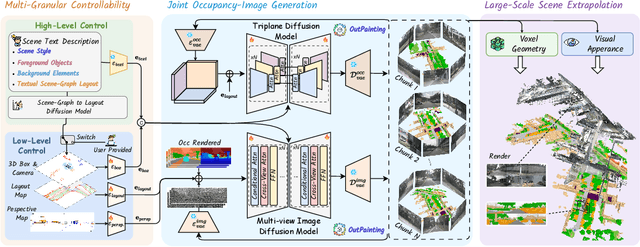

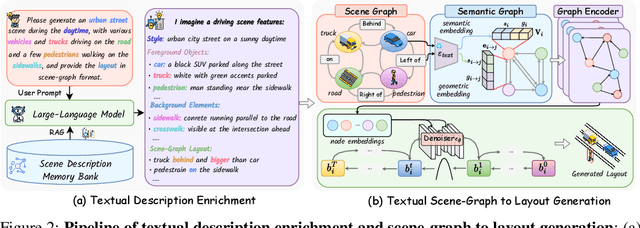
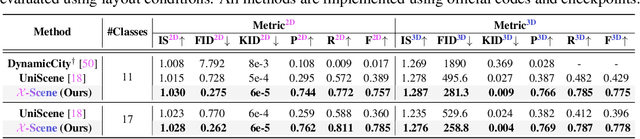
Diffusion models are advancing autonomous driving by enabling realistic data synthesis, predictive end-to-end planning, and closed-loop simulation, with a primary focus on temporally consistent generation. However, the generation of large-scale 3D scenes that require spatial coherence remains underexplored. In this paper, we propose X-Scene, a novel framework for large-scale driving scene generation that achieves both geometric intricacy and appearance fidelity, while offering flexible controllability. Specifically, X-Scene supports multi-granular control, including low-level conditions such as user-provided or text-driven layout for detailed scene composition and high-level semantic guidance such as user-intent and LLM-enriched text prompts for efficient customization. To enhance geometrical and visual fidelity, we introduce a unified pipeline that sequentially generates 3D semantic occupancy and the corresponding multiview images, while ensuring alignment between modalities. Additionally, we extend the generated local region into a large-scale scene through consistency-aware scene outpainting, which extrapolates new occupancy and images conditioned on the previously generated area, enhancing spatial continuity and preserving visual coherence. The resulting scenes are lifted into high-quality 3DGS representations, supporting diverse applications such as scene exploration. Comprehensive experiments demonstrate that X-Scene significantly advances controllability and fidelity for large-scale driving scene generation, empowering data generation and simulation for autonomous driving.
L2COcc: Lightweight Camera-Centric Semantic Scene Completion via Distillation of LiDAR Model
Mar 16, 2025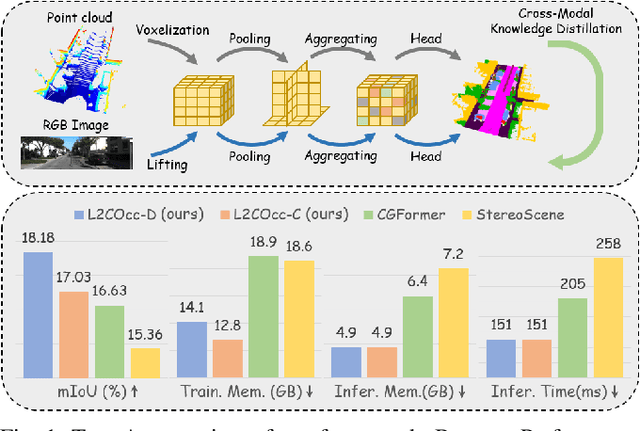
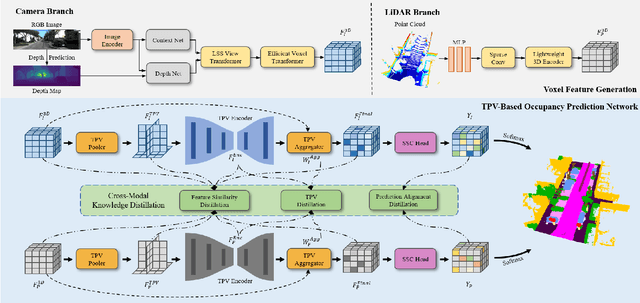
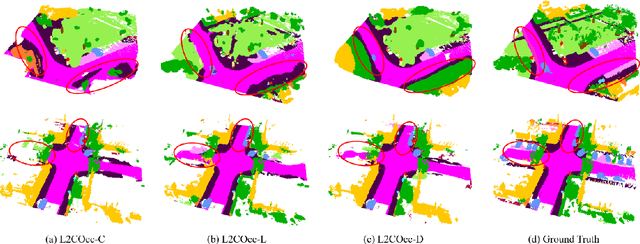
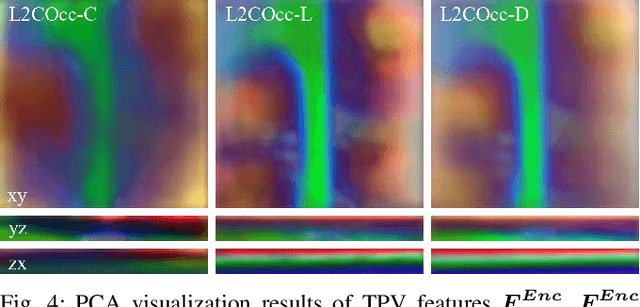
Semantic Scene Completion (SSC) constitutes a pivotal element in autonomous driving perception systems, tasked with inferring the 3D semantic occupancy of a scene from sensory data. To improve accuracy, prior research has implemented various computationally demanding and memory-intensive 3D operations, imposing significant computational requirements on the platform during training and testing. This paper proposes L2COcc, a lightweight camera-centric SSC framework that also accommodates LiDAR inputs. With our proposed efficient voxel transformer (EVT) and cross-modal knowledge modules, including feature similarity distillation (FSD), TPV distillation (TPVD) and prediction alignment distillation (PAD), our method substantially reduce computational burden while maintaining high accuracy. The experimental evaluations demonstrate that our proposed method surpasses the current state-of-the-art vision-based SSC methods regarding accuracy on both the SemanticKITTI and SSCBench-KITTI-360 benchmarks, respectively. Additionally, our method is more lightweight, exhibiting a reduction in both memory consumption and inference time by over 23% compared to the current state-of-the-arts method. Code is available at our project page:https://studyingfufu.github.io/L2COcc/.
LeapVAD: A Leap in Autonomous Driving via Cognitive Perception and Dual-Process Thinking
Jan 14, 2025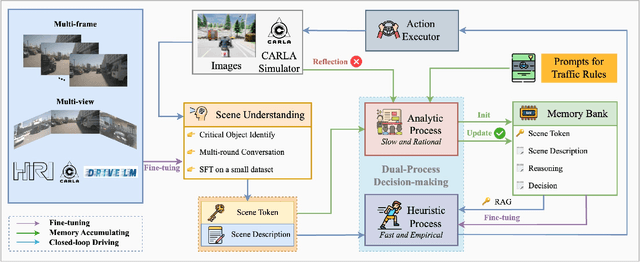
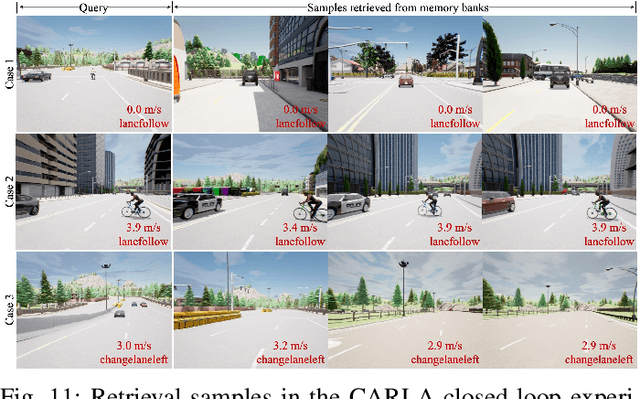
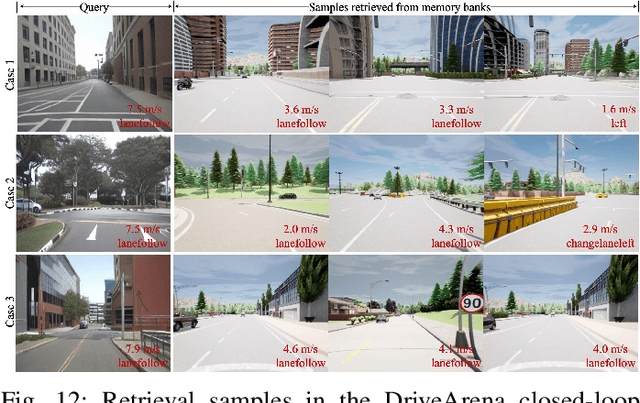
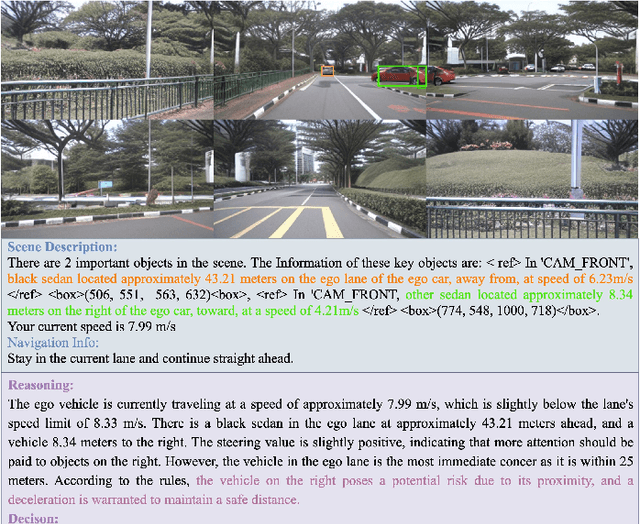
While autonomous driving technology has made remarkable strides, data-driven approaches still struggle with complex scenarios due to their limited reasoning capabilities. Meanwhile, knowledge-driven autonomous driving systems have evolved considerably with the popularization of visual language models. In this paper, we propose LeapVAD, a novel method based on cognitive perception and dual-process thinking. Our approach implements a human-attentional mechanism to identify and focus on critical traffic elements that influence driving decisions. By characterizing these objects through comprehensive attributes - including appearance, motion patterns, and associated risks - LeapVAD achieves more effective environmental representation and streamlines the decision-making process. Furthermore, LeapVAD incorporates an innovative dual-process decision-making module miming the human-driving learning process. The system consists of an Analytic Process (System-II) that accumulates driving experience through logical reasoning and a Heuristic Process (System-I) that refines this knowledge via fine-tuning and few-shot learning. LeapVAD also includes reflective mechanisms and a growing memory bank, enabling it to learn from past mistakes and continuously improve its performance in a closed-loop environment. To enhance efficiency, we develop a scene encoder network that generates compact scene representations for rapid retrieval of relevant driving experiences. Extensive evaluations conducted on two leading autonomous driving simulators, CARLA and DriveArena, demonstrate that LeapVAD achieves superior performance compared to camera-only approaches despite limited training data. Comprehensive ablation studies further emphasize its effectiveness in continuous learning and domain adaptation. Project page: https://pjlab-adg.github.io/LeapVAD/.
Monocular Event-Inertial Odometry with Adaptive decay-based Time Surface and Polarity-aware Tracking
Sep 21, 2024Event cameras have garnered considerable attention due to their advantages over traditional cameras in low power consumption, high dynamic range, and no motion blur. This paper proposes a monocular event-inertial odometry incorporating an adaptive decay kernel-based time surface with polarity-aware tracking. We utilize an adaptive decay-based Time Surface to extract texture information from asynchronous events, which adapts to the dynamic characteristics of the event stream and enhances the representation of environmental textures. However, polarity-weighted time surfaces suffer from event polarity shifts during changes in motion direction. To mitigate its adverse effects on feature tracking, we optimize the feature tracking by incorporating an additional polarity-inverted time surface to enhance the robustness. Comparative analysis with visual-inertial and event-inertial odometry methods shows that our approach outperforms state-of-the-art techniques, with competitive results across various datasets.