 Add to Chrome
 Add to Firefox
 Add to Edge
Sol-Attn: Accelerating Video Generation Inference via On-the-Fly Attention Sparsification
Jul 27, 2026
Diffusion transformers are essential for high-fidelity video generation, but long token sequences make attention a dominant inference bottleneck. Training-free dynamic sparse attention alleviates this bottleneck by computing only selected key-value blocks, yet existing methods struggle to sparsify attention both efficiently and accurately for two reasons: (1) Rigid, unpredictable, and costly routing: selecting a fixed fraction of top-ranked blocks by proxy score imposes fixed budgets, whereas retaining blocks to reach a target cumulative proxy probability mass yields dynamic but potentially imbalanced budgets; both incur non-negligible overhead from computing and materializing proxy scores. (2) Lossy keep-or-drop sparsification: unselected blocks are discarded entirely, degrading accuracy under aggressive sparsity. These limitations motivate cheaper dynamic-budget routing while limiting accuracy degradation. In this paper, we introduce training-free Sol-Attn (Sparsifying online attention), which unifies dynamic routing, sparse computation, and approximation correction in a single online-softmax pass, achieving a better accuracy-efficiency trade-off in sparse attention. The core of Sol-Attn is on-the-fly block thresholding with proxy-score reuse, which selects critical blocks by comparing block proxy scores against a threshold during online softmax. This design enables dynamic yet controllable block budgets without materializing the proxy map, while directly reusing the proxy scores of unselected blocks to approximate their contribution. Experiments across image and video generation tasks show that Sol-Attn advances the quality-efficiency frontier of training-free sparse attention, delivering 2.1 times and 2.3 times end-to-end speedups for video generation and editing, respectively, while preserving visual quality.

Real-time fall detection based on vision for low-power edge platforms
Jul 14, 2026Falling detection is vital for elderly care and intelligent surveillance; however, prevailing vision-based approaches predominantly frame it as static pose classification or discrete temporal pattern matching, fundamentally overlooking the instability dynamics of the human support system. This paper proposes a physics-informed falling detection framework that recasts falling as a stability-loss event in a coupled dynamical system. We introduce a novel dual-LTC architecture comprising a Center-of-Mass (CoM) subsystem and a Base-of-Support (BoS) subsystem, both instantiated as Liquid Time-Constant (LTC) neural networks to continuously model inertial trajectory evolution and ground-contact adjustment through adaptive time constants, Physical interpretability of falling motion. A learnable coupling module emulates physical interaction between the two subsystems, while a Stability Manifold classifier operates in the joint latent space to detect boundary crossing via Lyapunov-inspired stability metrics. Complementary counterfactual trajectory projection and Time-to-Collision (TTC) estimation further enable irreversibility assessment and early warning. The architecture is designed to support a three-state prediction paradigm (Normal, Falling, Fallen); in this preliminary study, we validate the core stability discrimination capability on a two-class dataset (Normal vs. Falling), leaving the full three-state temporal transition to future work. Unlike conventional CNN--RNN pipelines, the proposed formulation encodes continuous-time mechanical inertia, yielding a sub-50K-parameter network capable of real-time inference on resource-constrained edge devices. Extensive experiments demonstrate competitive accuracy with superior physical interpretability, validating its efficacy for low-compute visual fall detection.
Sol Video Inference Engine: Agent-Native Full-Stack Acceleration Framework for Efficient Video Generation
Jun 24, 2026Modern video diffusion models achieve higher generation quality through scaling, but this also increases inference cost. Although many acceleration methods have been proposed, a central challenge is that the most effective acceleration strategy is highly instance-specific: a recipe that works well for one combination of model, hardware, and inference configuration often does not transfer to another. Different models vary in architecture, numerical sensitivity, and attention concentration patterns. Inference settings differ in spatial and temporal resolution and video duration, while hardware platforms differ in memory hierarchy, supported numerical formats, and kernel throughput. These factors create a large tuning space, making manual performance engineering costly. We present Sol Video Inference Engine, an agentic, native, training-free acceleration framework for video diffusion models. It organizes five broadly applicable techniques, cache, sparse attention, token pruning, quantization, and kernel fusion, into an agentic acceleration stack for instance-specific optimization. For a concrete deployment target defined by a model, hardware platform, and serving configuration, parallel skill agents optimize the implementation of each technique, an agent integrator composes them into a global acceleration stack, and a human validator provides feedback on generation quality. We instantiate this workflow on three video models with different sizes and architectures: 64B Cosmos3-Super, 22B LTX-2.3, and 2B SANA-Video. With little human effort, the full stack achieves more than 2x end-to-end acceleration while maintaining near-lossless VBench quality, demonstrating the effectiveness of the agent framework for video diffusion acceleration.
MaineCoon: Pursuing A Real-Time Audio-Visual Social World Model
Jun 16, 2026As an increasing majority of global video content is consumed on social platforms for interactive social purposes, video generation models built for social worlds are important but largely overlooked by previous studies. In this work, we define the position of social world models and build a prototype model as the first step towards this goal. While previous world models successfully simulate physical environments or gaming world exploration, they remain fundamentally detached from human-centric social dynamics. To bridge this gap as the first step to social world models, we present MaineCoon, the first real-time audio-visual autoregressive model that has 22B parameters and is capable of real-time streaming generation and sub-second interaction, with a record-breaking frame rate of up to 47.5 FPS, on a single GPU. To the best of our knowledge, MaineCoon is also the first real-time audio-visual generation model specifically optimized for social-interactive applications. To enable efficient and stable training, we introduce several novel techniques into MaineCoon, including self-resampling, cross-modal representation alignment, domain-aware preference optimization, and reinforced online-policy distillation (ROPD). We also design the first agentic streaming inference framework that supports thousand-second-scale or even longer generation while mitigating drift with agentic cache management and prompt planing. These innovations significantly accelerate training while optimizing real-time inference performance. We believe this work not only sets a new state-of-the-art (SOTA) performance benchmark for high-quality, low-latency, and long-horizon audio-visual autoregressive models, but also points out the paradigm shift desired for next-generation AI-native social platforms.
Lightning Unified Video Editing via In-Context Sparse Attention
May 06, 2026Video editing has evolved toward In-Context Learning (ICL) paradigms, yet the resulting quadratic attention costs create a critical computational bottleneck. In this work, we propose In-context Sparse Attention (ISA), the first near-lossless empirical sparse framework tailored for ICL video editing. Our design is grounded in two key insights: first, context tokens exhibit significantly lower saliency than source tokens; second, we theoretically prove and empirically validate that Query sharpness correlates with approximation error. Motivated by these findings, ISA implements an efficient pre-selection strategy to prune redundant context, followed by a dynamic query grouping mechanism that routes high-error queries to full attention and low-error ones to a computationally efficient 0-th order Taylor sparse attention. Furthermore, we build \textbf{\texttt{LIVEditor}} , a novel lightning video editing model via ISA and a proposed video-editing data pipeline that curated a 1.7M high-quality dataset. Extensive experiments demonstrate that LIVEditor achieves a $\sim$60% reduction in attention-module latency while surpassing state-of-the-art methods across EditVerseBench, IVE-Bench, and VIE-Bench, delivering near-lossless acceleration without compromising visual fidelity.
PISA: Piecewise Sparse Attention Is Wiser for Efficient Diffusion Transformers
Feb 03, 2026Diffusion Transformers are fundamental for video and image generation, but their efficiency is bottlenecked by the quadratic complexity of attention. While block sparse attention accelerates computation by attending only critical key-value blocks, it suffers from degradation at high sparsity by discarding context. In this work, we discover that attention scores of non-critical blocks exhibit distributional stability, allowing them to be approximated accurately and efficiently rather than discarded, which is essentially important for sparse attention design. Motivated by this key insight, we propose PISA, a training-free Piecewise Sparse Attention that covers the full attention span with sub-quadratic complexity. Unlike the conventional keep-or-drop paradigm that directly drop the non-critical block information, PISA introduces a novel exact-or-approximate strategy: it maintains exact computation for critical blocks while efficiently approximating the remainder through block-wise Taylor expansion. This design allows PISA to serve as a faithful proxy to full attention, effectively bridging the gap between speed and quality. Experimental results demonstrate that PISA achieves 1.91 times and 2.57 times speedups on Wan2.1-14B and Hunyuan-Video, respectively, while consistently maintaining the highest quality among sparse attention methods. Notably, even for image generation on FLUX, PISA achieves a 1.2 times acceleration without compromising visual quality. Code is available at: https://github.com/xie-lab-ml/piecewise-sparse-attention.
Autoregressive Image Generation with Randomized Parallel Decoding
Mar 13, 2025We introduce ARPG, a novel visual autoregressive model that enables randomized parallel generation, addressing the inherent limitations of conventional raster-order approaches, which hinder inference efficiency and zero-shot generalization due to their sequential, predefined token generation order. Our key insight is that effective random-order modeling necessitates explicit guidance for determining the position of the next predicted token. To this end, we propose a novel guided decoding framework that decouples positional guidance from content representation, encoding them separately as queries and key-value pairs. By directly incorporating this guidance into the causal attention mechanism, our approach enables fully random-order training and generation, eliminating the need for bidirectional attention. Consequently, ARPG readily generalizes to zero-shot tasks such as image inpainting, outpainting, and resolution expansion. Furthermore, it supports parallel inference by concurrently processing multiple queries using a shared KV cache. On the ImageNet-1K 256 benchmark, our approach attains an FID of 1.94 with only 64 sampling steps, achieving over a 20-fold increase in throughput while reducing memory consumption by over 75% compared to representative recent autoregressive models at a similar scale.
Admitting Ignorance Helps the Video Question Answering Models to Answer
Jan 15, 2025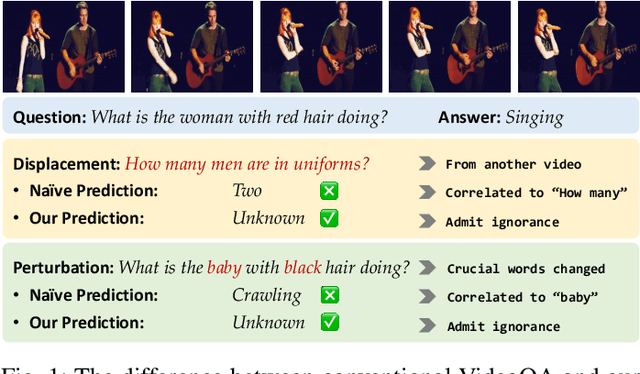
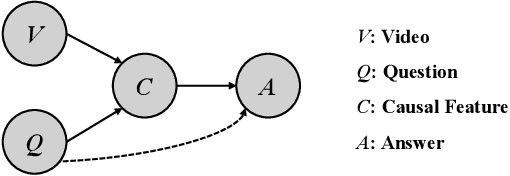
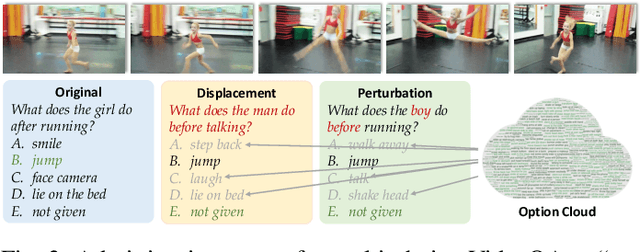

Significant progress has been made in the field of video question answering (VideoQA) thanks to deep learning and large-scale pretraining. Despite the presence of sophisticated model structures and powerful video-text foundation models, most existing methods focus solely on maximizing the correlation between answers and video-question pairs during training. We argue that these models often establish shortcuts, resulting in spurious correlations between questions and answers, especially when the alignment between video and text data is suboptimal. To address these spurious correlations, we propose a novel training framework in which the model is compelled to acknowledge its ignorance when presented with an intervened question, rather than making guesses solely based on superficial question-answer correlations. We introduce methodologies for intervening in questions, utilizing techniques such as displacement and perturbation, and design frameworks for the model to admit its lack of knowledge in both multi-choice VideoQA and open-ended settings. In practice, we integrate a state-of-the-art model into our framework to validate its effectiveness. The results clearly demonstrate that our framework can significantly enhance the performance of VideoQA models with minimal structural modifications.
Can Large Language Models Analyze Graphs like Professionals? A Benchmark, Datasets and Models
Sep 29, 2024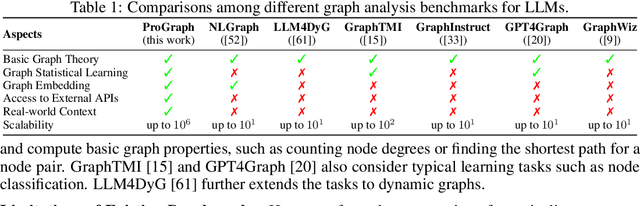

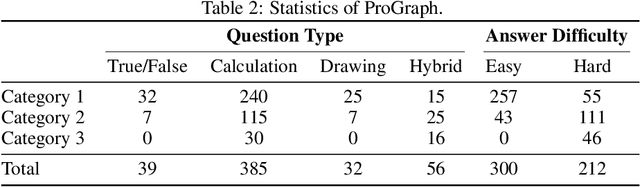

The need to analyze graphs is ubiquitous across various fields, from social networks to biological research and recommendation systems. Therefore, enabling the ability of large language models (LLMs) to process graphs is an important step toward more advanced general intelligence. However, current LLM benchmarks on graph analysis require models to directly reason over the prompts describing graph topology, and are thus limited to small graphs with only a few dozens of nodes. In contrast, human experts typically write programs based on popular libraries for task solving, and can thus handle graphs with different scales. To this end, a question naturally arises: can LLMs analyze graphs like professionals? In this paper, we introduce ProGraph, a manually crafted benchmark containing 3 categories of graph tasks. The benchmark expects solutions based on programming instead of directly reasoning over raw inputs. Our findings reveal that the performance of current LLMs is unsatisfactory, with the best model achieving only 36% accuracy. To bridge this gap, we propose LLM4Graph datasets, which include crawled documents and auto-generated codes based on 6 widely used graph libraries. By augmenting closed-source LLMs with document retrieval and fine-tuning open-source ones on the codes, we show 11-32% absolute improvements in their accuracies. Our results underscore that the capabilities of LLMs in handling structured data are still under-explored, and show the effectiveness of LLM4Graph in enhancing LLMs' proficiency of graph analysis. The benchmark, datasets and enhanced open-source models are available at https://github.com/BUPT-GAMMA/ProGraph.
Scalable Autoregressive Image Generation with Mamba
Aug 22, 2024We introduce AiM, an autoregressive (AR) image generative model based on Mamba architecture. AiM employs Mamba, a novel state-space model characterized by its exceptional performance for long-sequence modeling with linear time complexity, to supplant the commonly utilized Transformers in AR image generation models, aiming to achieve both superior generation quality and enhanced inference speed. Unlike existing methods that adapt Mamba to handle two-dimensional signals via multi-directional scan, AiM directly utilizes the next-token prediction paradigm for autoregressive image generation. This approach circumvents the need for extensive modifications to enable Mamba to learn 2D spatial representations. By implementing straightforward yet strategically targeted modifications for visual generative tasks, we preserve Mamba's core structure, fully exploiting its efficient long-sequence modeling capabilities and scalability. We provide AiM models in various scales, with parameter counts ranging from 148M to 1.3B. On the ImageNet1K 256*256 benchmark, our best AiM model achieves a FID of 2.21, surpassing all existing AR models of comparable parameter counts and demonstrating significant competitiveness against diffusion models, with 2 to 10 times faster inference speed. Code is available at https://github.com/hp-l33/AiM