 Add to Chrome
 Add to Firefox
 Add to Edge
REBOOT: Reuse Data for Bootstrapping Efficient Real-World Dexterous Manipulation
Sep 06, 2023
Dexterous manipulation tasks involving contact-rich interactions pose a significant challenge for both model-based control systems and imitation learning algorithms. The complexity arises from the need for multi-fingered robotic hands to dynamically establish and break contacts, balance non-prehensile forces, and control large degrees of freedom. Reinforcement learning (RL) offers a promising approach due to its general applicability and capacity to autonomously acquire optimal manipulation strategies. However, its real-world application is often hindered by the necessity to generate a large number of samples, reset the environment, and obtain reward signals. In this work, we introduce an efficient system for learning dexterous manipulation skills with RL to alleviate these challenges. The main idea of our approach is the integration of recent advances in sample-efficient RL and replay buffer bootstrapping. This combination allows us to utilize data from different tasks or objects as a starting point for training new tasks, significantly improving learning efficiency. Additionally, our system completes the real-world training cycle by incorporating learned resets via an imitation-based pickup policy as well as learned reward functions, eliminating the need for manual resets and reward engineering. We demonstrate the benefits of reusing past data as replay buffer initialization for new tasks, for instance, the fast acquisition of intricate manipulation skills in the real world on a four-fingered robotic hand. (Videos: https://sites.google.com/view/reboot-dexterous)

BridgeData V2: A Dataset for Robot Learning at Scale
Aug 24, 2023We introduce BridgeData V2, a large and diverse dataset of robotic manipulation behaviors designed to facilitate research on scalable robot learning. BridgeData V2 contains 60,096 trajectories collected across 24 environments on a publicly available low-cost robot. BridgeData V2 provides extensive task and environment variability, leading to skills that can generalize across environments, domains, and institutions, making the dataset a useful resource for a broad range of researchers. Additionally, the dataset is compatible with a wide variety of open-vocabulary, multi-task learning methods conditioned on goal images or natural language instructions. In our experiments, we train 6 state-of-the-art imitation learning and offline reinforcement learning methods on our dataset, and find that they succeed on a suite of tasks requiring varying amounts of generalization. We also demonstrate that the performance of these methods improves with more data and higher capacity models, and that training on a greater variety of skills leads to improved generalization. By publicly sharing BridgeData V2 and our pre-trained models, we aim to accelerate research in scalable robot learning methods. Project page at https://rail-berkeley.github.io/bridgedata
RT-2: Vision-Language-Action Models Transfer Web Knowledge to Robotic Control
Jul 28, 2023We study how vision-language models trained on Internet-scale data can be incorporated directly into end-to-end robotic control to boost generalization and enable emergent semantic reasoning. Our goal is to enable a single end-to-end trained model to both learn to map robot observations to actions and enjoy the benefits of large-scale pretraining on language and vision-language data from the web. To this end, we propose to co-fine-tune state-of-the-art vision-language models on both robotic trajectory data and Internet-scale vision-language tasks, such as visual question answering. In contrast to other approaches, we propose a simple, general recipe to achieve this goal: in order to fit both natural language responses and robotic actions into the same format, we express the actions as text tokens and incorporate them directly into the training set of the model in the same way as natural language tokens. We refer to such category of models as vision-language-action models (VLA) and instantiate an example of such a model, which we call RT-2. Our extensive evaluation (6k evaluation trials) shows that our approach leads to performant robotic policies and enables RT-2 to obtain a range of emergent capabilities from Internet-scale training. This includes significantly improved generalization to novel objects, the ability to interpret commands not present in the robot training data (such as placing an object onto a particular number or icon), and the ability to perform rudimentary reasoning in response to user commands (such as picking up the smallest or largest object, or the one closest to another object). We further show that incorporating chain of thought reasoning allows RT-2 to perform multi-stage semantic reasoning, for example figuring out which object to pick up for use as an improvised hammer (a rock), or which type of drink is best suited for someone who is tired (an energy drink).
Contrastive Example-Based Control
Jul 24, 2023While many real-world problems that might benefit from reinforcement learning, these problems rarely fit into the MDP mold: interacting with the environment is often expensive and specifying reward functions is challenging. Motivated by these challenges, prior work has developed data-driven approaches that learn entirely from samples from the transition dynamics and examples of high-return states. These methods typically learn a reward function from high-return states, use that reward function to label the transitions, and then apply an offline RL algorithm to these transitions. While these methods can achieve good results on many tasks, they can be complex, often requiring regularization and temporal difference updates. In this paper, we propose a method for offline, example-based control that learns an implicit model of multi-step transitions, rather than a reward function. We show that this implicit model can represent the Q-values for the example-based control problem. Across a range of state-based and image-based offline control tasks, our method outperforms baselines that use learned reward functions; additional experiments demonstrate improved robustness and scaling with dataset size.
* This is an updated version of a manuscript that originally appeared at L4DC 2023. The project website is here https://sites.google.com/view/laeo-rl
A Connection between One-Step Regularization and Critic Regularization in Reinforcement Learning
Jul 24, 2023As with any machine learning problem with limited data, effective offline RL algorithms require careful regularization to avoid overfitting. One-step methods perform regularization by doing just a single step of policy improvement, while critic regularization methods do many steps of policy improvement with a regularized objective. These methods appear distinct. One-step methods, such as advantage-weighted regression and conditional behavioral cloning, truncate policy iteration after just one step. This ``early stopping'' makes one-step RL simple and stable, but can limit its asymptotic performance. Critic regularization typically requires more compute but has appealing lower-bound guarantees. In this paper, we draw a close connection between these methods: applying a multi-step critic regularization method with a regularization coefficient of 1 yields the same policy as one-step RL. While practical implementations violate our assumptions and critic regularization is typically applied with smaller regularization coefficients, our experiments nevertheless show that our analysis makes accurate, testable predictions about practical offline RL methods (CQL and one-step RL) with commonly-used hyperparameters. Our results that every problem can be solved with a single step of policy improvement, but rather that one-step RL might be competitive with critic regularization on RL problems that demand strong regularization.
Multi-Stage Cable Routing through Hierarchical Imitation Learning
Jul 23, 2023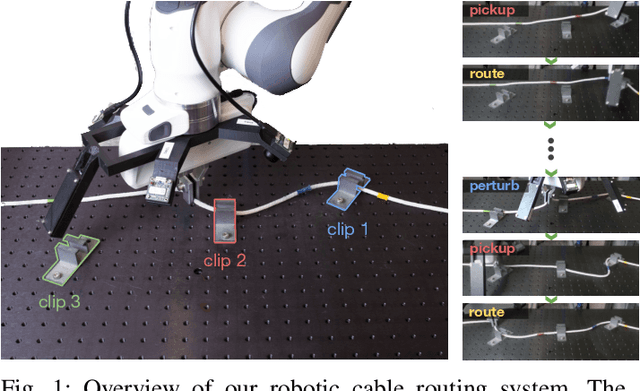
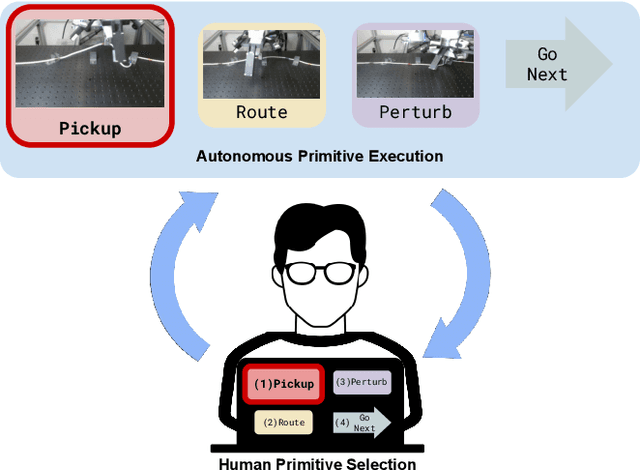
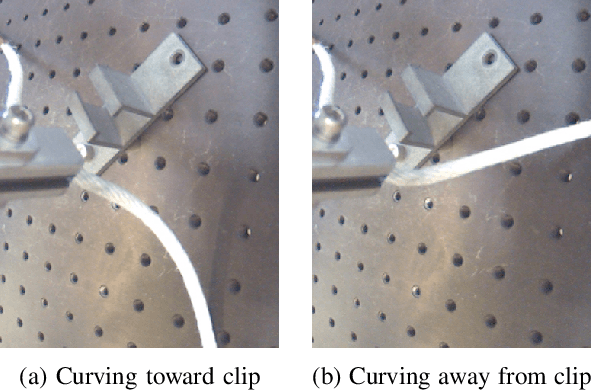
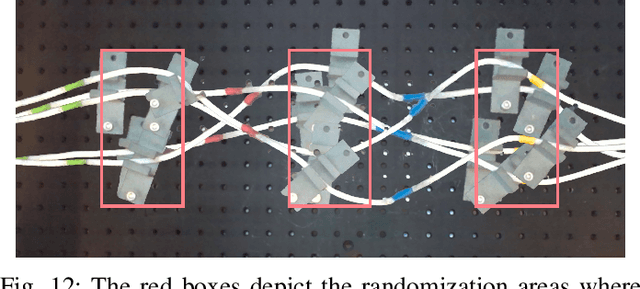
We study the problem of learning to perform multi-stage robotic manipulation tasks, with applications to cable routing, where the robot must route a cable through a series of clips. This setting presents challenges representative of complex multi-stage robotic manipulation scenarios: handling deformable objects, closing the loop on visual perception, and handling extended behaviors consisting of multiple steps that must be executed successfully to complete the entire task. In such settings, learning individual primitives for each stage that succeed with a high enough rate to perform a complete temporally extended task is impractical: if each stage must be completed successfully and has a non-negligible probability of failure, the likelihood of successful completion of the entire task becomes negligible. Therefore, successful controllers for such multi-stage tasks must be able to recover from failure and compensate for imperfections in low-level controllers by smartly choosing which controllers to trigger at any given time, retrying, or taking corrective action as needed. To this end, we describe an imitation learning system that uses vision-based policies trained from demonstrations at both the lower (motor control) and the upper (sequencing) level, present a system for instantiating this method to learn the cable routing task, and perform evaluations showing great performance in generalizing to very challenging clip placement variations. Supplementary videos, datasets, and code can be found at https://sites.google.com/view/cablerouting.
HIQL: Offline Goal-Conditioned RL with Latent States as Actions
Jul 22, 2023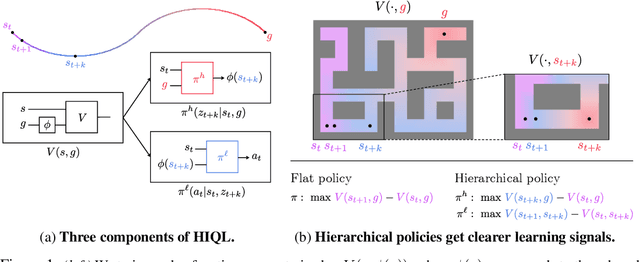
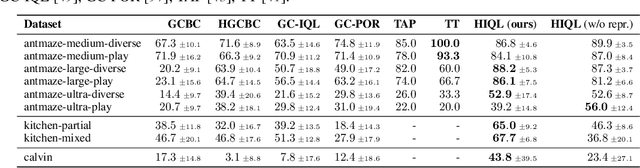
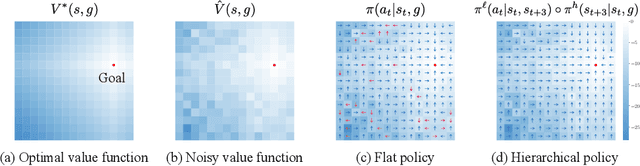
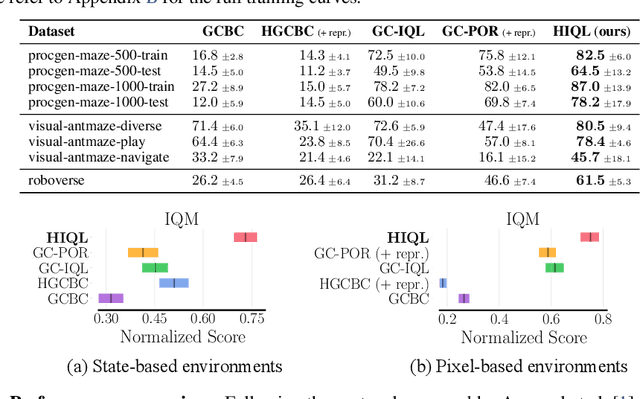
Unsupervised pre-training has recently become the bedrock for computer vision and natural language processing. In reinforcement learning (RL), goal-conditioned RL can potentially provide an analogous self-supervised approach for making use of large quantities of unlabeled (reward-free) data. However, building effective algorithms for goal-conditioned RL that can learn directly from diverse offline data is challenging, because it is hard to accurately estimate the exact value function for faraway goals. Nonetheless, goal-reaching problems exhibit structure, such that reaching distant goals entails first passing through closer subgoals. This structure can be very useful, as assessing the quality of actions for nearby goals is typically easier than for more distant goals. Based on this idea, we propose a hierarchical algorithm for goal-conditioned RL from offline data. Using one action-free value function, we learn two policies that allow us to exploit this structure: a high-level policy that treats states as actions and predicts (a latent representation of) a subgoal and a low-level policy that predicts the action for reaching this subgoal. Through analysis and didactic examples, we show how this hierarchical decomposition makes our method robust to noise in the estimated value function. We then apply our method to offline goal-reaching benchmarks, showing that our method can solve long-horizon tasks that stymie prior methods, can scale to high-dimensional image observations, and can readily make use of action-free data. Our code is available at https://seohong.me/projects/hiql/
Goal Representations for Instruction Following: A Semi-Supervised Language Interface to Control
Jun 30, 2023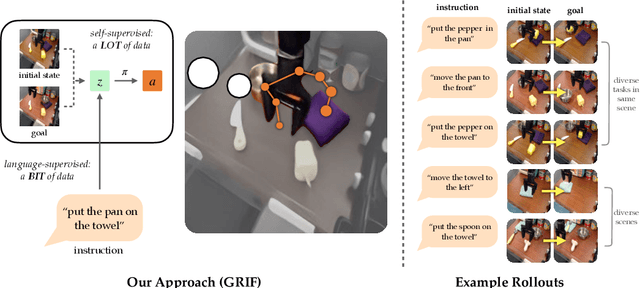
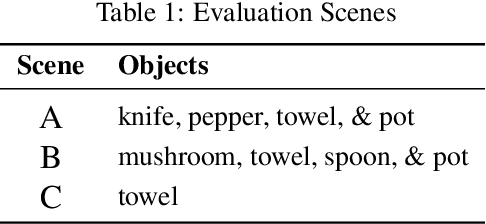
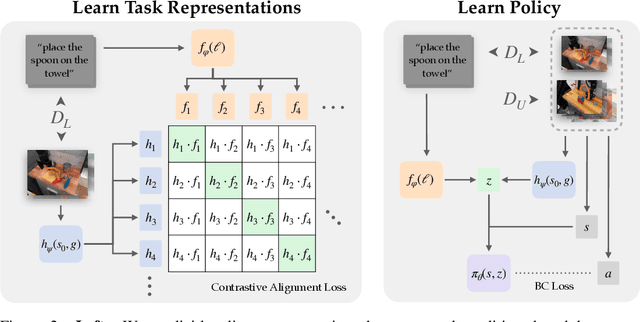
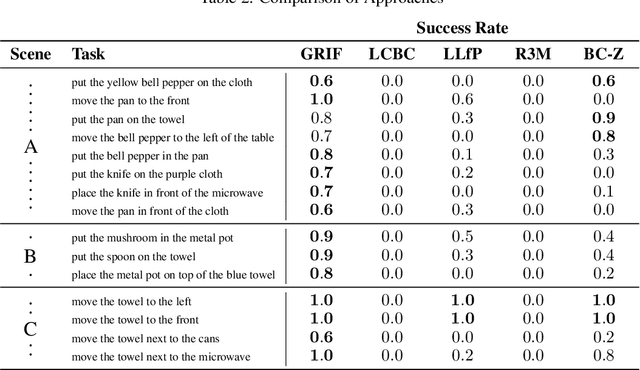
Our goal is for robots to follow natural language instructions like "put the towel next to the microwave." But getting large amounts of labeled data, i.e. data that contains demonstrations of tasks labeled with the language instruction, is prohibitive. In contrast, obtaining policies that respond to image goals is much easier, because any autonomous trial or demonstration can be labeled in hindsight with its final state as the goal. In this work, we contribute a method that taps into joint image- and goal- conditioned policies with language using only a small amount of language data. Prior work has made progress on this using vision-language models or by jointly training language-goal-conditioned policies, but so far neither method has scaled effectively to real-world robot tasks without significant human annotation. Our method achieves robust performance in the real world by learning an embedding from the labeled data that aligns language not to the goal image, but rather to the desired change between the start and goal images that the instruction corresponds to. We then train a policy on this embedding: the policy benefits from all the unlabeled data, but the aligned embedding provides an interface for language to steer the policy. We show instruction following across a variety of manipulation tasks in different scenes, with generalization to language instructions outside of the labeled data. Videos and code for our approach can be found on our website: http://tiny.cc/grif .
ViNT: A Foundation Model for Visual Navigation
Jun 26, 2023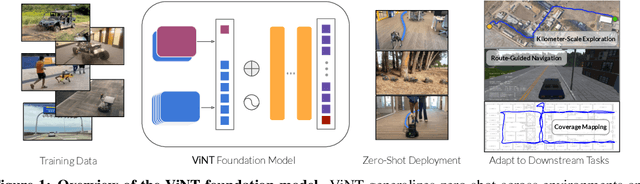
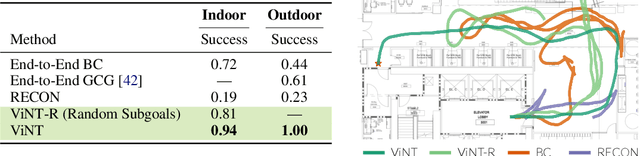
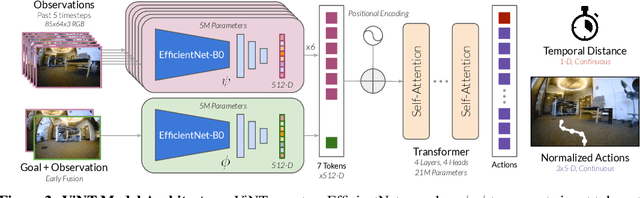

General-purpose pre-trained models ("foundation models") have enabled practitioners to produce generalizable solutions for individual machine learning problems with datasets that are significantly smaller than those required for learning from scratch. Such models are typically trained on large and diverse datasets with weak supervision, consuming much more training data than is available for any individual downstream application. In this paper, we describe the Visual Navigation Transformer (ViNT), a foundation model that aims to bring the success of general-purpose pre-trained models to vision-based robotic navigation. ViNT is trained with a general goal-reaching objective that can be used with any navigation dataset, and employs a flexible Transformer-based architecture to learn navigational affordances and enable efficient adaptation to a variety of downstream navigational tasks. ViNT is trained on a number of existing navigation datasets, comprising hundreds of hours of robotic navigation from a variety of different robotic platforms, and exhibits positive transfer, outperforming specialist models trained on singular datasets. ViNT can be augmented with diffusion-based subgoal proposals to explore novel environments, and can solve kilometer-scale navigation problems when equipped with long-range heuristics. ViNT can also be adapted to novel task specifications with a technique inspired by prompt-tuning, where the goal encoder is replaced by an encoding of another task modality (e.g., GPS waypoints or routing commands) embedded into the same space of goal tokens. This flexibility and ability to accommodate a variety of downstream problem domains establishes ViNT as an effective foundation model for mobile robotics. For videos, code, and model checkpoints, see our project page at https://visualnav-transformer.github.io.
Confidence-Based Model Selection: When to Take Shortcuts for Subpopulation Shifts
Jun 19, 2023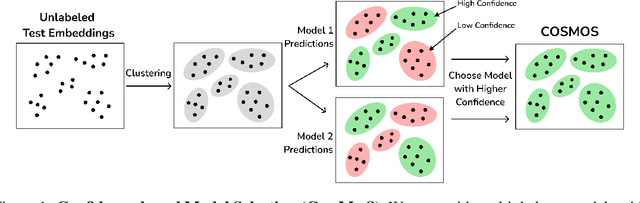

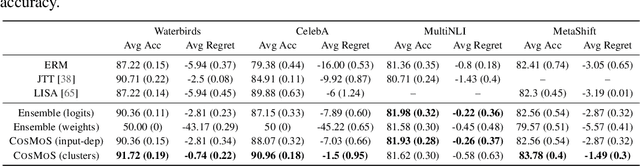
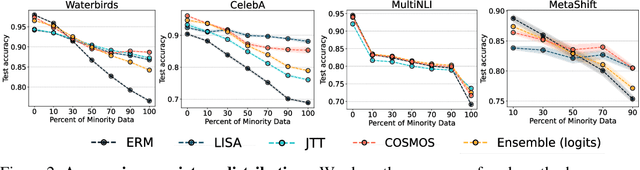
Effective machine learning models learn both robust features that directly determine the outcome of interest (e.g., an object with wheels is more likely to be a car), and shortcut features (e.g., an object on a road is more likely to be a car). The latter can be a source of error under distributional shift, when the correlations change at test-time. The prevailing sentiment in the robustness literature is to avoid such correlative shortcut features and learn robust predictors. However, while robust predictors perform better on worst-case distributional shifts, they often sacrifice accuracy on majority subpopulations. In this paper, we argue that shortcut features should not be entirely discarded. Instead, if we can identify the subpopulation to which an input belongs, we can adaptively choose among models with different strengths to achieve high performance on both majority and minority subpopulations. We propose COnfidence-baSed MOdel Selection (CosMoS), where we observe that model confidence can effectively guide model selection. Notably, CosMoS does not require any target labels or group annotations, either of which may be difficult to obtain or unavailable. We evaluate CosMoS on four datasets with spurious correlations, each with multiple test sets with varying levels of data distribution shift. We find that CosMoS achieves 2-5% lower average regret across all subpopulations, compared to using only robust predictors or other model aggregation methods.