 Add to Chrome
 Add to Firefox
 Add to Edge
ExpRL: Exploratory RL for LLM Mid-Training
Jun 15, 2026
Sparse reward reinforcement learning (RL) has become a standard tool for improving LLM reasoning, but its success depends critically on the coverage present in the base model. In practice, models are often primed for RL through \emph{mid-training} on curated reasoning traces that teach useful primitive skills such as decomposition, verification, or self-correction. Although effective, this strategy requires manually specifying what the model should learn, and it remains unclear whether such primitive coverage is enough for much harder problems, which require combining these skills into broader solution strategies. We study a more automated approach: \emph{RL-based mid-training} using large corpora of human-written question-answer data. Rather than treating reference solutions as targets to imitate, our method, ExpRL, uses them as \emph{reward scaffolds}: references are hidden from the policy and used only to construct problem-specific grading rubrics for judging on-policy reasoning traces. The policy samples from the original problem prompt, while an LLM judge compares the sampled reasoning trace against the reference solution and assigns outcome-level or process-level dense rewards. This lets ExpRL reinforce partial progress, useful intermediate reductions, and productive reasoning behaviors that sparse final-answer rewards often fail to upweight. On challenging math reasoning tasks, ExpRL yields stronger RL priming than SFT, sparse-reward GRPO, and self-distillation, and provides a better initialization for subsequent sparse-reward RL. Additional mixed-domain experiments further suggest that ExpRL can extend beyond the original math-only setting.

QED-Nano: Teaching a Tiny Model to Prove Hard Theorems
Apr 06, 2026Proprietary AI systems have recently demonstrated impressive capabilities on complex proof-based problems, with gold-level performance reported at the 2025 International Mathematical Olympiad (IMO). However, the training pipelines behind these systems remain largely undisclosed, and their reliance on large "internal" models and scaffolds makes them expensive to run, difficult to reproduce, and hard to study or improve upon. This raises a central question: can small, open models also be trained to achieve competitive reasoning performance on difficult Olympiad-level math? In this paper, we answer this question by building QED-Nano, a 4B model post-trained for Olympiad-level proofs. Our training recipe has three stages: (1) supervised fine-tuning to imbue good proof-writing styles by distilling from DeepSeek-Math-V2, (2) reinforcement learning (RL) with rubric-based rewards, and (3) expanding RL with a reasoning cache, which decomposes long proofs into iterative summarize-and-refine cycles and enables stronger test-time reasoning. QED-Nano surpasses the proof-generation performance of much larger open models, including Nomos-1 and GPT-OSS-120B, and approaches the performance of proprietary models like Gemini 3 Pro, at a fraction of the inference cost. To support further research on open mathematical reasoning, we release the full QED-Nano pipeline, including the QED-Nano and QED-Nano-SFT models, the FineProofs-SFT and FineProofs-RL datasets, and the training and evaluation code.
IsoCompute Playbook: Optimally Scaling Sampling Compute for LLM RL
Mar 12, 2026While scaling laws guide compute allocation for LLM pre-training, analogous prescriptions for reinforcement learning (RL) post-training of large language models (LLMs) remain poorly understood. We study the compute-optimal allocation of sampling compute for on-policy RL methods in LLMs, framing scaling as a compute-constrained optimization over three resources: parallel rollouts per problem, number of problems per batch, and number of update steps. We find that the compute-optimal number of parallel rollouts per problem increases predictably with compute budget and then saturates. This trend holds across both easy and hard problems, though driven by different mechanisms: solution sharpening on easy problems and coverage expansion on hard problems. We further show that increasing the number of parallel rollouts mitigates interference across problems, while the number of problems per batch primarily affects training stability and can be chosen within a broad range. Validated across base models and data distributions, our results recast RL scaling laws as prescriptive allocation rules and provide practical guidance for compute-efficient LLM RL post-training.
Reasoning Cache: Continual Improvement Over Long Horizons via Short-Horizon RL
Feb 03, 2026Large Language Models (LLMs) that can continually improve beyond their training budgets are able to solve increasingly difficult problems by adapting at test time, a property we refer to as extrapolation. However, standard reinforcement learning (RL) operates over fixed problem distributions and training budgets, which limits extrapolation amidst distribution shift at test time. To address this, we introduce RC, an iterative decoding algorithm that replaces standard autoregressive decoding during both training and inference. RC exploits an asymmetry between the response generation and summarization capabilities of LLMs to construct reasoning chains that consistently improve across iterations. Models trained to use RC can extrapolate and continually improve over reasoning horizons more than an order of magnitude longer than those seen during training. Empirically, training a 4B model with RC using a 16k-token training budget improves performance on HMMT 2025 from 40% to nearly 70% with 0.5m tokens at test time, outperforming both comparably sized models and many larger reasoning LLMs. Finally, we also show that models trained with RC can more effectively leverage existing scaffolds to further scale test-time performance, due to the improved summary-conditioned generation abilities learned through training.
Reuse your FLOPs: Scaling RL on Hard Problems by Conditioning on Very Off-Policy Prefixes
Jan 26, 2026Typical reinforcement learning (RL) methods for LLM reasoning waste compute on hard problems, where correct on-policy traces are rare, policy gradients vanish, and learning stalls. To bootstrap more efficient RL, we consider reusing old sampling FLOPs (from prior inference or RL training) in the form of off-policy traces. Standard off-policy methods supervise against off-policy data, causing instabilities during RL optimization. We introduce PrefixRL, where we condition on the prefix of successful off-policy traces and run on-policy RL to complete them, side-stepping off-policy instabilities. PrefixRL boosts the learning signal on hard problems by modulating the difficulty of the problem through the off-policy prefix length. We prove that the PrefixRL objective is not only consistent with the standard RL objective but also more sample efficient. Empirically, we discover back-generalization: training only on prefixed problems generalizes to out-of-distribution unprefixed performance, with learned strategies often differing from those in the prefix. In our experiments, we source the off-policy traces by rejection sampling with the base model, creating a self-improvement loop. On hard reasoning problems, PrefixRL reaches the same training reward 2x faster than the strongest baseline (SFT on off-policy data then RL), even after accounting for the compute spent on the initial rejection sampling, and increases the final reward by 3x. The gains transfer to held-out benchmarks, and PrefixRL is still effective when off-policy traces are derived from a different model family, validating its flexibility in practical settings.
POPE: Learning to Reason on Hard Problems via Privileged On-Policy Exploration
Jan 26, 2026Reinforcement learning (RL) has improved the reasoning abilities of large language models (LLMs), yet state-of-the-art methods still fail to learn on many training problems. On hard problems, on-policy RL rarely explores even a single correct rollout, yielding zero reward and no learning signal for driving improvement. We find that natural solutions to remedy this exploration problem from classical RL, such as entropy bonuses, more permissive clipping of the importance ratio, or direct optimization of pass@k objectives, do not resolve this issue and often destabilize optimization without improving solvability. A natural alternative is to leverage transfer from easier problems. However, we show that mixing easy and hard problems during RL training is counterproductive due to ray interference, where optimization focuses on already-solvable problems in a way that actively inhibits progress on harder ones. To address this challenge, we introduce Privileged On-Policy Exploration (POPE), an approach that leverages human- or other oracle solutions as privileged information to guide exploration on hard problems, unlike methods that use oracle solutions as training targets (e.g., off-policy RL methods or warmstarting from SFT). POPE augments hard problems with prefixes of oracle solutions, enabling RL to obtain non-zero rewards during guided rollouts. Crucially, the resulting behaviors transfer back to the original, unguided problems through a synergy between instruction-following and reasoning. Empirically, POPE expands the set of solvable problems and substantially improves performance on challenging reasoning benchmarks.
InT: Self-Proposed Interventions Enable Credit Assignment in LLM Reasoning
Jan 20, 2026Outcome-reward reinforcement learning (RL) has proven effective at improving the reasoning capabilities of large language models (LLMs). However, standard RL assigns credit only at the level of the final answer, penalizing entire reasoning traces when the outcome is incorrect and uniformly reinforcing all steps when it is correct. As a result, correct intermediate steps may be discouraged in failed traces, while spurious steps may be reinforced in successful ones. We refer to this failure mode as the problem of credit assignment. While a natural remedy is to train a process reward model, accurately optimizing such models to identify corrective reasoning steps remains challenging. We introduce Intervention Training (InT), a training paradigm in which the model performs fine-grained credit assignment on its own reasoning traces by proposing short, targeted corrections that steer trajectories toward higher reward. Using reference solutions commonly available in mathematical reasoning datasets and exploiting the fact that verifying a model-generated solution is easier than generating a correct one from scratch, the model identifies the first error in its reasoning and proposes a single-step intervention to redirect the trajectory toward the correct solution. We then apply supervised fine-tuning (SFT) to the on-policy rollout up to the point of error concatenated with the intervention, localizing error to the specific step that caused failure. We show that the resulting model serves as a far better initialization for RL training. After running InT and subsequent fine-tuning with RL, we improve accuracy by nearly 14% over a 4B-parameter base model on IMO-AnswerBench, outperforming larger open-source models such as gpt-oss-20b.
RLAD: Training LLMs to Discover Abstractions for Solving Reasoning Problems
Oct 02, 2025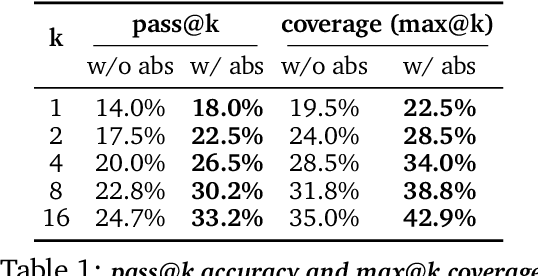
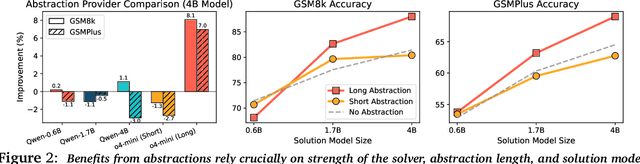
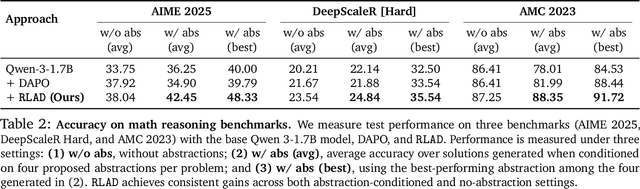
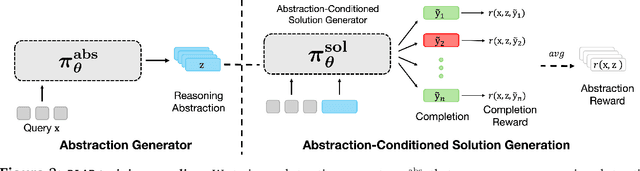
Reasoning requires going beyond pattern matching or memorization of solutions to identify and implement "algorithmic procedures" that can be used to deduce answers to hard problems. Doing so requires realizing the most relevant primitives, intermediate results, or shared procedures, and building upon them. While RL post-training on long chains of thought ultimately aims to uncover this kind of algorithmic behavior, most reasoning traces learned by large models fail to consistently capture or reuse procedures, instead drifting into verbose and degenerate exploration. To address more effective reasoning, we introduce reasoning abstractions: concise natural language descriptions of procedural and factual knowledge that guide the model toward learning successful reasoning. We train models to be capable of proposing multiple abstractions given a problem, followed by RL that incentivizes building a solution while using the information provided by these abstractions. This results in a two-player RL training paradigm, abbreviated as RLAD, that jointly trains an abstraction generator and a solution generator. This setup effectively enables structured exploration, decouples learning signals of abstraction proposal and solution generation, and improves generalization to harder problems. We also show that allocating more test-time compute to generating abstractions is more beneficial for performance than generating more solutions at large test budgets, illustrating the role of abstractions in guiding meaningful exploration.
Lower Bounds for Public-Private Learning under Distribution Shift
Jul 23, 2025The most effective differentially private machine learning algorithms in practice rely on an additional source of purportedly public data. This paradigm is most interesting when the two sources combine to be more than the sum of their parts. However, there are settings such as mean estimation where we have strong lower bounds, showing that when the two data sources have the same distribution, there is no complementary value to combining the two data sources. In this work we extend the known lower bounds for public-private learning to setting where the two data sources exhibit significant distribution shift. Our results apply to both Gaussian mean estimation where the two distributions have different means, and to Gaussian linear regression where the two distributions exhibit parameter shift. We find that when the shift is small (relative to the desired accuracy), either public or private data must be sufficiently abundant to estimate the private parameter. Conversely, when the shift is large, public data provides no benefit.
e3: Learning to Explore Enables Extrapolation of Test-Time Compute for LLMs
Jun 10, 2025Test-time scaling offers a promising path to improve LLM reasoning by utilizing more compute at inference time; however, the true promise of this paradigm lies in extrapolation (i.e., improvement in performance on hard problems as LLMs keep "thinking" for longer, beyond the maximum token budget they were trained on). Surprisingly, we find that most existing reasoning models do not extrapolate well. We show that one way to enable extrapolation is by training the LLM to perform in-context exploration: training the LLM to effectively spend its test time budget by chaining operations (such as generation, verification, refinement, etc.), or testing multiple hypotheses before it commits to an answer. To enable in-context exploration, we identify three key ingredients as part of our recipe e3: (1) chaining skills that the base LLM has asymmetric competence in, e.g., chaining verification (easy) with generation (hard), as a way to implement in-context search; (2) leveraging "negative" gradients from incorrect traces to amplify exploration during RL, resulting in longer search traces that chains additional asymmetries; and (3) coupling task difficulty with training token budget during training via a specifically-designed curriculum to structure in-context exploration. Our recipe e3 produces the best known 1.7B model according to AIME'25 and HMMT'25 scores, and extrapolates to 2x the training token budget. Our e3-1.7B model not only attains high pass@1 scores, but also improves pass@k over the base model.