 Add to Chrome
 Add to Firefox
 Add to Edge
Learning More from Less: Reinforcement Learning from Hindsight
Jul 10, 2026
Reinforcement learning (RL) is increasingly used to post-train vision-language-action (VLA) models, but every update consumes robot rollouts that are slow and costly to collect, making sample efficiency a central concern. Manipulation tasks typically provide only sparse rewards, so a weak policy fails almost every rollout early in training and has little to learn from, even when those failures execute coherent behavior. Such a failure, however, is a success at a different task. We present Learning from Hindsight (LfH), which brings hindsight relabeling to RL post-training of VLAs by scoring failed rollouts against the tasks they actually achieved. A single vision-language model relabels both the instruction and the reward, proposing a hindsight instruction for a group of failed rollouts and scoring how well each satisfies it, and the policy trains on the relabeled and original rollouts jointly. Because VLAs generalize across language, relabeling in language lets the policy learn more from the same trajectories. On out-of-distribution LIBERO-PRO tasks, where standard RL improves only slowly, LfH achieves $5\times$ improvement in sample efficiency, and outperforms a dense progress-reward baseline. The gains hold across VLA backbones and on a physical Franka robot.

Prompt-Driven Exploration
Jul 09, 2026Exploration is essential to RL since a policy cannot improve by repeatedly sampling the behaviors it already prefers. Standard methods inject stochasticity in the action space, but such jitter only yields rollouts close to the original. Escaping a weak policy often requires global perturbations that action noise cannot produce. Large language models (LLMs) and vision-language-action (VLA) models offer a pathway: they condition the policy on a natural language prompt, and since the rollout follows from it, modifying the prompt induces global changes. The challenge is finding prompts that induce useful global changes. With a weak policy that rarely succeeds, reward is too sparse to select on. Our idea is to refine prompts from the rollouts themselves: a vision-language model (VLM) reasons over the rollout video, diagnoses how the policy responded, and rewrites the prompt to elicit better behavior next time. This procedure realizes posterior sampling, a classical RL exploration framework, at the level of prompts: the VLM maintains an implicit distribution over useful prompts and updates it from observed rollouts. We call this strategy Prompt-Driven Exploration (PDE). Across manipulation and reasoning tasks, PDE enables RL to learn successful policies even from zero-reward starts, and improves sample efficiency more broadly. Our website is available at https://xinyunsunshine.github.io/prompt-rl.
ViNT: A Foundation Model for Visual Navigation
Jun 26, 2023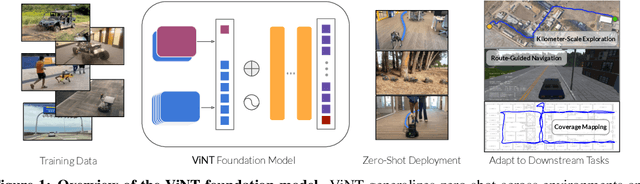
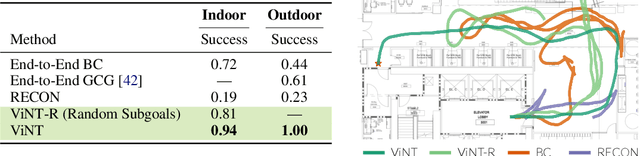
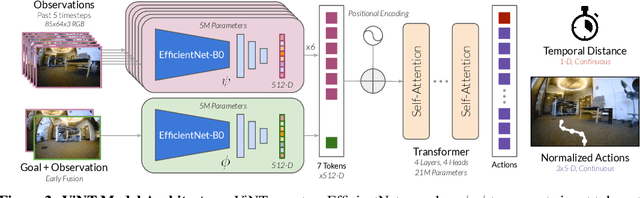

General-purpose pre-trained models ("foundation models") have enabled practitioners to produce generalizable solutions for individual machine learning problems with datasets that are significantly smaller than those required for learning from scratch. Such models are typically trained on large and diverse datasets with weak supervision, consuming much more training data than is available for any individual downstream application. In this paper, we describe the Visual Navigation Transformer (ViNT), a foundation model that aims to bring the success of general-purpose pre-trained models to vision-based robotic navigation. ViNT is trained with a general goal-reaching objective that can be used with any navigation dataset, and employs a flexible Transformer-based architecture to learn navigational affordances and enable efficient adaptation to a variety of downstream navigational tasks. ViNT is trained on a number of existing navigation datasets, comprising hundreds of hours of robotic navigation from a variety of different robotic platforms, and exhibits positive transfer, outperforming specialist models trained on singular datasets. ViNT can be augmented with diffusion-based subgoal proposals to explore novel environments, and can solve kilometer-scale navigation problems when equipped with long-range heuristics. ViNT can also be adapted to novel task specifications with a technique inspired by prompt-tuning, where the goal encoder is replaced by an encoding of another task modality (e.g., GPS waypoints or routing commands) embedded into the same space of goal tokens. This flexibility and ability to accommodate a variety of downstream problem domains establishes ViNT as an effective foundation model for mobile robotics. For videos, code, and model checkpoints, see our project page at https://visualnav-transformer.github.io.
Hybrid Imitative Planning with Geometric and Predictive Costs in Off-road Environments
Nov 22, 2021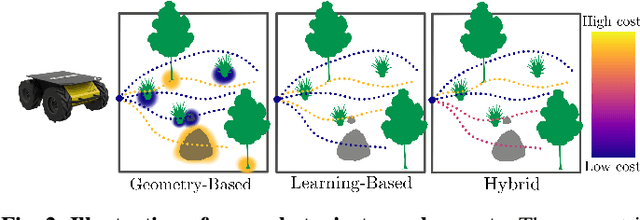
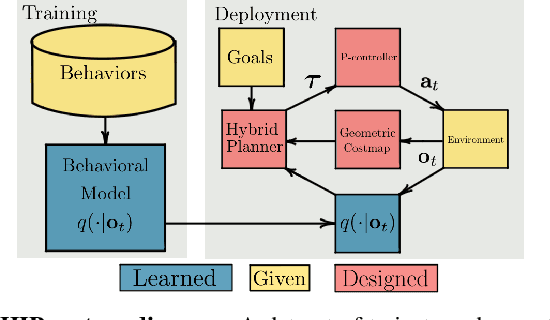
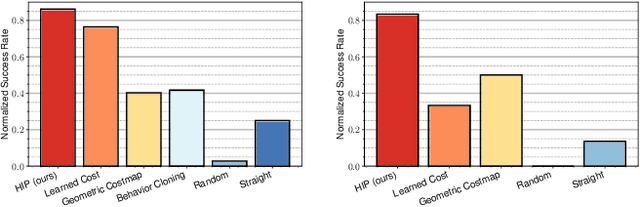
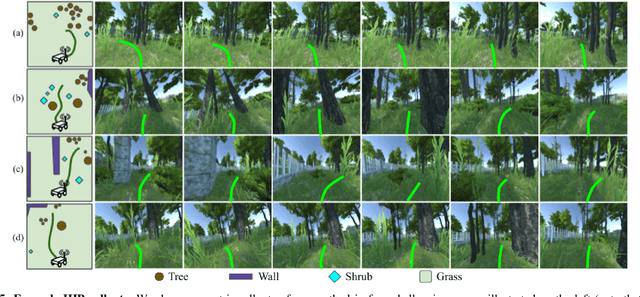
Geometric methods for solving open-world off-road navigation tasks, by learning occupancy and metric maps, provide good generalization but can be brittle in outdoor environments that violate their assumptions (e.g., tall grass). Learning-based methods can directly learn collision-free behavior from raw observations, but are difficult to integrate with standard geometry-based pipelines. This creates an unfortunate conflict -- either use learning and lose out on well-understood geometric navigational components, or do not use it, in favor of extensively hand-tuned geometry-based cost maps. In this work, we reject this dichotomy by designing the learning and non-learning-based components in a way such that they can be effectively combined in a self-supervised manner. Both components contribute to a planning criterion: the learned component contributes predicted traversability as rewards, while the geometric component contributes obstacle cost information. We instantiate and comparatively evaluate our system in both in-distribution and out-of-distribution environments, showing that this approach inherits complementary gains from the learned and geometric components and significantly outperforms either of them. Videos of our results are hosted at https://sites.google.com/view/hybrid-imitative-planning