 Add to Chrome
 Add to Firefox
 Add to Edge
The World is Your Canvas: Painting Promptable Events with Reference Images, Trajectories, and Text
Dec 18, 2025

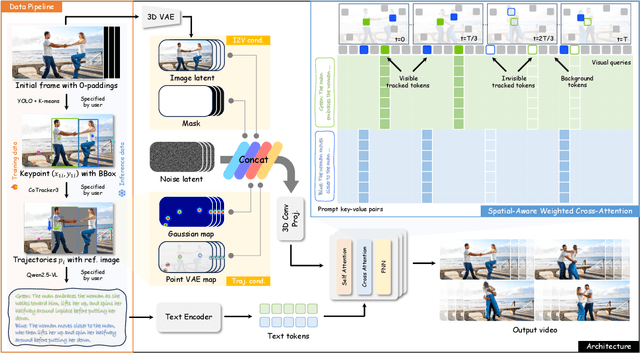
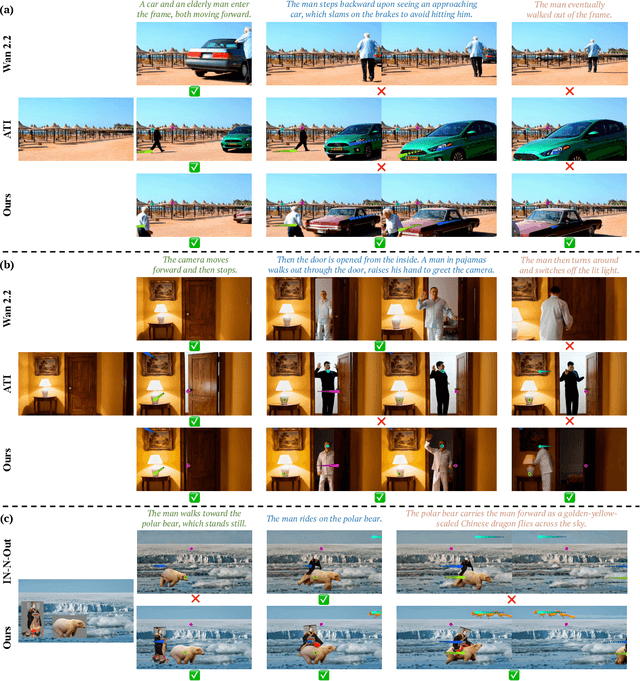
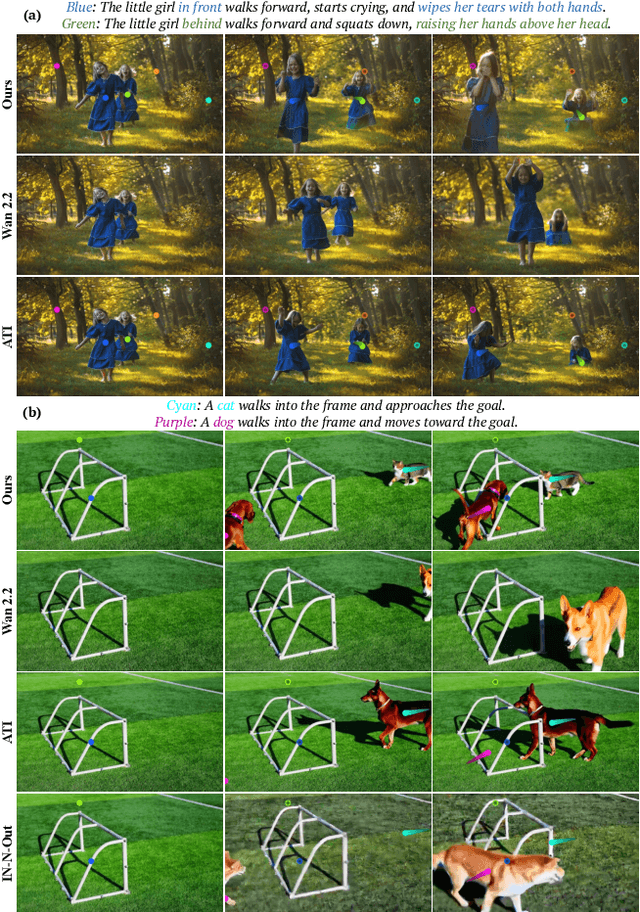
We present WorldCanvas, a framework for promptable world events that enables rich, user-directed simulation by combining text, trajectories, and reference images. Unlike text-only approaches and existing trajectory-controlled image-to-video methods, our multimodal approach combines trajectories -- encoding motion, timing, and visibility -- with natural language for semantic intent and reference images for visual grounding of object identity, enabling the generation of coherent, controllable events that include multi-agent interactions, object entry/exit, reference-guided appearance and counterintuitive events. The resulting videos demonstrate not only temporal coherence but also emergent consistency, preserving object identity and scene despite temporary disappearance. By supporting expressive world events generation, WorldCanvas advances world models from passive predictors to interactive, user-shaped simulators. Our project page is available at: https://worldcanvas.github.io/.

Structure From Tracking: Distilling Structure-Preserving Motion for Video Generation
Dec 12, 2025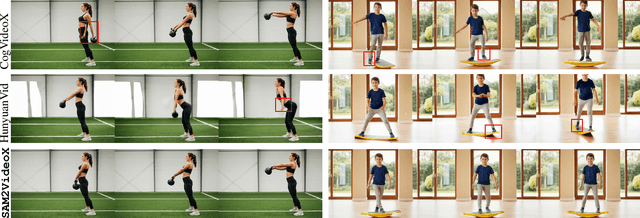
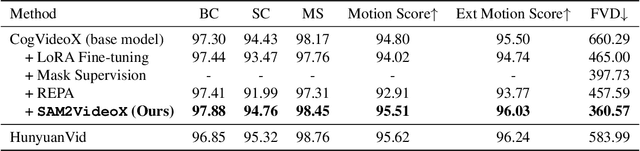
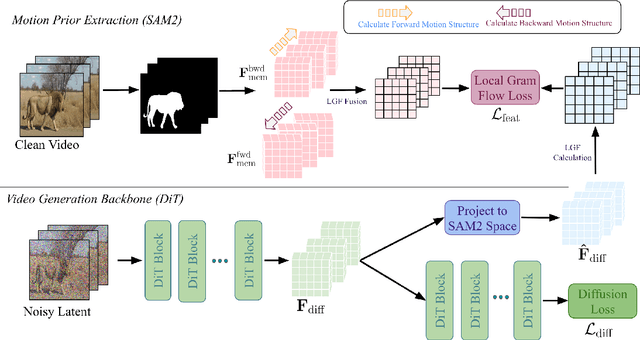
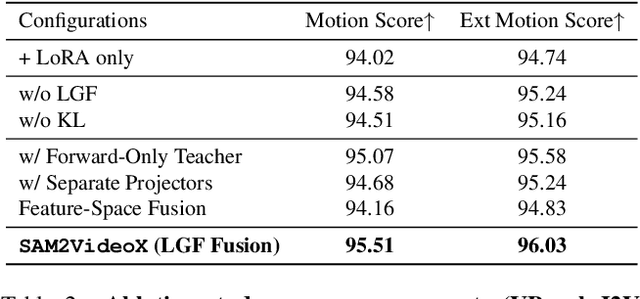
Reality is a dance between rigid constraints and deformable structures. For video models, that means generating motion that preserves fidelity as well as structure. Despite progress in diffusion models, producing realistic structure-preserving motion remains challenging, especially for articulated and deformable objects such as humans and animals. Scaling training data alone, so far, has failed to resolve physically implausible transitions. Existing approaches rely on conditioning with noisy motion representations, such as optical flow or skeletons extracted using an external imperfect model. To address these challenges, we introduce an algorithm to distill structure-preserving motion priors from an autoregressive video tracking model (SAM2) into a bidirectional video diffusion model (CogVideoX). With our method, we train SAM2VideoX, which contains two innovations: (1) a bidirectional feature fusion module that extracts global structure-preserving motion priors from a recurrent model like SAM2; (2) a Local Gram Flow loss that aligns how local features move together. Experiments on VBench and in human studies show that SAM2VideoX delivers consistent gains (+2.60\% on VBench, 21-22\% lower FVD, and 71.4\% human preference) over prior baselines. Specifically, on VBench, we achieve 95.51\%, surpassing REPA (92.91\%) by 2.60\%, and reduce FVD to 360.57, a 21.20\% and 22.46\% improvement over REPA- and LoRA-finetuning, respectively. The project website can be found at https://sam2videox.github.io/ .
Zero-shot Synthetic Video Realism Enhancement via Structure-aware Denoising
Nov 18, 2025We propose an approach to enhancing synthetic video realism, which can re-render synthetic videos from a simulator in photorealistic fashion. Our realism enhancement approach is a zero-shot framework that focuses on preserving the multi-level structures from synthetic videos into the enhanced one in both spatial and temporal domains, built upon a diffusion video foundational model without further fine-tuning. Specifically, we incorporate an effective modification to have the generation/denoising process conditioned on estimated structure-aware information from the synthetic video, such as depth maps, semantic maps, and edge maps, by an auxiliary model, rather than extracting the information from a simulator. This guidance ensures that the enhanced videos are consistent with the original synthetic video at both the structural and semantic levels. Our approach is a simple yet general and powerful approach to enhancing synthetic video realism: we show that our approach outperforms existing baselines in structural consistency with the original video while maintaining state-of-the-art photorealism quality in our experiments.
LiDAR-GS++:Improving LiDAR Gaussian Reconstruction via Diffusion Priors
Nov 15, 2025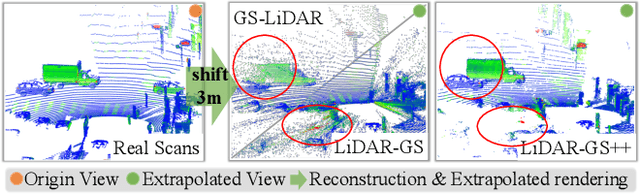
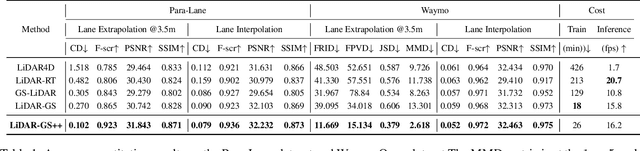
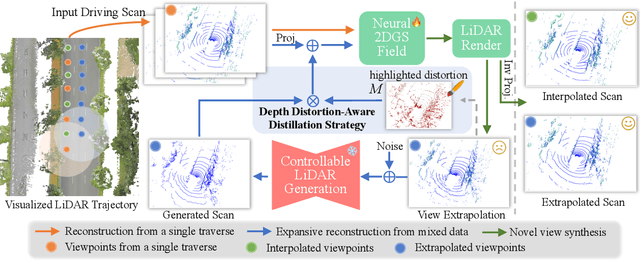
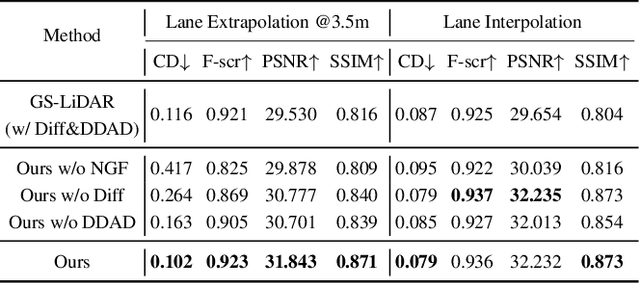
Recent GS-based rendering has made significant progress for LiDAR, surpassing Neural Radiance Fields (NeRF) in both quality and speed. However, these methods exhibit artifacts in extrapolated novel view synthesis due to the incomplete reconstruction from single traversal scans. To address this limitation, we present LiDAR-GS++, a LiDAR Gaussian Splatting reconstruction method enhanced by diffusion priors for real-time and high-fidelity re-simulation on public urban roads. Specifically, we introduce a controllable LiDAR generation model conditioned on coarsely extrapolated rendering to produce extra geometry-consistent scans and employ an effective distillation mechanism for expansive reconstruction. By extending reconstruction to under-fitted regions, our approach ensures global geometric consistency for extrapolative novel views while preserving detailed scene surfaces captured by sensors. Experiments on multiple public datasets demonstrate that LiDAR-GS++ achieves state-of-the-art performance for both interpolated and extrapolated viewpoints, surpassing existing GS and NeRF-based methods.
ScaleCUA: Scaling Open-Source Computer Use Agents with Cross-Platform Data
Sep 18, 2025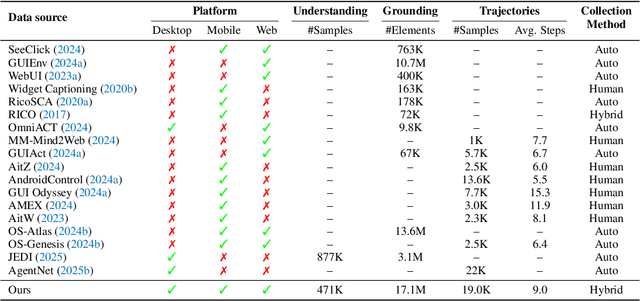
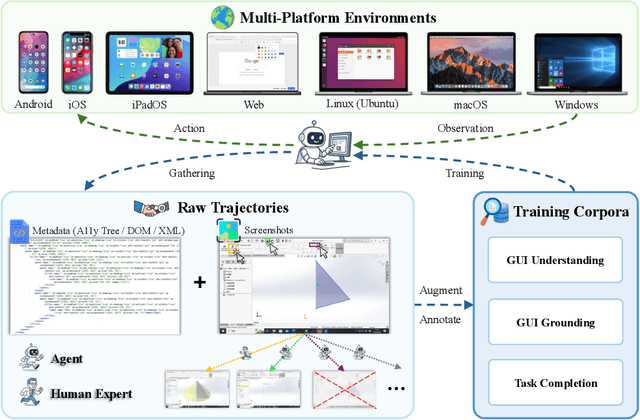
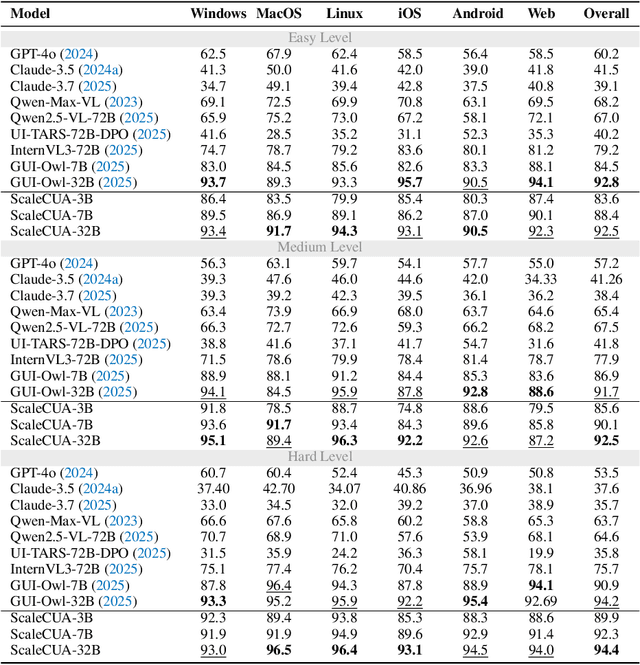
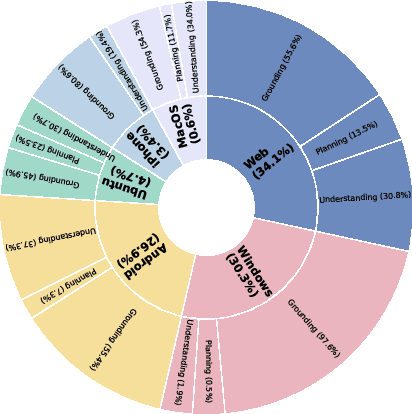
Vision-Language Models (VLMs) have enabled computer use agents (CUAs) that operate GUIs autonomously, showing great potential, yet progress is limited by the lack of large-scale, open-source computer use data and foundation models. In this work, we introduce ScaleCUA, a step toward scaling open-source CUAs. It offers a large-scale dataset spanning 6 operating systems and 3 task domains, built via a closed-loop pipeline uniting automated agents with human experts. Trained on this scaled-up data, ScaleCUA can operate seamlessly across platforms. Specifically, it delivers strong gains over baselines (+26.6 on WebArena-Lite-v2, +10.7 on ScreenSpot-Pro) and sets new state-of-the-art results (94.4% on MMBench-GUI L1-Hard, 60.6% on OSWorld-G, 47.4% on WebArena-Lite-v2). These findings underscore the power of data-driven scaling for general-purpose computer use agents. We will release data, models, and code to advance future research: https://github.com/OpenGVLab/ScaleCUA.
Follow-Your-Shape: Shape-Aware Image Editing via Trajectory-Guided Region Control
Aug 12, 2025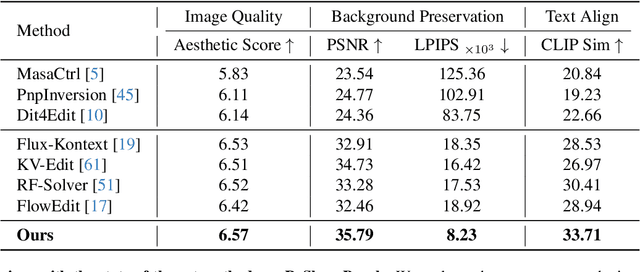
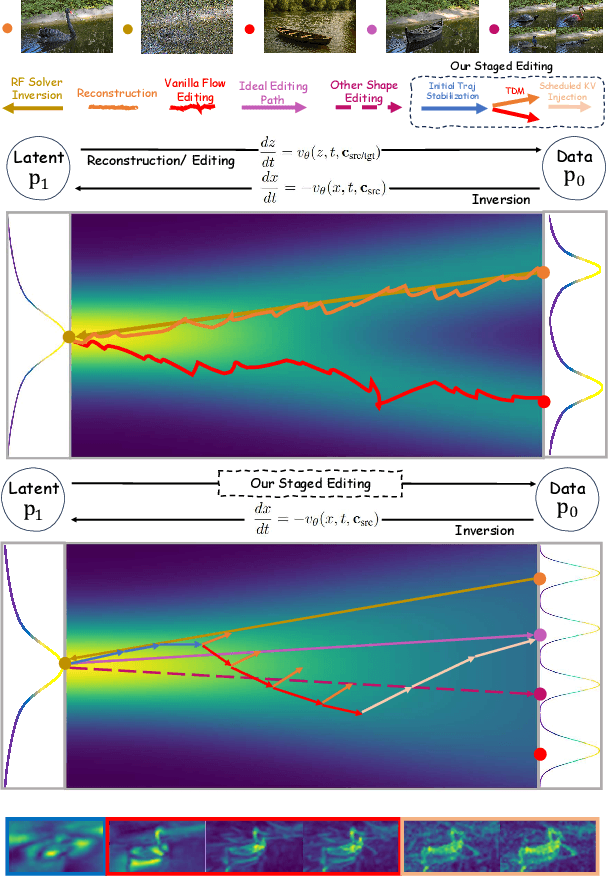
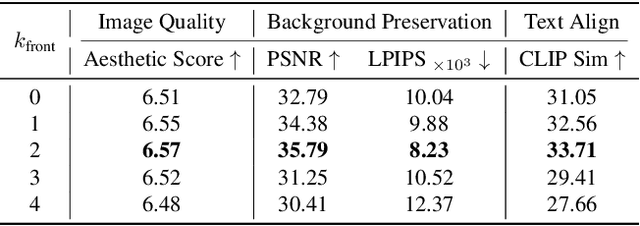
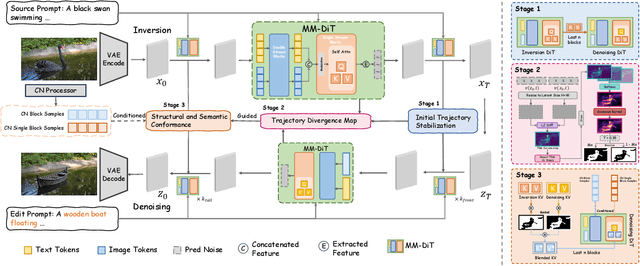
While recent flow-based image editing models demonstrate general-purpose capabilities across diverse tasks, they often struggle to specialize in challenging scenarios -- particularly those involving large-scale shape transformations. When performing such structural edits, these methods either fail to achieve the intended shape change or inadvertently alter non-target regions, resulting in degraded background quality. We propose Follow-Your-Shape, a training-free and mask-free framework that supports precise and controllable editing of object shapes while strictly preserving non-target content. Motivated by the divergence between inversion and editing trajectories, we compute a Trajectory Divergence Map (TDM) by comparing token-wise velocity differences between the inversion and denoising paths. The TDM enables precise localization of editable regions and guides a Scheduled KV Injection mechanism that ensures stable and faithful editing. To facilitate a rigorous evaluation, we introduce ReShapeBench, a new benchmark comprising 120 new images and enriched prompt pairs specifically curated for shape-aware editing. Experiments demonstrate that our method achieves superior editability and visual fidelity, particularly in tasks requiring large-scale shape replacement.
Follow-Your-Instruction: A Comprehensive MLLM Agent for World Data Synthesis
Aug 07, 2025With the growing demands of AI-generated content (AIGC), the need for high-quality, diverse, and scalable data has become increasingly crucial. However, collecting large-scale real-world data remains costly and time-consuming, hindering the development of downstream applications. While some works attempt to collect task-specific data via a rendering process, most approaches still rely on manual scene construction, limiting their scalability and accuracy. To address these challenges, we propose Follow-Your-Instruction, a Multimodal Large Language Model (MLLM)-driven framework for automatically synthesizing high-quality 2D, 3D, and 4D data. Our \textbf{Follow-Your-Instruction} first collects assets and their associated descriptions through multimodal inputs using the MLLM-Collector. Then it constructs 3D layouts, and leverages Vision-Language Models (VLMs) for semantic refinement through multi-view scenes with the MLLM-Generator and MLLM-Optimizer, respectively. Finally, it uses MLLM-Planner to generate temporally coherent future frames. We evaluate the quality of the generated data through comprehensive experiments on the 2D, 3D, and 4D generative tasks. The results show that our synthetic data significantly boosts the performance of existing baseline models, demonstrating Follow-Your-Instruction's potential as a scalable and effective data engine for generative intelligence.
SpA2V: Harnessing Spatial Auditory Cues for Audio-driven Spatially-aware Video Generation
Aug 01, 2025Audio-driven video generation aims to synthesize realistic videos that align with input audio recordings, akin to the human ability to visualize scenes from auditory input. However, existing approaches predominantly focus on exploring semantic information, such as the classes of sounding sources present in the audio, limiting their ability to generate videos with accurate content and spatial composition. In contrast, we humans can not only naturally identify the semantic categories of sounding sources but also determine their deeply encoded spatial attributes, including locations and movement directions. This useful information can be elucidated by considering specific spatial indicators derived from the inherent physical properties of sound, such as loudness or frequency. As prior methods largely ignore this factor, we present SpA2V, the first framework explicitly exploits these spatial auditory cues from audios to generate videos with high semantic and spatial correspondence. SpA2V decomposes the generation process into two stages: 1) Audio-guided Video Planning: We meticulously adapt a state-of-the-art MLLM for a novel task of harnessing spatial and semantic cues from input audio to construct Video Scene Layouts (VSLs). This serves as an intermediate representation to bridge the gap between the audio and video modalities. 2) Layout-grounded Video Generation: We develop an efficient and effective approach to seamlessly integrate VSLs as conditional guidance into pre-trained diffusion models, enabling VSL-grounded video generation in a training-free manner. Extensive experiments demonstrate that SpA2V excels in generating realistic videos with semantic and spatial alignment to the input audios.
LPO: Towards Accurate GUI Agent Interaction via Location Preference Optimization
Jun 11, 2025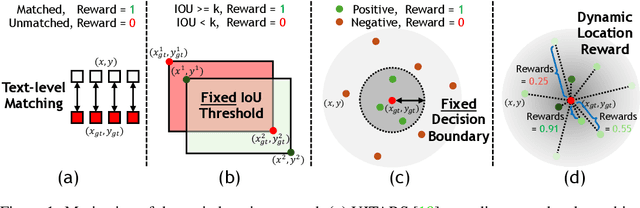
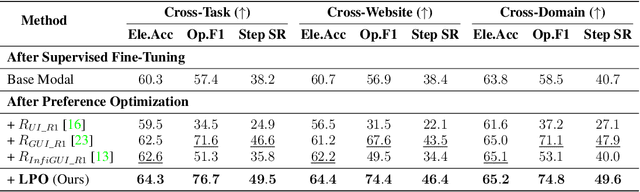

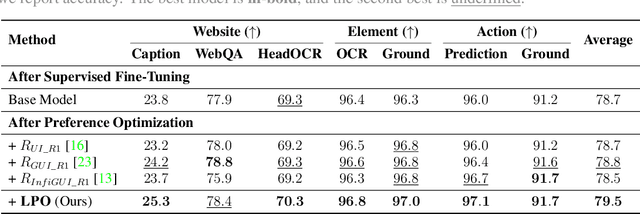
The advent of autonomous agents is transforming interactions with Graphical User Interfaces (GUIs) by employing natural language as a powerful intermediary. Despite the predominance of Supervised Fine-Tuning (SFT) methods in current GUI agents for achieving spatial localization, these methods face substantial challenges due to their limited capacity to accurately perceive positional data. Existing strategies, such as reinforcement learning, often fail to assess positional accuracy effectively, thereby restricting their utility. In response, we introduce Location Preference Optimization (LPO), a novel approach that leverages locational data to optimize interaction preferences. LPO uses information entropy to predict interaction positions by focusing on zones rich in information. Besides, it further introduces a dynamic location reward function based on physical distance, reflecting the varying importance of interaction positions. Supported by Group Relative Preference Optimization (GRPO), LPO facilitates an extensive exploration of GUI environments and significantly enhances interaction precision. Comprehensive experiments demonstrate LPO's superior performance, achieving SOTA results across both offline benchmarks and real-world online evaluations. Our code will be made publicly available soon, at https://github.com/AIDC-AI/LPO.
FullDiT2: Efficient In-Context Conditioning for Video Diffusion Transformers
Jun 05, 2025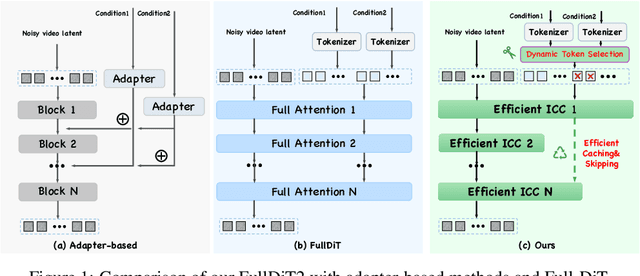
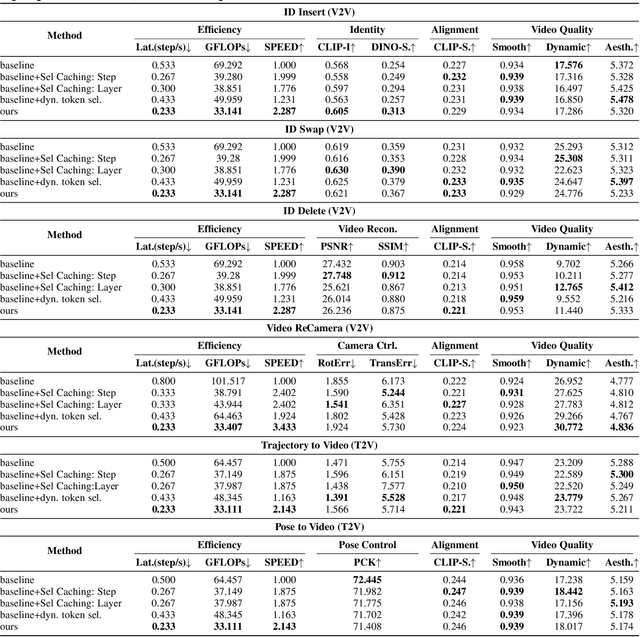
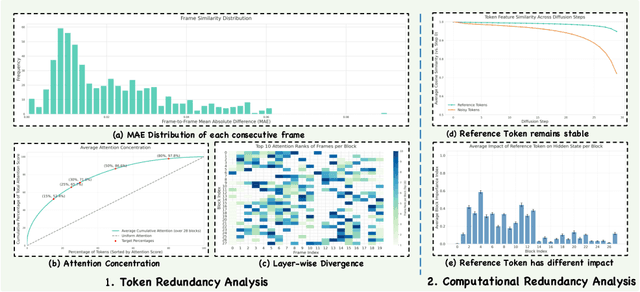
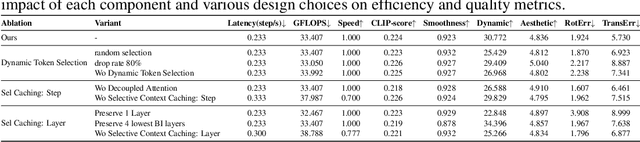
Fine-grained and efficient controllability on video diffusion transformers has raised increasing desires for the applicability. Recently, In-context Conditioning emerged as a powerful paradigm for unified conditional video generation, which enables diverse controls by concatenating varying context conditioning signals with noisy video latents into a long unified token sequence and jointly processing them via full-attention, e.g., FullDiT. Despite their effectiveness, these methods face quadratic computation overhead as task complexity increases, hindering practical deployment. In this paper, we study the efficiency bottleneck neglected in original in-context conditioning video generation framework. We begin with systematic analysis to identify two key sources of the computation inefficiencies: the inherent redundancy within context condition tokens and the computational redundancy in context-latent interactions throughout the diffusion process. Based on these insights, we propose FullDiT2, an efficient in-context conditioning framework for general controllability in both video generation and editing tasks, which innovates from two key perspectives. Firstly, to address the token redundancy, FullDiT2 leverages a dynamic token selection mechanism to adaptively identify important context tokens, reducing the sequence length for unified full-attention. Additionally, a selective context caching mechanism is devised to minimize redundant interactions between condition tokens and video latents. Extensive experiments on six diverse conditional video editing and generation tasks demonstrate that FullDiT2 achieves significant computation reduction and 2-3 times speedup in averaged time cost per diffusion step, with minimal degradation or even higher performance in video generation quality. The project page is at \href{https://fulldit2.github.io/}{https://fulldit2.github.io/}.