 Add to Chrome
 Add to Firefox
 Add to Edge
CameraAnything: Refilming Videos with Arbitrary Camera Control
Jul 27, 2026
We introduce CameraAnything, the first unified framework for camera controlled video editing that enables joint control of both intrinsic and extrinsic camera parameters. Existing approaches either rely on expensive 3D reconstruction to achieve full camera functionality or restrict editing to extrinsic parameter manipulation. Moreover, the coupled influence of intrinsic and extrinsic parameters on video appearance makes disentangled modeling particularly challenging. To address this, we adopt per-pixel Plücker ray injection alongside resolution-aware 3D RoPE in self-attention, building both camera conditioning and spatial positional encoding on the target latent to jointly control camera position, focal length, and native resolution editing without cropping or outpainting. To overcome the scarcity of paired training data, we further develop a scalable synthetic pipeline that constructs diverse dynamic scenes through structured multi-camera recording and generates synchronized videos with varied camera configurations. With a tailored orthogonal training strategy, CameraAnything enables expressive video reshooting with arbitrary viewpoint control, focal length adjustment, resolution adaptation, and multi-shot transitions within a single generation process, offering strong practical value for cinematic video editing and cross-platform content adaptation in video production.

WorldDirector: Building Controllable World Simulators with Persistent Dynamic Memory
Jul 02, 2026We present WorldDirector, a highly controllable video world model framework designed for persistent dynamic object memory and unrestricted viewpoint exploration. Unlike existing world models that entangle physical dynamics with pixel rendering and rely on continuous visual observation to sustain motion, our framework explicitly decouples semantic motion orchestration from visual generation. By leveraging an LLM to coordinate 3D trajectories with camera movements and subsequently employing these orchestrated trajectories as control signals for video generation, our approach ensures strict physical logic and appearance stability, successfully preserving the exact visual identities of dynamic entities even when they re-enter the scene after prolonged periods out of view. Experimental results demonstrate that our method supports the synthesis of complex and extended events with unprecedented controllability and persistent dynamic object memory. Project Page: https://worlddirector.github.io/
CausalCine: Real-Time Autoregressive Generation for Multi-Shot Video Narratives
May 12, 2026Autoregressive video generation aims at real-time, open-ended synthesis. Yet, cinematic storytelling is not merely the endless extension of a single scene; it requires progressing through evolving events, viewpoint shifts, and discrete shot boundaries. Existing autoregressive models often struggle in this setting. Trained primarily for short-horizon continuation, they treat long sequences as extended single shots, inevitably suffering from motion stagnation and semantic drift during long rollouts. To bridge this gap, we introduce CausalCine, an interactive autoregressive framework that transforms multi-shot video generation into an online directing process. CausalCine generates causally across shot changes, accepts dynamic prompts on the fly, and reuses context without regenerating previous shots. To achieve this, we first train a causal base model on native multi-shot sequences to learn complex shot transitions prior to acceleration. We then propose Content-Aware Memory Routing (CAMR), which dynamically retrieves historical KV entries according to attention-based relevance scores rather than temporal proximity, preserving cross-shot coherence under bounded active memory. Finally, we distill the causal base model into a few-step generator for real-time interactive generation. Extensive experiments demonstrate that CausalCine significantly outperforms autoregressive baselines and approaches the capability of bidirectional models while unlocking the streaming interactivity of causal generation. Demo available at https://yihao-meng.github.io/CausalCine/
ControlFoley: Unified and Controllable Video-to-Audio Generation with Cross-Modal Conflict Handling
Apr 16, 2026Recent advances in video-to-audio (V2A) generation enable high-quality audio synthesis from visual content, yet achieving robust and fine-grained controllability remains challenging. Existing methods suffer from weak textual controllability under visual-text conflict and imprecise stylistic control due to entangled temporal and timbre information in reference audio. Moreover, the lack of standardized benchmarks limits systematic evaluation. We propose ControlFoley, a unified multimodal V2A framework that enables precise control over video, text, and reference audio. We introduce a joint visual encoding paradigm that integrates CLIP with a spatio-temporal audio-visual encoder to improve alignment and textual controllability. We further propose temporal-timbre decoupling to suppress redundant temporal cues while preserving discriminative timbre features. In addition, we design a modality-robust training scheme with unified multimodal representation alignment (REPA) and random modality dropout. We also present VGGSound-TVC, a benchmark for evaluating textual controllability under varying degrees of visual-text conflict. Extensive experiments demonstrate state-of-the-art performance across multiple V2A tasks, including text-guided, text-controlled, and audio-controlled generation. ControlFoley achieves superior controllability under cross-modal conflict while maintaining strong synchronization and audio quality, and shows competitive or better performance compared to an industrial V2A system. Code, models, datasets, and demos are available at: https://yjx-research.github.io/ControlFoley/.
Advancing Open-source World Models
Jan 28, 2026We present LingBot-World, an open-sourced world simulator stemming from video generation. Positioned as a top-tier world model, LingBot-World offers the following features. (1) It maintains high fidelity and robust dynamics in a broad spectrum of environments, including realism, scientific contexts, cartoon styles, and beyond. (2) It enables a minute-level horizon while preserving contextual consistency over time, which is also known as "long-term memory". (3) It supports real-time interactivity, achieving a latency of under 1 second when producing 16 frames per second. We provide public access to the code and model in an effort to narrow the divide between open-source and closed-source technologies. We believe our release will empower the community with practical applications across areas like content creation, gaming, and robot learning.
TimeColor: Flexible Reference Colorization via Temporal Concatenation
Jan 01, 2026Most colorization models condition only on a single reference, typically the first frame of the scene. However, this approach ignores other sources of conditional data, such as character sheets, background images, or arbitrary colorized frames. We propose TimeColor, a sketch-based video colorization model that supports heterogeneous, variable-count references with the use of explicit per-reference region assignment. TimeColor encodes references as additional latent frames which are concatenated temporally, permitting them to be processed concurrently in each diffusion step while keeping the model's parameter count fixed. TimeColor also uses spatiotemporal correspondence-masked attention to enforce subject-reference binding in addition to modality-disjoint RoPE indexing. These mechanisms mitigate shortcutting and cross-identity palette leakage. Experiments on SAKUGA-42M under both single- and multi-reference protocols show that TimeColor improves color fidelity, identity consistency, and temporal stability over prior baselines.
The World is Your Canvas: Painting Promptable Events with Reference Images, Trajectories, and Text
Dec 18, 2025
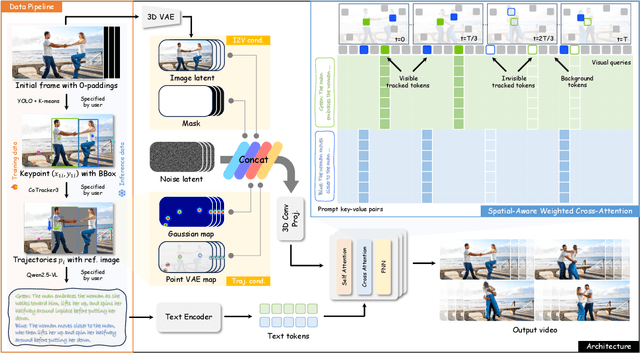
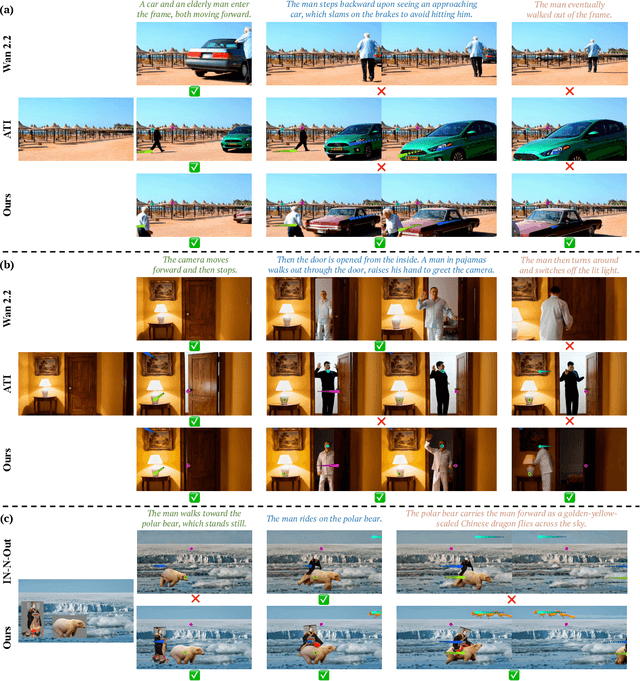
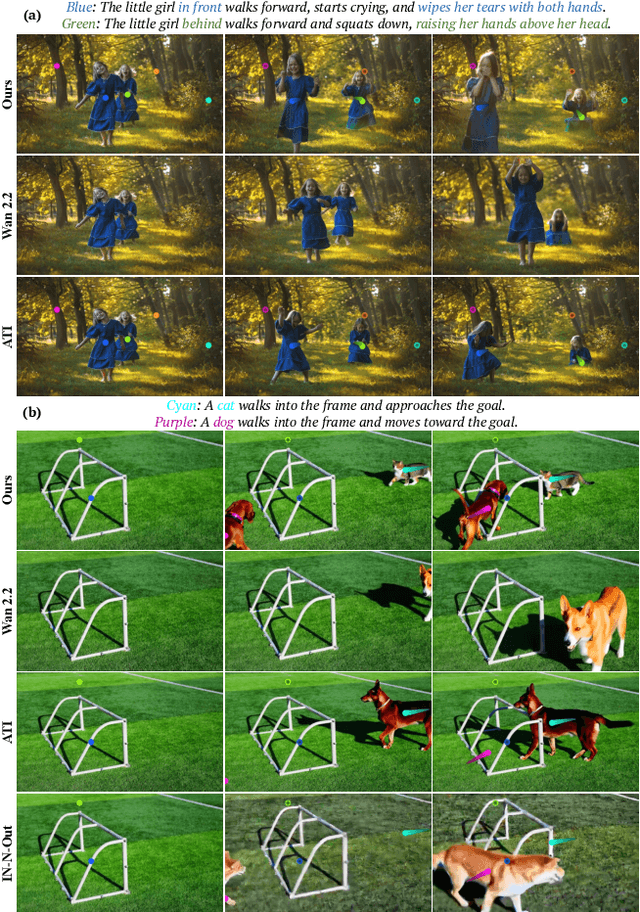
We present WorldCanvas, a framework for promptable world events that enables rich, user-directed simulation by combining text, trajectories, and reference images. Unlike text-only approaches and existing trajectory-controlled image-to-video methods, our multimodal approach combines trajectories -- encoding motion, timing, and visibility -- with natural language for semantic intent and reference images for visual grounding of object identity, enabling the generation of coherent, controllable events that include multi-agent interactions, object entry/exit, reference-guided appearance and counterintuitive events. The resulting videos demonstrate not only temporal coherence but also emergent consistency, preserving object identity and scene despite temporary disappearance. By supporting expressive world events generation, WorldCanvas advances world models from passive predictors to interactive, user-shaped simulators. Our project page is available at: https://worldcanvas.github.io/.
HoloCine: Holistic Generation of Cinematic Multi-Shot Long Video Narratives
Oct 23, 2025State-of-the-art text-to-video models excel at generating isolated clips but fall short of creating the coherent, multi-shot narratives, which are the essence of storytelling. We bridge this "narrative gap" with HoloCine, a model that generates entire scenes holistically to ensure global consistency from the first shot to the last. Our architecture achieves precise directorial control through a Window Cross-Attention mechanism that localizes text prompts to specific shots, while a Sparse Inter-Shot Self-Attention pattern (dense within shots but sparse between them) ensures the efficiency required for minute-scale generation. Beyond setting a new state-of-the-art in narrative coherence, HoloCine develops remarkable emergent abilities: a persistent memory for characters and scenes, and an intuitive grasp of cinematic techniques. Our work marks a pivotal shift from clip synthesis towards automated filmmaking, making end-to-end cinematic creation a tangible future. Our code is available at: https://holo-cine.github.io/.
LongAnimation: Long Animation Generation with Dynamic Global-Local Memory
Jul 02, 2025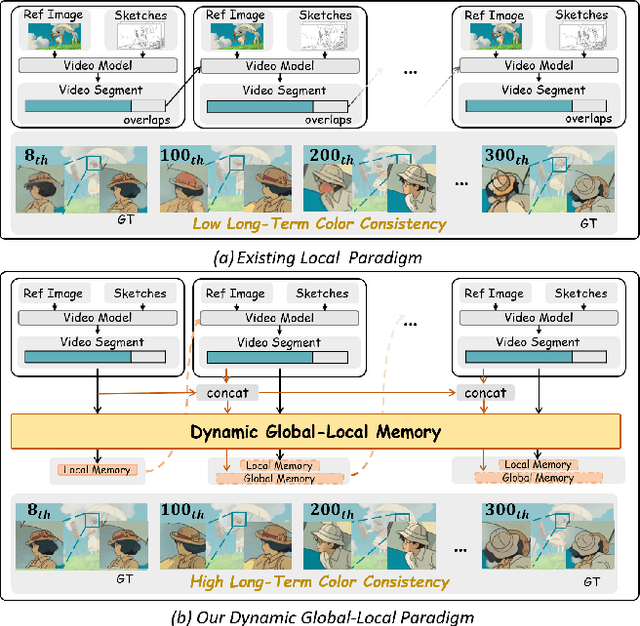

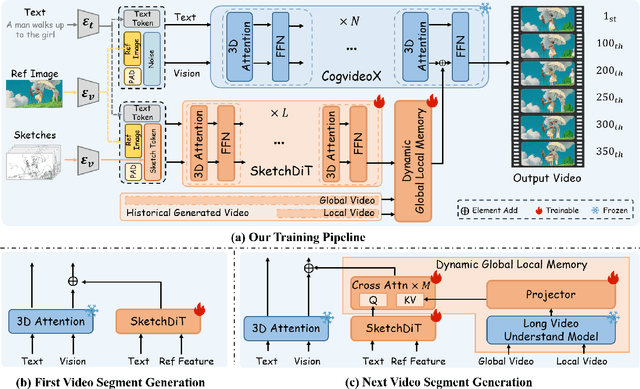
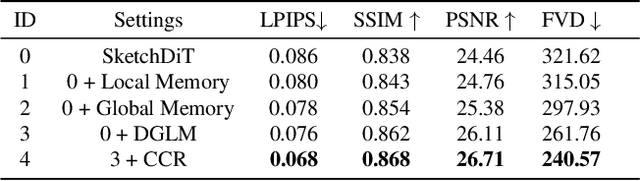
Animation colorization is a crucial part of real animation industry production. Long animation colorization has high labor costs. Therefore, automated long animation colorization based on the video generation model has significant research value. Existing studies are limited to short-term colorization. These studies adopt a local paradigm, fusing overlapping features to achieve smooth transitions between local segments. However, the local paradigm neglects global information, failing to maintain long-term color consistency. In this study, we argue that ideal long-term color consistency can be achieved through a dynamic global-local paradigm, i.e., dynamically extracting global color-consistent features relevant to the current generation. Specifically, we propose LongAnimation, a novel framework, which mainly includes a SketchDiT, a Dynamic Global-Local Memory (DGLM), and a Color Consistency Reward. The SketchDiT captures hybrid reference features to support the DGLM module. The DGLM module employs a long video understanding model to dynamically compress global historical features and adaptively fuse them with the current generation features. To refine the color consistency, we introduce a Color Consistency Reward. During inference, we propose a color consistency fusion to smooth the video segment transition. Extensive experiments on both short-term (14 frames) and long-term (average 500 frames) animations show the effectiveness of LongAnimation in maintaining short-term and long-term color consistency for open-domain animation colorization task. The code can be found at https://cn-makers.github.io/long_animation_web/.
AniDoc: Animation Creation Made Easier
Dec 18, 2024The production of 2D animation follows an industry-standard workflow, encompassing four essential stages: character design, keyframe animation, in-betweening, and coloring. Our research focuses on reducing the labor costs in the above process by harnessing the potential of increasingly powerful generative AI. Using video diffusion models as the foundation, AniDoc emerges as a video line art colorization tool, which automatically converts sketch sequences into colored animations following the reference character specification. Our model exploits correspondence matching as an explicit guidance, yielding strong robustness to the variations (e.g., posture) between the reference character and each line art frame. In addition, our model could even automate the in-betweening process, such that users can easily create a temporally consistent animation by simply providing a character image as well as the start and end sketches. Our code is available at: https://yihao-meng.github.io/AniDoc_demo.