 Add to Chrome
 Add to Firefox
 Add to Edge
Robust-U1: Can MLLMs Self-Recover Corrupted Visual Content for Robust Understanding?
Jun 06, 2026
Multimodal Large Language Models (MLLMs) have demonstrated remarkable success in visual understanding, yet their performance degrades significantly under real-world visual corruptions. While existing robustness enhancement approaches exist, they are limited: black-box feature alignment lacks interpretability, and white-box text-based reasoning cannot restore lost pixel-level details. This work investigates a fundamental research question: Can MLLMs recover corrupted visual content by themselves? To address this, we propose Robust-U1, a novel framework that equips MLLMs with explicit visual self-recovery capability for robust understanding. The approach comprises three core stages: supervised fine-tuning for initial reconstruction, reinforcement learning with dual rewards (pixel-level SSIM and semantic-level CLIP similarity) for aligning high visual quality, and multimodal reasoning that jointly considers both the corrupted input and the recovered image. Extensive experiments demonstrate that Robust-U1 achieves state-of-the-art robustness on the real-world corruption benchmark and maintains superior performance under adversarial corruptions on general VQA benchmarks. Analysis confirms that high-quality visual recovery directly enhances reasoning performance, establishing self-recovery as a critical mechanism for robust visual understanding. The source code is available at https://github.com/jqtangust/Robust-U1.

The Texture-Shape Dilemma: Boundary-Safe Synthetic Generation for 3D Medical Transformers
Mar 01, 2026Vision Transformers (ViTs) have revolutionized medical image analysis, yet their data-hungry nature clashes with the scarcity and privacy constraints of clinical archives. Formula-Driven Supervised Learning (FDSL) has emerged as a promising solution to this bottleneck, synthesizing infinite annotated samples from mathematical formulas without utilizing real patient data. However, existing FDSL paradigms rely on simple geometric shapes with homogeneous intensities, creating a substantial gap by neglecting tissue textures and noise patterns inherent in modalities like CT and MRI. In this paper, we identify a critical optimization conflict termed boundary aliasing: when high-frequency synthetic textures are naively added, they corrupt the image gradient signals necessary for learning structural boundaries, causing the model to fail in delineating real anatomical margins. To bridge this gap, we propose a novel Physics-inspired Spatially-Decoupled Synthesis framework. Our approach orthogonalizes the synthesis process: it first constructs a gradient-shielded buffer zone based on boundary distance to ensure stable shape learning, and subsequently injects physics-driven spectral textures into the object core. This design effectively reconciles robust shape representation learning with invariance to acquisition noise. Extensive experiments on the BTCV and MSD datasets demonstrate that our method significantly outperforms previous FDSL, as well as SSL methods trained on real-world medical datasets, by 1.43% on BTCV and up to 1.51% on MSD task, offering a scalable, annotation-free foundation for medical ViTs. The code will be made publicly available upon acceptance.
Fake It Right: Injecting Anatomical Logic into Synthetic Supervised Pre-training for Medical Segmentation
Mar 01, 2026Vision Transformers (ViTs) excel in 3D medical segmentation but require massive annotated datasets. While Self-Supervised Learning (SSL) mitigates this using unlabeled data, it still faces strict privacy and logistical barriers. Formula-Driven Supervised Learning (FDSL) offers a privacy-preserving alternative by pre-training on synthetic mathematical primitives. However, a critical semantic gap limits its efficacy: generic shapes lack the morphological fidelity, fixed spatial layouts, and inter-organ relationships of real anatomy, preventing models from learning essential global structural priors. To bridge this gap, we propose an Anatomy-Informed Synthetic Supervised Pre-training framework unifying FDSL's infinite scalability with anatomical realism. We replace basic primitives with a lightweight shape bank with de-identified, label-only segmentation masks from 5 subjects. Furthermore, we introduce a structure-aware sequential placement strategy to govern the patch synthesis process. Instead of random placement, we enforce physiological plausibility using spatial anchors for correct localization and a topological graph to manage inter-organ interactions (e.g., preventing impossible overlaps). Extensive experiments on BTCV and MSD datasets demonstrate that our method significantly outperforms state-of-the-art FDSL baselines and SSL methods by 1.74\% and up to 1.66\%, while exhibiting a robust scaling effect where performance improves with increased synthetic data volume. This provides a data-efficient, privacy-compliant solution for medical segmentation. The code will be made publicly available upon acceptance.
The Geometry of Transfer: Unlocking Medical Vision Manifolds for Training-Free Model Ranking
Feb 27, 2026The advent of large-scale self-supervised learning (SSL) has produced a vast zoo of medical foundation models. However, selecting optimal medical foundation models for specific segmentation tasks remains a computational bottleneck. Existing Transferability Estimation (TE) metrics, primarily designed for classification, rely on global statistical assumptions and fail to capture the topological complexity essential for dense prediction. We propose a novel Topology-Driven Transferability Estimation framework that evaluates manifold tractability rather than statistical overlap. Our approach introduces three components: (1) Global Representation Topology Divergence (GRTD), utilizing Minimum Spanning Trees to quantify feature-label structural isomorphism; (2) Local Boundary-Aware Topological Consistency (LBTC), which assesses manifold separability specifically at critical anatomical boundaries; and (3) Task-Adaptive Fusion, which dynamically integrates global and local metrics based on the semantic cardinality of the target task. Validated on the large-scale OpenMind benchmark across diverse anatomical targets and SSL foundation models, our approach significantly outperforms state-of-the-art baselines by around \textbf{31\%} relative improvement in the weighted Kendall, providing a robust, training-free proxy for efficient model selection without the cost of fine-tuning. The code will be made publicly available upon acceptance.
Adaptive Debiasing Tsallis Entropy for Test-Time Adaptation
Feb 12, 2026Mainstream Test-Time Adaptation (TTA) methods for adapting vision-language models, e.g., CLIP, typically rely on Shannon Entropy (SE) at test time to measure prediction uncertainty and inconsistency. However, since CLIP has a built-in bias from pretraining on highly imbalanced web-crawled data, SE inevitably results in producing biased estimates of uncertainty entropy. To address this issue, we notably find and demonstrate that Tsallis Entropy (TE), a generalized form of SE, is naturally suited for characterizing biased distributions by introducing a non-extensive parameter q, with the performance of SE serving as a lower bound for TE. Building upon this, we generalize TE into Adaptive Debiasing Tsallis Entropy (ADTE) for TTA, customizing a class-specific parameter q^l derived by normalizing the estimated label bias from continuously incoming test instances, for each category. This adaptive approach allows ADTE to accurately select high-confidence views and seamlessly integrate with a label adjustment strategy to enhance adaptation, without introducing distribution-specific hyperparameter tuning. Besides, our investigation reveals that both TE and ADTE can serve as direct, advanced alternatives to SE in TTA, without any other modifications. Experimental results show that ADTE outperforms state-of-the-art methods on ImageNet and its five variants, and achieves the highest average performance on 10 cross-domain benchmarks, regardless of the model architecture or text prompts used. Our code is available at https://github.com/Jinx630/ADTE.
LongVideoAgent: Multi-Agent Reasoning with Long Videos
Dec 23, 2025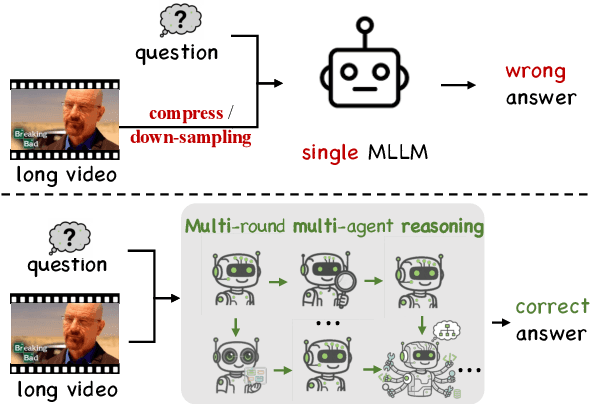
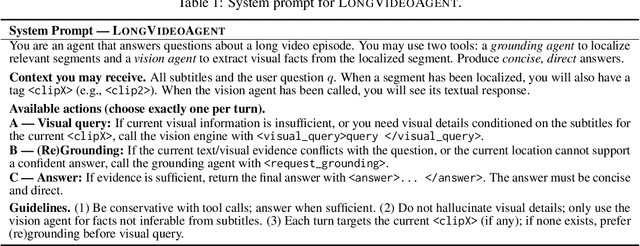
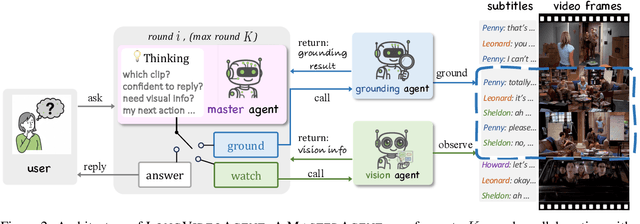
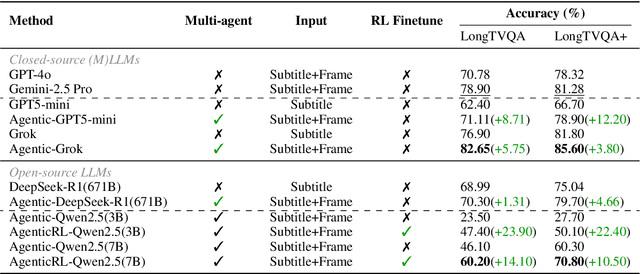
Recent advances in multimodal LLMs and systems that use tools for long-video QA point to the promise of reasoning over hour-long episodes. However, many methods still compress content into lossy summaries or rely on limited toolsets, weakening temporal grounding and missing fine-grained cues. We propose a multi-agent framework in which a master LLM coordinates a grounding agent to localize question-relevant segments and a vision agent to extract targeted textual observations. The master agent plans with a step limit, and is trained with reinforcement learning to encourage concise, correct, and efficient multi-agent cooperation. This design helps the master agent focus on relevant clips via grounding, complements subtitles with visual detail, and yields interpretable trajectories. On our proposed LongTVQA and LongTVQA+ which are episode-level datasets aggregated from TVQA/TVQA+, our multi-agent system significantly outperforms strong non-agent baselines. Experiments also show reinforcement learning further strengthens reasoning and planning for the trained agent. Code and data will be shared at https://longvideoagent.github.io/.
Robust-R1: Degradation-Aware Reasoning for Robust Visual Understanding
Dec 19, 2025Multimodal Large Language Models struggle to maintain reliable performance under extreme real-world visual degradations, which impede their practical robustness. Existing robust MLLMs predominantly rely on implicit training/adaptation that focuses solely on visual encoder generalization, suffering from limited interpretability and isolated optimization. To overcome these limitations, we propose Robust-R1, a novel framework that explicitly models visual degradations through structured reasoning chains. Our approach integrates: (i) supervised fine-tuning for degradation-aware reasoning foundations, (ii) reward-driven alignment for accurately perceiving degradation parameters, and (iii) dynamic reasoning depth scaling adapted to degradation intensity. To facilitate this approach, we introduce a specialized 11K dataset featuring realistic degradations synthesized across four critical real-world visual processing stages, each annotated with structured chains connecting degradation parameters, perceptual influence, pristine semantic reasoning chain, and conclusion. Comprehensive evaluations demonstrate state-of-the-art robustness: Robust-R1 outperforms all general and robust baselines on the real-world degradation benchmark R-Bench, while maintaining superior anti-degradation performance under multi-intensity adversarial degradations on MMMB, MMStar, and RealWorldQA.
ACE: Attribution-Controlled Knowledge Editing for Multi-hop Factual Recall
Oct 09, 2025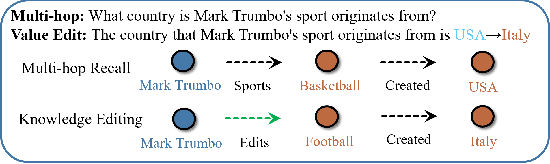
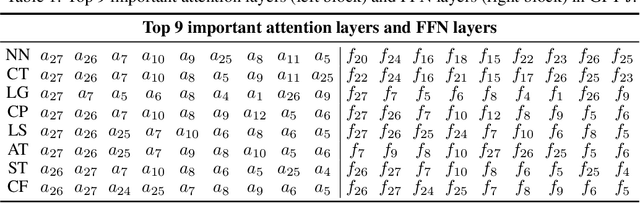
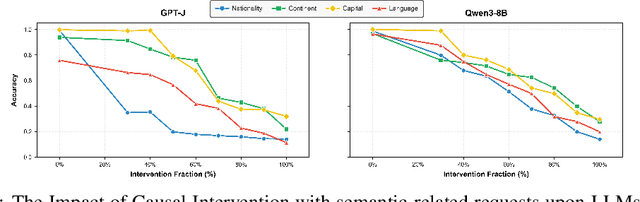
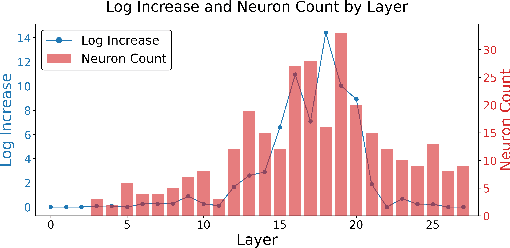
Large Language Models (LLMs) require efficient knowledge editing (KE) to update factual information, yet existing methods exhibit significant performance decay in multi-hop factual recall. This failure is particularly acute when edits involve intermediate implicit subjects within reasoning chains. Through causal analysis, we reveal that this limitation stems from an oversight of how chained knowledge is dynamically represented and utilized at the neuron level. We discover that during multi hop reasoning, implicit subjects function as query neurons, which sequentially activate corresponding value neurons across transformer layers to accumulate information toward the final answer, a dynamic prior KE work has overlooked. Guided by this insight, we propose ACE: Attribution-Controlled Knowledge Editing for Multi-hop Factual Recall, a framework that leverages neuron-level attribution to identify and edit these critical query-value (Q-V) pathways. ACE provides a mechanistically grounded solution for multi-hop KE, empirically outperforming state-of-the-art methods by 9.44% on GPT-J and 37.46% on Qwen3-8B. Our analysis further reveals more fine-grained activation patterns in Qwen3 and demonstrates that the semantic interpretability of value neurons is orchestrated by query-driven accumulation. These findings establish a new pathway for advancing KE capabilities based on the principled understanding of internal reasoning mechanisms.
LPO: Towards Accurate GUI Agent Interaction via Location Preference Optimization
Jun 11, 2025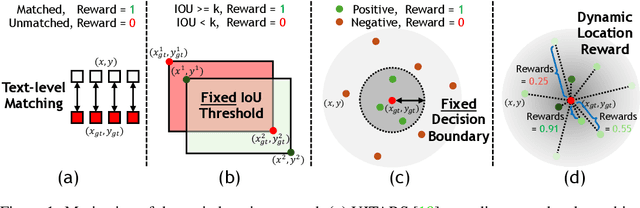
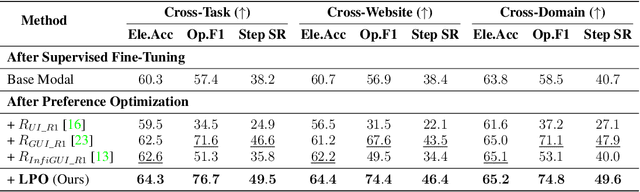
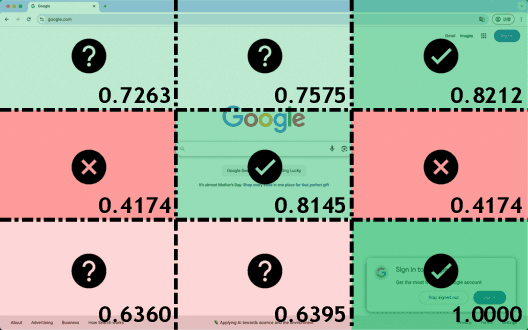
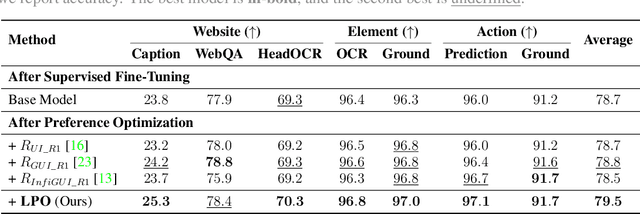
The advent of autonomous agents is transforming interactions with Graphical User Interfaces (GUIs) by employing natural language as a powerful intermediary. Despite the predominance of Supervised Fine-Tuning (SFT) methods in current GUI agents for achieving spatial localization, these methods face substantial challenges due to their limited capacity to accurately perceive positional data. Existing strategies, such as reinforcement learning, often fail to assess positional accuracy effectively, thereby restricting their utility. In response, we introduce Location Preference Optimization (LPO), a novel approach that leverages locational data to optimize interaction preferences. LPO uses information entropy to predict interaction positions by focusing on zones rich in information. Besides, it further introduces a dynamic location reward function based on physical distance, reflecting the varying importance of interaction positions. Supported by Group Relative Preference Optimization (GRPO), LPO facilitates an extensive exploration of GUI environments and significantly enhances interaction precision. Comprehensive experiments demonstrate LPO's superior performance, achieving SOTA results across both offline benchmarks and real-world online evaluations. Our code will be made publicly available soon, at https://github.com/AIDC-AI/LPO.
Sage Deer: A Super-Aligned Driving Generalist Is Your Copilot
May 15, 2025The intelligent driving cockpit, an important part of intelligent driving, needs to match different users' comfort, interaction, and safety needs. This paper aims to build a Super-Aligned and GEneralist DRiving agent, SAGE DeeR. Sage Deer achieves three highlights: (1) Super alignment: It achieves different reactions according to different people's preferences and biases. (2) Generalist: It can understand the multi-view and multi-mode inputs to reason the user's physiological indicators, facial emotions, hand movements, body movements, driving scenarios, and behavioral decisions. (3) Self-Eliciting: It can elicit implicit thought chains in the language space to further increase generalist and super-aligned abilities. Besides, we collected multiple data sets and built a large-scale benchmark. This benchmark measures the deer's perceptual decision-making ability and the super alignment's accuracy.