 Add to Chrome
 Add to Firefox
 Add to Edge
Multi-Agent Forensic Reasoning for Generalizable Deepfake Video Detection
Aug 07, 2026
The malicious use of generative artificial intelligence to create highly realistic deepfake videos raises serious ethical concerns and poses substantial challenges to AI safety. However, existing deepfake video benchmarks provide limited coverage of recent synthesis methods and generally lack reliable fine-grained textual annotations. Meanwhile, conventional detectors and multimodal large language models (MLLMs), whether operating as a single model or relying on a single analytical perspective, often fail to capture subtle forgery artifacts, limiting their generalization to emerging AI-generated methods. To address these limitations, we introduce FaceVid-Forensics-100K, a large-scale deepfake video dataset comprising 100,000 videos and spanning 33 synthesis methods across face swapping, face reenactment, and entire-face synthesis, including recent generators such as Seedance 2.0. The dataset provides fine-grained textual annotations of visual observations and verdict-consistent forensic explanations, automatically synthesized through a multi-model aggregation and conflict-resolution pipeline powered by advanced MLLMs. Building on this benchmark, we propose a multi-agent forensic reasoning framework that employs four specialized domain-expert agents to independently analyze forgery cues from four perspectives: texture, lighting, motion, and physics. A judge agent then reconciles their reports to produce a final prediction together with an explanation. Extensive evaluations on out-of-domain test sets show that, despite being composed entirely of small open-source MLLMs, our framework outperforms all methods including closed-source GPT and Gemini models and ranks first across all reported metrics on this benchmark. The project page is available at https://xavierjiezou.github.io/ARGUS/.

OvisOCR2 Technical Report
Jul 15, 2026We introduce OvisOCR2, a 0.8B document parsing model. OvisOCR2 is designed as an end-to-end parser: given a document page image, it generates a Markdown representation in natural reading order, covering text, formulas, tables, and visual regions. We build a data engine that combines filtered real-document annotations with synthetic pages whose rendered images and Markdown targets are derived from the same HTML source. The training recipe includes supervised fine-tuning, reinforcement learning on a 4B branch with a multi-component reward design, on-policy distillation into the 0.8B model, and model fusion. On OmniDocBench v1.6, OvisOCR2 achieves a state-of-the-art overall score of 96.58, placing an end-to-end model at the top of this leaderboard previously dominated by pipeline methods and highlighting the potential of end-to-end document parsing. On PureDocBench, OvisOCR2 also achieves the highest Avg3 score of 75.06. Beyond these two public benchmarks, we evaluate OvisOCR2 on an in-house benchmark designed to cover a broader set of long-tail and challenging scenarios. OvisOCR2 obtains the best overall performance among the compared methods, providing further evidence of its generalization and robustness. OvisOCR2 is available at https://huggingface.co/ATH-MaaS/OvisOCR2.
Posterior Optimization with Clipped Objective for Bridging Efficiency and Stability in Generative Policy Learning
Apr 02, 2026Expressive generative models have advanced robotic manipulation by capturing complex, multi-modal action distributions over temporally extended trajectories. However, fine-tuning these policies via RL remains challenging due to instability and sample inefficiency. We introduce Posterior Optimization with Clipped Objective (POCO), a principled RL framework that formulates policy improvement as a posterior inference problem tailored for temporal action chunks. Through an Expectation-Maximization procedure, POCO distills a reward-weighted implicit posterior into the policy without likelihood estimation. Furthermore, POCO adopts an offline-to-online paradigm that anchors online exploration to pre-trained priors, and its model-agnostic design scales to fine-tune large VLA models without architectural modifications. Evaluations across 7 simulation benchmarks and 4 contact-rich real-world tasks demonstrate that POCO prevents catastrophic policy collapse, outperforms SOTA baselines, and achieves a 96.7% success rate on real-world tasks. Videos are available at our project website https://cccedric.github.io/poco/.
WoVR: World Models as Reliable Simulators for Post-Training VLA Policies with RL
Feb 15, 2026Reinforcement learning (RL) promises to unlock capabilities beyond imitation learning for Vision-Language-Action (VLA) models, but its requirement for massive real-world interaction prevents direct deployment on physical robots. Recent work attempts to use learned world models as simulators for policy optimization, yet closed-loop imagined rollouts inevitably suffer from hallucination and long-horizon error accumulation. Such errors do not merely degrade visual fidelity; they corrupt the optimization signal, encouraging policies to exploit model inaccuracies rather than genuine task progress. We propose WoVR, a reliable world-model-based reinforcement learning framework for post-training VLA policies. Instead of assuming a faithful world model, WoVR explicitly regulates how RL interacts with imperfect imagined dynamics. It improves rollout stability through a controllable action-conditioned video world model, reshapes imagined interaction to reduce effective error depth via Keyframe-Initialized Rollouts, and maintains policy-simulator alignment through World Model-Policy co-evolution. Extensive experiments on LIBERO benchmarks and real-world robotic manipulation demonstrate that WoVR enables stable long-horizon imagined rollouts and effective policy optimization, improving average LIBERO success from 39.95% to 69.2% (+29.3 points) and real-robot success from 61.7% to 91.7% (+30.0 points). These results show that learned world models can serve as practical simulators for reinforcement learning when hallucination is explicitly controlled.
Dual-Granularity Contrastive Reward via Generated Episodic Guidance for Efficient Embodied RL
Feb 13, 2026Designing suitable rewards poses a significant challenge in reinforcement learning (RL), especially for embodied manipulation. Trajectory success rewards are suitable for human judges or model fitting, but the sparsity severely limits RL sample efficiency. While recent methods have effectively improved RL via dense rewards, they rely heavily on high-quality human-annotated data or abundant expert supervision. To tackle these issues, this paper proposes Dual-granularity contrastive reward via generated Episodic Guidance (DEG), a novel framework to seek sample-efficient dense rewards without requiring human annotations or extensive supervision. Leveraging the prior knowledge of large video generation models, DEG only needs a small number of expert videos for domain adaptation to generate dedicated task guidance for each RL episode. Then, the proposed dual-granularity reward that balances coarse-grained exploration and fine-grained matching, will guide the agent to efficiently approximate the generated guidance video sequentially in the contrastive self-supervised latent space, and finally complete the target task. Extensive experiments on 18 diverse tasks across both simulation and real-world settings show that DEG can not only serve as an efficient exploration stimulus to help the agent quickly discover sparse success rewards, but also guide effective RL and stable policy convergence independently.
Towards Long-Lived Robots: Continual Learning VLA Models via Reinforcement Fine-Tuning
Feb 11, 2026Pretrained on large-scale and diverse datasets, VLA models demonstrate strong generalization and adaptability as general-purpose robotic policies. However, Supervised Fine-Tuning (SFT), which serves as the primary mechanism for adapting VLAs to downstream domains, requires substantial amounts of task-specific data and is prone to catastrophic forgetting. To address these limitations, we propose LifeLong-RFT, a simple yet effective Reinforcement Fine-Tuning (RFT) strategy for VLA models independent of online environmental feedback and pre-trained reward models. By integrating chunking-level on-policy reinforcement learning with the proposed Multi-Dimensional Process Reward (MDPR) mechanism, LifeLong-RFT quantifies the heterogeneous contributions of intermediate action chunks across three dimensions to facilitate policy optimization. Specifically, (1) the Quantized Action Consistency Reward (QACR) ensures accurate action prediction within the discrete action space; (2) the Continuous Trajectory Alignment Reward (CTAR) aligns decoded continuous action chunks with reference trajectories to ensure precise control; (3) the Format Compliance Reward (FCR) guarantees the structural validity of outputs. Comprehensive experiments across SimplerEnv, LIBERO, and real-world tasks demonstrate that LifeLong-RFT exhibits strong performance in multi-task learning. Furthermore, for continual learning on the LIBERO benchmark, our method achieves a 22% gain in average success rate over SFT, while effectively adapting to new tasks using only 20% of the training data. Overall, our method provides a promising post-training paradigm for VLAs.
Survey of Vision-Language-Action Models for Embodied Manipulation
Aug 21, 2025Embodied intelligence systems, which enhance agent capabilities through continuous environment interactions, have garnered significant attention from both academia and industry. Vision-Language-Action models, inspired by advancements in large foundation models, serve as universal robotic control frameworks that substantially improve agent-environment interaction capabilities in embodied intelligence systems. This expansion has broadened application scenarios for embodied AI robots. This survey comprehensively reviews VLA models for embodied manipulation. Firstly, it chronicles the developmental trajectory of VLA architectures. Subsequently, we conduct a detailed analysis of current research across 5 critical dimensions: VLA model structures, training datasets, pre-training methods, post-training methods, and model evaluation. Finally, we synthesize key challenges in VLA development and real-world deployment, while outlining promising future research directions.
LPO: Towards Accurate GUI Agent Interaction via Location Preference Optimization
Jun 11, 2025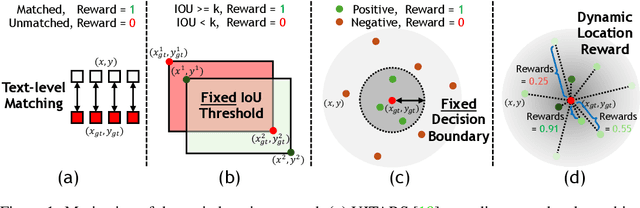
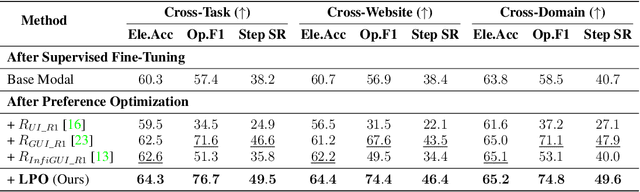
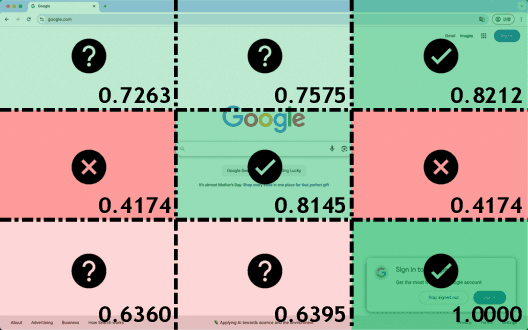
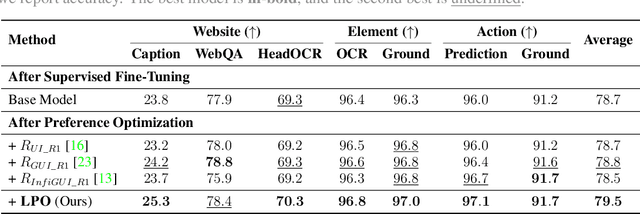
The advent of autonomous agents is transforming interactions with Graphical User Interfaces (GUIs) by employing natural language as a powerful intermediary. Despite the predominance of Supervised Fine-Tuning (SFT) methods in current GUI agents for achieving spatial localization, these methods face substantial challenges due to their limited capacity to accurately perceive positional data. Existing strategies, such as reinforcement learning, often fail to assess positional accuracy effectively, thereby restricting their utility. In response, we introduce Location Preference Optimization (LPO), a novel approach that leverages locational data to optimize interaction preferences. LPO uses information entropy to predict interaction positions by focusing on zones rich in information. Besides, it further introduces a dynamic location reward function based on physical distance, reflecting the varying importance of interaction positions. Supported by Group Relative Preference Optimization (GRPO), LPO facilitates an extensive exploration of GUI environments and significantly enhances interaction precision. Comprehensive experiments demonstrate LPO's superior performance, achieving SOTA results across both offline benchmarks and real-world online evaluations. Our code will be made publicly available soon, at https://github.com/AIDC-AI/LPO.
TeViR: Text-to-Video Reward with Diffusion Models for Efficient Reinforcement Learning
May 26, 2025Developing scalable and generalizable reward engineering for reinforcement learning (RL) is crucial for creating general-purpose agents, especially in the challenging domain of robotic manipulation. While recent advances in reward engineering with Vision-Language Models (VLMs) have shown promise, their sparse reward nature significantly limits sample efficiency. This paper introduces TeViR, a novel method that leverages a pre-trained text-to-video diffusion model to generate dense rewards by comparing the predicted image sequence with current observations. Experimental results across 11 complex robotic tasks demonstrate that TeViR outperforms traditional methods leveraging sparse rewards and other state-of-the-art (SOTA) methods, achieving better sample efficiency and performance without ground truth environmental rewards. TeViR's ability to efficiently guide agents in complex environments highlights its potential to advance reinforcement learning applications in robotic manipulation.
ConRFT: A Reinforced Fine-tuning Method for VLA Models via Consistency Policy
Feb 08, 2025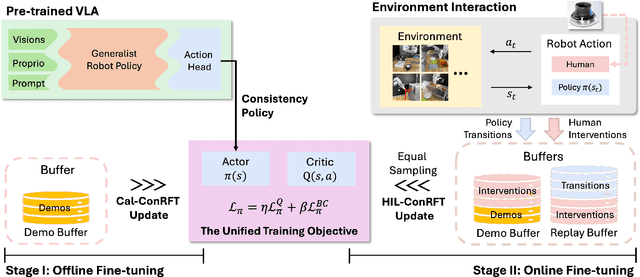


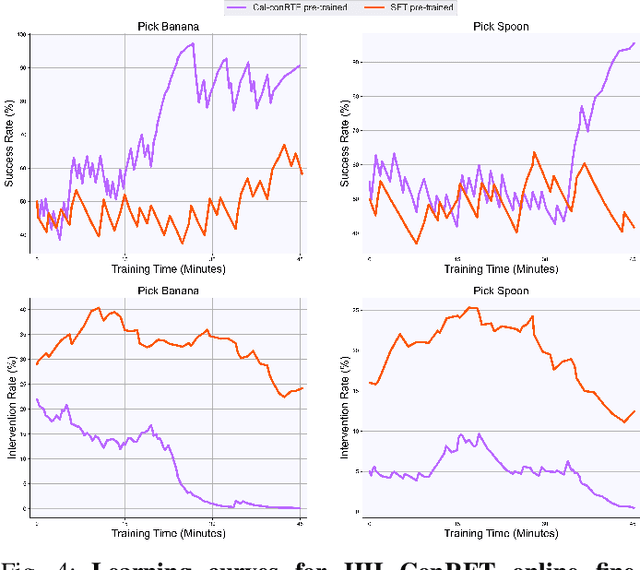
Vision-Language-Action (VLA) models have shown substantial potential in real-world robotic manipulation. However, fine-tuning these models through supervised learning struggles to achieve robust performance due to limited, inconsistent demonstrations, especially in contact-rich environments. In this paper, we propose a reinforced fine-tuning approach for VLA models, named ConRFT, which consists of offline and online fine-tuning with a unified consistency-based training objective, to address these challenges. In the offline stage, our method integrates behavior cloning and Q-learning to effectively extract policy from a small set of demonstrations and stabilize value estimating. In the online stage, the VLA model is further fine-tuned via consistency policy, with human interventions to ensure safe exploration and high sample efficiency. We evaluate our approach on eight diverse real-world manipulation tasks. It achieves an average success rate of 96.3% within 45-90 minutes of online fine-tuning, outperforming prior supervised methods with a 144% improvement in success rate and 1.9x shorter episode length. This work highlights the potential of integrating reinforcement learning to enhance the performance of VLA models for real-world robotic applications.