 Add to Chrome
 Add to Firefox
 Add to Edge
Immune2V: Image Immunization Against Dual-Stream Image-to-Video Generation
Apr 12, 2026
Image-to-video (I2V) generation has the potential for societal harm because it enables the unauthorized animation of static images to create realistic deepfakes. While existing defenses effectively protect against static image manipulation, extending these to I2V generation remains underexplored and non-trivial. In this paper, we systematically analyze why modern I2V models are highly robust against naive image-level adversarial attacks (i.e., immunization). We observe that the video encoding process rapidly dilutes the adversarial noise across future frames, and the continuous text-conditioned guidance actively overrides the intended disruptive effect of the immunization. Building on these findings, we propose the Immune2V framework which enforces temporally balanced latent divergence at the encoder level to prevent signal dilution, and aligns intermediate generative representations with a precomputed collapse-inducing trajectory to counteract the text-guidance override. Extensive experiments demonstrate that Immune2V produces substantially stronger and more persistent degradation than adapted image-level baselines under the same imperceptibility budget.

Follow-Your-Shape: Shape-Aware Image Editing via Trajectory-Guided Region Control
Aug 12, 2025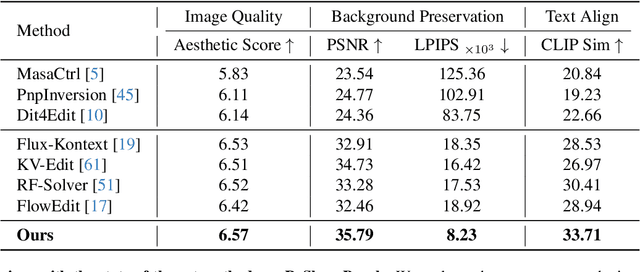
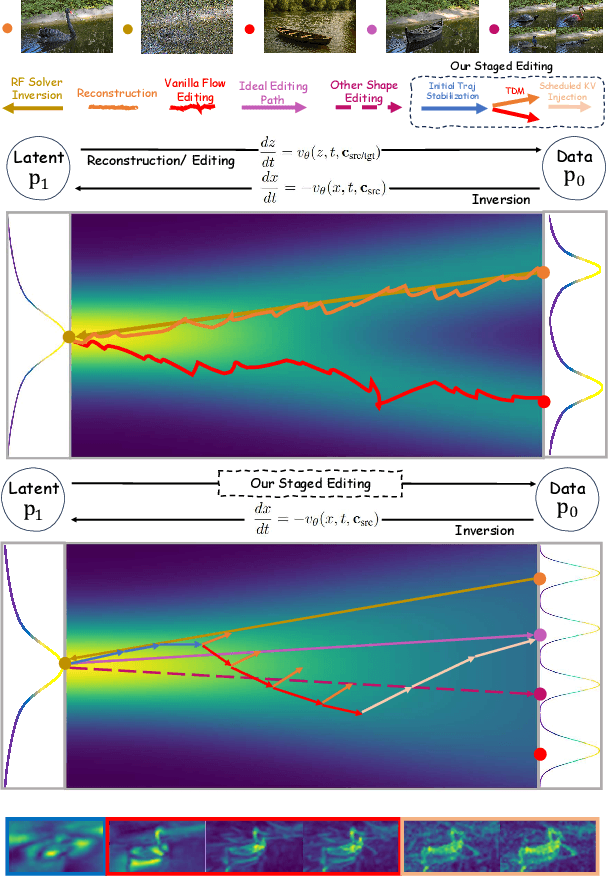
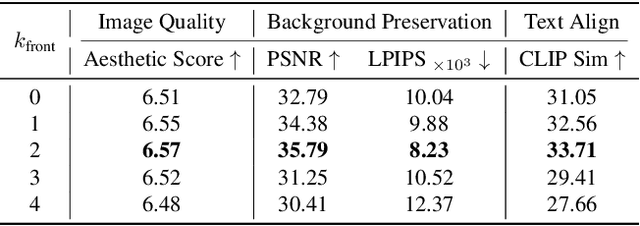
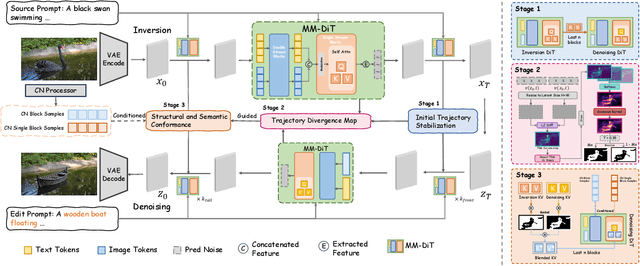
While recent flow-based image editing models demonstrate general-purpose capabilities across diverse tasks, they often struggle to specialize in challenging scenarios -- particularly those involving large-scale shape transformations. When performing such structural edits, these methods either fail to achieve the intended shape change or inadvertently alter non-target regions, resulting in degraded background quality. We propose Follow-Your-Shape, a training-free and mask-free framework that supports precise and controllable editing of object shapes while strictly preserving non-target content. Motivated by the divergence between inversion and editing trajectories, we compute a Trajectory Divergence Map (TDM) by comparing token-wise velocity differences between the inversion and denoising paths. The TDM enables precise localization of editable regions and guides a Scheduled KV Injection mechanism that ensures stable and faithful editing. To facilitate a rigorous evaluation, we introduce ReShapeBench, a new benchmark comprising 120 new images and enriched prompt pairs specifically curated for shape-aware editing. Experiments demonstrate that our method achieves superior editability and visual fidelity, particularly in tasks requiring large-scale shape replacement.