 Add to Chrome
 Add to Firefox
 Add to Edge
Tiny LVLM-eHub: Early Multimodal Experiments with Bard
Aug 07, 2023
Recent advancements in Large Vision-Language Models (LVLMs) have demonstrated significant progress in tackling complex multimodal tasks. Among these cutting-edge developments, Google's Bard stands out for its remarkable multimodal capabilities, promoting comprehensive comprehension and reasoning across various domains. This work presents an early and holistic evaluation of LVLMs' multimodal abilities, with a particular focus on Bard, by proposing a lightweight variant of LVLM-eHub, named Tiny LVLM-eHub. In comparison to the vanilla version, Tiny LVLM-eHub possesses several appealing properties. Firstly, it provides a systematic assessment of six categories of multimodal capabilities, including visual perception, visual knowledge acquisition, visual reasoning, visual commonsense, object hallucination, and embodied intelligence, through quantitative evaluation of $42$ standard text-related visual benchmarks. Secondly, it conducts an in-depth analysis of LVLMs' predictions using the ChatGPT Ensemble Evaluation (CEE), which leads to a robust and accurate evaluation and exhibits improved alignment with human evaluation compared to the word matching approach. Thirdly, it comprises a mere $2.1$K image-text pairs, facilitating ease of use for practitioners to evaluate their own offline LVLMs. Through extensive experimental analysis, this study demonstrates that Bard outperforms previous LVLMs in most multimodal capabilities except object hallucination, to which Bard is still susceptible. Tiny LVLM-eHub serves as a baseline evaluation for various LVLMs and encourages innovative strategies aimed at advancing multimodal techniques. Our project is publicly available at \url{https://github.com/OpenGVLab/Multi-Modality-Arena}.

InternVid: A Large-scale Video-Text Dataset for Multimodal Understanding and Generation
Jul 13, 2023This paper introduces InternVid, a large-scale video-centric multimodal dataset that enables learning powerful and transferable video-text representations for multimodal understanding and generation. The InternVid dataset contains over 7 million videos lasting nearly 760K hours, yielding 234M video clips accompanied by detailed descriptions of total 4.1B words. Our core contribution is to develop a scalable approach to autonomously build a high-quality video-text dataset with large language models (LLM), thereby showcasing its efficacy in learning video-language representation at scale. Specifically, we utilize a multi-scale approach to generate video-related descriptions. Furthermore, we introduce ViCLIP, a video-text representation learning model based on ViT-L. Learned on InternVid via contrastive learning, this model demonstrates leading zero-shot action recognition and competitive video retrieval performance. Beyond basic video understanding tasks like recognition and retrieval, our dataset and model have broad applications. They are particularly beneficial for generating interleaved video-text data for learning a video-centric dialogue system, advancing video-to-text and text-to-video generation research. These proposed resources provide a tool for researchers and practitioners interested in multimodal video understanding and generation.
GPT4RoI: Instruction Tuning Large Language Model on Region-of-Interest
Jul 07, 2023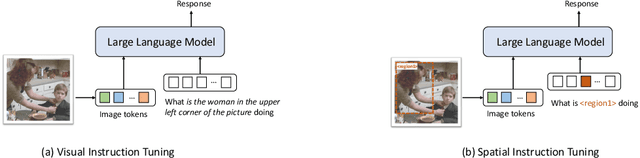
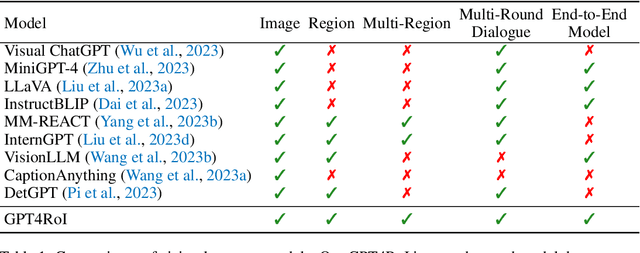
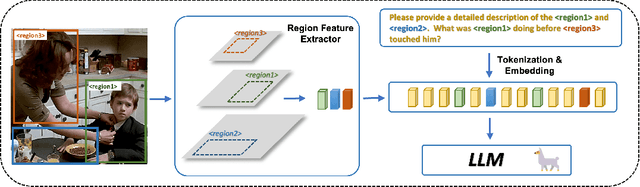
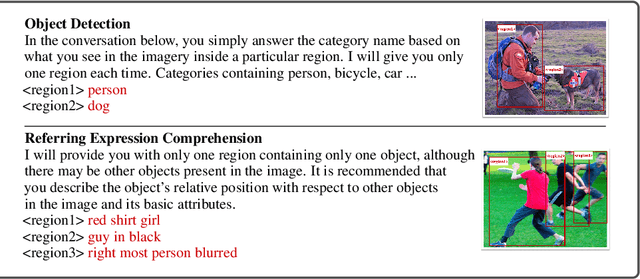
Instruction tuning large language model (LLM) on image-text pairs has achieved unprecedented vision-language multimodal abilities. However, their vision-language alignments are only built on image-level, the lack of region-level alignment limits their advancements to fine-grained multimodal understanding. In this paper, we propose instruction tuning on region-of-interest. The key design is to reformulate the bounding box as the format of spatial instruction. The interleaved sequences of visual features extracted by the spatial instruction and the language embedding are input to LLM, and trained on the transformed region-text data in instruction tuning format. Our region-level vision-language model, termed as GPT4RoI, brings brand new conversational and interactive experience beyond image-level understanding. (1) Controllability: Users can interact with our model by both language and spatial instructions to flexibly adjust the detail level of the question. (2) Capacities: Our model supports not only single-region spatial instruction but also multi-region. This unlocks more region-level multimodal capacities such as detailed region caption and complex region reasoning. (3) Composition: Any off-the-shelf object detector can be a spatial instruction provider so as to mine informative object attributes from our model, like color, shape, material, action, relation to other objects, etc. The code, data, and demo can be found at https://github.com/jshilong/GPT4RoI.
ChiPFormer: Transferable Chip Placement via Offline Decision Transformer
Jun 26, 2023Placement is a critical step in modern chip design, aiming to determine the positions of circuit modules on the chip canvas. Recent works have shown that reinforcement learning (RL) can improve human performance in chip placement. However, such an RL-based approach suffers from long training time and low transfer ability in unseen chip circuits. To resolve these challenges, we cast the chip placement as an offline RL formulation and present ChiPFormer that enables learning a transferable placement policy from fixed offline data. ChiPFormer has several advantages that prior arts do not have. First, ChiPFormer can exploit offline placement designs to learn transferable policies more efficiently in a multi-task setting. Second, ChiPFormer can promote effective finetuning for unseen chip circuits, reducing the placement runtime from hours to minutes. Third, extensive experiments on 32 chip circuits demonstrate that ChiPFormer achieves significantly better placement quality while reducing the runtime by 10x compared to recent state-of-the-art approaches in both public benchmarks and realistic industrial tasks. The deliverables are released at https://sites.google.com/view/chipformer/home.
Align, Adapt and Inject: Sound-guided Unified Image Generation
Jun 20, 2023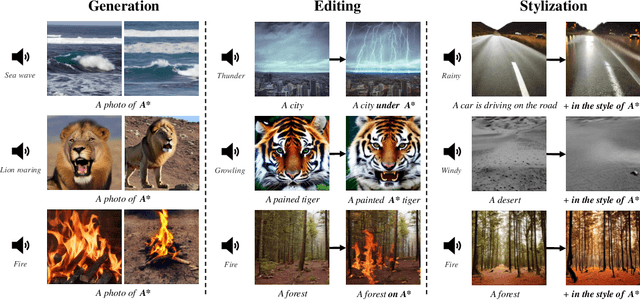

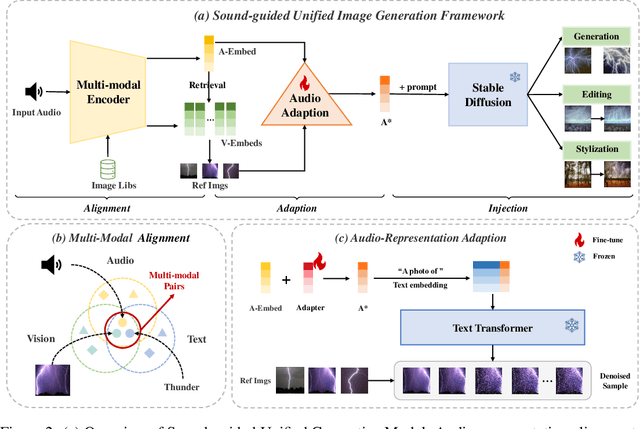

Text-guided image generation has witnessed unprecedented progress due to the development of diffusion models. Beyond text and image, sound is a vital element within the sphere of human perception, offering vivid representations and naturally coinciding with corresponding scenes. Taking advantage of sound therefore presents a promising avenue for exploration within image generation research. However, the relationship between audio and image supervision remains significantly underdeveloped, and the scarcity of related, high-quality datasets brings further obstacles. In this paper, we propose a unified framework 'Align, Adapt, and Inject' (AAI) for sound-guided image generation, editing, and stylization. In particular, our method adapts input sound into a sound token, like an ordinary word, which can plug and play with existing powerful diffusion-based Text-to-Image (T2I) models. Specifically, we first train a multi-modal encoder to align audio representation with the pre-trained textual manifold and visual manifold, respectively. Then, we propose the audio adapter to adapt audio representation into an audio token enriched with specific semantics, which can be injected into a frozen T2I model flexibly. In this way, we are able to extract the dynamic information of varied sounds, while utilizing the formidable capability of existing T2I models to facilitate sound-guided image generation, editing, and stylization in a convenient and cost-effective manner. The experiment results confirm that our proposed AAI outperforms other text and sound-guided state-of-the-art methods. And our aligned multi-modal encoder is also competitive with other approaches in the audio-visual retrieval and audio-text retrieval tasks.
LVLM-eHub: A Comprehensive Evaluation Benchmark for Large Vision-Language Models
Jun 15, 2023Large Vision-Language Models (LVLMs) have recently played a dominant role in multimodal vision-language learning. Despite the great success, it lacks a holistic evaluation of their efficacy. This paper presents a comprehensive evaluation of publicly available large multimodal models by building a LVLM evaluation Hub (LVLM-eHub). Our LVLM-eHub consists of $8$ representative LVLMs such as InstructBLIP and MiniGPT-4, which are thoroughly evaluated by a quantitative capability evaluation and an online arena platform. The former evaluates $6$ categories of multimodal capabilities of LVLMs such as visual question answering and embodied artificial intelligence on $47$ standard text-related visual benchmarks, while the latter provides the user-level evaluation of LVLMs in an open-world question-answering scenario. The study reveals several innovative findings. First, instruction-tuned LVLM with massive in-domain data such as InstructBLIP heavily overfits many existing tasks, generalizing poorly in the open-world scenario. Second, instruction-tuned LVLM with moderate instruction-following data may result in object hallucination issues (i.e., generate objects that are inconsistent with target images in the descriptions). It either makes the current evaluation metric such as CIDEr for image captioning ineffective or generates wrong answers. Third, employing a multi-turn reasoning evaluation framework can mitigate the issue of object hallucination, shedding light on developing an effective pipeline for LVLM evaluation. The findings provide a foundational framework for the conception and assessment of innovative strategies aimed at enhancing zero-shot multimodal techniques. Our LVLM-eHub will be available at https://github.com/OpenGVLab/Multi-Modality-Arena
Scene as Occupancy
Jun 06, 2023Human driver can easily describe the complex traffic scene by visual system. Such an ability of precise perception is essential for driver's planning. To achieve this, a geometry-aware representation that quantizes the physical 3D scene into structured grid map with semantic labels per cell, termed as 3D Occupancy, would be desirable. Compared to the form of bounding box, a key insight behind occupancy is that it could capture the fine-grained details of critical obstacles in the scene, and thereby facilitate subsequent tasks. Prior or concurrent literature mainly concentrate on a single scene completion task, where we might argue that the potential of this occupancy representation might obsess broader impact. In this paper, we propose OccNet, a multi-view vision-centric pipeline with a cascade and temporal voxel decoder to reconstruct 3D occupancy. At the core of OccNet is a general occupancy embedding to represent 3D physical world. Such a descriptor could be applied towards a wide span of driving tasks, including detection, segmentation and planning. To validate the effectiveness of this new representation and our proposed algorithm, we propose OpenOcc, the first dense high-quality 3D occupancy benchmark built on top of nuScenes. Empirical experiments show that there are evident performance gain across multiple tasks, e.g., motion planning could witness a collision rate reduction by 15%-58%, demonstrating the superiority of our method.
DiffRate : Differentiable Compression Rate for Efficient Vision Transformers
May 29, 2023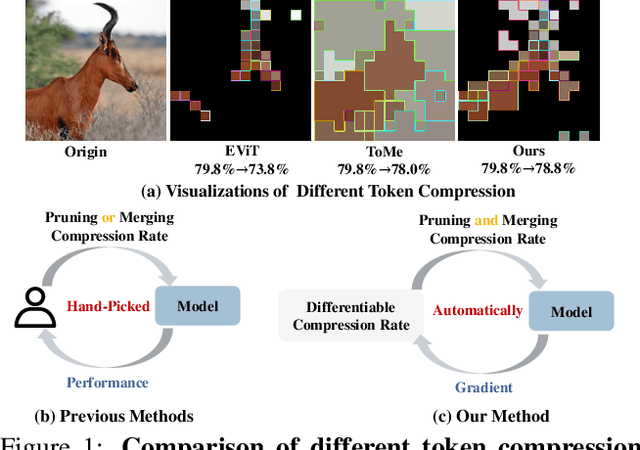
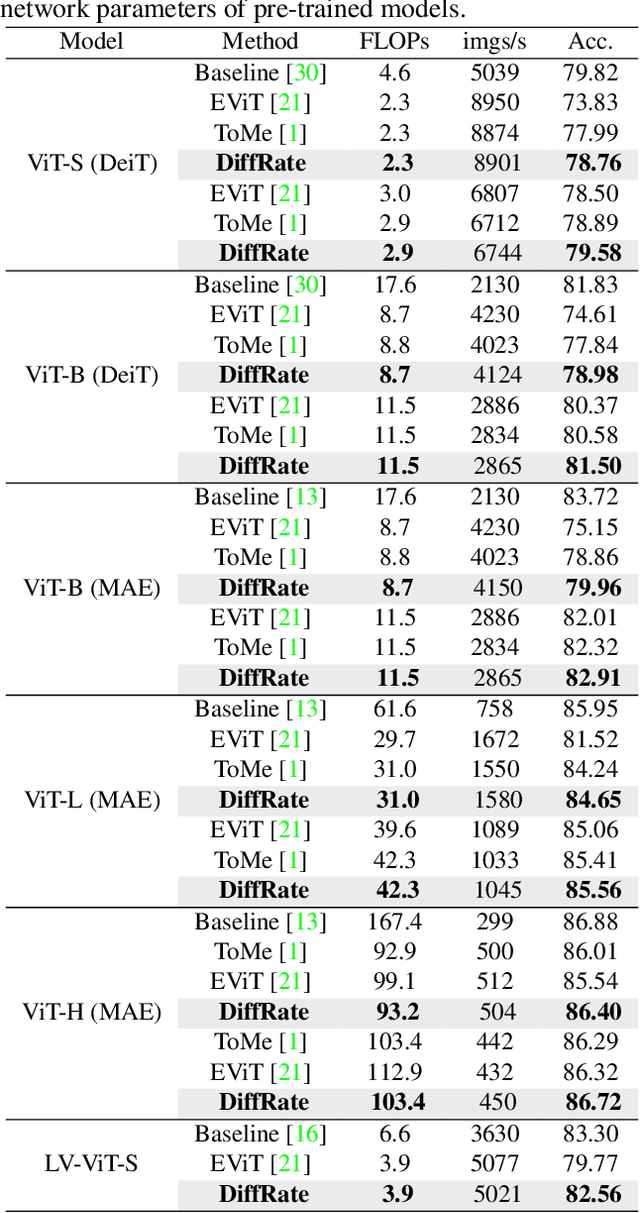
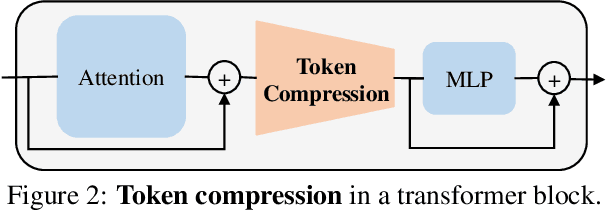
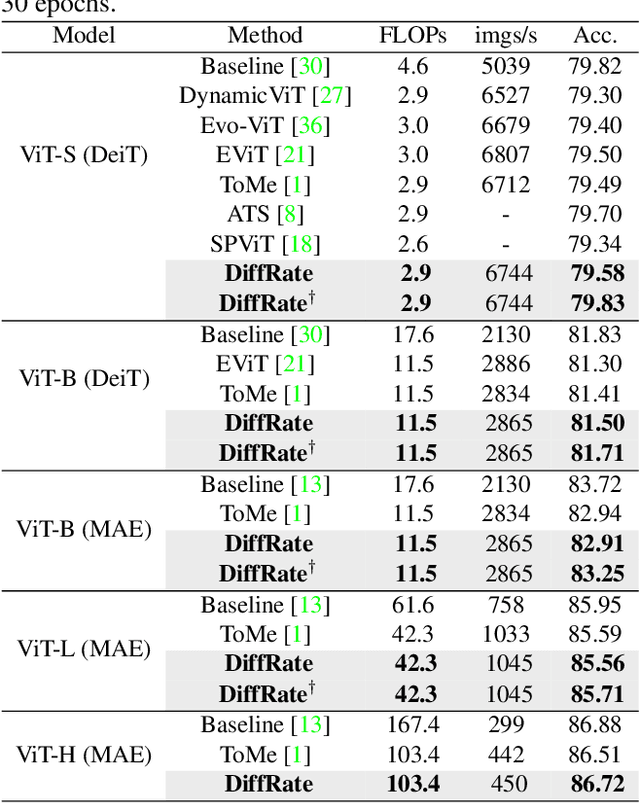
Token compression aims to speed up large-scale vision transformers (e.g. ViTs) by pruning (dropping) or merging tokens. It is an important but challenging task. Although recent advanced approaches achieved great success, they need to carefully handcraft a compression rate (i.e. number of tokens to remove), which is tedious and leads to sub-optimal performance. To tackle this problem, we propose Differentiable Compression Rate (DiffRate), a novel token compression method that has several appealing properties prior arts do not have. First, DiffRate enables propagating the loss function's gradient onto the compression ratio, which is considered as a non-differentiable hyperparameter in previous work. In this case, different layers can automatically learn different compression rates layer-wisely without extra overhead. Second, token pruning and merging can be naturally performed simultaneously in DiffRate, while they were isolated in previous works. Third, extensive experiments demonstrate that DiffRate achieves state-of-the-art performance. For example, by applying the learned layer-wise compression rates to an off-the-shelf ViT-H (MAE) model, we achieve a 40% FLOPs reduction and a 1.5x throughput improvement, with a minor accuracy drop of 0.16% on ImageNet without fine-tuning, even outperforming previous methods with fine-tuning. Codes and models are available at https://github.com/OpenGVLab/DiffRate.
RAPHAEL: Text-to-Image Generation via Large Mixture of Diffusion Paths
May 29, 2023

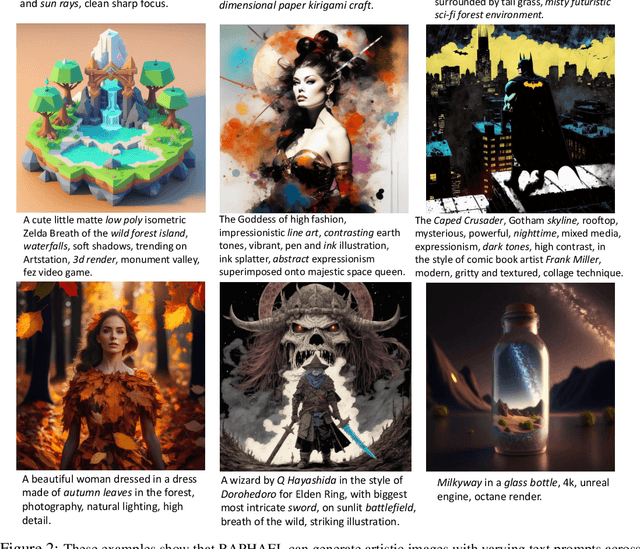

Text-to-image generation has recently witnessed remarkable achievements. We introduce a text-conditional image diffusion model, termed RAPHAEL, to generate highly artistic images, which accurately portray the text prompts, encompassing multiple nouns, adjectives, and verbs. This is achieved by stacking tens of mixture-of-experts (MoEs) layers, i.e., space-MoE and time-MoE layers, enabling billions of diffusion paths (routes) from the network input to the output. Each path intuitively functions as a "painter" for depicting a particular textual concept onto a specified image region at a diffusion timestep. Comprehensive experiments reveal that RAPHAEL outperforms recent cutting-edge models, such as Stable Diffusion, ERNIE-ViLG 2.0, DeepFloyd, and DALL-E 2, in terms of both image quality and aesthetic appeal. Firstly, RAPHAEL exhibits superior performance in switching images across diverse styles, such as Japanese comics, realism, cyberpunk, and ink illustration. Secondly, a single model with three billion parameters, trained on 1,000 A100 GPUs for two months, achieves a state-of-the-art zero-shot FID score of 6.61 on the COCO dataset. Furthermore, RAPHAEL significantly surpasses its counterparts in human evaluation on the ViLG-300 benchmark. We believe that RAPHAEL holds the potential to propel the frontiers of image generation research in both academia and industry, paving the way for future breakthroughs in this rapidly evolving field. More details can be found on a project webpage: https://raphael-painter.github.io/.
SyNDock: N Rigid Protein Docking via Learnable Group Synchronization
May 25, 2023The regulation of various cellular processes heavily relies on the protein complexes within a living cell, necessitating a comprehensive understanding of their three-dimensional structures to elucidate the underlying mechanisms. While neural docking techniques have exhibited promising outcomes in binary protein docking, the application of advanced neural architectures to multimeric protein docking remains uncertain. This study introduces SyNDock, an automated framework that swiftly assembles precise multimeric complexes within seconds, showcasing performance that can potentially surpass or be on par with recent advanced approaches. SyNDock possesses several appealing advantages not present in previous approaches. Firstly, SyNDock formulates multimeric protein docking as a problem of learning global transformations to holistically depict the placement of chain units of a complex, enabling a learning-centric solution. Secondly, SyNDock proposes a trainable two-step SE(3) algorithm, involving initial pairwise transformation and confidence estimation, followed by global transformation synchronization. This enables effective learning for assembling the complex in a globally consistent manner. Lastly, extensive experiments conducted on our proposed benchmark dataset demonstrate that SyNDock outperforms existing docking software in crucial performance metrics, including accuracy and runtime. For instance, it achieves a 4.5% improvement in performance and a remarkable millionfold acceleration in speed.