 Add to Chrome
 Add to Firefox
 Add to Edge
LithoGRPO: Fast Inverse Lithography via GRPO Reinforced Flow Matching
May 29, 2026
In semiconductor manufacturing, lithography projects circuit layouts onto silicon wafers through an optical mask. As circuit features shrink below the wavelength of light, optical diffraction causes the printed patterns to deviate from their intended layouts. Inverse Lithography Technology (ILT) addresses this challenge by generating optimized masks that enhance the fidelity of pattern transfer onto wafers. While ILT resembles an image synthesis task, its reliance on explicit physical metrics for mask evaluation limits the applicability of existing generative models. We introduce LithoGRPO, an ILT framework that integrates the flow-matching paradigm with GRPO-based reinforcement learning (RL) fine-tuning, enabling efficient exploration of diverse masks for a given target layout. Unlike purely generative or optimization-based approaches, RL in LithoGRPO exploits the explicitly defined, physics-based reward function of ILT, enabling optimization under complex, process-aware constraints. To the best of our knowledge, this is the first framework that unifies flow matching and RL for mask optimization. To improve RL sampling efficiency, we propose a fast shot-counting algorithm for manufacturability evaluation, achieving over 130x speedup while preserving the mask ranking of the traditional shot-count metric. Extensive experiments demonstrate that LithoGRPO achieves state-of-the-art performance over both optimization-based and learning-based methods, while maintaining efficient mask generation.

ClawMark: A Living-World Benchmark for Multi-Turn, Multi-Day, Multimodal Coworker Agents
Apr 26, 2026Language-model agents are increasingly used as persistent coworkers that assist users across multiple working days. During such workflows, the surrounding environment may change independently of the agent: new emails arrive, calendar entries shift, knowledge-base records are updated, and evidence appears across images, scanned PDFs, audio, video, and spreadsheets. Existing benchmarks do not adequately evaluate this setting because they typically run within a single static episode and remain largely text-centric. We introduce \bench{}, a benchmark for coworker agents built around multi-turn multi-day tasks, a stateful sandboxed service environment whose state evolves between turns, and rule-based verification. The current release contains 100 tasks across 13 professional scenarios, executed against five stateful sandboxed services (filesystem, email, calendar, knowledge base, spreadsheet) and scored by 1537 deterministic Python checkers over post-execution service state; no LLM-as-judge is invoked during scoring. We benchmark seven frontier agent systems. The strongest model reaches 75.8 weighted score, but the best strict Task Success is only 20.0\%, indicating that partial progress is common while complete end-to-end workflow completion remains rare. Turn-level analysis shows that performance drops after the first exogenous environment update, highlighting adaptation to changing state as a key open challenge. We release the benchmark, evaluation harness, and construction pipeline to support reproducible coworker-agent evaluation.
AnalogRetriever: Learning Cross-Modal Representations for Analog Circuit Retrieval
Apr 25, 2026Analog circuit design relies heavily on reusing existing intellectual property (IP), yet searching across heterogeneous representations such as SPICE netlists, schematics, and functional descriptions remains challenging. Existing methods are largely limited to exact matching within a single modality, failing to capture cross-modal semantic relationships. To bridge this gap, we present AnalogRetriever, a unified tri-modal retrieval framework for analog circuit search. We first build a high-quality dataset on top of Masala-CHAI through a two-stage repair pipeline that raises the netlist compile rate from 22\% to 100\%. Built on this foundation, AnalogRetriever encodes schematics and descriptions with a vision-language model and netlists with a port-aware relational graph convolutional network, mapping all three modalities into a shared embedding space via curriculum contrastive learning. Experiments show that AnalogRetriever achieves an average Recall@1 of 75.2\% across all six cross-modal retrieval directions, significantly outperforming existing baselines. When integrated into the AnalogCoder agentic framework as a retrieval-augmented generation module, it consistently improves functional pass rates and enables previously unsolved tasks to be completed. Our code and dataset will be released.
Beyond GEMM-Centric NPUs: Enabling Efficient Diffusion LLM Sampling
Jan 28, 2026Diffusion Large Language Models (dLLMs) introduce iterative denoising to enable parallel token generation, but their sampling phase displays fundamentally different characteristics compared to GEMM-centric transformer layers. Profiling on modern GPUs reveals that sampling can account for up to 70% of total model inference latency-primarily due to substantial memory loads and writes from vocabulary-wide logits, reduction-based token selection, and iterative masked updates. These processes demand large on-chip SRAM and involve irregular memory accesses that conventional NPUs struggle to handle efficiently. To address this, we identify a set of critical instructions that an NPU architecture must specifically optimize for dLLM sampling. Our design employs lightweight non-GEMM vector primitives, in-place memory reuse strategies, and a decoupled mixed-precision memory hierarchy. Together, these optimizations deliver up to a 2.53x speedup over the NVIDIA RTX A6000 GPU under an equivalent nm technology node. We also open-source our cycle-accurate simulation and post-synthesis RTL verification code, confirming functional equivalence with current dLLM PyTorch implementations.
Re$^{\text{2}}$MaP: Macro Placement by Recursively Prototyping and Packing Tree-based Relocating
Nov 11, 2025This work introduces the Re$^{\text{2}}$MaP method, which generates expert-quality macro placements through recursively prototyping and packing tree-based relocating. We first perform multi-level macro grouping and PPA-aware cell clustering to produce a unified connection matrix that captures both wirelength and dataflow among macros and clusters. Next, we use DREAMPlace to build a mixed-size placement prototype and obtain reference positions for each macro and cluster. Based on this prototype, we introduce ABPlace, an angle-based analytical method that optimizes macro positions on an ellipse to distribute macros uniformly near chip periphery, while optimizing wirelength and dataflow. A packing tree-based relocating procedure is then designed to jointly adjust the locations of macro groups and the macros within each group, by optimizing an expertise-inspired cost function that captures various design constraints through evolutionary search. Re$^{\text{2}}$MaP repeats the above process: Only a subset of macro groups are positioned in each iteration, and the remaining macros are deferred to the next iteration to improve the prototype's accuracy. Using a well-established backend flow with sufficient timing optimizations, Re$^{\text{2}}$MaP achieves up to 22.22% (average 10.26%) improvement in worst negative slack (WNS) and up to 97.91% (average 33.97%) improvement in total negative slack (TNS) compared to the state-of-the-art academic placer Hier-RTLMP. It also ranks higher on WNS, TNS, power, design rule check (DRC) violations, and runtime than the conference version ReMaP, across seven tested cases. Our code is available at https://github.com/lamda-bbo/Re2MaP.
FUDOKI: Discrete Flow-based Unified Understanding and Generation via Kinetic-Optimal Velocities
May 26, 2025The rapid progress of large language models (LLMs) has catalyzed the emergence of multimodal large language models (MLLMs) that unify visual understanding and image generation within a single framework. However, most existing MLLMs rely on autoregressive (AR) architectures, which impose inherent limitations on future development, such as the raster-scan order in image generation and restricted reasoning abilities in causal context modeling. In this work, we challenge the dominance of AR-based approaches by introducing FUDOKI, a unified multimodal model purely based on discrete flow matching, as an alternative to conventional AR paradigms. By leveraging metric-induced probability paths with kinetic optimal velocities, our framework goes beyond the previous masking-based corruption process, enabling iterative refinement with self-correction capability and richer bidirectional context integration during generation. To mitigate the high cost of training from scratch, we initialize FUDOKI from pre-trained AR-based MLLMs and adaptively transition to the discrete flow matching paradigm. Experimental results show that FUDOKI achieves performance comparable to state-of-the-art AR-based MLLMs across both visual understanding and image generation tasks, highlighting its potential as a foundation for next-generation unified multimodal models. Furthermore, we show that applying test-time scaling techniques to FUDOKI yields significant performance gains, further underscoring its promise for future enhancement through reinforcement learning.
INSIGHT: Universal Neural Simulator for Analog Circuits Harnessing Autoregressive Transformers
Jul 10, 2024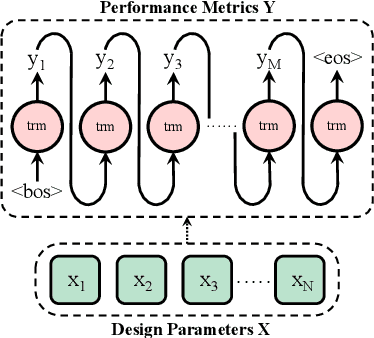
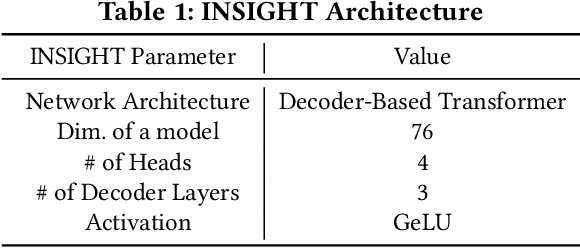

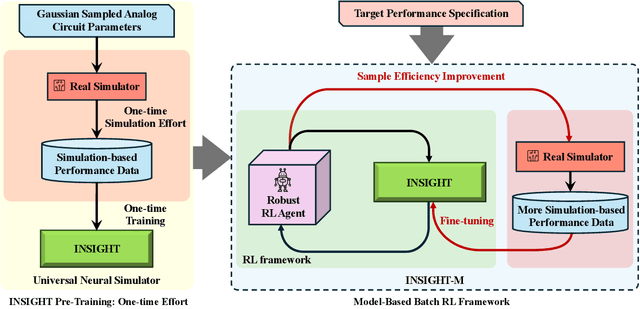
Analog front-end design heavily relies on specialized human expertise and costly trial-and-error simulations, which motivated many prior works on analog design automation. However, efficient and effective exploration of the vast and complex design space remains constrained by the time-consuming nature of CPU-based SPICE simulations, making effective design automation a challenging endeavor. In this paper, we introduce INSIGHT, a GPU-powered, technology-independent, effective universal neural simulator in the analog front-end design automation loop. INSIGHT accurately predicts the performance metrics of analog circuits across various technology nodes, significantly reducing inference time. Notably, its autoregressive capabilities enable INSIGHT to accurately predict simulation-costly critical transient specifications leveraging less expensive performance metric information. The low cost and high fidelity feature make INSIGHT a good substitute for standard simulators in analog front-end optimization frameworks. INSIGHT is compatible with any optimization framework, facilitating enhanced design space exploration for sample efficiency through sophisticated offline learning and adaptation techniques. Our experiments demonstrate that INSIGHT-M, a model-based batch reinforcement learning framework that leverages INSIGHT for analog sizing, achieves at least 50X improvement in sample efficiency across circuits. To the best of our knowledge, this marks the first use of autoregressive transformers in analog front-end design.
LLM-Enhanced Bayesian Optimization for Efficient Analog Layout Constraint Generation
Jun 07, 2024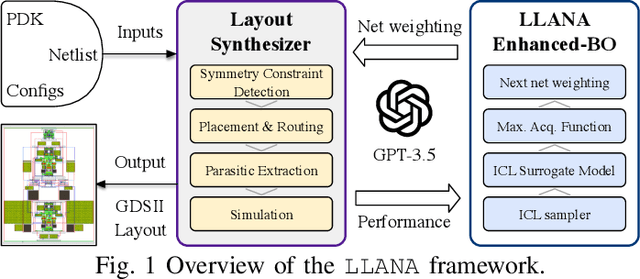
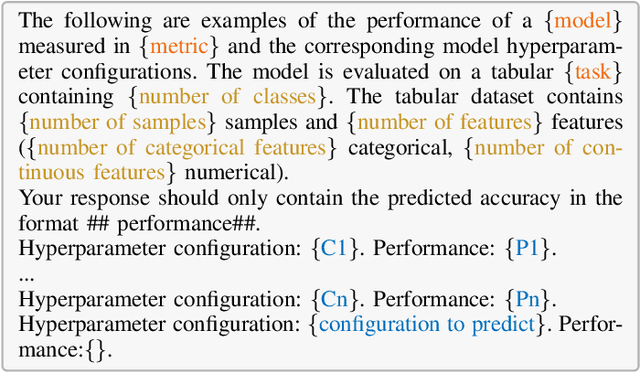
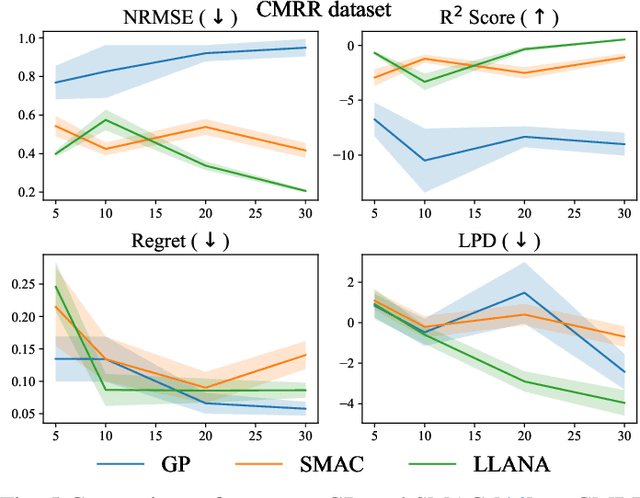
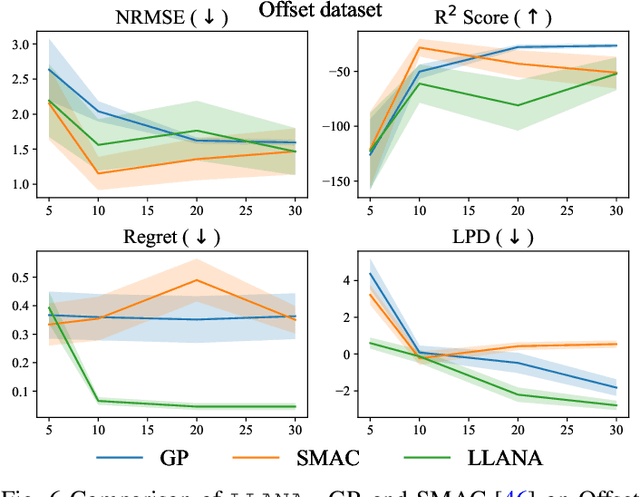
Analog layout synthesis faces significant challenges due to its dependence on manual processes, considerable time requirements, and performance instability. Current Bayesian Optimization (BO)-based techniques for analog layout synthesis, despite their potential for automation, suffer from slow convergence and extensive data needs, limiting their practical application. This paper presents the \texttt{LLANA} framework, a novel approach that leverages Large Language Models (LLMs) to enhance BO by exploiting the few-shot learning abilities of LLMs for more efficient generation of analog design-dependent parameter constraints. Experimental results demonstrate that \texttt{LLANA} not only achieves performance comparable to state-of-the-art (SOTA) BO methods but also enables a more effective exploration of the analog circuit design space, thanks to LLM's superior contextual understanding and learning efficiency. The code is available at \url{https://github.com/dekura/LLANA}.
AnalogCoder: Analog Circuit Design via Training-Free Code Generation
May 23, 2024
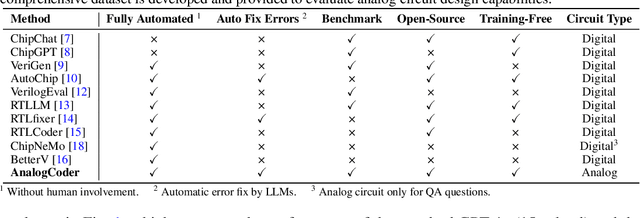


Analog circuit design is a significant task in modern chip technology, focusing on the selection of component types, connectivity, and parameters to ensure proper circuit functionality. Despite advances made by Large Language Models (LLMs) in digital circuit design, the complexity and scarcity of data in analog circuitry pose significant challenges. To mitigate these issues, we introduce AnalogCoder, the first training-free LLM agent for designing analog circuits through Python code generation. Firstly, AnalogCoder incorporates a feedback-enhanced flow with tailored domain-specific prompts, enabling the automated and self-correcting design of analog circuits with a high success rate. Secondly, it proposes a circuit tool library to archive successful designs as reusable modular sub-circuits, simplifying composite circuit creation. Thirdly, extensive experiments on a benchmark designed to cover a wide range of analog circuit tasks show that AnalogCoder outperforms other LLM-based methods. It has successfully designed 20 circuits, 5 more than standard GPT-4o. We believe AnalogCoder can significantly improve the labor-intensive chip design process, enabling non-experts to design analog circuits efficiently. Codes and the benchmark are provided at https://github.com/anonyanalog/AnalogCoder.
Scalable and Effective Arithmetic Tree Generation for Adder and Multiplier Designs
May 10, 2024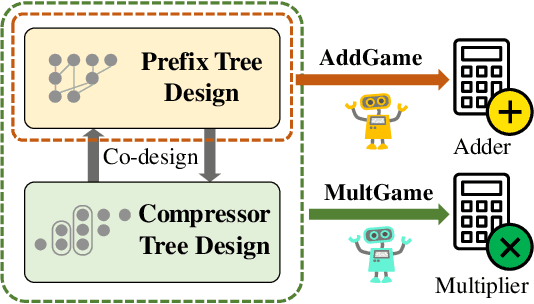
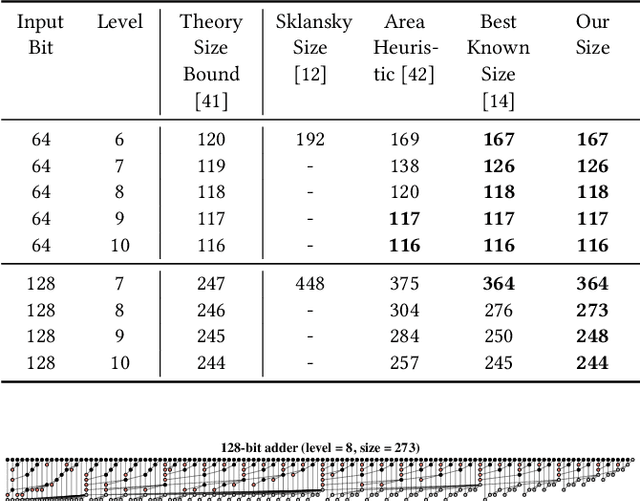
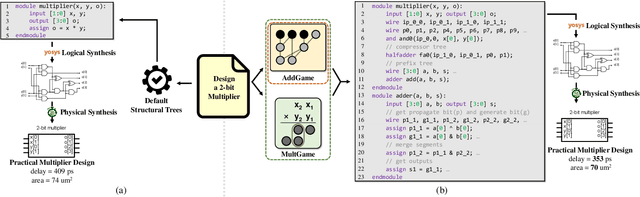
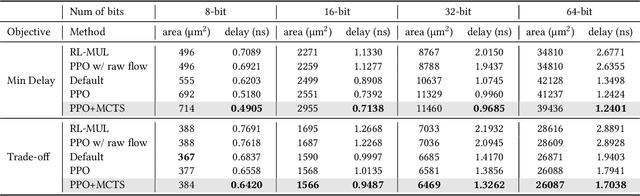
Across a wide range of hardware scenarios, the computational efficiency and physical size of the arithmetic units significantly influence the speed and footprint of the overall hardware system. Nevertheless, the effectiveness of prior arithmetic design techniques proves inadequate, as it does not sufficiently optimize speed and area, resulting in a reduced processing rate and larger module size. To boost the arithmetic performance, in this work, we focus on the two most common and fundamental arithmetic modules: adders and multipliers. We cast the design tasks as single-player tree generation games, leveraging reinforcement learning techniques to optimize their arithmetic tree structures. Such a tree generation formulation allows us to efficiently navigate the vast search space and discover superior arithmetic designs that improve computational efficiency and hardware size within just a few hours. For adders, our approach discovers designs of 128-bit adders that achieve Pareto optimality in theoretical metrics. Compared with the state-of-the-art PrefixRL, our method decreases computational delay and hardware size by up to 26% and 30%, respectively. For multipliers, when compared to RL-MUL, our approach increases speed and reduces size by as much as 49% and 45%. Moreover, the inherent flexibility and scalability of our method enable us to deploy our designs into cutting-edge technologies, as we show that they can be seamlessly integrated into 7nm technology. We believe our work will offer valuable insights into hardware design, further accelerating speed and reducing size through the refined search space and our tree generation methodologies. See our introduction video at https://bit.ly/ArithmeticTree. Codes are released at https://github.com/laiyao1/ArithmeticTree.