 Add to Chrome
 Add to Firefox
 Add to Edge
Learning 3D Photography Videos via Self-supervised Diffusion on Single Images
Feb 21, 2023
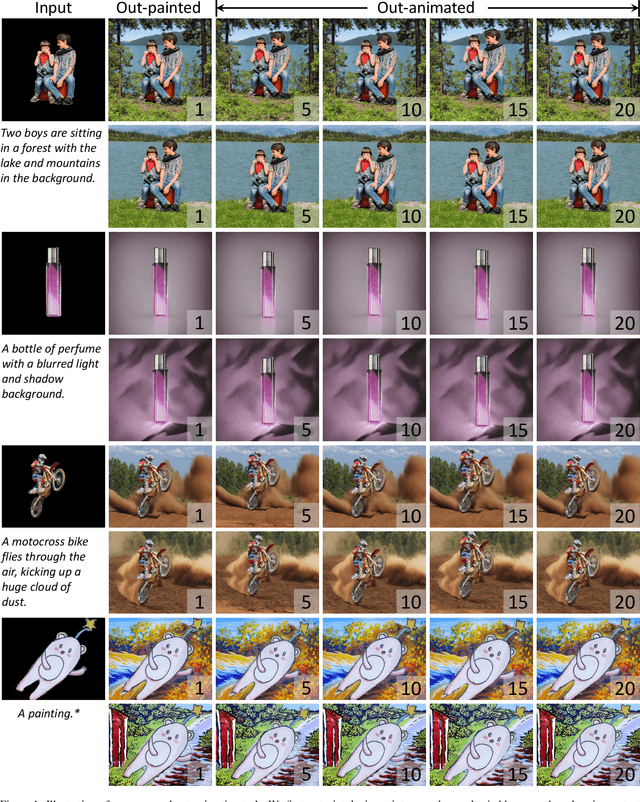
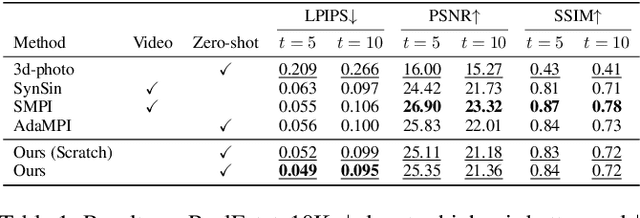
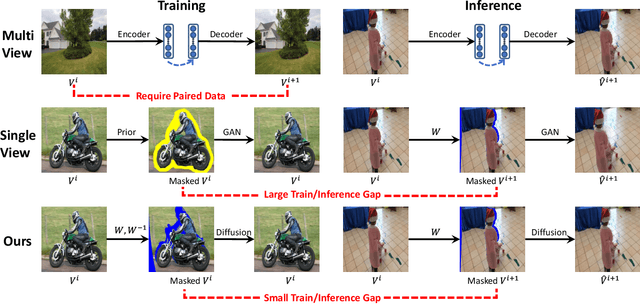
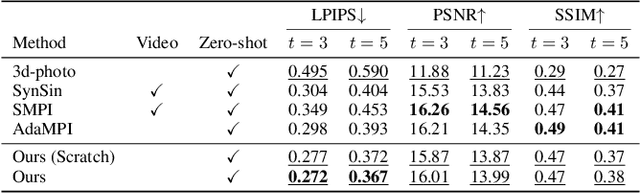
3D photography renders a static image into a video with appealing 3D visual effects. Existing approaches typically first conduct monocular depth estimation, then render the input frame to subsequent frames with various viewpoints, and finally use an inpainting model to fill those missing/occluded regions. The inpainting model plays a crucial role in rendering quality, but it is normally trained on out-of-domain data. To reduce the training and inference gap, we propose a novel self-supervised diffusion model as the inpainting module. Given a single input image, we automatically construct a training pair of the masked occluded image and the ground-truth image with random cycle-rendering. The constructed training samples are closely aligned to the testing instances, without the need of data annotation. To make full use of the masked images, we design a Masked Enhanced Block (MEB), which can be easily plugged into the UNet and enhance the semantic conditions. Towards real-world animation, we present a novel task: out-animation, which extends the space and time of input objects. Extensive experiments on real datasets show that our method achieves competitive results with existing SOTA methods.

Modeling Sequential Sentence Relation to Improve Cross-lingual Dense Retrieval
Feb 03, 2023Recently multi-lingual pre-trained language models (PLM) such as mBERT and XLM-R have achieved impressive strides in cross-lingual dense retrieval. Despite its successes, they are general-purpose PLM while the multilingual PLM tailored for cross-lingual retrieval is still unexplored. Motivated by an observation that the sentences in parallel documents are approximately in the same order, which is universal across languages, we propose to model this sequential sentence relation to facilitate cross-lingual representation learning. Specifically, we propose a multilingual PLM called masked sentence model (MSM), which consists of a sentence encoder to generate the sentence representations, and a document encoder applied to a sequence of sentence vectors from a document. The document encoder is shared for all languages to model the universal sequential sentence relation across languages. To train the model, we propose a masked sentence prediction task, which masks and predicts the sentence vector via a hierarchical contrastive loss with sampled negatives. Comprehensive experiments on four cross-lingual retrieval tasks show MSM significantly outperforms existing advanced pre-training models, demonstrating the effectiveness and stronger cross-lingual retrieval capabilities of our approach. Code and model will be available.
Synthetic Prompting: Generating Chain-of-Thought Demonstrations for Large Language Models
Feb 01, 2023Large language models can perform various reasoning tasks by using chain-of-thought prompting, which guides them to find answers through step-by-step demonstrations. However, the quality of the prompts depends on the demonstrations given to the models, and creating many of them by hand is costly. We introduce Synthetic prompting, a method that leverages a few handcrafted examples to prompt the model to generate more examples by itself, and selects effective demonstrations to elicit better reasoning. Our method alternates between a backward and forward process to generate new examples. The backward process generates a question that match a sampled reasoning chain, so that the question is solvable and clear. The forward process produces a more detailed reasoning chain for the question, improving the quality of the example. We evaluate our method on numerical, symbolic, and algorithmic reasoning tasks, and show that it outperforms existing prompting techniques.
GENIE: Large Scale Pre-training for Text Generation with Diffusion Model
Dec 22, 2022
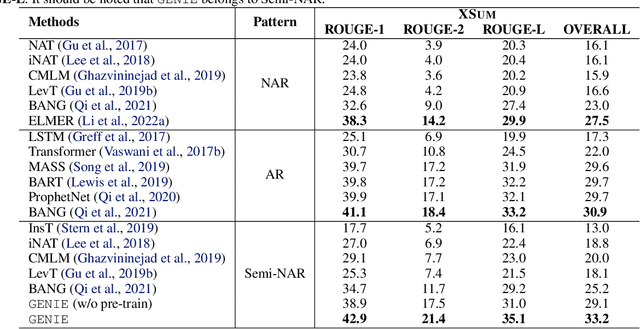
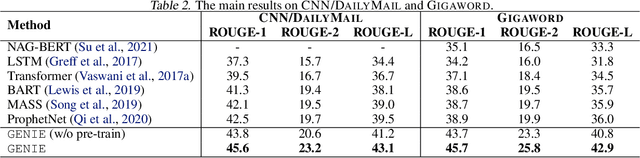
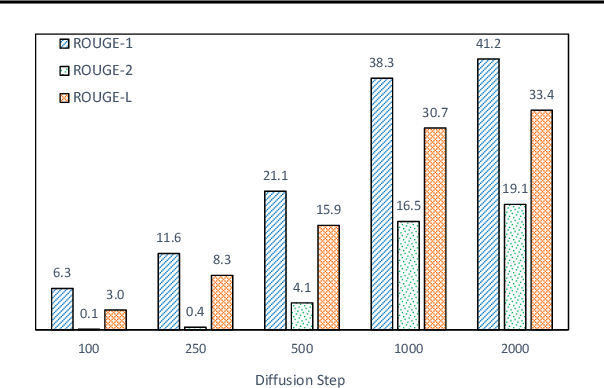
In this paper, we propose a large-scale language pre-training for text GENeration using dIffusion modEl, which is named GENIE. GENIE is a pre-training sequence-to-sequence text generation model which combines Transformer and diffusion. The diffusion model accepts the latent information from the encoder, which is used to guide the denoising of the current time step. After multiple such denoise iterations, the diffusion model can restore the Gaussian noise to the diverse output text which is controlled by the input text. Moreover, such architecture design also allows us to adopt large scale pre-training on the GENIE. We propose a novel pre-training method named continuous paragraph denoise based on the characteristics of the diffusion model. Extensive experiments on the XSum, CNN/DailyMail, and Gigaword benchmarks shows that GENIE can achieves comparable performance with various strong baselines, especially after pre-training, the generation quality of GENIE is greatly improved. We have also conduct a lot of experiments on the generation diversity and parameter impact of GENIE. The code for GENIE will be made publicly available.
Curriculum Sampling for Dense Retrieval with Document Expansion
Dec 18, 2022The dual-encoder has become the de facto architecture for dense retrieval. Typically, it computes the latent representations of the query and document independently, thus failing to fully capture the interactions between the query and document. To alleviate this, recent work expects to get query-informed representations of documents. During training, it expands the document with a real query, while replacing the real query with a generated pseudo query at inference. This discrepancy between training and inference makes the dense retrieval model pay more attention to the query information but ignore the document when computing the document representation. As a result, it even performs worse than the vanilla dense retrieval model, since its performance depends heavily on the relevance between the generated queries and the real query. In this paper, we propose a curriculum sampling strategy, which also resorts to the pseudo query at training and gradually increases the relevance of the generated query to the real query. In this way, the retrieval model can learn to extend its attention from the document only to both the document and query, hence getting high-quality query-informed document representations. Experimental results on several passage retrieval datasets show that our approach outperforms the previous dense retrieval methods1.
MASTER: Multi-task Pre-trained Bottlenecked Masked Autoencoders are Better Dense Retrievers
Dec 15, 2022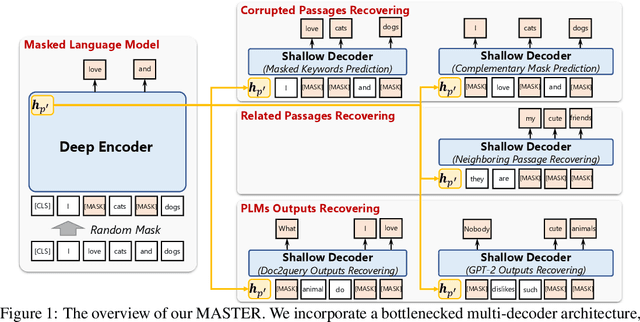
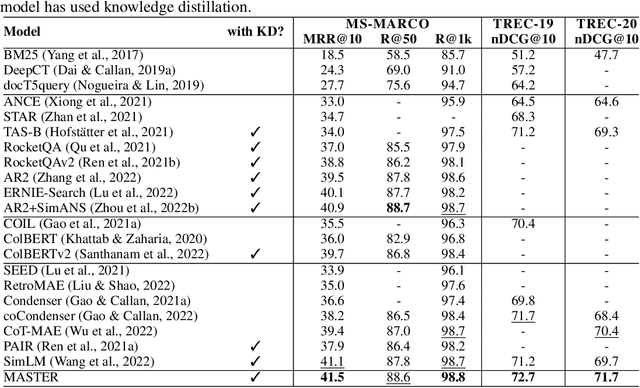
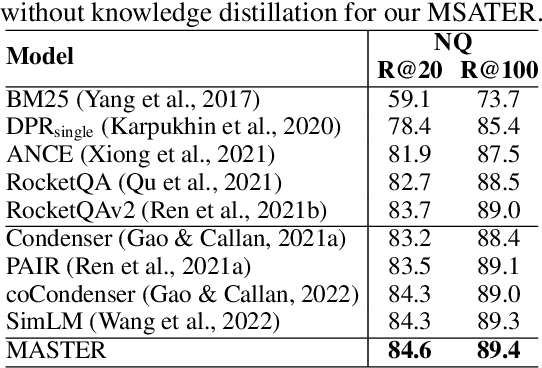
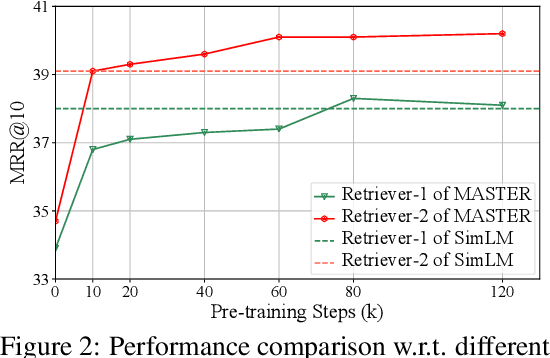
Dense retrieval aims to map queries and passages into low-dimensional vector space for efficient similarity measuring, showing promising effectiveness in various large-scale retrieval tasks. Since most existing methods commonly adopt pre-trained Transformers (e.g. BERT) for parameter initialization, some work focuses on proposing new pre-training tasks for compressing the useful semantic information from passages into dense vectors, achieving remarkable performances. However, it is still challenging to effectively capture the rich semantic information and relations about passages into the dense vectors via one single particular pre-training task. In this work, we propose a multi-task pre-trained model, MASTER, that unifies and integrates multiple pre-training tasks with different learning objectives under the bottlenecked masked autoencoder architecture. Concretely, MASTER utilizes a multi-decoder architecture to integrate three types of pre-training tasks: corrupted passages recovering, related passage recovering and PLMs outputs recovering. By incorporating a shared deep encoder, we construct a representation bottleneck in our architecture, compressing the abundant semantic information across tasks into dense vectors. The first two types of tasks concentrate on capturing the semantic information of passages and relationships among them within the pre-training corpus. The third one can capture the knowledge beyond the corpus from external PLMs (e.g. GPT-2). Extensive experiments on several large-scale passage retrieval datasets have shown that our approach outperforms the previous state-of-the-art dense retrieval methods. Our code and data are publicly released in https://github.com/microsoft/SimXNS
APOLLO: An Optimized Training Approach for Long-form Numerical Reasoning
Dec 14, 2022Long-form numerical reasoning in financial analysis aims to generate a reasoning program to calculate the correct answer for a given question. Previous work followed a retriever-generator framework, where the retriever selects key facts from a long-form document, and the generator generates a reasoning program based on retrieved facts. However, they treated all facts equally without considering the different contributions of facts with and without numbers. Meanwhile, the program consistency were ignored under supervised training, resulting in lower training accuracy and diversity. To solve these problems, we proposed APOLLO to improve the long-form numerical reasoning framework. For the retriever, we adopt a number-aware negative sampling strategy to enable the retriever to be more discriminative on key numerical facts. For the generator, we design consistency-based reinforcement learning and target program augmentation strategy based on the consistency of program execution results. Experimental results on the FinQA and ConvFinQA leaderboard verify the effectiveness of our proposed method, achieving the new state-of-the-art.
LEAD: Liberal Feature-based Distillation for Dense Retrieval
Dec 10, 2022
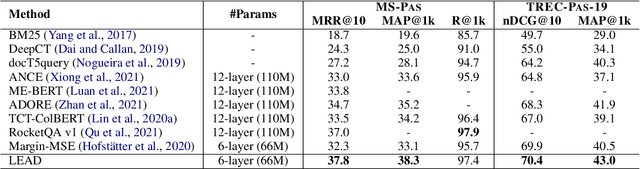


Knowledge distillation is often used to transfer knowledge from a strong teacher model to a relatively weak student model. Traditional knowledge distillation methods include response-based methods and feature-based methods. Response-based methods are used the most widely but suffer from lower upper limit of model performance, while feature-based methods have constraints on the vocabularies and tokenizers. In this paper, we propose a tokenizer-free method liberal feature-based distillation (LEAD). LEAD aligns the distribution between teacher model and student model, which is effective, extendable, portable and has no requirements on vocabularies, tokenizer, or model architecture. Extensive experiments show the effectiveness of LEAD on several widely-used benchmarks, including MS MARCO Passage, TREC Passage 19, TREC Passage 20, MS MARCO Document, TREC Document 19 and TREC Document 20.
CodeExp: Explanatory Code Document Generation
Nov 25, 2022Developing models that can automatically generate detailed code explanation can greatly benefit software maintenance and programming education. However, existing code-to-text generation models often produce only high-level summaries of code that do not capture implementation-level choices essential for these scenarios. To fill in this gap, we propose the code explanation generation task. We first conducted a human study to identify the criteria for high-quality explanatory docstring for code. Based on that, we collected and refined a large-scale code docstring corpus and formulated automatic evaluation metrics that best match human assessments. Finally, we present a multi-stage fine-tuning strategy and baseline models for the task. Our experiments show that (1) our refined training dataset lets models achieve better performance in the explanation generation tasks compared to larger unrefined data (15x larger), and (2) fine-tuned models can generate well-structured long docstrings comparable to human-written ones. We envision our training dataset, human-evaluation protocol, recommended metrics, and fine-tuning strategy can boost future code explanation research. The code and annotated data are available at https://github.com/subercui/CodeExp.
ReCo: Region-Controlled Text-to-Image Generation
Nov 23, 2022Recently, large-scale text-to-image (T2I) models have shown impressive performance in generating high-fidelity images, but with limited controllability, e.g., precisely specifying the content in a specific region with a free-form text description. In this paper, we propose an effective technique for such regional control in T2I generation. We augment T2I models' inputs with an extra set of position tokens, which represent the quantized spatial coordinates. Each region is specified by four position tokens to represent the top-left and bottom-right corners, followed by an open-ended natural language regional description. Then, we fine-tune a pre-trained T2I model with such new input interface. Our model, dubbed as ReCo (Region-Controlled T2I), enables the region control for arbitrary objects described by open-ended regional texts rather than by object labels from a constrained category set. Empirically, ReCo achieves better image quality than the T2I model strengthened by positional words (FID: 8.82->7.36, SceneFID: 15.54->6.51 on COCO), together with objects being more accurately placed, amounting to a 20.40% region classification accuracy improvement on COCO. Furthermore, we demonstrate that ReCo can better control the object count, spatial relationship, and region attributes such as color/size, with the free-form regional description. Human evaluation on PaintSkill shows that ReCo is +19.28% and +17.21% more accurate in generating images with correct object count and spatial relationship than the T2I model.