 Add to Chrome
 Add to Firefox
 Add to Edge
Robust-R1: Degradation-Aware Reasoning for Robust Visual Understanding
Dec 19, 2025
Multimodal Large Language Models struggle to maintain reliable performance under extreme real-world visual degradations, which impede their practical robustness. Existing robust MLLMs predominantly rely on implicit training/adaptation that focuses solely on visual encoder generalization, suffering from limited interpretability and isolated optimization. To overcome these limitations, we propose Robust-R1, a novel framework that explicitly models visual degradations through structured reasoning chains. Our approach integrates: (i) supervised fine-tuning for degradation-aware reasoning foundations, (ii) reward-driven alignment for accurately perceiving degradation parameters, and (iii) dynamic reasoning depth scaling adapted to degradation intensity. To facilitate this approach, we introduce a specialized 11K dataset featuring realistic degradations synthesized across four critical real-world visual processing stages, each annotated with structured chains connecting degradation parameters, perceptual influence, pristine semantic reasoning chain, and conclusion. Comprehensive evaluations demonstrate state-of-the-art robustness: Robust-R1 outperforms all general and robust baselines on the real-world degradation benchmark R-Bench, while maintaining superior anti-degradation performance under multi-intensity adversarial degradations on MMMB, MMStar, and RealWorldQA.

Toward expert-level motivational interviewing for health behavior improvement with LLMs
Dec 17, 2025Background: Motivational interviewing (MI) is an effective counseling approach for promoting health behavior change, but its impact is constrained by the need for highly trained human counselors. Objective: This study aimed to explore a scalable alternative by developing and evaluating Large Language Models for Motivational Interviewing (MI-LLMs). Methods: We first curated five Chinese psychological counseling corpora and, using GPT-4 with an MI-informed prompt, transcribed multi-turn dialogues from the two highest-quality datasets (CPsyCounD and PsyDTCorpus) into 2,040 MI-style counseling conversations, of which 2,000 were used for training and 40 for testing. Three Chinese-capable open-source LLMs (Baichuan2-7B-Chat, ChatGLM-4-9B-Chat and Llama-3-8B-Chinese-Chat-v2) were fine-tuned on this corpus and were named as MI-LLMs. We evaluated MI-LLMs using round-based automatic metrics and expert manual coding with the Motivational Interviewing Treatment Integrity (MITI) Coding Manual 4.2.1. Results: Across all three models, fine-tuning substantially improved BLEU-4 and ROUGE scores compared with the base models, and manual coding showed that MI-LLMs achieved technical and relational global scores, and MI-adherent ratios that approached those of real MI dialogues, although complex reflections and reflection-to-question ratios remained less frequent. Conclusions: These findings provide initial evidence that MI-oriented fine-tuning can endow general-purpose LLMs with core MI-consistent counseling behaviors, suggesting a scalable pathway toward AI-assisted health behavior change support while underscoring the need for further work on data scale, complex MI skills and real-world intervention trials.
JoDiffusion: Jointly Diffusing Image with Pixel-Level Annotations for Semantic Segmentation Promotion
Dec 15, 2025Given the inherently costly and time-intensive nature of pixel-level annotation, the generation of synthetic datasets comprising sufficiently diverse synthetic images paired with ground-truth pixel-level annotations has garnered increasing attention recently for training high-performance semantic segmentation models. However, existing methods necessitate to either predict pseudo annotations after image generation or generate images conditioned on manual annotation masks, which incurs image-annotation semantic inconsistency or scalability problem. To migrate both problems with one stone, we present a novel dataset generative diffusion framework for semantic segmentation, termed JoDiffusion. Firstly, given a standard latent diffusion model, JoDiffusion incorporates an independent annotation variational auto-encoder (VAE) network to map annotation masks into the latent space shared by images. Then, the diffusion model is tailored to capture the joint distribution of each image and its annotation mask conditioned on a text prompt. By doing these, JoDiffusion enables simultaneously generating paired images and semantically consistent annotation masks solely conditioned on text prompts, thereby demonstrating superior scalability. Additionally, a mask optimization strategy is developed to mitigate the annotation noise produced during generation. Experiments on Pascal VOC, COCO, and ADE20K datasets show that the annotated dataset generated by JoDiffusion yields substantial performance improvements in semantic segmentation compared to existing methods.
ProImage-Bench: Rubric-Based Evaluation for Professional Image Generation
Dec 13, 2025We study professional image generation, where a model must synthesize information-dense, scientifically precise illustrations from technical descriptions rather than merely produce visually plausible pictures. To quantify the progress, we introduce ProImage-Bench, a rubric-based benchmark that targets biology schematics, engineering/patent drawings, and general scientific diagrams. For 654 figures collected from real textbooks and technical reports, we construct detailed image instructions and a hierarchy of rubrics that decompose correctness into 6,076 criteria and 44,131 binary checks. Rubrics are derived from surrounding text and reference figures using large multimodal models, and are evaluated by an automated LMM-based judge with a principled penalty scheme that aggregates sub-question outcomes into interpretable criterion scores. We benchmark several representative text-to-image models on ProImage-Bench and find that, despite strong open-domain performance, the best base model reaches only 0.791 rubric accuracy and 0.553 criterion score overall, revealing substantial gaps in fine-grained scientific fidelity. Finally, we show that the same rubrics provide actionable supervision: feeding failed checks back into an editing model for iterative refinement boosts a strong generator from 0.653 to 0.865 in rubric accuracy and from 0.388 to 0.697 in criterion score. ProImage-Bench thus offers both a rigorous diagnostic for professional image generation and a scalable signal for improving specification-faithful scientific illustrations.
SceneMaker: Open-set 3D Scene Generation with Decoupled De-occlusion and Pose Estimation Model
Dec 11, 2025We propose a decoupled 3D scene generation framework called SceneMaker in this work. Due to the lack of sufficient open-set de-occlusion and pose estimation priors, existing methods struggle to simultaneously produce high-quality geometry and accurate poses under severe occlusion and open-set settings. To address these issues, we first decouple the de-occlusion model from 3D object generation, and enhance it by leveraging image datasets and collected de-occlusion datasets for much more diverse open-set occlusion patterns. Then, we propose a unified pose estimation model that integrates global and local mechanisms for both self-attention and cross-attention to improve accuracy. Besides, we construct an open-set 3D scene dataset to further extend the generalization of the pose estimation model. Comprehensive experiments demonstrate the superiority of our decoupled framework on both indoor and open-set scenes. Our codes and datasets is released at https://idea-research.github.io/SceneMaker/.
Photo3D: Advancing Photorealistic 3D Generation through Structure-Aligned Detail Enhancement
Dec 09, 2025Although recent 3D-native generators have made great progress in synthesizing reliable geometry, they still fall short in achieving realistic appearances. A key obstacle lies in the lack of diverse and high-quality real-world 3D assets with rich texture details, since capturing such data is intrinsically difficult due to the diverse scales of scenes, non-rigid motions of objects, and the limited precision of 3D scanners. We introduce Photo3D, a framework for advancing photorealistic 3D generation, which is driven by the image data generated by the GPT-4o-Image model. Considering that the generated images can distort 3D structures due to their lack of multi-view consistency, we design a structure-aligned multi-view synthesis pipeline and construct a detail-enhanced multi-view dataset paired with 3D geometry. Building on it, we present a realistic detail enhancement scheme that leverages perceptual feature adaptation and semantic structure matching to enforce appearance consistency with realistic details while preserving the structural consistency with the 3D-native geometry. Our scheme is general to different 3D-native generators, and we present dedicated training strategies to facilitate the optimization of geometry-texture coupled and decoupled 3D-native generation paradigms. Experiments demonstrate that Photo3D generalizes well across diverse 3D-native generation paradigms and achieves state-of-the-art photorealistic 3D generation performance.
MICo-150K: A Comprehensive Dataset Advancing Multi-Image Composition
Dec 08, 2025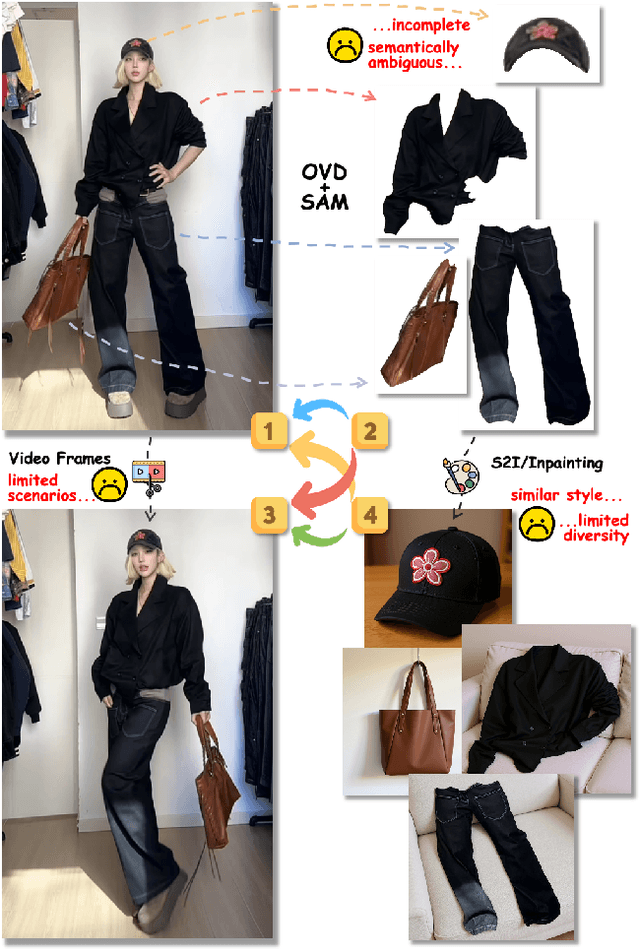
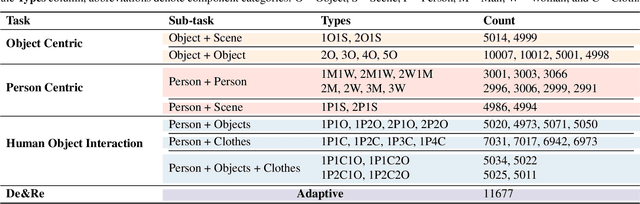
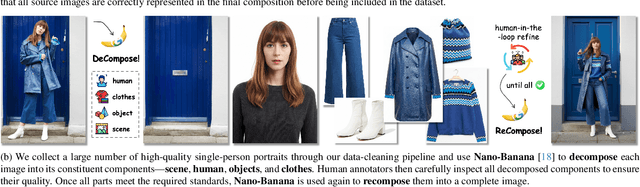
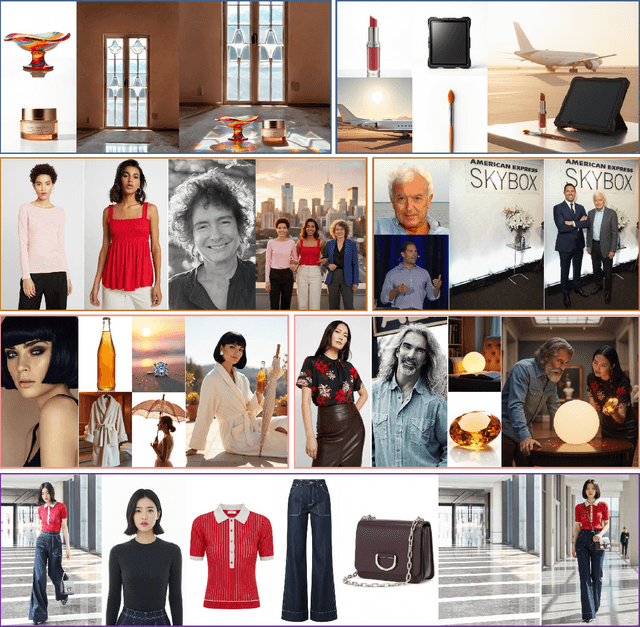
In controllable image generation, synthesizing coherent and consistent images from multiple reference inputs, i.e., Multi-Image Composition (MICo), remains a challenging problem, partly hindered by the lack of high-quality training data. To bridge this gap, we conduct a systematic study of MICo, categorizing it into 7 representative tasks and curate a large-scale collection of high-quality source images and construct diverse MICo prompts. Leveraging powerful proprietary models, we synthesize a rich amount of balanced composite images, followed by human-in-the-loop filtering and refinement, resulting in MICo-150K, a comprehensive dataset for MICo with identity consistency. We further build a Decomposition-and-Recomposition (De&Re) subset, where 11K real-world complex images are decomposed into components and recomposed, enabling both real and synthetic compositions. To enable comprehensive evaluation, we construct MICo-Bench with 100 cases per task and 300 challenging De&Re cases, and further introduce a new metric, Weighted-Ref-VIEScore, specifically tailored for MICo evaluation. Finally, we fine-tune multiple models on MICo-150K and evaluate them on MICo-Bench. The results show that MICo-150K effectively equips models without MICo capability and further enhances those with existing skills. Notably, our baseline model, Qwen-MICo, fine-tuned from Qwen-Image-Edit, matches Qwen-Image-2509 in 3-image composition while supporting arbitrary multi-image inputs beyond the latter's limitation. Our dataset, benchmark, and baseline collectively offer valuable resources for further research on Multi-Image Composition.
Unsupervised Robust Domain Adaptation: Paradigm, Theory and Algorithm
Nov 14, 2025Unsupervised domain adaptation (UDA) aims to transfer knowledge from a label-rich source domain to an unlabeled target domain by addressing domain shifts. Most UDA approaches emphasize transfer ability, but often overlook robustness against adversarial attacks. Although vanilla adversarial training (VAT) improves the robustness of deep neural networks, it has little effect on UDA. This paper focuses on answering three key questions: 1) Why does VAT, known for its defensive effectiveness, fail in the UDA paradigm? 2) What is the generalization bound theory under attacks and how does it evolve from classical UDA theory? 3) How can we implement a robustification training procedure without complex modifications? Specifically, we explore and reveal the inherent entanglement challenge in general UDA+VAT paradigm, and propose an unsupervised robust domain adaptation (URDA) paradigm. We further derive the generalization bound theory of the URDA paradigm so that it can resist adversarial noise and domain shift. To the best of our knowledge, this is the first time to establish the URDA paradigm and theory. We further introduce a simple, novel yet effective URDA algorithm called Disentangled Adversarial Robustness Training (DART), a two-step training procedure that ensures both transferability and robustness. DART first pre-trains an arbitrary UDA model, and then applies an instantaneous robustification post-training step via disentangled distillation.Experiments on four benchmark datasets with/without attacks show that DART effectively enhances robustness while maintaining domain adaptability, and validate the URDA paradigm and theory.
T-Rex-Omni: Integrating Negative Visual Prompt in Generic Object Detection
Nov 12, 2025Object detection methods have evolved from closed-set to open-set paradigms over the years. Current open-set object detectors, however, remain constrained by their exclusive reliance on positive indicators based on given prompts like text descriptions or visual exemplars. This positive-only paradigm experiences consistent vulnerability to visually similar but semantically different distractors. We propose T-Rex-Omni, a novel framework that addresses this limitation by incorporating negative visual prompts to negate hard negative distractors. Specifically, we first introduce a unified visual prompt encoder that jointly processes positive and negative visual prompts. Next, a training-free Negating Negative Computing (NNC) module is proposed to dynamically suppress negative responses during the probability computing stage. To further boost performance through fine-tuning, our Negating Negative Hinge (NNH) loss enforces discriminative margins between positive and negative embeddings. T-Rex-Omni supports flexible deployment in both positive-only and joint positive-negative inference modes, accommodating either user-specified or automatically generated negative examples. Extensive experiments demonstrate remarkable zero-shot detection performance, significantly narrowing the performance gap between visual-prompted and text-prompted methods while showing particular strength in long-tailed scenarios (51.2 AP_r on LVIS-minival). This work establishes negative prompts as a crucial new dimension for advancing open-set visual recognition systems.
DualFete: Revisiting Teacher-Student Interactions from a Feedback Perspective for Semi-supervised Medical Image Segmentation
Nov 12, 2025The teacher-student paradigm has emerged as a canonical framework in semi-supervised learning. When applied to medical image segmentation, the paradigm faces challenges due to inherent image ambiguities, making it particularly vulnerable to erroneous supervision. Crucially, the student's iterative reconfirmation of these errors leads to self-reinforcing bias. While some studies attempt to mitigate this bias, they often rely on external modifications to the conventional teacher-student framework, overlooking its intrinsic potential for error correction. In response, this work introduces a feedback mechanism into the teacher-student framework to counteract error reconfirmations. Here, the student provides feedback on the changes induced by the teacher's pseudo-labels, enabling the teacher to refine these labels accordingly. We specify that this interaction hinges on two key components: the feedback attributor, which designates pseudo-labels triggering the student's update, and the feedback receiver, which determines where to apply this feedback. Building on this, a dual-teacher feedback model is further proposed, which allows more dynamics in the feedback loop and fosters more gains by resolving disagreements through cross-teacher supervision while avoiding consistent errors. Comprehensive evaluations on three medical image benchmarks demonstrate the method's effectiveness in addressing error propagation in semi-supervised medical image segmentation.