 Add to Chrome
 Add to Firefox
 Add to Edge
Panoramic Affordance Prediction
Mar 16, 2026
Affordance prediction serves as a critical bridge between perception and action in embodied AI. However, existing research is confined to pinhole camera models, which suffer from narrow Fields of View (FoV) and fragmented observations, often missing critical holistic environmental context. In this paper, we present the first exploration into Panoramic Affordance Prediction, utilizing 360-degree imagery to capture global spatial relationships and holistic scene understanding. To facilitate this novel task, we first introduce PAP-12K, a large-scale benchmark dataset containing over 1,000 ultra-high-resolution (12k, 11904 x 5952) panoramic images with over 12k carefully annotated QA pairs and affordance masks. Furthermore, we propose PAP, a training-free, coarse-to-fine pipeline inspired by the human foveal visual system to tackle the ultra-high resolution and severe distortion inherent in panoramic images. PAP employs recursive visual routing via grid prompting to progressively locate targets, applies an adaptive gaze mechanism to rectify local geometric distortions, and utilizes a cascaded grounding pipeline to extract precise instance-level masks. Experimental results on PAP-12K reveal that existing affordance prediction methods designed for standard perspective images suffer severe performance degradation and fail due to the unique challenges of panoramic vision. In contrast, PAP framework effectively overcomes these obstacles, significantly outperforming state-of-the-art baselines and highlighting the immense potential of panoramic perception for robust embodied intelligence.

DVD: Deterministic Video Depth Estimation with Generative Priors
Mar 12, 2026Existing video depth estimation faces a fundamental trade-off: generative models suffer from stochastic geometric hallucinations and scale drift, while discriminative models demand massive labeled datasets to resolve semantic ambiguities. To break this impasse, we present DVD, the first framework to deterministically adapt pre-trained video diffusion models into single-pass depth regressors. Specifically, DVD features three core designs: (i) repurposing the diffusion timestep as a structural anchor to balance global stability with high-frequency details; (ii) latent manifold rectification (LMR) to mitigate regression-induced over-smoothing, enforcing differential constraints to restore sharp boundaries and coherent motion; and (iii) global affine coherence, an inherent property bounding inter-window divergence, which enables seamless long-video inference without requiring complex temporal alignment. Extensive experiments demonstrate that DVD achieves state-of-the-art zero-shot performance across benchmarks. Furthermore, DVD successfully unlocks the profound geometric priors implicit in video foundation models using 163x less task-specific data than leading baselines. Notably, we fully release our pipeline, providing the whole training suite for SOTA video depth estimation to benefit the open-source community.
EventVGGT: Exploring Cross-Modal Distillation for Consistent Event-based Depth Estimation
Mar 10, 2026Event cameras offer superior sensitivity to high-speed motion and extreme lighting, making event-based monocular depth estimation a promising approach for robust 3D perception in challenging conditions. However, progress is severely hindered by the scarcity of dense depth annotations. While recent annotation-free approaches mitigate this by distilling knowledge from Vision Foundation Models (VFMs), a critical limitation persists: they process event streams as independent frames. By neglecting the inherent temporal continuity of event data, these methods fail to leverage the rich temporal priors encoded in VFMs, ultimately yielding temporally inconsistent and less accurate depth predictions. To address this, we introduce EventVGGT, a novel framework that explicitly models the event stream as a coherent video sequence. To the best of our knowledge, we are the first to distill spatio-temporal and multi-view geometric priors from the Visual Geometry Grounded Transformer (VGGT) into the event domain. We achieve this via a comprehensive tri-level distillation strategy: (i) Cross-Modal Feature Mixture (CMFM) bridges the modality gap at the output level by fusing RGB and event features to generate auxiliary depth predictions; (ii) Spatio-Temporal Feature Distillation (STFD) distills VGGT's powerful spatio-temporal representations at the feature level; and (iii) Temporal Consistency Distillation (TCD) enforces cross-frame coherence at the temporal level by aligning inter-frame depth changes. Extensive experiments demonstrate that EventVGGT consistently outperforms existing methods -- reducing the absolute mean depth error at 30m by over 53\% on EventScape (from 2.30 to 1.06) -- while exhibiting robust zero-shot generalization on the unseen DENSE and MVSEC datasets.
A4-Agent: An Agentic Framework for Zero-Shot Affordance Reasoning
Dec 16, 2025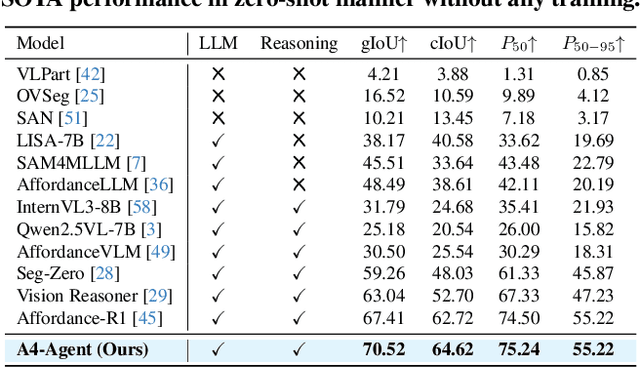
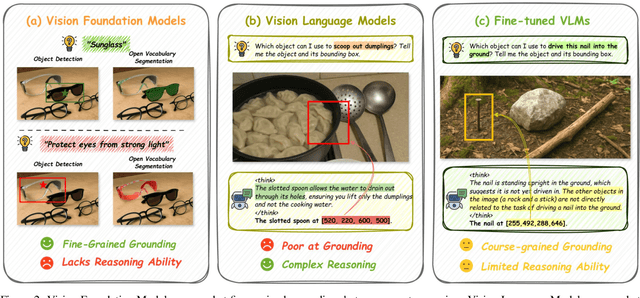
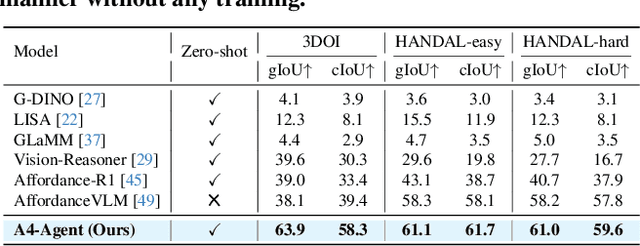
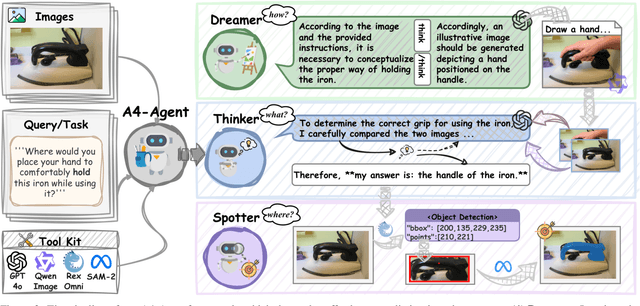
Affordance prediction, which identifies interaction regions on objects based on language instructions, is critical for embodied AI. Prevailing end-to-end models couple high-level reasoning and low-level grounding into a single monolithic pipeline and rely on training over annotated datasets, which leads to poor generalization on novel objects and unseen environments. In this paper, we move beyond this paradigm by proposing A4-Agent, a training-free agentic framework that decouples affordance prediction into a three-stage pipeline. Our framework coordinates specialized foundation models at test time: (1) a $\textbf{Dreamer}$ that employs generative models to visualize $\textit{how}$ an interaction would look; (2) a $\textbf{Thinker}$ that utilizes large vision-language models to decide $\textit{what}$ object part to interact with; and (3) a $\textbf{Spotter}$ that orchestrates vision foundation models to precisely locate $\textit{where}$ the interaction area is. By leveraging the complementary strengths of pre-trained models without any task-specific fine-tuning, our zero-shot framework significantly outperforms state-of-the-art supervised methods across multiple benchmarks and demonstrates robust generalization to real-world settings.
TiViBench: Benchmarking Think-in-Video Reasoning for Video Generative Models
Nov 17, 2025The rapid evolution of video generative models has shifted their focus from producing visually plausible outputs to tackling tasks requiring physical plausibility and logical consistency. However, despite recent breakthroughs such as Veo 3's chain-of-frames reasoning, it remains unclear whether these models can exhibit reasoning capabilities similar to large language models (LLMs). Existing benchmarks predominantly evaluate visual fidelity and temporal coherence, failing to capture higher-order reasoning abilities. To bridge this gap, we propose TiViBench, a hierarchical benchmark specifically designed to evaluate the reasoning capabilities of image-to-video (I2V) generation models. TiViBench systematically assesses reasoning across four dimensions: i) Structural Reasoning & Search, ii) Spatial & Visual Pattern Reasoning, iii) Symbolic & Logical Reasoning, and iv) Action Planning & Task Execution, spanning 24 diverse task scenarios across 3 difficulty levels. Through extensive evaluations, we show that commercial models (e.g., Sora 2, Veo 3.1) demonstrate stronger reasoning potential, while open-source models reveal untapped potential that remains hindered by limited training scale and data diversity. To further unlock this potential, we introduce VideoTPO, a simple yet effective test-time strategy inspired by preference optimization. By performing LLM self-analysis on generated candidates to identify strengths and weaknesses, VideoTPO significantly enhances reasoning performance without requiring additional training, data, or reward models. Together, TiViBench and VideoTPO pave the way for evaluating and advancing reasoning in video generation models, setting a foundation for future research in this emerging field.
T-Rex-Omni: Integrating Negative Visual Prompt in Generic Object Detection
Nov 12, 2025Object detection methods have evolved from closed-set to open-set paradigms over the years. Current open-set object detectors, however, remain constrained by their exclusive reliance on positive indicators based on given prompts like text descriptions or visual exemplars. This positive-only paradigm experiences consistent vulnerability to visually similar but semantically different distractors. We propose T-Rex-Omni, a novel framework that addresses this limitation by incorporating negative visual prompts to negate hard negative distractors. Specifically, we first introduce a unified visual prompt encoder that jointly processes positive and negative visual prompts. Next, a training-free Negating Negative Computing (NNC) module is proposed to dynamically suppress negative responses during the probability computing stage. To further boost performance through fine-tuning, our Negating Negative Hinge (NNH) loss enforces discriminative margins between positive and negative embeddings. T-Rex-Omni supports flexible deployment in both positive-only and joint positive-negative inference modes, accommodating either user-specified or automatically generated negative examples. Extensive experiments demonstrate remarkable zero-shot detection performance, significantly narrowing the performance gap between visual-prompted and text-prompted methods while showing particular strength in long-tailed scenarios (51.2 AP_r on LVIS-minival). This work establishes negative prompts as a crucial new dimension for advancing open-set visual recognition systems.
PhysToolBench: Benchmarking Physical Tool Understanding for MLLMs
Oct 10, 2025The ability to use, understand, and create tools is a hallmark of human intelligence, enabling sophisticated interaction with the physical world. For any general-purpose intelligent agent to achieve true versatility, it must also master these fundamental skills. While modern Multimodal Large Language Models (MLLMs) leverage their extensive common knowledge for high-level planning in embodied AI and in downstream Vision-Language-Action (VLA) models, the extent of their true understanding of physical tools remains unquantified. To bridge this gap, we present PhysToolBench, the first benchmark dedicated to evaluating the comprehension of physical tools by MLLMs. Our benchmark is structured as a Visual Question Answering (VQA) dataset comprising over 1,000 image-text pairs. It assesses capabilities across three distinct difficulty levels: (1) Tool Recognition: Requiring the recognition of a tool's primary function. (2) Tool Understanding: Testing the ability to grasp the underlying principles of a tool's operation. (3) Tool Creation: Challenging the model to fashion a new tool from surrounding objects when conventional options are unavailable. Our comprehensive evaluation of 32 MLLMs-spanning proprietary, open-source, specialized embodied, and backbones in VLAs-reveals a significant deficiency in tool understanding. Furthermore, we provide an in-depth analysis and propose preliminary solutions. Code and dataset are publicly available.
Hierarchical Vision-Language Learning for Medical Out-of-Distribution Detection
Aug 25, 2025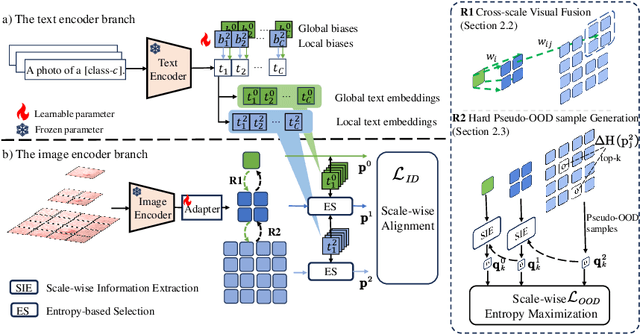
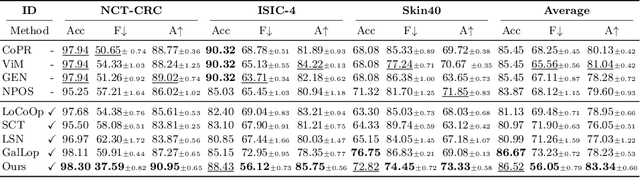
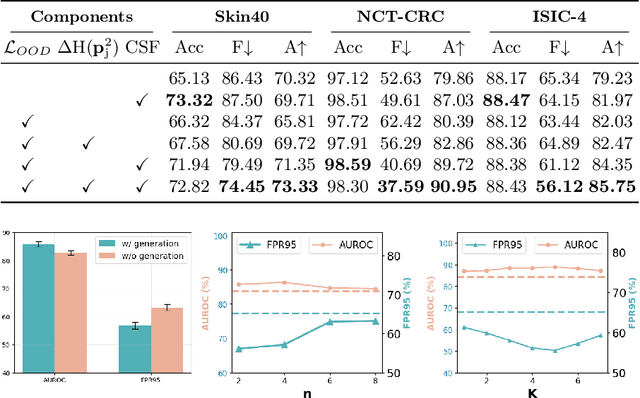
In trustworthy medical diagnosis systems, integrating out-of-distribution (OOD) detection aims to identify unknown diseases in samples, thereby mitigating the risk of misdiagnosis. In this study, we propose a novel OOD detection framework based on vision-language models (VLMs), which integrates hierarchical visual information to cope with challenging unknown diseases that resemble known diseases. Specifically, a cross-scale visual fusion strategy is proposed to couple visual embeddings from multiple scales. This enriches the detailed representation of medical images and thus improves the discrimination of unknown diseases. Moreover, a cross-scale hard pseudo-OOD sample generation strategy is proposed to benefit OOD detection maximally. Experimental evaluations on three public medical datasets support that the proposed framework achieves superior OOD detection performance compared to existing methods. The source code is available at https://openi.pcl.ac.cn/OpenMedIA/HVL.
DiMeR: Disentangled Mesh Reconstruction Model
Apr 24, 2025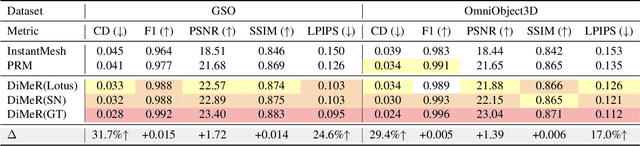
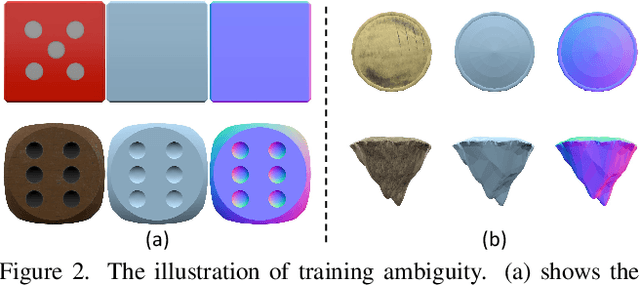
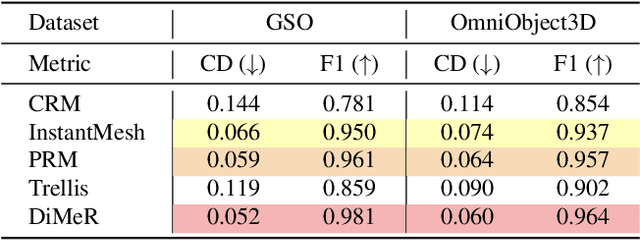
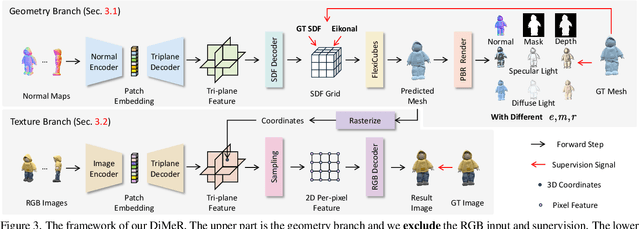
With the advent of large-scale 3D datasets, feed-forward 3D generative models, such as the Large Reconstruction Model (LRM), have gained significant attention and achieved remarkable success. However, we observe that RGB images often lead to conflicting training objectives and lack the necessary clarity for geometry reconstruction. In this paper, we revisit the inductive biases associated with mesh reconstruction and introduce DiMeR, a novel disentangled dual-stream feed-forward model for sparse-view mesh reconstruction. The key idea is to disentangle both the input and framework into geometry and texture parts, thereby reducing the training difficulty for each part according to the Principle of Occam's Razor. Given that normal maps are strictly consistent with geometry and accurately capture surface variations, we utilize normal maps as exclusive input for the geometry branch to reduce the complexity between the network's input and output. Moreover, we improve the mesh extraction algorithm to introduce 3D ground truth supervision. As for texture branch, we use RGB images as input to obtain the textured mesh. Overall, DiMeR demonstrates robust capabilities across various tasks, including sparse-view reconstruction, single-image-to-3D, and text-to-3D. Numerous experiments show that DiMeR significantly outperforms previous methods, achieving over 30% improvement in Chamfer Distance on the GSO and OmniObject3D dataset.
Path-adaptive Spatio-Temporal State Space Model for Event-based Recognition with Arbitrary Duration
Sep 25, 2024Event cameras are bio-inspired sensors that capture the intensity changes asynchronously and output event streams with distinct advantages, such as high temporal resolution. To exploit event cameras for object/action recognition, existing methods predominantly sample and aggregate events in a second-level duration at every fixed temporal interval (or frequency). However, they often face difficulties in capturing the spatiotemporal relationships for longer, e.g., minute-level, events and generalizing across varying temporal frequencies. To fill the gap, we present a novel framework, dubbed PAST-SSM, exhibiting superior capacity in recognizing events with arbitrary duration (e.g., 0.1s to 4.5s) and generalizing to varying inference frequencies. Our key insight is to learn the spatiotemporal relationships from the encoded event features via the state space model (SSM) -- whose linear complexity makes it ideal for modeling high temporal resolution events with longer sequences. To achieve this goal, we first propose a Path-Adaptive Event Aggregation and Scan (PEAS) module to encode events of varying duration into features with fixed dimensions by adaptively scanning and selecting aggregated event frames. On top of PEAS, we introduce a novel Multi-faceted Selection Guiding (MSG) loss to minimize the randomness and redundancy of the encoded features. This subtly enhances the model generalization across different inference frequencies. Lastly, the SSM is employed to better learn the spatiotemporal properties from the encoded features. Moreover, we build a minute-level event-based recognition dataset, named ArDVS100, with arbitrary duration for the benefit of the community. Extensive experiments prove that our method outperforms prior arts by +3.45%, +0.38% and +8.31% on the DVS Action, SeAct and HARDVS datasets, respectively.