 Add to Chrome
 Add to Firefox
 Add to Edge
ScaleHP: Estimating Hand Pose in Metric Space
Jun 24, 2026
Accurate metric-space hand pose estimation (HPE) is essential for immersive human-computer interaction and robotics. However, most existing methods predict poses in a root-relative coordinate system and cannot estimate the hand in absolute metric scale. In this work, we observe that the intrinsic proportional relationships among human hand bones encode stable anthropometric priors that implicitly correlate with the overall metric size of the hand. Leveraging this insight, we present ScaleHP, an end-to-end one-stage hand pose estimation framework that bypasses fragile extrinsic depth modules to recover the hand in metric space. ScaleHP employs a transformer-based decoder with a novel scale token to fuse multi-scale morphological and appearance features. By solving for metric coordinates through a perspective-constrained least-squares approach, we achieve high-precision pose estimation in the camera coordinate system. ScaleHP delivers state-of-the-art performance, including 35.8 CS-MPJPE on FreiHand and 4.6/5.9 PA-MPJPE on DexYCB and HO3Dv3. These results demonstrate that internal biological constraints significantly reduce relative geometry and absolute metric errors, offering a robust solution for generalized, real-world hand tracking.

SceneParser: Hierarchical Scene Parsing for Visual Semantics Understanding
May 14, 2026General scene perception has progressed from object recognition toward open-vocabulary grounding, part localization, and affordance prediction. Yet these capabilities are often realized as isolated predictions that localize objects, parts, or interaction points without capturing the structured dependencies needed for interaction-oriented scene understanding. To address this gap, we introduce Hierarchical Scene Parsing, an interaction-oriented parsing task that represents physical scenes as explicit scene -> object -> part -> affordance hierarchies with cross-level bindings. We instantiate this task with SceneParser, a VLM-based parser trained for unified hierarchical generation with structural-completion pseudo labels and curriculum learning. To support training and evaluation, we construct SceneParser-Bench, a large-scale benchmark built with a scalable hierarchical data engine, containing 110K training images, a 5K validation split, 777K objects, 1.14M parts, 1.74M affordance annotations, and 1.74M valid object-part-affordance chain instances. We further introduce Level-1 to Level-3 conditional metrics and ParseRate to evaluate localization, cross-level binding, and hierarchical completeness. Experiments show that existing MLLMs and perception-stitching pipelines struggle with hierarchical parsing on our SceneParser-Bench, while SceneParser achieves stronger structure-aware performance. Besides, ablations, evaluations on COCO and AGD20K, and a downstream planning probe demonstrate that our SceneParser is compatible with conventional tasks and provides an actionable representation for visual understanding.
Guide, Think, Act: Interactive Embodied Reasoning in Vision-Language-Action Models
May 13, 2026In this paper, we propose GTA-VLA(Guide, Think, Act), an interactive Vision-Language-Action (VLA) framework that enables spatially steerable embodied reasoning by allowing users to guide robot policies with explicit visual cues. Existing VLA models learn a direct "Sense-to-Act" mapping from multimodal observations to robot actions. While effective within the training distribution, such tightly coupled policies are brittle under out-of-domain (OOD) shifts and difficult to correct when failures occur. Although recent embodied Chain-of-Thought (CoT) approaches expose intermediate reasoning, they still lack a mechanism for incorporating human spatial guidance, limiting their ability to resolve visual ambiguities or recover from mistakes. To address this gap, our framework allows users to optionally guide the policy with spatial priors, such as affordance points, boxes, and traces, which the subsequent reasoning process can directly condition on. Based on these inputs, the model generates a unified spatial-visual Chain-of-Thought that integrates external guidance with internal task planning, aligning human visual intent with autonomous decision-making. For practical deployment, we further couple the reasoning module with a lightweight reactive action head for efficient action execution. Extensive experiments demonstrate the effectiveness of our approach. On the in-domain SimplerEnv WidowX benchmark, our framework achieves a state-of-the-art 81.2% success rate. Under OOD visual shifts and spatial ambiguities, a single visual interaction substantially improves task success over existing methods, highlighting the value of interactive reasoning for failure recovery in embodied control. Details of the project can be found here: https://signalispupupu.github.io/GTA-VLA_ProjPage/
V-Reflection: Transforming MLLMs from Passive Observers to Active Interrogators
Mar 31, 2026Multimodal Large Language Models (MLLMs) have achieved remarkable success, yet they remain prone to perception-related hallucinations in fine-grained tasks. This vulnerability arises from a fundamental limitation: their reasoning is largely restricted to the language domain, treating visual input as a static, reasoning-agnostic preamble rather than a dynamic participant. Consequently, current models act as passive observers, unable to re-examine visual details to ground their evolving reasoning states. To overcome this, we propose V-Reflection, a framework that transforms the MLLM into an active interrogator through a "think-then-look" visual reflection mechanism. During reasoning, latent states function as dynamic probes that actively interrogate the visual feature space, grounding each reasoning step for task-critical evidence. Our approach employs a two-stage distillation strategy. First, the Box-Guided Compression (BCM) module establishes stable pixel-to-latent targets through explicit spatial grounding. Next, a Dynamic Autoregressive Compression (DAC) module maps the model's hidden states into dynamic probes that interrogate the global visual feature map. By distilling the spatial expertise of the BCM teacher into the DAC student, V-Reflection internalizes the ability to localize task-critical evidence. During inference, both modules remain entirely inactive, maintaining a purely end-to-end autoregressive decoding in the latent space with optimal efficiency. Extensive experiments demonstrate the effectiveness of our V-Reflection across six perception-intensive benchmarks, significantly narrowing the fine-grained perception gap. Visualizations confirm that latent reasoning autonomously localizes task-critical visual evidence.
SoPE: Spherical Coordinate-Based Positional Embedding for Enhancing Spatial Perception of 3D LVLMs
Feb 26, 20263D Large Vision-Language Models (3D LVLMs) built upon Large Language Models (LLMs) have achieved remarkable progress across various multimodal tasks. However, their inherited position-dependent modeling mechanism, Rotary Position Embedding (RoPE), remains suboptimal for 3D multimodal understanding. The vanilla RoPE formulation fails to preserve essential three-dimensional spatial structures when encoding 3D tokens, and its relative distance computation overlooks angular dependencies, hindering the model's ability to capture directional variations in visual representations. To overcome these limitations, we introduce Spherical Coordinate-based Positional Embedding (SoPE). Our method maps point-cloud token indices into a 3D spherical coordinate space, enabling unified modeling of spatial locations and directional angles. This formulation preserves the inherent geometric structure of point-cloud data, enhances spatial awareness, and yields more consistent and expressive geometric representations for multimodal learning. In addition, we introduce a multi-scale frequency mixing strategy to fuse feature information across different frequency domains. Experimental results on multiple 3D scene benchmarks validate the effectiveness of our approach, while real-world deployment experiments further demonstrate its strong generalization capability.
T-Rex-Omni: Integrating Negative Visual Prompt in Generic Object Detection
Nov 12, 2025Object detection methods have evolved from closed-set to open-set paradigms over the years. Current open-set object detectors, however, remain constrained by their exclusive reliance on positive indicators based on given prompts like text descriptions or visual exemplars. This positive-only paradigm experiences consistent vulnerability to visually similar but semantically different distractors. We propose T-Rex-Omni, a novel framework that addresses this limitation by incorporating negative visual prompts to negate hard negative distractors. Specifically, we first introduce a unified visual prompt encoder that jointly processes positive and negative visual prompts. Next, a training-free Negating Negative Computing (NNC) module is proposed to dynamically suppress negative responses during the probability computing stage. To further boost performance through fine-tuning, our Negating Negative Hinge (NNH) loss enforces discriminative margins between positive and negative embeddings. T-Rex-Omni supports flexible deployment in both positive-only and joint positive-negative inference modes, accommodating either user-specified or automatically generated negative examples. Extensive experiments demonstrate remarkable zero-shot detection performance, significantly narrowing the performance gap between visual-prompted and text-prompted methods while showing particular strength in long-tailed scenarios (51.2 AP_r on LVIS-minival). This work establishes negative prompts as a crucial new dimension for advancing open-set visual recognition systems.
Detect Anything via Next Point Prediction
Oct 14, 2025Object detection has long been dominated by traditional coordinate regression-based models, such as YOLO, DETR, and Grounding DINO. Although recent efforts have attempted to leverage MLLMs to tackle this task, they face challenges like low recall rate, duplicate predictions, coordinate misalignment, etc. In this work, we bridge this gap and propose Rex-Omni, a 3B-scale MLLM that achieves state-of-the-art object perception performance. On benchmarks like COCO and LVIS, Rex-Omni attains performance comparable to or exceeding regression-based models (e.g., DINO, Grounding DINO) in a zero-shot setting. This is enabled by three key designs: 1) Task Formulation: we use special tokens to represent quantized coordinates from 0 to 999, reducing the model's learning difficulty and improving token efficiency for coordinate prediction; 2) Data Engines: we construct multiple data engines to generate high-quality grounding, referring, and pointing data, providing semantically rich supervision for training; \3) Training Pipelines: we employ a two-stage training process, combining supervised fine-tuning on 22 million data with GRPO-based reinforcement post-training. This RL post-training leverages geometry-aware rewards to effectively bridge the discrete-to-continuous coordinate prediction gap, improve box accuracy, and mitigate undesirable behaviors like duplicate predictions that stem from the teacher-guided nature of the initial SFT stage. Beyond conventional detection, Rex-Omni's inherent language understanding enables versatile capabilities such as object referring, pointing, visual prompting, GUI grounding, spatial referring, OCR and key-pointing, all systematically evaluated on dedicated benchmarks. We believe that Rex-Omni paves the way for more versatile and language-aware visual perception systems.
Rex-Thinker: Grounded Object Referring via Chain-of-Thought Reasoning
Jun 04, 2025Object referring aims to detect all objects in an image that match a given natural language description. We argue that a robust object referring model should be grounded, meaning its predictions should be both explainable and faithful to the visual content. Specifically, it should satisfy two key properties: 1) Verifiable, by producing interpretable reasoning that justifies its predictions and clearly links them to visual evidence; and 2) Trustworthy, by learning to abstain when no object in the image satisfies the given expression. However, most methods treat referring as a direct bounding box prediction task, offering limited interpretability and struggling to reject expressions with no matching object. In this work, we propose Rex-Thinker, a model that formulates object referring as an explicit CoT reasoning task. Given a referring expression, we first identify all candidate object instances corresponding to the referred object category. Rex-Thinker then performs step-by-step reasoning over each candidate to assess whether it matches the given expression, before making a final prediction. To support this paradigm, we construct a large-scale CoT-style referring dataset named HumanRef-CoT by prompting GPT-4o on the HumanRef dataset. Each reasoning trace follows a structured planning, action, and summarization format, enabling the model to learn decomposed, interpretable reasoning over object candidates. We then train Rex-Thinker in two stages: a cold-start supervised fine-tuning phase to teach the model how to perform structured reasoning, followed by GRPO-based RL learning to improve accuracy and generalization. Experiments show that our approach outperforms standard baselines in both precision and interpretability on in-domain evaluation, while also demonstrating improved ability to reject hallucinated outputs and strong generalization in out-of-domain settings.
Referring to Any Person
Mar 11, 2025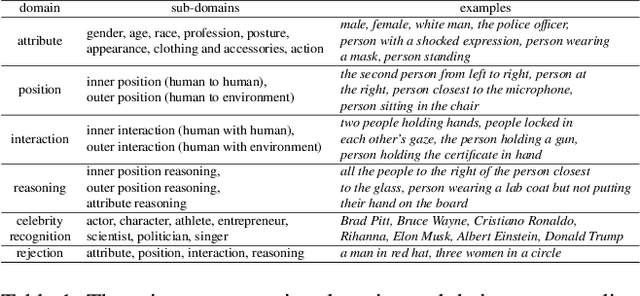
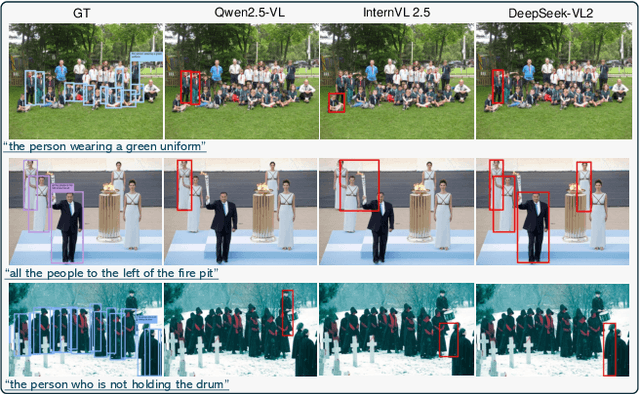
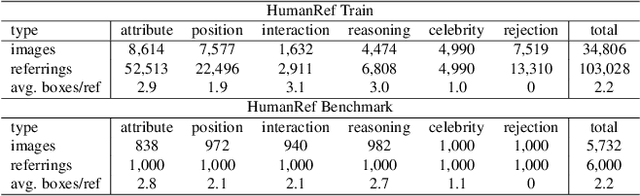
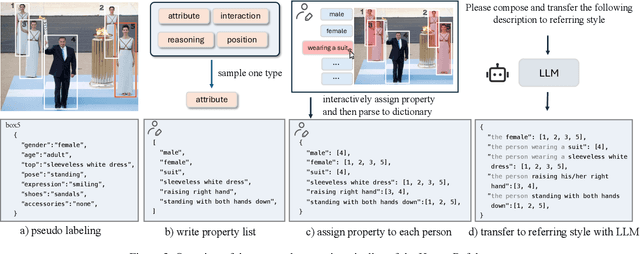
Humans are undoubtedly the most important participants in computer vision, and the ability to detect any individual given a natural language description, a task we define as referring to any person, holds substantial practical value. However, we find that existing models generally fail to achieve real-world usability, and current benchmarks are limited by their focus on one-to-one referring, that hinder progress in this area. In this work, we revisit this task from three critical perspectives: task definition, dataset design, and model architecture. We first identify five aspects of referable entities and three distinctive characteristics of this task. Next, we introduce HumanRef, a novel dataset designed to tackle these challenges and better reflect real-world applications. From a model design perspective, we integrate a multimodal large language model with an object detection framework, constructing a robust referring model named RexSeek. Experimental results reveal that state-of-the-art models, which perform well on commonly used benchmarks like RefCOCO/+/g, struggle with HumanRef due to their inability to detect multiple individuals. In contrast, RexSeek not only excels in human referring but also generalizes effectively to common object referring, making it broadly applicable across various perception tasks. Code is available at https://github.com/IDEA-Research/RexSeek
ChatRex: Taming Multimodal LLM for Joint Perception and Understanding
Dec 02, 2024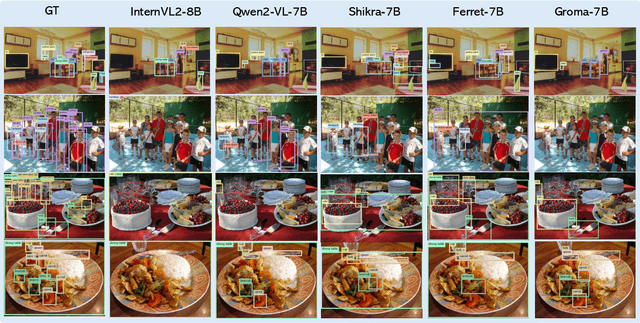
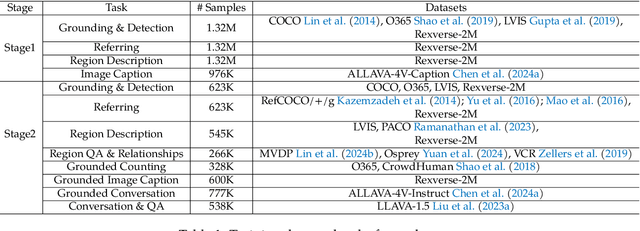
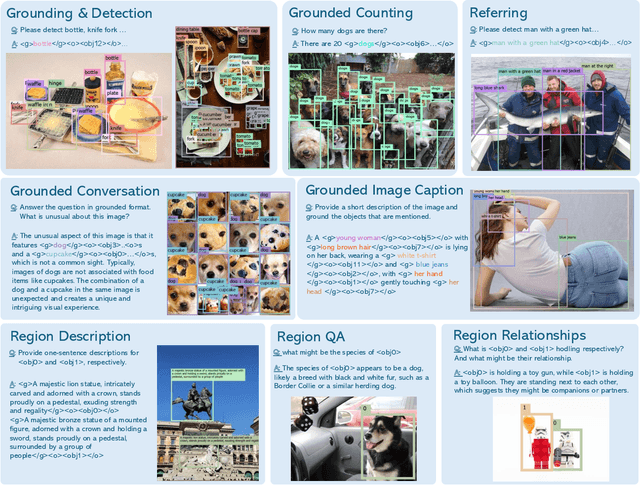
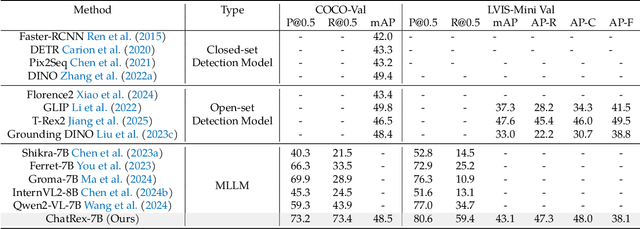
Perception and understanding are two pillars of computer vision. While multimodal large language models (MLLM) have demonstrated remarkable visual understanding capabilities, they arguably lack accurate perception abilities, e.g. the stage-of-the-art model Qwen2-VL only achieves a 43.9 recall rate on the COCO dataset, limiting many tasks requiring the combination of perception and understanding. In this work, we aim to bridge this perception gap from both model designing and data development perspectives. We first introduce ChatRex, an MLLM with a decoupled perception design. Instead of having the LLM directly predict box coordinates, we feed the output boxes from a universal proposal network into the LLM, allowing it to output the corresponding box indices to represent its detection results, turning the regression task into a retrieval-based task that LLM handles more proficiently. From the data perspective, we build a fully automated data engine and construct the Rexverse-2M dataset which possesses multiple granularities to support the joint training of perception and understanding. After standard two-stage training, ChatRex demonstrates strong perception capabilities while preserving multimodal understanding performance. The combination of these two capabilities simultaneously unlocks many attractive applications, demonstrating the complementary roles of both perception and understanding in MLLM. Code is available at \url{https://github.com/IDEA-Research/ChatRex}.