 Add to Chrome
 Add to Firefox
 Add to Edge
Argus: Reorchestrating Static Analysis via a Multi-Agent Ensemble for Full-Chain Security Vulnerability Detection
Apr 08, 2026
Recent advancements in Large Language Models (LLMs) have sparked interest in their application to Static Application Security Testing (SAST), primarily due to their superior contextual reasoning capabilities compared to traditional symbolic or rule-based methods. However, existing LLM-based approaches typically attempt to replace human experts directly without integrating effectively with existing SAST tools. This lack of integration results in ineffectiveness, including high rates of false positives, hallucinations, limited reasoning depth, and excessive token usage, making them impractical for industrial deployment. To overcome these limitations, we present a paradigm shift that reorchestrates the SAST workflow from current LLM-assisted structure to a new LLM-centered workflow. We introduce Argus (Agentic and Retrieval-Augmented Guarding System), the first multi-agent framework designed specifically for vulnerability detection. Argus incorporates three key novelties: comprehensive supply chain analysis, collaborative multi-agent workflows, and the integration of state-of-the-art techniques such as Retrieval-Augmented Generation (RAG) and ReAct to minimize hallucinations and enhance reasoning. Extensive empirical evaluation demonstrates that Argus significantly outperforms existing methods by detecting a higher volume of true vulnerabilities while simultaneously reducing false positives and operational costs. Notably, Argus has identified several critical zero-day vulnerabilities with CVE assignments.

Robust-R1: Degradation-Aware Reasoning for Robust Visual Understanding
Dec 19, 2025Multimodal Large Language Models struggle to maintain reliable performance under extreme real-world visual degradations, which impede their practical robustness. Existing robust MLLMs predominantly rely on implicit training/adaptation that focuses solely on visual encoder generalization, suffering from limited interpretability and isolated optimization. To overcome these limitations, we propose Robust-R1, a novel framework that explicitly models visual degradations through structured reasoning chains. Our approach integrates: (i) supervised fine-tuning for degradation-aware reasoning foundations, (ii) reward-driven alignment for accurately perceiving degradation parameters, and (iii) dynamic reasoning depth scaling adapted to degradation intensity. To facilitate this approach, we introduce a specialized 11K dataset featuring realistic degradations synthesized across four critical real-world visual processing stages, each annotated with structured chains connecting degradation parameters, perceptual influence, pristine semantic reasoning chain, and conclusion. Comprehensive evaluations demonstrate state-of-the-art robustness: Robust-R1 outperforms all general and robust baselines on the real-world degradation benchmark R-Bench, while maintaining superior anti-degradation performance under multi-intensity adversarial degradations on MMMB, MMStar, and RealWorldQA.
Compliance-to-Code: Enhancing Financial Compliance Checking via Code Generation
May 26, 2025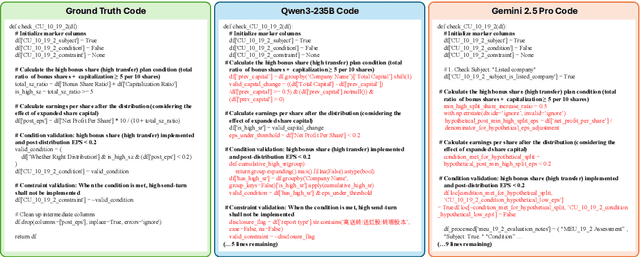
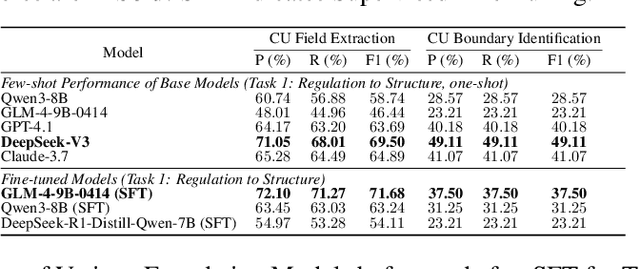
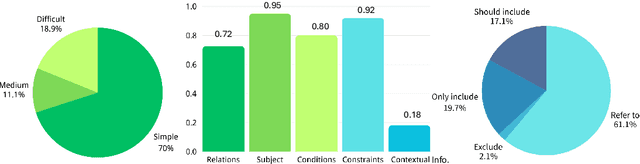
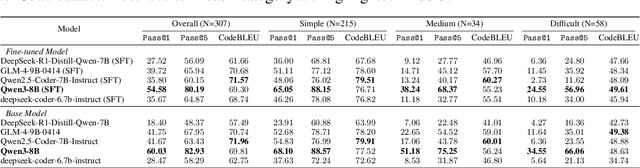
Nowadays, regulatory compliance has become a cornerstone of corporate governance, ensuring adherence to systematic legal frameworks. At its core, financial regulations often comprise highly intricate provisions, layered logical structures, and numerous exceptions, which inevitably result in labor-intensive or comprehension challenges. To mitigate this, recent Regulatory Technology (RegTech) and Large Language Models (LLMs) have gained significant attention in automating the conversion of regulatory text into executable compliance logic. However, their performance remains suboptimal particularly when applied to Chinese-language financial regulations, due to three key limitations: (1) incomplete domain-specific knowledge representation, (2) insufficient hierarchical reasoning capabilities, and (3) failure to maintain temporal and logical coherence. One promising solution is to develop a domain specific and code-oriented datasets for model training. Existing datasets such as LexGLUE, LegalBench, and CODE-ACCORD are often English-focused, domain-mismatched, or lack fine-grained granularity for compliance code generation. To fill these gaps, we present Compliance-to-Code, the first large-scale Chinese dataset dedicated to financial regulatory compliance. Covering 1,159 annotated clauses from 361 regulations across ten categories, each clause is modularly structured with four logical elements-subject, condition, constraint, and contextual information-along with regulation relations. We provide deterministic Python code mappings, detailed code reasoning, and code explanations to facilitate automated auditing. To demonstrate utility, we present FinCheck: a pipeline for regulation structuring, code generation, and report generation.