 Add to Chrome
 Add to Firefox
 Add to Edge
Generation Enhances Understanding in Unified Multimodal Models via Multi-Representation Generation
Jan 29, 2026
Unified Multimodal Models (UMMs) integrate both visual understanding and generation within a single framework. Their ultimate aspiration is to create a cycle where understanding and generation mutually reinforce each other. While recent post-training methods have successfully leveraged understanding to enhance generation, the reverse direction of utilizing generation to improve understanding remains largely unexplored. In this work, we propose UniMRG (Unified Multi-Representation Generation), a simple yet effective architecture-agnostic post-training method. UniMRG enhances the understanding capabilities of UMMs by incorporating auxiliary generation tasks. Specifically, we train UMMs to generate multiple intrinsic representations of input images, namely pixel (reconstruction), depth (geometry), and segmentation (structure), alongside standard visual understanding objectives. By synthesizing these diverse representations, UMMs capture complementary information regarding appearance, spatial relations, and structural layout. Consequently, UMMs develop a deeper and more comprehensive understanding of visual inputs. Extensive experiments across diverse UMM architectures demonstrate that our method notably enhances fine-grained perception, reduces hallucinations, and improves spatial understanding, while simultaneously boosting generation capabilities.

MICo-150K: A Comprehensive Dataset Advancing Multi-Image Composition
Dec 08, 2025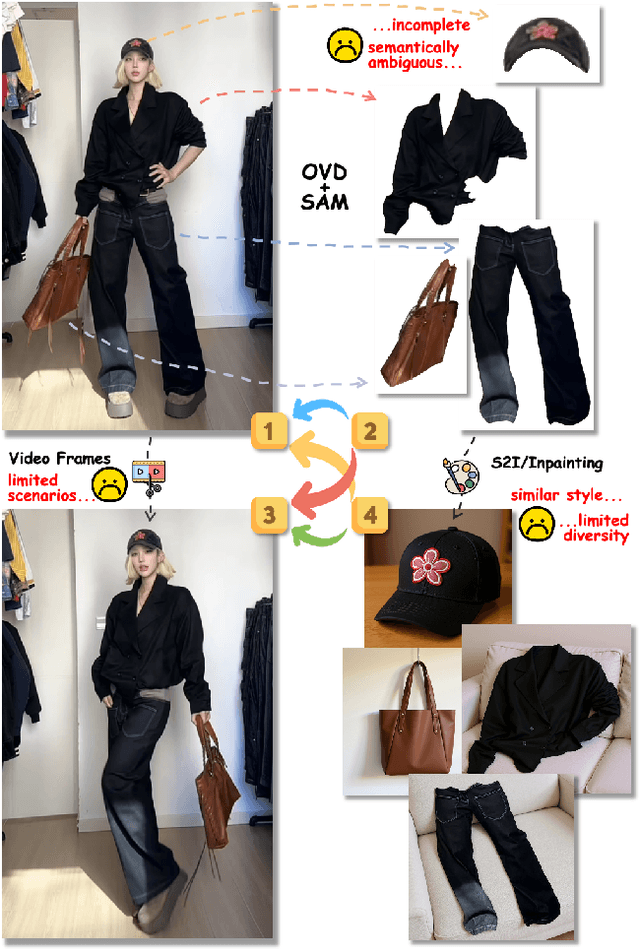
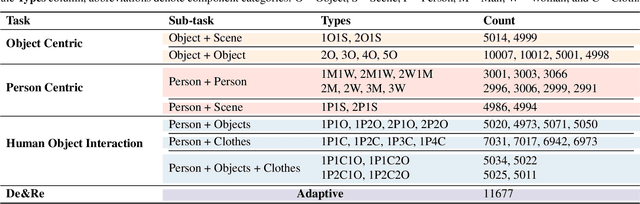
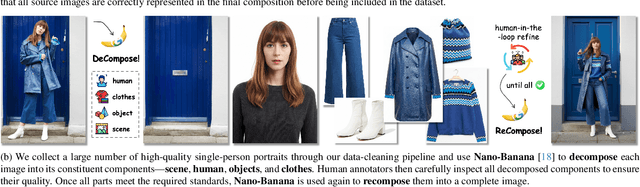
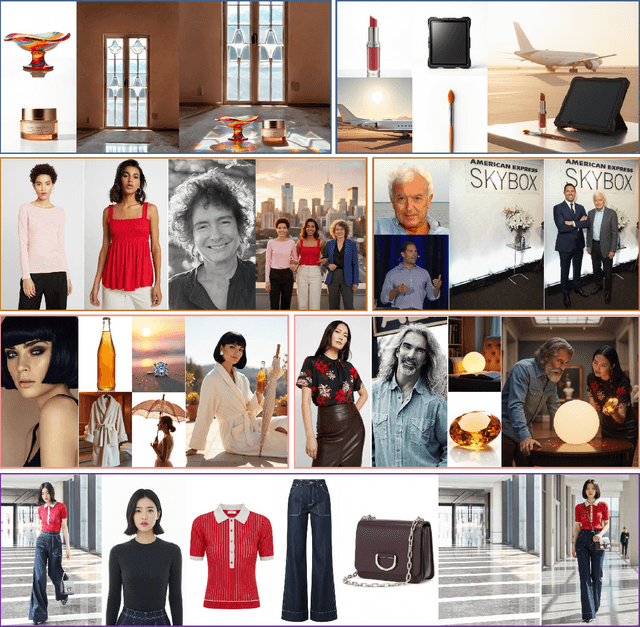
In controllable image generation, synthesizing coherent and consistent images from multiple reference inputs, i.e., Multi-Image Composition (MICo), remains a challenging problem, partly hindered by the lack of high-quality training data. To bridge this gap, we conduct a systematic study of MICo, categorizing it into 7 representative tasks and curate a large-scale collection of high-quality source images and construct diverse MICo prompts. Leveraging powerful proprietary models, we synthesize a rich amount of balanced composite images, followed by human-in-the-loop filtering and refinement, resulting in MICo-150K, a comprehensive dataset for MICo with identity consistency. We further build a Decomposition-and-Recomposition (De&Re) subset, where 11K real-world complex images are decomposed into components and recomposed, enabling both real and synthetic compositions. To enable comprehensive evaluation, we construct MICo-Bench with 100 cases per task and 300 challenging De&Re cases, and further introduce a new metric, Weighted-Ref-VIEScore, specifically tailored for MICo evaluation. Finally, we fine-tune multiple models on MICo-150K and evaluate them on MICo-Bench. The results show that MICo-150K effectively equips models without MICo capability and further enhances those with existing skills. Notably, our baseline model, Qwen-MICo, fine-tuned from Qwen-Image-Edit, matches Qwen-Image-2509 in 3-image composition while supporting arbitrary multi-image inputs beyond the latter's limitation. Our dataset, benchmark, and baseline collectively offer valuable resources for further research on Multi-Image Composition.
LayerT2V: Interactive Multi-Object Trajectory Layering for Video Generation
Aug 06, 2025Controlling object motion trajectories in Text-to-Video (T2V) generation is a challenging and relatively under-explored area, particularly in scenarios involving multiple moving objects. Most community models and datasets in the T2V domain are designed for single-object motion, limiting the performance of current generative models in multi-object tasks. Additionally, existing motion control methods in T2V either lack support for multi-object motion scenes or experience severe performance degradation when object trajectories intersect, primarily due to the semantic conflicts in colliding regions. To address these limitations, we introduce LayerT2V, the first approach for generating video by compositing background and foreground objects layer by layer. This layered generation enables flexible integration of multiple independent elements within a video, positioning each element on a distinct "layer" and thus facilitating coherent multi-object synthesis while enhancing control over the generation process. Extensive experiments demonstrate the superiority of LayerT2V in generating complex multi-object scenarios, showcasing 1.4x and 4.5x improvements in mIoU and AP50 metrics over state-of-the-art (SOTA) methods. Project page and code are available at https://kr-panghu.github.io/LayerT2V/ .