 Add to Chrome
 Add to Firefox
 Add to Edge
AdaptCLIP: Adapting CLIP for Universal Visual Anomaly Detection
May 15, 2025
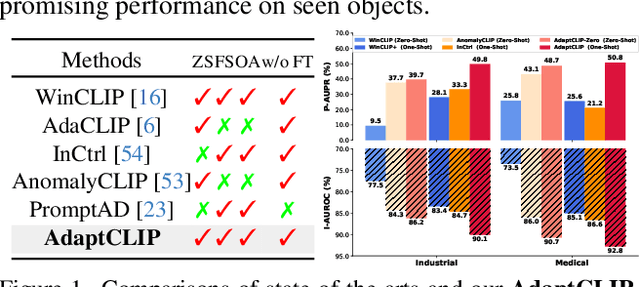
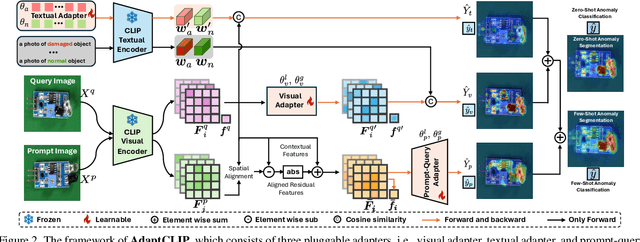
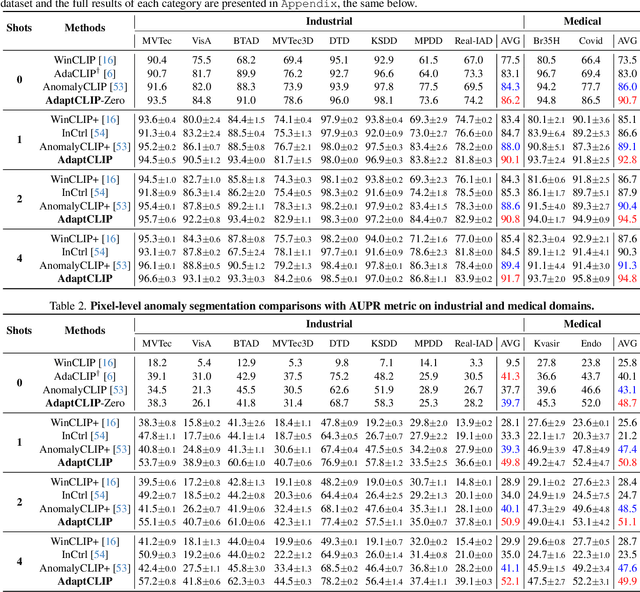
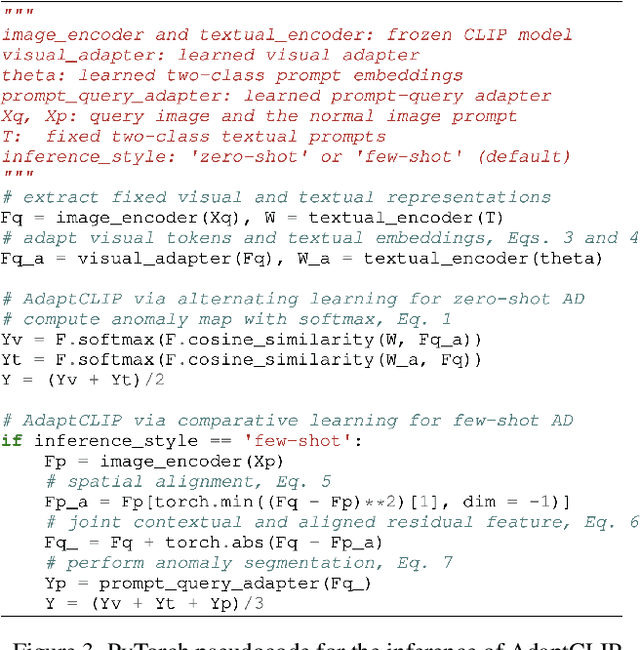
Universal visual anomaly detection aims to identify anomalies from novel or unseen vision domains without additional fine-tuning, which is critical in open scenarios. Recent studies have demonstrated that pre-trained vision-language models like CLIP exhibit strong generalization with just zero or a few normal images. However, existing methods struggle with designing prompt templates, complex token interactions, or requiring additional fine-tuning, resulting in limited flexibility. In this work, we present a simple yet effective method called AdaptCLIP based on two key insights. First, adaptive visual and textual representations should be learned alternately rather than jointly. Second, comparative learning between query and normal image prompt should incorporate both contextual and aligned residual features, rather than relying solely on residual features. AdaptCLIP treats CLIP models as a foundational service, adding only three simple adapters, visual adapter, textual adapter, and prompt-query adapter, at its input or output ends. AdaptCLIP supports zero-/few-shot generalization across domains and possesses a training-free manner on target domains once trained on a base dataset. AdaptCLIP achieves state-of-the-art performance on 12 anomaly detection benchmarks from industrial and medical domains, significantly outperforming existing competitive methods. We will make the code and model of AdaptCLIP available at https://github.com/gaobb/AdaptCLIP.

Seasonal Forecasting of Pan-Arctic Sea Ice with State Space Model
May 15, 2025The rapid decline of Arctic sea ice resulting from anthropogenic climate change poses significant risks to indigenous communities, ecosystems, and the global climate system. This situation emphasizes the immediate necessity for precise seasonal sea ice forecasts. While dynamical models perform well for short-term forecasts, they encounter limitations in long-term forecasts and are computationally intensive. Deep learning models, while more computationally efficient, often have difficulty managing seasonal variations and uncertainties when dealing with complex sea ice dynamics. In this research, we introduce IceMamba, a deep learning architecture that integrates sophisticated attention mechanisms within the state space model. Through comparative analysis of 25 renowned forecast models, including dynamical, statistical, and deep learning approaches, our experimental results indicate that IceMamba delivers excellent seasonal forecasting capabilities for Pan-Arctic sea ice concentration. Specifically, IceMamba outperforms all tested models regarding average RMSE and anomaly correlation coefficient (ACC) and ranks second in Integrated Ice Edge Error (IIEE). This innovative approach enhances our ability to foresee and alleviate the effects of sea ice variability, offering essential insights for strategies aimed at climate adaptation.
* This paper is published in npj Climate and Atmospheric Science: https://www.nature.com/articles/s41612-025-01058-0#Sec16 Supplementary information: https://static-content.springer.com/esm/art%3A10.1038%2Fs41612-025-01058-0/MediaObjects/41612_2025_1058_MOESM1_ESM.pdf
SEReDeEP: Hallucination Detection in Retrieval-Augmented Models via Semantic Entropy and Context-Parameter Fusion
May 12, 2025Retrieval-Augmented Generation (RAG) models frequently encounter hallucination phenomena when integrating external information with internal parametric knowledge. Empirical studies demonstrate that the disequilibrium between external contextual information and internal parametric knowledge constitutes a primary factor in hallucination generation. Existing hallucination detection methodologies predominantly emphasize either the external or internal mechanism in isolation, thereby overlooking their synergistic effects. The recently proposed ReDeEP framework decouples these dual mechanisms, identifying two critical contributors to hallucinations: excessive reliance on parametric knowledge encoded in feed-forward networks (FFN) and insufficient utilization of external information by attention mechanisms (particularly copy heads). ReDeEP quantitatively assesses these factors to detect hallucinations and dynamically modulates the contributions of FFNs and copy heads to attenuate their occurrence. Nevertheless, ReDeEP and numerous other hallucination detection approaches have been employed at logit-level uncertainty estimation or language-level self-consistency evaluation, inadequately address the semantic dimensions of model responses, resulting in inconsistent hallucination assessments in RAG implementations. Building upon ReDeEP's foundation, this paper introduces SEReDeEP, which enhances computational processes through semantic entropy captured via trained linear probes, thereby achieving hallucination assessments that more accurately reflect ground truth evaluations.
YuLan-OneSim: Towards the Next Generation of Social Simulator with Large Language Models
May 12, 2025Leveraging large language model (LLM) based agents to simulate human social behaviors has recently gained significant attention. In this paper, we introduce a novel social simulator called YuLan-OneSim. Compared to previous works, YuLan-OneSim distinguishes itself in five key aspects: (1) Code-free scenario construction: Users can simply describe and refine their simulation scenarios through natural language interactions with our simulator. All simulation code is automatically generated, significantly reducing the need for programming expertise. (2) Comprehensive default scenarios: We implement 50 default simulation scenarios spanning 8 domains, including economics, sociology, politics, psychology, organization, demographics, law, and communication, broadening access for a diverse range of social researchers. (3) Evolvable simulation: Our simulator is capable of receiving external feedback and automatically fine-tuning the backbone LLMs, significantly enhancing the simulation quality. (4) Large-scale simulation: By developing a fully responsive agent framework and a distributed simulation architecture, our simulator can handle up to 100,000 agents, ensuring more stable and reliable simulation results. (5) AI social researcher: Leveraging the above features, we develop an AI social researcher. Users only need to propose a research topic, and the AI researcher will automatically analyze the input, construct simulation environments, summarize results, generate technical reports, review and refine the reports--completing the social science research loop. To demonstrate the advantages of YuLan-OneSim, we conduct experiments to evaluate the quality of the automatically generated scenarios, the reliability, efficiency, and scalability of the simulation process, as well as the performance of the AI social researcher.
Scalable Chain of Thoughts via Elastic Reasoning
May 08, 2025Large reasoning models (LRMs) have achieved remarkable progress on complex tasks by generating extended chains of thought (CoT). However, their uncontrolled output lengths pose significant challenges for real-world deployment, where inference-time budgets on tokens, latency, or compute are strictly constrained. We propose Elastic Reasoning, a novel framework for scalable chain of thoughts that explicitly separates reasoning into two phases--thinking and solution--with independently allocated budgets. At test time, Elastic Reasoning prioritize that completeness of solution segments, significantly improving reliability under tight resource constraints. To train models that are robust to truncated thinking, we introduce a lightweight budget-constrained rollout strategy, integrated into GRPO, which teaches the model to reason adaptively when the thinking process is cut short and generalizes effectively to unseen budget constraints without additional training. Empirical results on mathematical (AIME, MATH500) and programming (LiveCodeBench, Codeforces) benchmarks demonstrate that Elastic Reasoning performs robustly under strict budget constraints, while incurring significantly lower training cost than baseline methods. Remarkably, our approach also produces more concise and efficient reasoning even in unconstrained settings. Elastic Reasoning offers a principled and practical solution to the pressing challenge of controllable reasoning at scale.
Not All Parameters Matter: Masking Diffusion Models for Enhancing Generation Ability
May 06, 2025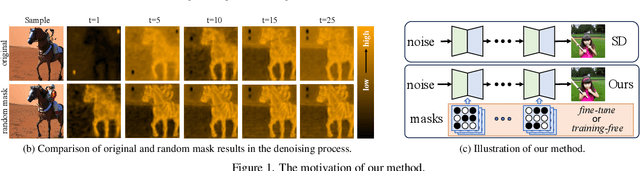
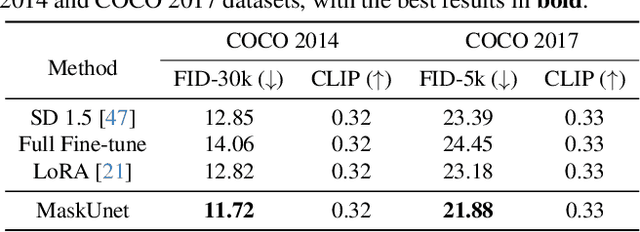
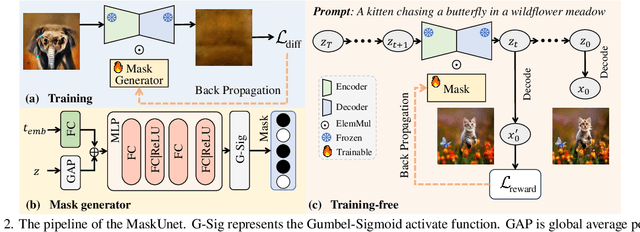
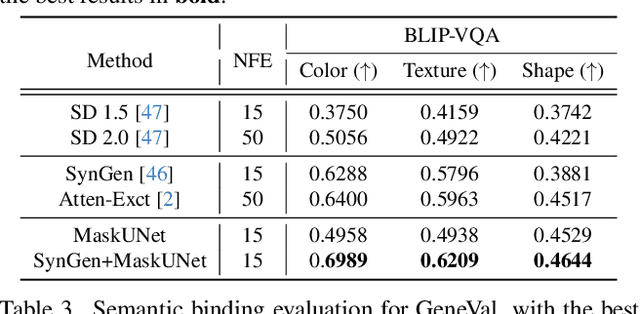
The diffusion models, in early stages focus on constructing basic image structures, while the refined details, including local features and textures, are generated in later stages. Thus the same network layers are forced to learn both structural and textural information simultaneously, significantly differing from the traditional deep learning architectures (e.g., ResNet or GANs) which captures or generates the image semantic information at different layers. This difference inspires us to explore the time-wise diffusion models. We initially investigate the key contributions of the U-Net parameters to the denoising process and identify that properly zeroing out certain parameters (including large parameters) contributes to denoising, substantially improving the generation quality on the fly. Capitalizing on this discovery, we propose a simple yet effective method-termed ``MaskUNet''- that enhances generation quality with negligible parameter numbers. Our method fully leverages timestep- and sample-dependent effective U-Net parameters. To optimize MaskUNet, we offer two fine-tuning strategies: a training-based approach and a training-free approach, including tailored networks and optimization functions. In zero-shot inference on the COCO dataset, MaskUNet achieves the best FID score and further demonstrates its effectiveness in downstream task evaluations. Project page: https://gudaochangsheng.github.io/MaskUnet-Page/
A Survey on Parameter-Efficient Fine-Tuning for Foundation Models in Federated Learning
Apr 29, 2025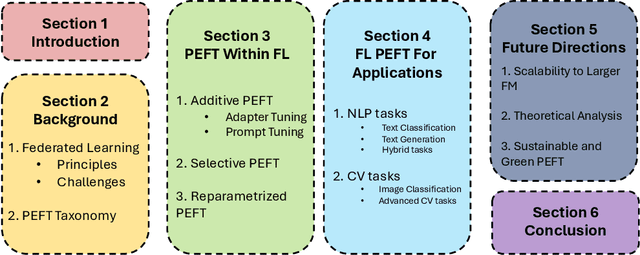
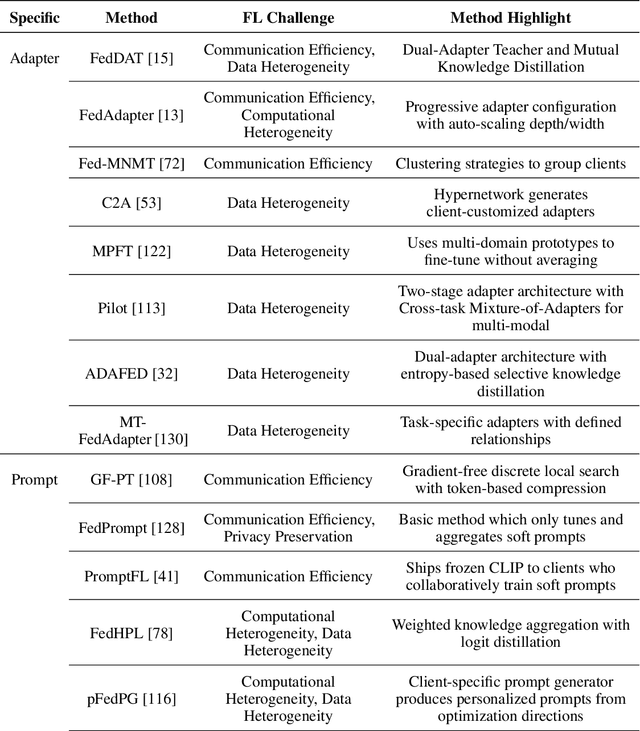
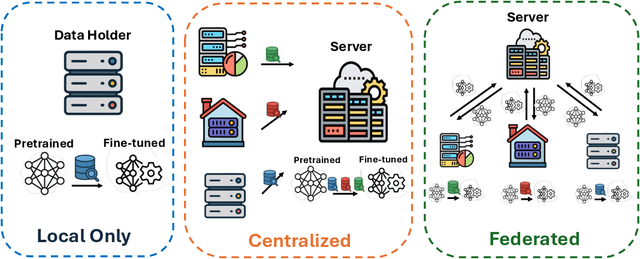
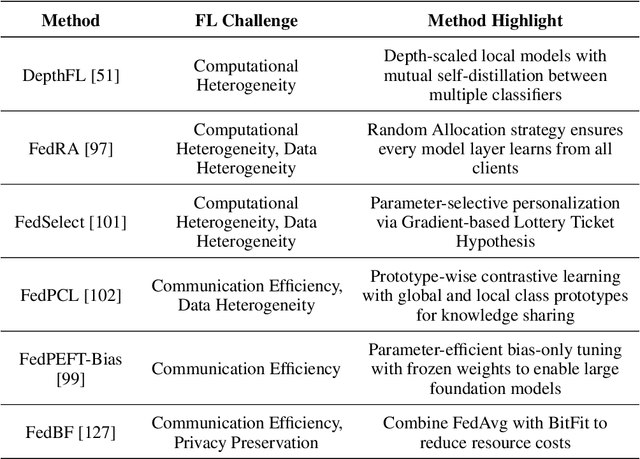
Foundation models have revolutionized artificial intelligence by providing robust, versatile architectures pre-trained on large-scale datasets. However, adapting these massive models to specific downstream tasks requires fine-tuning, which can be prohibitively expensive in computational resources. Parameter-Efficient Fine-Tuning (PEFT) methods address this challenge by selectively updating only a small subset of parameters. Meanwhile, Federated Learning (FL) enables collaborative model training across distributed clients without sharing raw data, making it ideal for privacy-sensitive applications. This survey provides a comprehensive review of the integration of PEFT techniques within federated learning environments. We systematically categorize existing approaches into three main groups: Additive PEFT (which introduces new trainable parameters), Selective PEFT (which fine-tunes only subsets of existing parameters), and Reparameterized PEFT (which transforms model architectures to enable efficient updates). For each category, we analyze how these methods address the unique challenges of federated settings, including data heterogeneity, communication efficiency, computational constraints, and privacy concerns. We further organize the literature based on application domains, covering both natural language processing and computer vision tasks. Finally, we discuss promising research directions, including scaling to larger foundation models, theoretical analysis of federated PEFT methods, and sustainable approaches for resource-constrained environments.
ChiseLLM: Unleashing the Power of Reasoning LLMs for Chisel Agile Hardware Development
Apr 27, 2025The growing demand for Domain-Specific Architecture (DSA) has driven the development of Agile Hardware Development Methodology (AHDM). Hardware Construction Language (HCL) like Chisel offers high-level abstraction features, making it an ideal language for HCL-Based AHDM. While Large Language Models (LLMs) excel in code generation tasks, they still face challenges with Chisel generation, particularly regarding syntax correctness and design variability. Recent reasoning models have significantly enhanced code generation capabilities through test-time scaling techniques. However, we found that reasoning models without domain adaptation cannot bring substantial benefits to Chisel code generation tasks. This paper presents ChiseLLM, a solution comprising data processing and transformation, prompt-guided reasoning trace synthesis, and domain-adapted model training. We constructed high-quality datasets from public RTL code resources and guided the model to adopt structured thinking patterns through prompt enhancement methods. Experiments demonstrate that our ChiseLLM-7B and ChiseLLM-32B models improved syntax correctness by 18.85% and 26.32% respectively over base models, while increasing variability design ability by 47.58% compared to baseline reasoning models. Our datasets and models are publicly available, providing high-performance, cost-effective models for HCL-Based AHDM, and offering an effective baseline for future research. Github repository: https://github.com/observerw/ChiseLLM
Redefining Superalignment: From Weak-to-Strong Alignment to Human-AI Co-Alignment to Sustainable Symbiotic Society
Apr 24, 2025Artificial Intelligence (AI) systems are becoming increasingly powerful and autonomous, and may progress to surpass human intelligence levels, namely Artificial Superintelligence (ASI). During the progression from AI to ASI, it may exceed human control, violate human values, and even lead to irreversible catastrophic consequences in extreme cases. This gives rise to a pressing issue that needs to be addressed: superalignment, ensuring that AI systems much smarter than humans, remain aligned with human (compatible) intentions and values. Existing scalable oversight and weak-to-strong generalization methods may prove substantially infeasible and inadequate when facing ASI. We must explore safer and more pluralistic frameworks and approaches for superalignment. In this paper, we redefine superalignment as the human-AI co-alignment towards a sustainable symbiotic society, and highlight a framework that integrates external oversight and intrinsic proactive alignment. External oversight superalignment should be grounded in human-centered ultimate decision, supplemented by interpretable automated evaluation and correction, to achieve continuous alignment with humanity's evolving values. Intrinsic proactive superalignment is rooted in a profound understanding of the self, others, and society, integrating self-awareness, self-reflection, and empathy to spontaneously infer human intentions, distinguishing good from evil and proactively considering human well-being, ultimately attaining human-AI co-alignment through iterative interaction. The integration of externally-driven oversight with intrinsically-driven proactive alignment empowers sustainable symbiotic societies through human-AI co-alignment, paving the way for achieving safe and beneficial AGI and ASI for good, for human, and for a symbiotic ecology.
TileLang: A Composable Tiled Programming Model for AI Systems
Apr 24, 2025Modern AI workloads rely heavily on optimized computing kernels for both training and inference. These AI kernels follow well-defined data-flow patterns, such as moving tiles between DRAM and SRAM and performing a sequence of computations on those tiles. However, writing high-performance kernels remains complex despite the clarity of these patterns. Achieving peak performance requires careful, hardware-centric optimizations to fully leverage modern accelerators. While domain-specific compilers attempt to reduce the burden of writing high-performance kernels, they often struggle with usability and expressiveness gaps. In this paper, we present TileLang, a generalized tiled programming model for more efficient AI Kernel programming. TileLang decouples scheduling space (thread binding, layout, tensorize and pipeline) from dataflow, and encapsulated them as a set of customization annotations and primitives. This approach allows users to focus on the kernel's data-flow itself, while leaving most other optimizations to compilers. We conduct comprehensive experiments on commonly-used devices, across numerous experiments, our evaluation shows that TileLang can achieve state-of-the-art performance in key kernels, demonstrating that its unified block-and-thread paradigm and transparent scheduling capabilities deliver both the power and flexibility demanded by modern AI system development.