 Add to Chrome
 Add to Firefox
 Add to Edge
LLM Agents as Social Scientists: A Human-AI Collaborative Platform for Social Science Automation
Apr 02, 2026
Traditional social science research often requires designing complex experiments across vast methodological spaces and depends on real human participants, making it labor-intensive, costly, and difficult to scale. Here we present S-Researcher, an LLM-agent-based platform that assists researchers in conducting social science research more efficiently and at greater scale by "siliconizing" both the research process and the participant pool. To build S-Researcher, we first develop YuLan-OneSim, a large-scale social simulation system designed around three core requirements: generality via auto-programming from natural language to executable scenarios, scalability via a distributed architecture supporting up to 100,000 concurrent agents, and reliability via feedback-driven LLM fine-tuning. Leveraging this system, S-Researcher supports researchers in designing social experiments, simulating human behavior with LLM agents, analyzing results, and generating reports, forming a complete human-AI collaborative research loop in which researchers retain oversight and intervention at every stage. We operationalize LLM simulation research paradigms into three canonical reasoning modes (induction, deduction, and abduction) and validate S-Researcher through systematic case studies: inductive reproduction of cultural dynamics consistent with Axelrod's theory, deductive testing of competing hypotheses on teacher attention validated against survey data, and abductive identification of a cooperation mechanism in public goods games confirmed by human experiments. S-Researcher establishes a new human--AI collaborative paradigm for social science, in which computational simulation augments human researchers to accelerate discovery across the full spectrum of social inquiry.

Attributed Graph Clustering with Multi-Scale Weight-Based Pairwise Coarsening and Contrastive Learning
Jul 28, 2025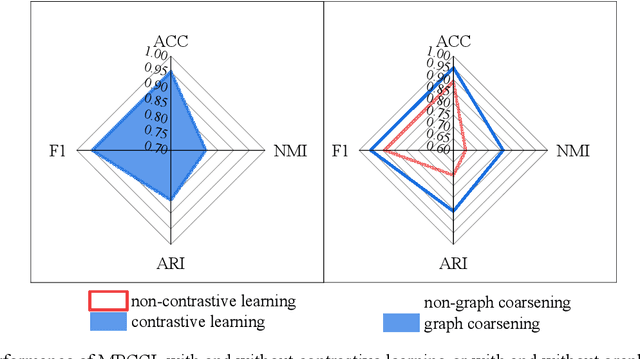
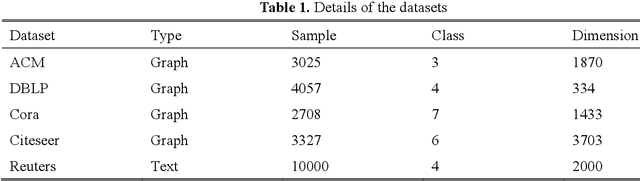
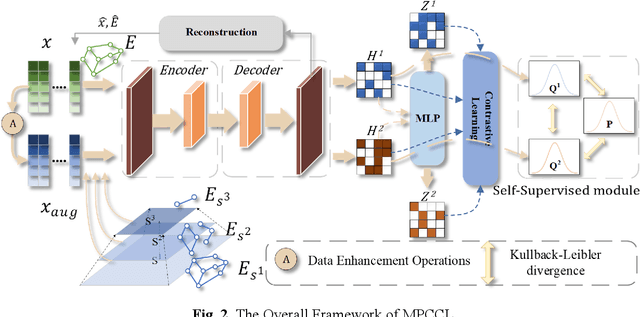
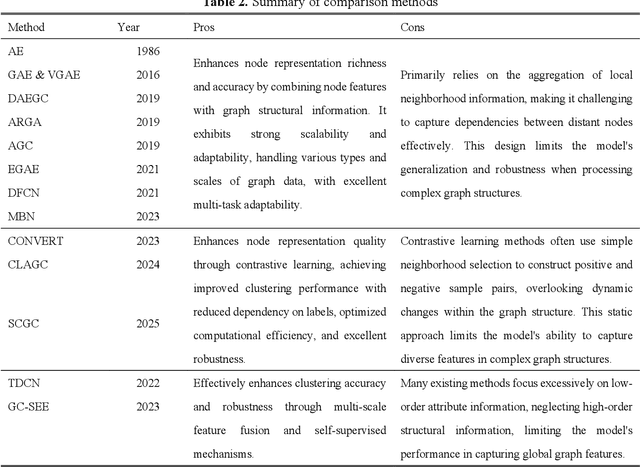
This study introduces the Multi-Scale Weight-Based Pairwise Coarsening and Contrastive Learning (MPCCL) model, a novel approach for attributed graph clustering that effectively bridges critical gaps in existing methods, including long-range dependency, feature collapse, and information loss. Traditional methods often struggle to capture high-order graph features due to their reliance on low-order attribute information, while contrastive learning techniques face limitations in feature diversity by overemphasizing local neighborhood structures. Similarly, conventional graph coarsening methods, though reducing graph scale, frequently lose fine-grained structural details. MPCCL addresses these challenges through an innovative multi-scale coarsening strategy, which progressively condenses the graph while prioritizing the merging of key edges based on global node similarity to preserve essential structural information. It further introduces a one-to-many contrastive learning paradigm, integrating node embeddings with augmented graph views and cluster centroids to enhance feature diversity, while mitigating feature masking issues caused by the accumulation of high-frequency node weights during multi-scale coarsening. By incorporating a graph reconstruction loss and KL divergence into its self-supervised learning framework, MPCCL ensures cross-scale consistency of node representations. Experimental evaluations reveal that MPCCL achieves a significant improvement in clustering performance, including a remarkable 15.24% increase in NMI on the ACM dataset and notable robust gains on smaller-scale datasets such as Citeseer, Cora and DBLP.
* The source code for this study is available at https://github.com/YF-W/MPCCL
YuLan-OneSim: Towards the Next Generation of Social Simulator with Large Language Models
May 12, 2025Leveraging large language model (LLM) based agents to simulate human social behaviors has recently gained significant attention. In this paper, we introduce a novel social simulator called YuLan-OneSim. Compared to previous works, YuLan-OneSim distinguishes itself in five key aspects: (1) Code-free scenario construction: Users can simply describe and refine their simulation scenarios through natural language interactions with our simulator. All simulation code is automatically generated, significantly reducing the need for programming expertise. (2) Comprehensive default scenarios: We implement 50 default simulation scenarios spanning 8 domains, including economics, sociology, politics, psychology, organization, demographics, law, and communication, broadening access for a diverse range of social researchers. (3) Evolvable simulation: Our simulator is capable of receiving external feedback and automatically fine-tuning the backbone LLMs, significantly enhancing the simulation quality. (4) Large-scale simulation: By developing a fully responsive agent framework and a distributed simulation architecture, our simulator can handle up to 100,000 agents, ensuring more stable and reliable simulation results. (5) AI social researcher: Leveraging the above features, we develop an AI social researcher. Users only need to propose a research topic, and the AI researcher will automatically analyze the input, construct simulation environments, summarize results, generate technical reports, review and refine the reports--completing the social science research loop. To demonstrate the advantages of YuLan-OneSim, we conduct experiments to evaluate the quality of the automatically generated scenarios, the reliability, efficiency, and scalability of the simulation process, as well as the performance of the AI social researcher.
GenSim: A General Social Simulation Platform with Large Language Model based Agents
Oct 06, 2024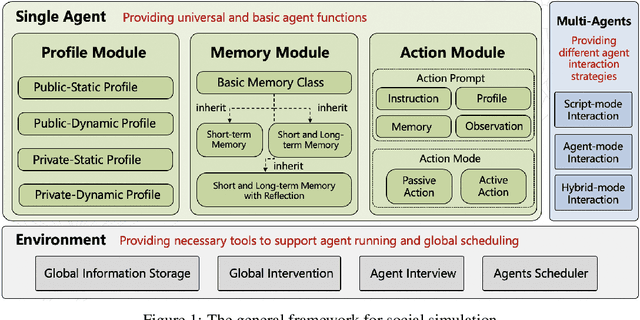
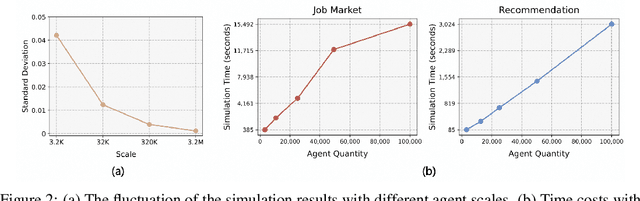
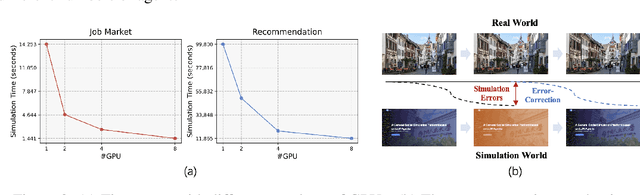
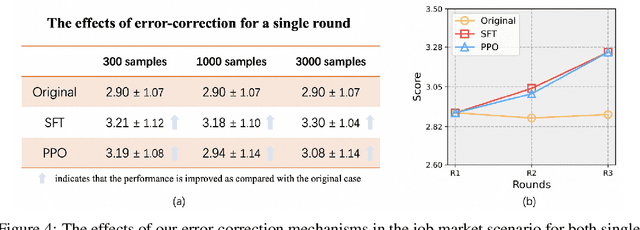
With the rapid advancement of large language models (LLMs), recent years have witnessed many promising studies on leveraging LLM-based agents to simulate human social behavior. While prior work has demonstrated significant potential across various domains, much of it has focused on specific scenarios involving a limited number of agents and has lacked the ability to adapt when errors occur during simulation. To overcome these limitations, we propose a novel LLM-agent-based simulation platform called \textit{GenSim}, which: (1) \textbf{Abstracts a set of general functions} to simplify the simulation of customized social scenarios; (2) \textbf{Supports one hundred thousand agents} to better simulate large-scale populations in real-world contexts; (3) \textbf{Incorporates error-correction mechanisms} to ensure more reliable and long-term simulations. To evaluate our platform, we assess both the efficiency of large-scale agent simulations and the effectiveness of the error-correction mechanisms. To our knowledge, GenSim represents an initial step toward a general, large-scale, and correctable social simulation platform based on LLM agents, promising to further advance the field of social science.