 Add to Chrome
 Add to Firefox
 Add to Edge
Towards End-to-End Alignment of User Satisfaction via Questionnaire in Video Recommendation
Jan 28, 2026
Short-video recommender systems typically optimize ranking models using dense user behavioral signals, such as clicks and watch time. However, these signals are only indirect proxies of user satisfaction and often suffer from noise and bias. Recently, explicit satisfaction feedback collected through questionnaires has emerged as a high-quality direct alignment supervision, but is extremely sparse and easily overwhelmed by abundant behavioral data, making it difficult to incorporate into online recommendation models. To address these challenges, we propose a novel framework which is towards End-to-End Alignment of user Satisfaction via Questionaire, named EASQ, to enable real-time alignment of ranking models with true user satisfaction. Specifically, we first construct an independent parameter pathway for sparse questionnaire signals by combining a multi-task architecture and a lightweight LoRA module. The multi-task design separates sparse satisfaction supervision from dense behavioral signals, preventing the former from being overwhelmed. The LoRA module pre-inject these preferences in a parameter-isolated manner, ensuring stability in the backbone while optimizing user satisfaction. Furthermore, we employ a DPO-based optimization objective tailored for online learning, which aligns the main model outputs with sparse satisfaction signals in real time. This design enables end-to-end online learning, allowing the model to continuously adapt to new questionnaire feedback while maintaining the stability and effectiveness of the backbone. Extensive offline experiments and large-scale online A/B tests demonstrate that EASQ consistently improves user satisfaction metrics across multiple scenarios. EASQ has been successfully deployed in a production short-video recommendation system, delivering significant and stable business gains.

Unleashing the Native Recommendation Potential: LLM-Based Generative Recommendation via Structured Term Identifiers
Jan 11, 2026Leveraging the vast open-world knowledge and understanding capabilities of Large Language Models (LLMs) to develop general-purpose, semantically-aware recommender systems has emerged as a pivotal research direction in generative recommendation. However, existing methods face bottlenecks in constructing item identifiers. Text-based methods introduce LLMs' vast output space, leading to hallucination, while methods based on Semantic IDs (SIDs) encounter a semantic gap between SIDs and LLMs' native vocabulary, requiring costly vocabulary expansion and alignment training. To address this, this paper introduces Term IDs (TIDs), defined as a set of semantically rich and standardized textual keywords, to serve as robust item identifiers. We propose GRLM, a novel framework centered on TIDs, employs Context-aware Term Generation to convert item's metadata into standardized TIDs and utilizes Integrative Instruction Fine-tuning to collaboratively optimize term internalization and sequential recommendation. Additionally, Elastic Identifier Grounding is designed for robust item mapping. Extensive experiments on real-world datasets demonstrate that GRLM significantly outperforms baselines across multiple scenarios, pointing a promising direction for generalizable and high-performance generative recommendation systems.
Boosting Latent Diffusion Models via Disentangled Representation Alignment
Jan 09, 2026Latent Diffusion Models (LDMs) generate high-quality images by operating in a compressed latent space, typically obtained through image tokenizers such as Variational Autoencoders (VAEs). In pursuit of a generation-friendly VAE, recent studies have explored leveraging Vision Foundation Models (VFMs) as representation alignment targets for VAEs, mirroring the approach commonly adopted for LDMs. Although this yields certain performance gains, using the same alignment target for both VAEs and LDMs overlooks their fundamentally different representational requirements. We advocate that while LDMs benefit from latents retaining high-level semantic concepts, VAEs should excel in semantic disentanglement, enabling encoding of attribute-level information in a structured way. To address this, we propose the Semantic disentangled VAE (Send-VAE), explicitly optimized for disentangled representation learning through aligning its latent space with the semantic hierarchy of pre-trained VFMs. Our approach employs a non-linear mapper network to transform VAE latents, aligning them with VFMs to bridge the gap between attribute-level disentanglement and high-level semantics, facilitating effective guidance for VAE learning. We evaluate semantic disentanglement via linear probing on attribute prediction tasks, showing strong correlation with improved generation performance. Finally, using Send-VAE, we train flow-based transformers SiTs; experiments show Send-VAE significantly speeds up training and achieves a state-of-the-art FID of 1.21 and 1.75 with and without classifier-free guidance on ImageNet 256x256.
PROMISE: Process Reward Models Unlock Test-Time Scaling Laws in Generative Recommendations
Jan 08, 2026Generative Recommendation has emerged as a promising paradigm, reformulating recommendation as a sequence-to-sequence generation task over hierarchical Semantic IDs. However, existing methods suffer from a critical issue we term Semantic Drift, where errors in early, high-level tokens irreversibly divert the generation trajectory into irrelevant semantic subspaces. Inspired by Process Reward Models (PRMs) that enhance reasoning in Large Language Models, we propose Promise, a novel framework that integrates dense, step-by-step verification into generative models. Promise features a lightweight PRM to assess the quality of intermediate inference steps, coupled with a PRM-guided Beam Search strategy that leverages dense feedback to dynamically prune erroneous branches. Crucially, our approach unlocks Test-Time Scaling Laws for recommender systems: by increasing inference compute, smaller models can match or surpass larger models. Extensive offline experiments and online A/B tests on a large-scale platform demonstrate that Promise effectively mitigates Semantic Drift, significantly improving recommendation accuracy while enabling efficient deployment.
DeepSynth-Eval: Objectively Evaluating Information Consolidation in Deep Survey Writing
Jan 07, 2026The evolution of Large Language Models (LLMs) towards autonomous agents has catalyzed progress in Deep Research. While retrieval capabilities are well-benchmarked, the post-retrieval synthesis stage--where agents must digest massive amounts of context and consolidate fragmented evidence into coherent, long-form reports--remains under-evaluated due to the subjectivity of open-ended writing. To bridge this gap, we introduce DeepSynth-Eval, a benchmark designed to objectively evaluate information consolidation capabilities. We leverage high-quality survey papers as gold standards, reverse-engineering research requests and constructing "Oracle Contexts" from their bibliographies to isolate synthesis from retrieval noise. We propose a fine-grained evaluation protocol using General Checklists (for factual coverage) and Constraint Checklists (for structural organization), transforming subjective judgment into verifiable metrics. Experiments across 96 tasks reveal that synthesizing information from hundreds of references remains a significant challenge. Our results demonstrate that agentic plan-and-write workflows significantly outperform single-turn generation, effectively reducing hallucinations and improving adherence to complex structural constraints.
ResTok: Learning Hierarchical Residuals in 1D Visual Tokenizers for Autoregressive Image Generation
Jan 07, 2026Existing 1D visual tokenizers for autoregressive (AR) generation largely follow the design principles of language modeling, as they are built directly upon transformers whose priors originate in language, yielding single-hierarchy latent tokens and treating visual data as flat sequential token streams. However, this language-like formulation overlooks key properties of vision, particularly the hierarchical and residual network designs that have long been essential for convergence and efficiency in visual models. To bring "vision" back to vision, we propose the Residual Tokenizer (ResTok), a 1D visual tokenizer that builds hierarchical residuals for both image tokens and latent tokens. The hierarchical representations obtained through progressively merging enable cross-level feature fusion at each layer, substantially enhancing representational capacity. Meanwhile, the semantic residuals between hierarchies prevent information overlap, yielding more concentrated latent distributions that are easier for AR modeling. Cross-level bindings consequently emerge without any explicit constraints. To accelerate the generation process, we further introduce a hierarchical AR generator that substantially reduces sampling steps by predicting an entire level of latent tokens at once rather than generating them strictly token-by-token. Extensive experiments demonstrate that restoring hierarchical residual priors in visual tokenization significantly improves AR image generation, achieving a gFID of 2.34 on ImageNet-256 with only 9 sampling steps. Code is available at https://github.com/Kwai-Kolors/ResTok.
VINO: A Unified Visual Generator with Interleaved OmniModal Context
Jan 05, 2026We present VINO, a unified visual generator that performs image and video generation and editing within a single framework. Instead of relying on task-specific models or independent modules for each modality, VINO uses a shared diffusion backbone that conditions on text, images and videos, enabling a broad range of visual creation and editing tasks under one model. Specifically, VINO couples a vision-language model (VLM) with a Multimodal Diffusion Transformer (MMDiT), where multimodal inputs are encoded as interleaved conditioning tokens, and then used to guide the diffusion process. This design supports multi-reference grounding, long-form instruction following, and coherent identity preservation across static and dynamic content, while avoiding modality-specific architectural components. To train such a unified system, we introduce a multi-stage training pipeline that progressively expands a video generation base model into a unified, multi-task generator capable of both image and video input and output. Across diverse generation and editing benchmarks, VINO demonstrates strong visual quality, faithful instruction following, improved reference and attribute preservation, and more controllable multi-identity edits. Our results highlight a practical path toward scalable unified visual generation, and the promise of interleaved, in-context computation as a foundation for general-purpose visual creation.
OpenOneRec Technical Report
Dec 31, 2025While the OneRec series has successfully unified the fragmented recommendation pipeline into an end-to-end generative framework, a significant gap remains between recommendation systems and general intelligence. Constrained by isolated data, they operate as domain specialists-proficient in pattern matching but lacking world knowledge, reasoning capabilities, and instruction following. This limitation is further compounded by the lack of a holistic benchmark to evaluate such integrated capabilities. To address this, our contributions are: 1) RecIF Bench & Open Data: We propose RecIF-Bench, a holistic benchmark covering 8 diverse tasks that thoroughly evaluate capabilities from fundamental prediction to complex reasoning. Concurrently, we release a massive training dataset comprising 96 million interactions from 160,000 users to facilitate reproducible research. 2) Framework & Scaling: To ensure full reproducibility, we open-source our comprehensive training pipeline, encompassing data processing, co-pretraining, and post-training. Leveraging this framework, we demonstrate that recommendation capabilities can scale predictably while mitigating catastrophic forgetting of general knowledge. 3) OneRec-Foundation: We release OneRec Foundation (1.7B and 8B), a family of models establishing new state-of-the-art (SOTA) results across all tasks in RecIF-Bench. Furthermore, when transferred to the Amazon benchmark, our models surpass the strongest baselines with an average 26.8% improvement in Recall@10 across 10 diverse datasets (Figure 1). This work marks a step towards building truly intelligent recommender systems. Nonetheless, realizing this vision presents significant technical and theoretical challenges, highlighting the need for broader research engagement in this promising direction.
SemanticGen: Video Generation in Semantic Space
Dec 24, 2025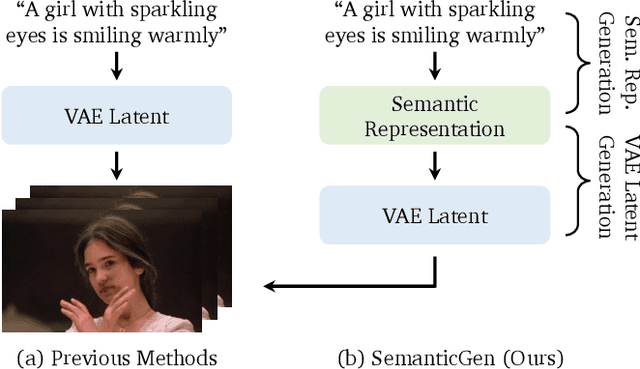
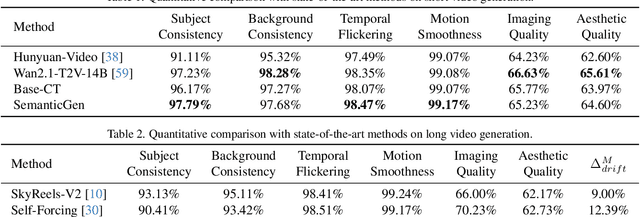
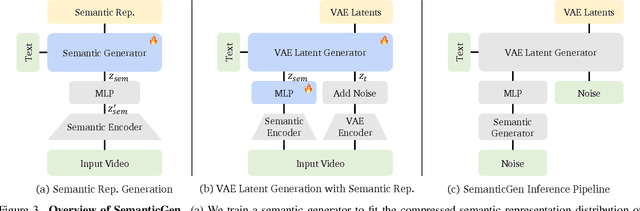

State-of-the-art video generative models typically learn the distribution of video latents in the VAE space and map them to pixels using a VAE decoder. While this approach can generate high-quality videos, it suffers from slow convergence and is computationally expensive when generating long videos. In this paper, we introduce SemanticGen, a novel solution to address these limitations by generating videos in the semantic space. Our main insight is that, due to the inherent redundancy in videos, the generation process should begin in a compact, high-level semantic space for global planning, followed by the addition of high-frequency details, rather than directly modeling a vast set of low-level video tokens using bi-directional attention. SemanticGen adopts a two-stage generation process. In the first stage, a diffusion model generates compact semantic video features, which define the global layout of the video. In the second stage, another diffusion model generates VAE latents conditioned on these semantic features to produce the final output. We observe that generation in the semantic space leads to faster convergence compared to the VAE latent space. Our method is also effective and computationally efficient when extended to long video generation. Extensive experiments demonstrate that SemanticGen produces high-quality videos and outperforms state-of-the-art approaches and strong baselines.
Visual-Aware CoT: Achieving High-Fidelity Visual Consistency in Unified Models
Dec 22, 2025Recently, the introduction of Chain-of-Thought (CoT) has largely improved the generation ability of unified models. However, it is observed that the current thinking process during generation mainly focuses on the text consistency with the text prompt, ignoring the \textbf{visual context consistency} with the visual reference images during the multi-modal generation, e.g., multi-reference generation. The lack of such consistency results in the failure in maintaining key visual features (like human ID, object attribute, style). To this end, we integrate the visual context consistency into the reasoning of unified models, explicitly motivating the model to sustain such consistency by 1) Adaptive Visual Planning: generating structured visual check list to figure out the visual element of needed consistency keeping, and 2) Iterative Visual Correction: performing self-reflection with the guidance of check lists and refining the generated result in an iterative manner. To achieve this, we use supervised finetuning to teach the model how to plan the visual checking, conduct self-reflection and self-refinement, and use flow-GRPO to further enhance the visual consistency through a customized visual checking reward. The experiments show that our method outperforms both zero-shot unified models and those with text CoTs in multi-modal generation, demonstrating higher visual context consistency.