 Add to Chrome
 Add to Firefox
 Add to Edge
Towards Professional Tennis Styles for Humanoid Robots with Adaptive Motion Planning and Tracking
Aug 20, 2026
Humanoid robots have recently demonstrated promising capabilities in real-world ball sports. However, achieving professional motion styles while maintaining strong task performance remains challenging. In this work, we propose AdaPT, an Adaptive Motion Planning and Tracking framework that learns professional tennis serving and rally styles directly from broadcast videos. This hierarchical design is motivated by the key insight that the planner generates stylistic kinematic motions, while the tracker executes them with minimal interference with planning. Despite its effectiveness in simulation, a substantial sim-to-real gap emerges: tracking performance inevitably degrades on real robots, and this degradation is partially overlooked by autoregressive planning and further compounded by noisy perception. To address these issues, our adaptation mechanism improves tracking robustness by learning to track randomized execution speeds, while conditioning the planner on a learned motion-speed adapter to mitigate compounding errors. Real-world experiments on the Unitree G1 demonstrate the effectiveness of our adaptation mechanism in bridging the sim-to-real gap. We further deploy AdaPT policies on the full-size Dobot Atom humanoid robot (1.7m) and demonstrate in-the-wild serving without motion capture. Beyond these results, our real-world experiments reveal both algorithmic and engineering insights for future humanoid ball-sports systems. Videos and code are available on our \href{https://humanoidtennis.github.io/AdaPT/}{project website}.

Scaling Behavior Foundation Model for Humanoid Robots
Jul 16, 2026Humanoid control requires natural whole-body coordination, precise real-time responses to control signals, and robust generalization across diverse environmental contexts, making it a cornerstone for generalist embodied agents. Behavior Foundation Models (BFMs) have recently emerged as a promising solution to address these challenges by leveraging large-scale behavioral data to achieve superior expressiveness, versatility and generalization. However, despite growing interest in scaling BFMs to further improve their capabilities, it remains unclear how key factors, including the learning paradigm, behavioral data and model architecture should be coordinated to enable effective scaling. In this work, we revisit the scaling recipe for BFMs and demonstrate that substantial performance gains can be achieved through the coordination of three core components: 1) the learning paradigm of motion tracking that reformulates diverse humanoid control problems as the reproduction of integrated whole-body behaviors in the global frame; 2) the strategic synergy between on-policy rollout quantity and reference motion diversity; and 3) the expressive and scalable model architecture termed Humanoid Transformer that facilitates the natural emergence of structured behavioral representations. Through extensive experiments in both simulation and real-world deployment, we demonstrate that our approach yields significant improvements in control fidelity and task generalization, reducing Mean Per-Keypoint Position Error (MPKPE) on the test set by over 10% in local mode and 82% in global mode compared with existing humanoid controllers. These results establish BFM as a principled and effective foundation for scalable and general-purpose humanoid control.
InternVLA-A1.5: Unifying Understanding, Latent Foresight, and Action for Compositional Generalization
Jul 06, 2026Unified models for robot manipulation aim to equip one policy with both the semantic priors of pretrained VLMs and the physical dynamics learned through future prediction. In practice, existing designs tend to erode the semantics of the pretrained backbone, suffer interference among heterogeneous objectives, and learn future prediction from scratch in pixel space, leaving the dynamics priors of pretrained video generators unexploited. We present InternVLA-A1.5, which builds the policy on a native VLM backbone that keeps training on VQA and subtask prediction, and attaches a lightweight unified expert for continuous action generation. Future prediction is recast as a latent-querying problem, where a small set of learnable foresight tokens condenses the task-relevant future into a compact latent code under the supervision of a frozen pretrained video generation model, so the policy inherits world-model dynamics priors without ever learning pixel-level generation. The video branch is discarded at inference, keeping real-time control. Pretrained on 1.2M robot episodes and 3M multimodal samples, InternVLA-A1.5 achieves the best overall results on all six simulation benchmarks. In the real world, the preserved semantics deliver the strongest compositional generalization on held-out instruction bindings, and the two designs together sustain long-horizon execution.
ReactiveBFM: Reactive Closed-Loop Motion Planning Towards Universal Humanoid Whole-Body Control
Jun 29, 2026While current Behavior Foundation Models (BFMs) provide robust control priors for humanoids, they only execute pre-defined reference motions. As a result, they are vulnerable to environmental shifts and incapable of reactive whole-body coordination. Naively cascading them with generative motion planners fails to achieve true reactivity, as inevitable tracking discrepancies induce fatal cumulative exposure bias. To bridge this gap, we propose ReactiveBFM, a real-time closed-loop planning-control framework. At its core, we effectively mitigate exposure bias via a scheduled prefix sampling curriculum, forcing the generative planner to actively learn error-recovery behaviors from imperfect physical states rather than ground-truth trajectories. Systematically, to reconcile the severe latency mismatch between auto-regressive planning and high-frequency tracking, we introduce an asynchronous replanning mechanism. Combined with trajectory chunking to temporally ensemble spatial references, our system guarantees spatio-temporally fluid execution without physical jitter. Deployed on the Unitree G1 humanoid, ReactiveBFM demonstrates unprecedented physical agility across a vast repertoire of text-conditioned closed-loop motions. Notably, ReactiveBFM achieves zero-shot moving target reaching, showcasing intricate whole-body coordination and on-the-fly replanning. In sim-to-sim benchmarking under severe perturbations, ReactiveBFM achieves a 93.1% success rate, significantly outperforming cascaded open-loop baselines by 28.6%.
Tele-Catch: Adaptive Teleoperation for Dexterous Dynamic 3D Object Catching
Mar 30, 2026Teleoperation is a key paradigm for transferring human dexterity to robots, yet most prior work targets objects that are initially static, such as grasping or manipulation. Dynamic object catch, where objects move before contact, remains underexplored. Pure teleoperation in this task often fails due to timing, pose, and force errors, highlighting the need for shared autonomy that combines human input with autonomous policies. To this end, we present Tele-Catch, a systematic framework for dexterous hand teleoperation in dynamic object catching. At its core, we design DAIM, a dynamics-aware adaptive integration mechanism that realizes shared autonomy by fusing glove-based teleoperation signals into the diffusion policy denoising process. It adaptively modulates control based on the interaction object state. To improve policy robustness, we introduce DP-U3R, which integrates unsupervised geometric representations from point cloud observations into diffusion policy learning, enabling geometry-aware decision making. Extensive experiments demonstrate that Tele-Catch significantly improves accuracy and robustness in dynamic catching tasks, while also exhibiting consistent gains across distinct dexterous hand embodiments and previously unseen object categories.
Gallant: Voxel Grid-based Humanoid Locomotion and Local-navigation across 3D Constrained Terrains
Nov 18, 2025Robust humanoid locomotion requires accurate and globally consistent perception of the surrounding 3D environment. However, existing perception modules, mainly based on depth images or elevation maps, offer only partial and locally flattened views of the environment, failing to capture the full 3D structure. This paper presents Gallant, a voxel-grid-based framework for humanoid locomotion and local navigation in 3D constrained terrains. It leverages voxelized LiDAR data as a lightweight and structured perceptual representation, and employs a z-grouped 2D CNN to map this representation to the control policy, enabling fully end-to-end optimization. A high-fidelity LiDAR simulation that dynamically generates realistic observations is developed to support scalable, LiDAR-based training and ensure sim-to-real consistency. Experimental results show that Gallant's broader perceptual coverage facilitates the use of a single policy that goes beyond the limitations of previous methods confined to ground-level obstacles, extending to lateral clutter, overhead constraints, multi-level structures, and narrow passages. Gallant also firstly achieves near 100% success rates in challenging scenarios such as stair climbing and stepping onto elevated platforms through improved end-to-end optimization.
ManipTrans: Efficient Dexterous Bimanual Manipulation Transfer via Residual Learning
Mar 27, 2025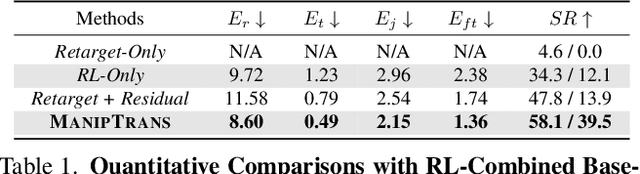
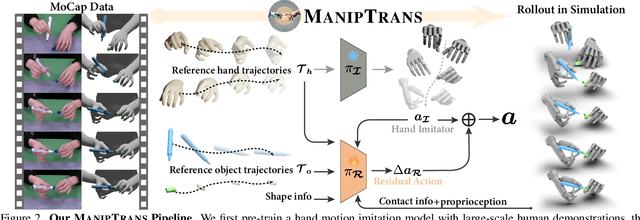
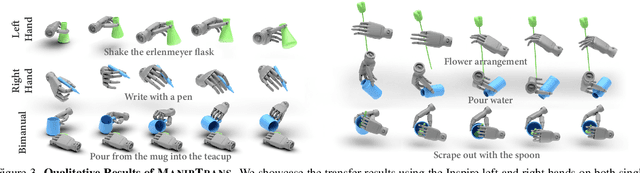
Human hands play a central role in interacting, motivating increasing research in dexterous robotic manipulation. Data-driven embodied AI algorithms demand precise, large-scale, human-like manipulation sequences, which are challenging to obtain with conventional reinforcement learning or real-world teleoperation. To address this, we introduce ManipTrans, a novel two-stage method for efficiently transferring human bimanual skills to dexterous robotic hands in simulation. ManipTrans first pre-trains a generalist trajectory imitator to mimic hand motion, then fine-tunes a specific residual module under interaction constraints, enabling efficient learning and accurate execution of complex bimanual tasks. Experiments show that ManipTrans surpasses state-of-the-art methods in success rate, fidelity, and efficiency. Leveraging ManipTrans, we transfer multiple hand-object datasets to robotic hands, creating DexManipNet, a large-scale dataset featuring previously unexplored tasks like pen capping and bottle unscrewing. DexManipNet comprises 3.3K episodes of robotic manipulation and is easily extensible, facilitating further policy training for dexterous hands and enabling real-world deployments.
Hydra-MDP++: Advancing End-to-End Driving via Expert-Guided Hydra-Distillation
Mar 17, 2025Hydra-MDP++ introduces a novel teacher-student knowledge distillation framework with a multi-head decoder that learns from human demonstrations and rule-based experts. Using a lightweight ResNet-34 network without complex components, the framework incorporates expanded evaluation metrics, including traffic light compliance (TL), lane-keeping ability (LK), and extended comfort (EC) to address unsafe behaviors not captured by traditional NAVSIM-derived teachers. Like other end-to-end autonomous driving approaches, \hydra processes raw images directly without relying on privileged perception signals. Hydra-MDP++ achieves state-of-the-art performance by integrating these components with a 91.0% drive score on NAVSIM through scaling to a V2-99 image encoder, demonstrating its effectiveness in handling diverse driving scenarios while maintaining computational efficiency.
Hydra-MDP: End-to-end Multimodal Planning with Multi-target Hydra-Distillation
Jun 11, 2024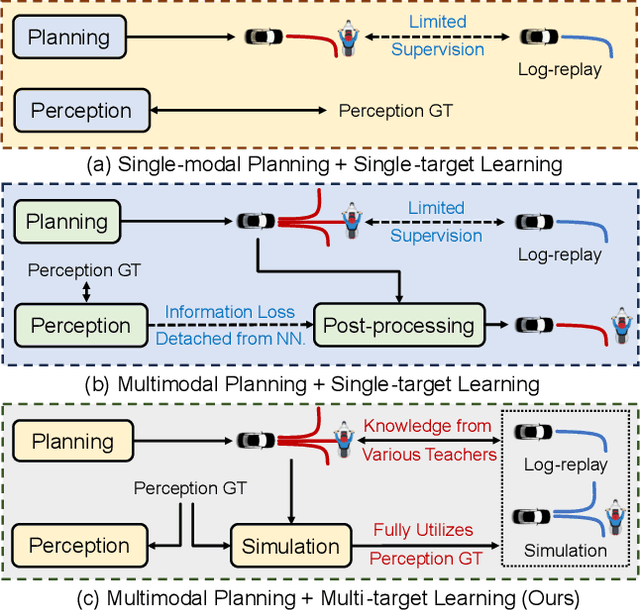

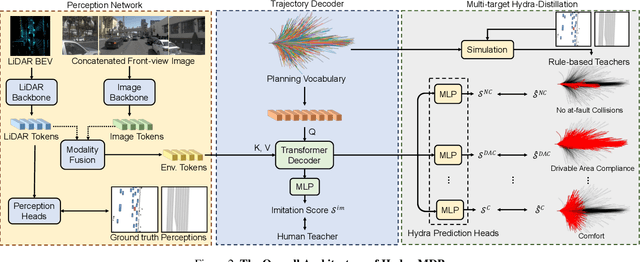

We propose Hydra-MDP, a novel paradigm employing multiple teachers in a teacher-student model. This approach uses knowledge distillation from both human and rule-based teachers to train the student model, which features a multi-head decoder to learn diverse trajectory candidates tailored to various evaluation metrics. With the knowledge of rule-based teachers, Hydra-MDP learns how the environment influences the planning in an end-to-end manner instead of resorting to non-differentiable post-processing. This method achieves the $1^{st}$ place in the Navsim challenge, demonstrating significant improvements in generalization across diverse driving environments and conditions. Code will be available at \url{https://github.com/woxihuanjiangguo/Hydra-MDP}
SemGrasp: Semantic Grasp Generation via Language Aligned Discretization
Apr 04, 2024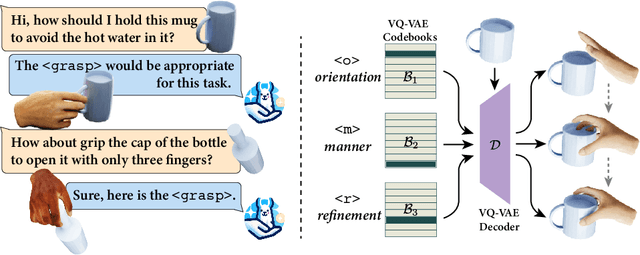
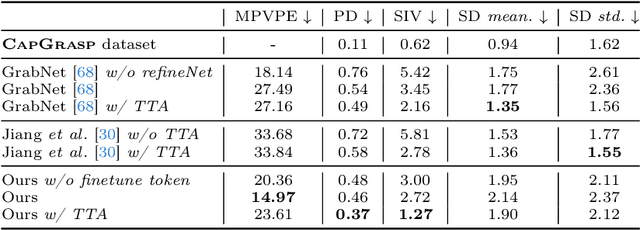
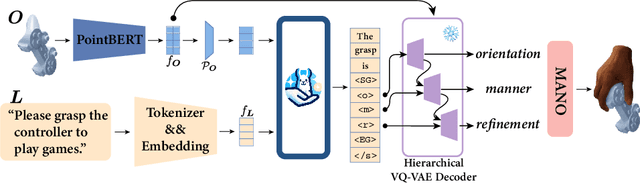

Generating natural human grasps necessitates consideration of not just object geometry but also semantic information. Solely depending on object shape for grasp generation confines the applications of prior methods in downstream tasks. This paper presents a novel semantic-based grasp generation method, termed SemGrasp, which generates a static human grasp pose by incorporating semantic information into the grasp representation. We introduce a discrete representation that aligns the grasp space with semantic space, enabling the generation of grasp postures in accordance with language instructions. A Multimodal Large Language Model (MLLM) is subsequently fine-tuned, integrating object, grasp, and language within a unified semantic space. To facilitate the training of SemGrasp, we have compiled a large-scale, grasp-text-aligned dataset named CapGrasp, featuring about 260k detailed captions and 50k diverse grasps. Experimental findings demonstrate that SemGrasp efficiently generates natural human grasps in alignment with linguistic intentions. Our code, models, and dataset are available publicly at: https://kailinli.github.io/SemGrasp.