 Add to Chrome
 Add to Firefox
 Add to Edge
Scaling Behavior Foundation Model for Humanoid Robots
Jul 16, 2026
Humanoid control requires natural whole-body coordination, precise real-time responses to control signals, and robust generalization across diverse environmental contexts, making it a cornerstone for generalist embodied agents. Behavior Foundation Models (BFMs) have recently emerged as a promising solution to address these challenges by leveraging large-scale behavioral data to achieve superior expressiveness, versatility and generalization. However, despite growing interest in scaling BFMs to further improve their capabilities, it remains unclear how key factors, including the learning paradigm, behavioral data and model architecture should be coordinated to enable effective scaling. In this work, we revisit the scaling recipe for BFMs and demonstrate that substantial performance gains can be achieved through the coordination of three core components: 1) the learning paradigm of motion tracking that reformulates diverse humanoid control problems as the reproduction of integrated whole-body behaviors in the global frame; 2) the strategic synergy between on-policy rollout quantity and reference motion diversity; and 3) the expressive and scalable model architecture termed Humanoid Transformer that facilitates the natural emergence of structured behavioral representations. Through extensive experiments in both simulation and real-world deployment, we demonstrate that our approach yields significant improvements in control fidelity and task generalization, reducing Mean Per-Keypoint Position Error (MPKPE) on the test set by over 10% in local mode and 82% in global mode compared with existing humanoid controllers. These results establish BFM as a principled and effective foundation for scalable and general-purpose humanoid control.

ReactiveBFM: Reactive Closed-Loop Motion Planning Towards Universal Humanoid Whole-Body Control
Jun 29, 2026While current Behavior Foundation Models (BFMs) provide robust control priors for humanoids, they only execute pre-defined reference motions. As a result, they are vulnerable to environmental shifts and incapable of reactive whole-body coordination. Naively cascading them with generative motion planners fails to achieve true reactivity, as inevitable tracking discrepancies induce fatal cumulative exposure bias. To bridge this gap, we propose ReactiveBFM, a real-time closed-loop planning-control framework. At its core, we effectively mitigate exposure bias via a scheduled prefix sampling curriculum, forcing the generative planner to actively learn error-recovery behaviors from imperfect physical states rather than ground-truth trajectories. Systematically, to reconcile the severe latency mismatch between auto-regressive planning and high-frequency tracking, we introduce an asynchronous replanning mechanism. Combined with trajectory chunking to temporally ensemble spatial references, our system guarantees spatio-temporally fluid execution without physical jitter. Deployed on the Unitree G1 humanoid, ReactiveBFM demonstrates unprecedented physical agility across a vast repertoire of text-conditioned closed-loop motions. Notably, ReactiveBFM achieves zero-shot moving target reaching, showcasing intricate whole-body coordination and on-the-fly replanning. In sim-to-sim benchmarking under severe perturbations, ReactiveBFM achieves a 93.1% success rate, significantly outperforming cascaded open-loop baselines by 28.6%.
UNSEEN: Enhancing Dataset Pruning from a Generalization Perspective
Nov 18, 2025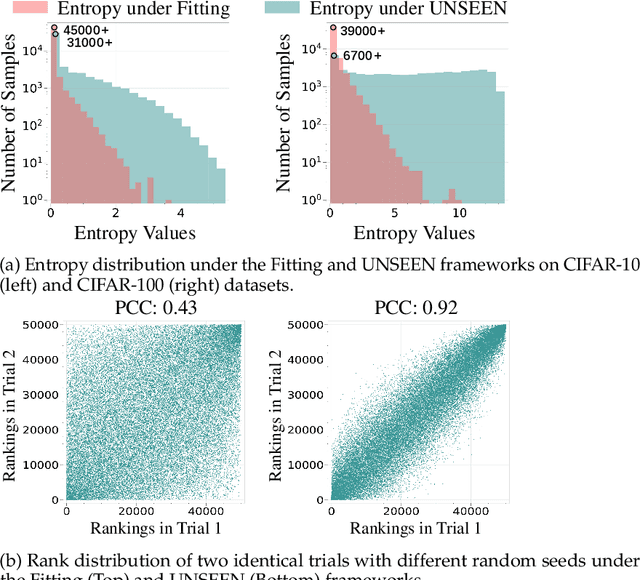
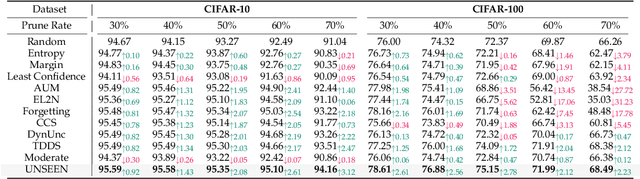
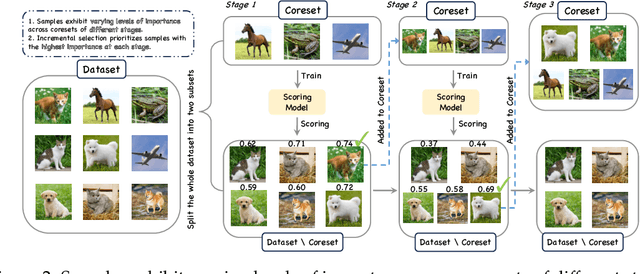
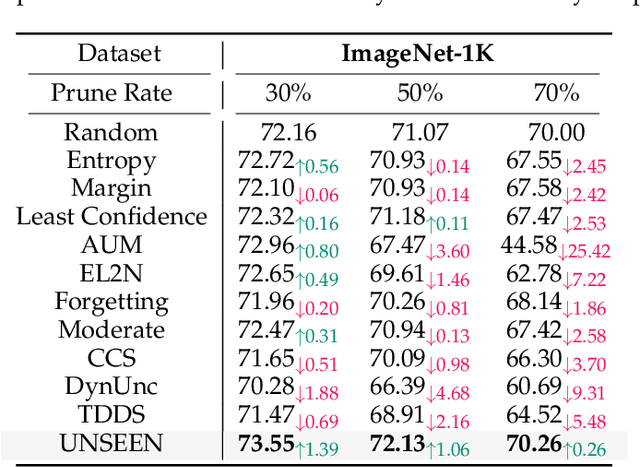
The growing scale of datasets in deep learning has introduced significant computational challenges. Dataset pruning addresses this challenge by constructing a compact but informative coreset from the full dataset with comparable performance. Previous approaches typically establish scoring metrics based on specific criteria to identify representative samples. However, these methods predominantly rely on sample scores obtained from the model's performance during the training (i.e., fitting) phase. As scoring models achieve near-optimal performance on training data, such fitting-centric approaches induce a dense distribution of sample scores within a narrow numerical range. This concentration reduces the distinction between samples and hinders effective selection. To address this challenge, we conduct dataset pruning from the perspective of generalization, i.e., scoring samples based on models not exposed to them during training. We propose a plug-and-play framework, UNSEEN, which can be integrated into existing dataset pruning methods. Additionally, conventional score-based methods are single-step and rely on models trained solely on the complete dataset, providing limited perspective on the importance of samples. To address this limitation, we scale UNSEEN to multi-step scenarios and propose an incremental selection technique through scoring models trained on varying coresets, and optimize the quality of the coreset dynamically. Extensive experiments demonstrate that our method significantly outperforms existing state-of-the-art (SOTA) methods on CIFAR-10, CIFAR-100, and ImageNet-1K. Notably, on ImageNet-1K, UNSEEN achieves lossless performance while reducing training data by 30\%.