 Add to Chrome
 Add to Firefox
 Add to Edge
InternVLA-A1: Unifying Understanding, Generation and Action for Robotic Manipulation
Jan 05, 2026
Prevalent Vision-Language-Action (VLA) models are typically built upon Multimodal Large Language Models (MLLMs) and demonstrate exceptional proficiency in semantic understanding, but they inherently lack the capability to deduce physical world dynamics. Consequently, recent approaches have shifted toward World Models, typically formulated via video prediction; however, these methods often suffer from a lack of semantic grounding and exhibit brittleness when handling prediction errors. To synergize semantic understanding with dynamic predictive capabilities, we present InternVLA-A1. This model employs a unified Mixture-of-Transformers architecture, coordinating three experts for scene understanding, visual foresight generation, and action execution. These components interact seamlessly through a unified masked self-attention mechanism. Building upon InternVL3 and Qwen3-VL, we instantiate InternVLA-A1 at 2B and 3B parameter scales. We pre-train these models on hybrid synthetic-real datasets spanning InternData-A1 and Agibot-World, covering over 533M frames. This hybrid training strategy effectively harnesses the diversity of synthetic simulation data while minimizing the sim-to-real gap. We evaluated InternVLA-A1 across 12 real-world robotic tasks and simulation benchmark. It significantly outperforms leading models like pi0 and GR00T N1.5, achieving a 14.5\% improvement in daily tasks and a 40\%-73.3\% boost in dynamic settings, such as conveyor belt sorting.

Wavelet Policy: Imitation Policy Learning in Frequency Domain with Wavelet Transforms
Apr 07, 2025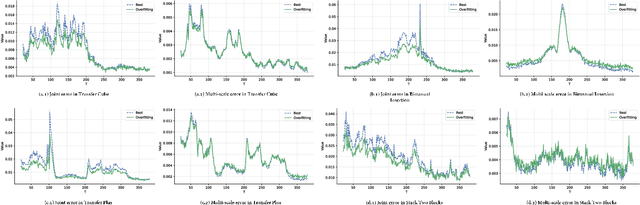


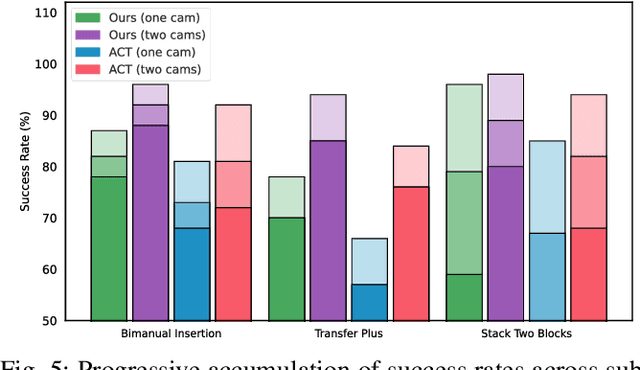
Recent imitation learning policies, often framed as time series prediction tasks, directly map robotic observations-such as high-dimensional visual data and proprioception-into the action space. While time series prediction primarily relies on spatial domain modeling, the underutilization of frequency domain analysis in robotic manipulation trajectory prediction may lead to neglecting the inherent temporal information embedded within action sequences. To address this, we reframe imitation learning policies through the lens of the frequency domain and introduce the Wavelet Policy. This novel approach employs wavelet transforms (WT) for feature preprocessing and extracts multi-scale features from the frequency domain using the SE2MD (Single Encoder to Multiple Decoder) architecture. Furthermore, to enhance feature mapping in the frequency domain and increase model capacity, we introduce a Learnable Frequency-Domain Filter (LFDF) after each frequency decoder, improving adaptability under different visual conditions. Our results show that the Wavelet Policy outperforms state-of-the-art (SOTA) end-to-end methods by over 10% on four challenging robotic arm tasks, while maintaining a comparable parameter count. In long-range settings, its performance declines more slowly as task volume increases. The code will be publicly available.
Bridging the Resource Gap: Deploying Advanced Imitation Learning Models onto Affordable Embedded Platforms
Nov 18, 2024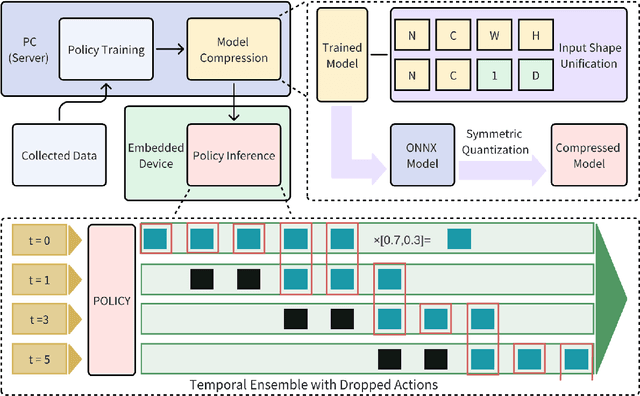
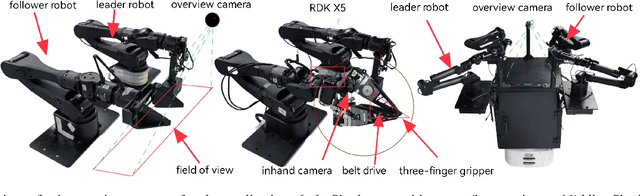
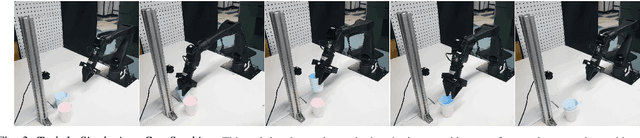

Advanced imitation learning with structures like the transformer is increasingly demonstrating its advantages in robotics. However, deploying these large-scale models on embedded platforms remains a major challenge. In this paper, we propose a pipeline that facilitates the migration of advanced imitation learning algorithms to edge devices. The process is achieved via an efficient model compression method and a practical asynchronous parallel method Temporal Ensemble with Dropped Actions (TEDA) that enhances the smoothness of operations. To show the efficiency of the proposed pipeline, large-scale imitation learning models are trained on a server and deployed on an edge device to complete various manipulation tasks.