 Add to Chrome
 Add to Firefox
 Add to Edge
Scaling Behavior Foundation Model for Humanoid Robots
Jul 16, 2026
Humanoid control requires natural whole-body coordination, precise real-time responses to control signals, and robust generalization across diverse environmental contexts, making it a cornerstone for generalist embodied agents. Behavior Foundation Models (BFMs) have recently emerged as a promising solution to address these challenges by leveraging large-scale behavioral data to achieve superior expressiveness, versatility and generalization. However, despite growing interest in scaling BFMs to further improve their capabilities, it remains unclear how key factors, including the learning paradigm, behavioral data and model architecture should be coordinated to enable effective scaling. In this work, we revisit the scaling recipe for BFMs and demonstrate that substantial performance gains can be achieved through the coordination of three core components: 1) the learning paradigm of motion tracking that reformulates diverse humanoid control problems as the reproduction of integrated whole-body behaviors in the global frame; 2) the strategic synergy between on-policy rollout quantity and reference motion diversity; and 3) the expressive and scalable model architecture termed Humanoid Transformer that facilitates the natural emergence of structured behavioral representations. Through extensive experiments in both simulation and real-world deployment, we demonstrate that our approach yields significant improvements in control fidelity and task generalization, reducing Mean Per-Keypoint Position Error (MPKPE) on the test set by over 10% in local mode and 82% in global mode compared with existing humanoid controllers. These results establish BFM as a principled and effective foundation for scalable and general-purpose humanoid control.

ReactiveBFM: Reactive Closed-Loop Motion Planning Towards Universal Humanoid Whole-Body Control
Jun 29, 2026While current Behavior Foundation Models (BFMs) provide robust control priors for humanoids, they only execute pre-defined reference motions. As a result, they are vulnerable to environmental shifts and incapable of reactive whole-body coordination. Naively cascading them with generative motion planners fails to achieve true reactivity, as inevitable tracking discrepancies induce fatal cumulative exposure bias. To bridge this gap, we propose ReactiveBFM, a real-time closed-loop planning-control framework. At its core, we effectively mitigate exposure bias via a scheduled prefix sampling curriculum, forcing the generative planner to actively learn error-recovery behaviors from imperfect physical states rather than ground-truth trajectories. Systematically, to reconcile the severe latency mismatch between auto-regressive planning and high-frequency tracking, we introduce an asynchronous replanning mechanism. Combined with trajectory chunking to temporally ensemble spatial references, our system guarantees spatio-temporally fluid execution without physical jitter. Deployed on the Unitree G1 humanoid, ReactiveBFM demonstrates unprecedented physical agility across a vast repertoire of text-conditioned closed-loop motions. Notably, ReactiveBFM achieves zero-shot moving target reaching, showcasing intricate whole-body coordination and on-the-fly replanning. In sim-to-sim benchmarking under severe perturbations, ReactiveBFM achieves a 93.1% success rate, significantly outperforming cascaded open-loop baselines by 28.6%.
RCdpia: A Renal Carcinoma Digital Pathology Image Annotation dataset based on pathologists
Mar 17, 2024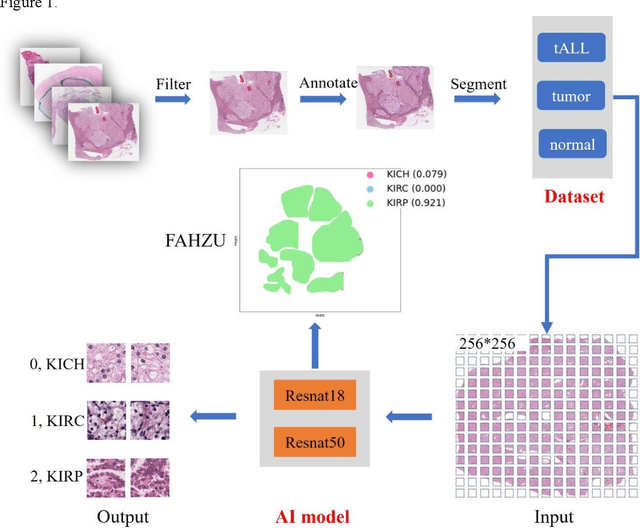
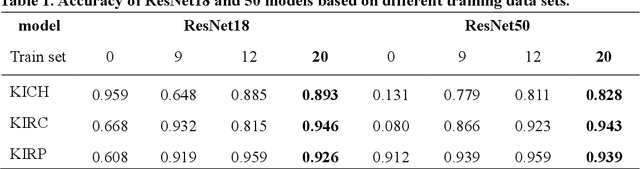
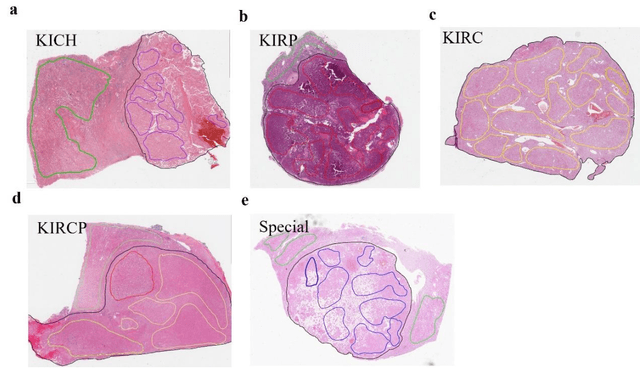
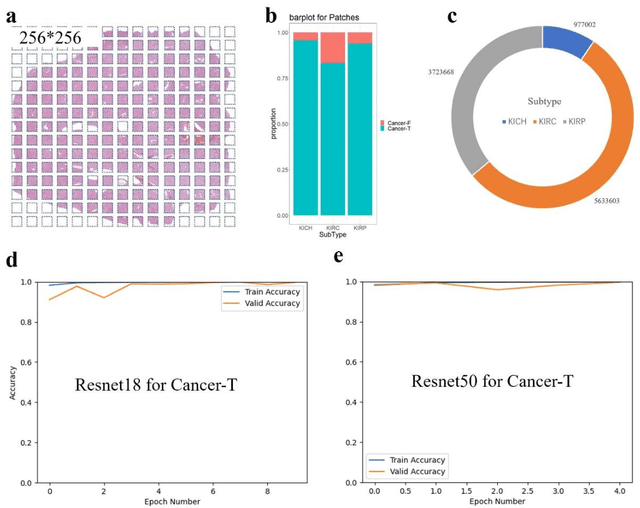
The annotation of digital pathological slide data for renal cell carcinoma is of paramount importance for correct diagnosis of artificial intelligence models due to the heterogeneous nature of the tumor. This process not only facilitates a deeper understanding of renal cell cancer heterogeneity but also aims to minimize noise in the data for more accurate studies. To enhance the applicability of the data, two pathologists were enlisted to meticulously curate, screen, and label a kidney cancer pathology image dataset from The Cancer Genome Atlas Program (TCGA) database. Subsequently, a Resnet model was developed to validate the annotated dataset against an additional dataset from the First Affiliated Hospital of Zhejiang University. Based on these results, we have meticulously compiled the TCGA digital pathological dataset with independent labeling of tumor regions and adjacent areas (RCdpia), which includes 109 cases of kidney chromophobe cell carcinoma, 486 cases of kidney clear cell carcinoma, and 292 cases of kidney papillary cell carcinoma. This dataset is now publicly accessible at http://39.171.241.18:8888/RCdpia/. Furthermore, model analysis has revealed significant discrepancies in predictive outcomes when applying the same model to datasets from different centers. Leveraging the RCdpia, we can now develop more precise digital pathology artificial intelligence models for tasks such as normalization, classification, and segmentation. These advancements underscore the potential for more nuanced and accurate AI applications in the field of digital pathology.