 Add to Chrome
 Add to Firefox
 Add to Edge
ReactiveBFM: Reactive Closed-Loop Motion Planning Towards Universal Humanoid Whole-Body Control
Jun 29, 2026
While current Behavior Foundation Models (BFMs) provide robust control priors for humanoids, they only execute pre-defined reference motions. As a result, they are vulnerable to environmental shifts and incapable of reactive whole-body coordination. Naively cascading them with generative motion planners fails to achieve true reactivity, as inevitable tracking discrepancies induce fatal cumulative exposure bias. To bridge this gap, we propose ReactiveBFM, a real-time closed-loop planning-control framework. At its core, we effectively mitigate exposure bias via a scheduled prefix sampling curriculum, forcing the generative planner to actively learn error-recovery behaviors from imperfect physical states rather than ground-truth trajectories. Systematically, to reconcile the severe latency mismatch between auto-regressive planning and high-frequency tracking, we introduce an asynchronous replanning mechanism. Combined with trajectory chunking to temporally ensemble spatial references, our system guarantees spatio-temporally fluid execution without physical jitter. Deployed on the Unitree G1 humanoid, ReactiveBFM demonstrates unprecedented physical agility across a vast repertoire of text-conditioned closed-loop motions. Notably, ReactiveBFM achieves zero-shot moving target reaching, showcasing intricate whole-body coordination and on-the-fly replanning. In sim-to-sim benchmarking under severe perturbations, ReactiveBFM achieves a 93.1% success rate, significantly outperforming cascaded open-loop baselines by 28.6%.

Imagine2Real: Towards Zero-shot Humanoid-Object Interaction via Video Generative Priors
May 21, 2026Whole-body Humanoid-Object Interaction (HOI) is bottlenecked by the scarcity of high-fidelity 3D data. While video generative priors offer a promising alternative, existing methods suffer from \textit{Representation Misalignment} due to their reliance on geometric priors (e.g., explicit CAD models), and \textit{Retargeting Complexity} arising from intensive morphing and morphological mismatch. We propose Imagine2Real, a zero-shot HOI framework for flexible, geometry-free interaction. To resolve misalignment, we formulate robot and object motions as unified 4D point trajectories. To overcome retargeting complexity, our Keypoints Tracker tracks only sparse critical points (base, hands, and object), entirely bypassing the error-amplifying retargeting process. To maintain natural gaits despite these sparse signals, we utilize the latent space of a Behavior Foundation Model (BFM) as the tracker's search domain. Using a progressive training strategy, Imagine2Real learns robust behaviors with simple tracking rewards, enabling zero-shot physical deployment within a motion capture(mocap) system.
Feel Robot Feels: Tactile Feedback Array Glove for Dexterous Manipulation
Mar 30, 2026Teleoperation is a key approach for collecting high-quality, physically consistent demonstrations for robotic manipulation. However, teleoperation for dexterous manipulation remains constrained by: (i) inaccurate hand-robot motion mapping, which limits teleoperated dexterity, and (ii) limited tactile feedback that forces vision-dominated interaction and hinders perception of contact geometry and force variation. To address these challenges, we present TAG, a low-cost glove system that integrates precise hand motion capture with high-resolution tactile feedback, enabling effective tactile-in-the-loop dexterous teleoperation. For motion capture, TAG employs a non-contact magnetic sensing design that provides drift-free, electromagnetically robust 21-DoF joint tracking with joint angle estimation errors below 1 degree. Meanwhile, to restore tactile sensation, TAG equips each finger with a 32-actuator tactile array within a compact 2 cm^2 module, allowing operators to directly feel physical interactions at the robot end-effector through spatial activation patterns. Through real-world teleoperation experiments and user studies, we show that TAG enables reliable real-time perception of contact geometry and dynamic force, improves success rates in contact-rich teleoperation tasks, and increases the reliability of demonstration data collection for learning-based manipulation.
JAEGER: Dual-Level Humanoid Whole-Body Controller
May 10, 2025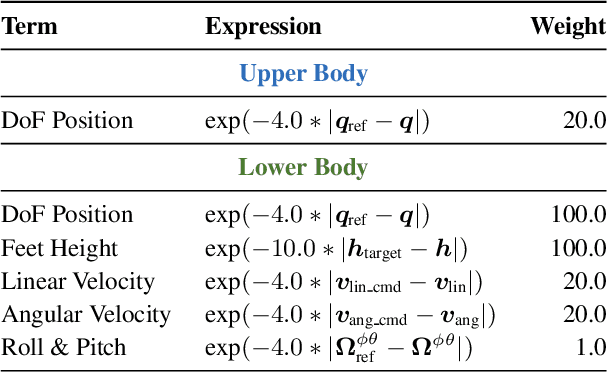
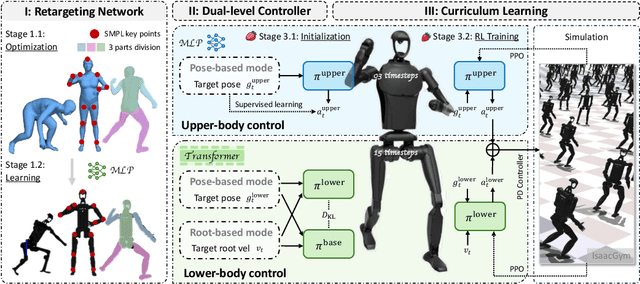
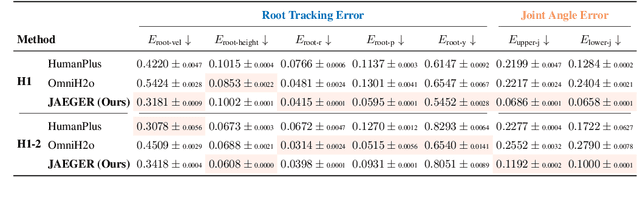
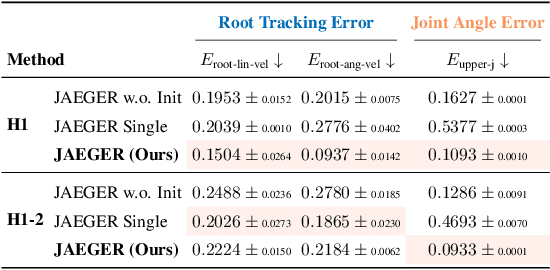
This paper presents JAEGER, a dual-level whole-body controller for humanoid robots that addresses the challenges of training a more robust and versatile policy. Unlike traditional single-controller approaches, JAEGER separates the control of the upper and lower bodies into two independent controllers, so that they can better focus on their distinct tasks. This separation alleviates the dimensionality curse and improves fault tolerance. JAEGER supports both root velocity tracking (coarse-grained control) and local joint angle tracking (fine-grained control), enabling versatile and stable movements. To train the controller, we utilize a human motion dataset (AMASS), retargeting human poses to humanoid poses through an efficient retargeting network, and employ a curriculum learning approach. This method performs supervised learning for initialization, followed by reinforcement learning for further exploration. We conduct our experiments on two humanoid platforms and demonstrate the superiority of our approach against state-of-the-art methods in both simulation and real environments.