 Add to Chrome
 Add to Firefox
 Add to Edge
InternVLA-A1.5: Unifying Understanding, Latent Foresight, and Action for Compositional Generalization
Jul 06, 2026
Unified models for robot manipulation aim to equip one policy with both the semantic priors of pretrained VLMs and the physical dynamics learned through future prediction. In practice, existing designs tend to erode the semantics of the pretrained backbone, suffer interference among heterogeneous objectives, and learn future prediction from scratch in pixel space, leaving the dynamics priors of pretrained video generators unexploited. We present InternVLA-A1.5, which builds the policy on a native VLM backbone that keeps training on VQA and subtask prediction, and attaches a lightweight unified expert for continuous action generation. Future prediction is recast as a latent-querying problem, where a small set of learnable foresight tokens condenses the task-relevant future into a compact latent code under the supervision of a frozen pretrained video generation model, so the policy inherits world-model dynamics priors without ever learning pixel-level generation. The video branch is discarded at inference, keeping real-time control. Pretrained on 1.2M robot episodes and 3M multimodal samples, InternVLA-A1.5 achieves the best overall results on all six simulation benchmarks. In the real world, the preserved semantics deliver the strongest compositional generalization on held-out instruction bindings, and the two designs together sustain long-horizon execution.

FutureVLA: Joint Visuomotor Prediction for Vision-Language-Action Model
Mar 11, 2026Predictive foresight is important to intelligent embodied agents. Since the motor execution of a robot is intrinsically constrained by its visual perception of environmental geometry, effectively anticipating the future requires capturing this tightly coupled visuomotor interplay. While recent vision-language-action models attempt to incorporate future guidance, they struggle with this joint modeling. Existing explicit methods divert capacity to task-irrelevant visual details, whereas implicit methods relying on sparse frame pairs disrupt temporal continuity. By heavily relying on visual reconstruction, these methods become visually dominated, entangling static scene context with dynamic action intent. We argue that effective joint visuomotor predictive modeling requires both temporal continuity and visually-conditioned supervision decoupling. To this end, we propose FutureVLA, featuring a novel Joint Visuomotor Predictive Architecture. FutureVLA is designed to extract joint visuomotor embeddings by first decoupling visual and motor information, and then jointly encoding generalized physical priors. Specifically, in the pretraining stage, we leverage heterogeneous manipulation datasets and introduce a Joint Visuomotor Gating mechanism to structurally separate visual state preservation from temporal action modeling. It allows the motor stream to focus on continuous physical dynamics while explicitly querying visual tokens for environmental constraints, yielding highly generalizable joint visuomotor embeddings. Subsequently, in the post-training stage, we employ a latent embeddings alignment strategy, enabling diverse downstream VLA models to internalize these temporal priors without modifying their inference architectures. Extensive experiments demonstrate that FutureVLA consistently improves VLA frameworks.
DBGroup: Dual-Branch Point Grouping for Weakly Supervised 3D Instance Segmentation
Nov 13, 2025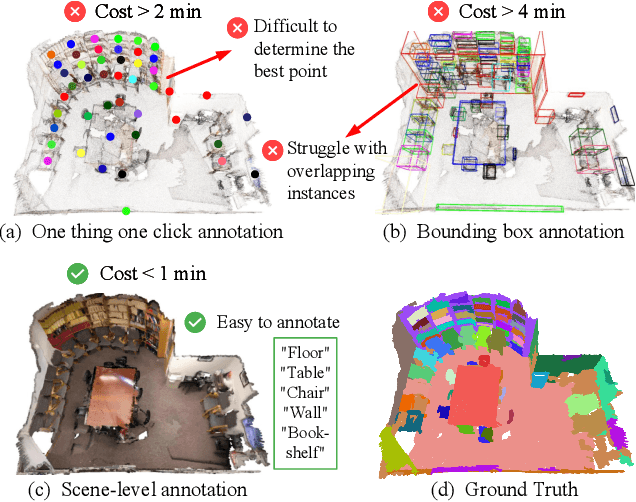
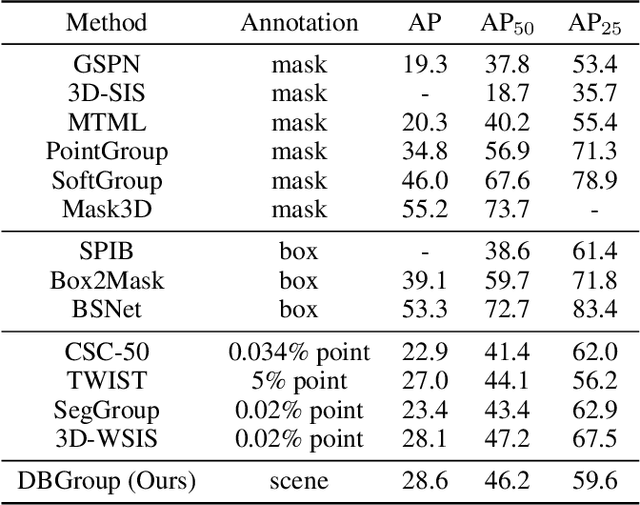
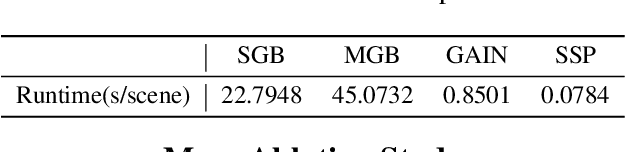
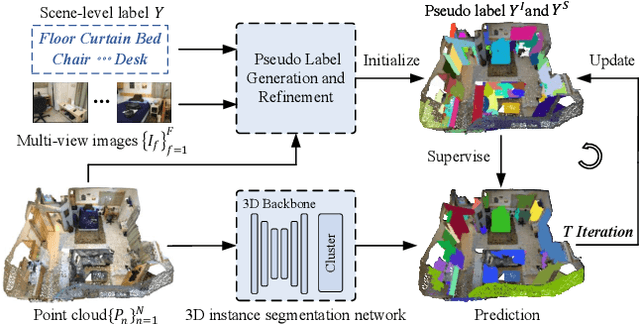
Weakly supervised 3D instance segmentation is essential for 3D scene understanding, especially as the growing scale of data and high annotation costs associated with fully supervised approaches. Existing methods primarily rely on two forms of weak supervision: one-thing-one-click annotations and bounding box annotations, both of which aim to reduce labeling efforts. However, these approaches still encounter limitations, including labor-intensive annotation processes, high complexity, and reliance on expert annotators. To address these challenges, we propose \textbf{DBGroup}, a two-stage weakly supervised 3D instance segmentation framework that leverages scene-level annotations as a more efficient and scalable alternative. In the first stage, we introduce a Dual-Branch Point Grouping module to generate pseudo labels guided by semantic and mask cues extracted from multi-view images. To further improve label quality, we develop two refinement strategies: Granularity-Aware Instance Merging and Semantic Selection and Propagation. The second stage involves multi-round self-training on an end-to-end instance segmentation network using the refined pseudo-labels. Additionally, we introduce an Instance Mask Filter strategy to address inconsistencies within the pseudo labels. Extensive experiments demonstrate that DBGroup achieves competitive performance compared to sparse-point-level supervised 3D instance segmentation methods, while surpassing state-of-the-art scene-level supervised 3D semantic segmentation approaches. Code is available at https://github.com/liuxuexun/DBGroup.
LESS: Label-Efficient and Single-Stage Referring 3D Segmentation
Oct 17, 2024
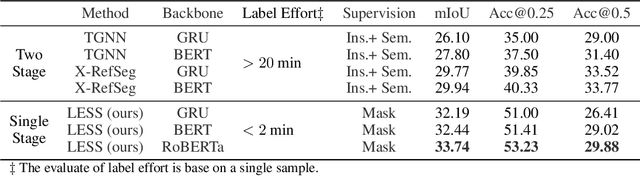
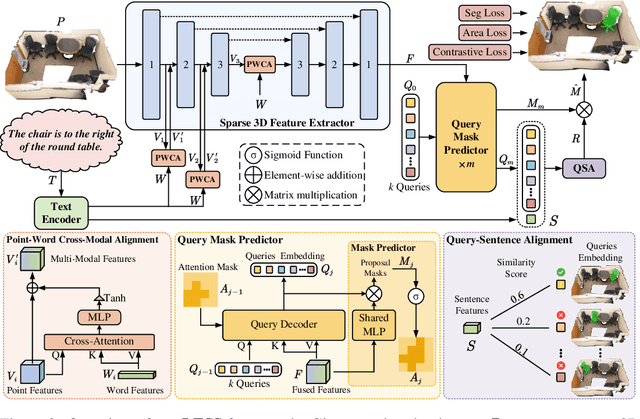

Referring 3D Segmentation is a visual-language task that segments all points of the specified object from a 3D point cloud described by a sentence of query. Previous works perform a two-stage paradigm, first conducting language-agnostic instance segmentation then matching with given text query. However, the semantic concepts from text query and visual cues are separately interacted during the training, and both instance and semantic labels for each object are required, which is time consuming and human-labor intensive. To mitigate these issues, we propose a novel Referring 3D Segmentation pipeline, Label-Efficient and Single-Stage, dubbed LESS, which is only under the supervision of efficient binary mask. Specifically, we design a Point-Word Cross-Modal Alignment module for aligning the fine-grained features of points and textual embedding. Query Mask Predictor module and Query-Sentence Alignment module are introduced for coarse-grained alignment between masks and query. Furthermore, we propose an area regularization loss, which coarsely reduces irrelevant background predictions on a large scale. Besides, a point-to-point contrastive loss is proposed concentrating on distinguishing points with subtly similar features. Through extensive experiments, we achieve state-of-the-art performance on ScanRefer dataset by surpassing the previous methods about 3.7% mIoU using only binary labels.
3D Weakly Supervised Semantic Segmentation with 2D Vision-Language Guidance
Jul 13, 2024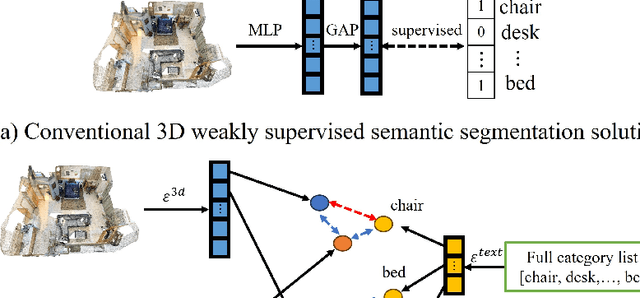
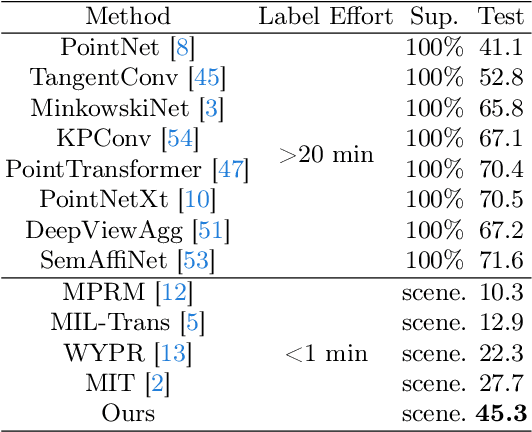
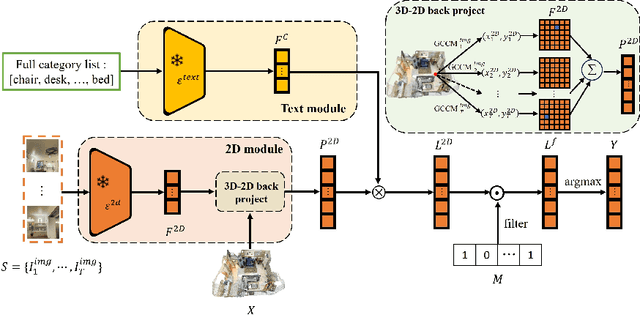
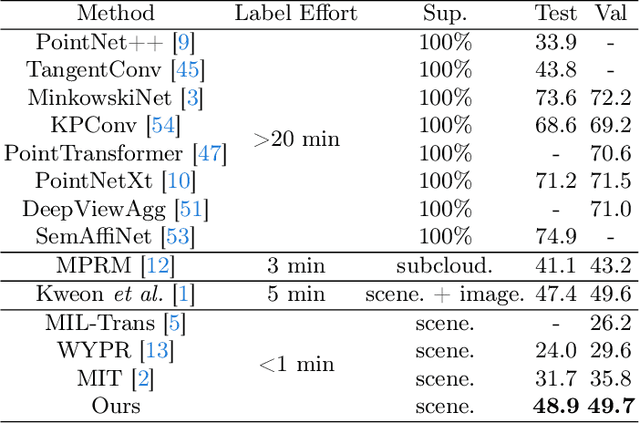
In this paper, we propose 3DSS-VLG, a weakly supervised approach for 3D Semantic Segmentation with 2D Vision-Language Guidance, an alternative approach that a 3D model predicts dense-embedding for each point which is co-embedded with both the aligned image and text spaces from the 2D vision-language model. Specifically, our method exploits the superior generalization ability of the 2D vision-language models and proposes the Embeddings Soft-Guidance Stage to utilize it to implicitly align 3D embeddings and text embeddings. Moreover, we introduce the Embeddings Specialization Stage to purify the feature representation with the help of a given scene-level label, specifying a better feature supervised by the corresponding text embedding. Thus, the 3D model is able to gain informative supervisions both from the image embedding and text embedding, leading to competitive segmentation performances. To the best of our knowledge, this is the first work to investigate 3D weakly supervised semantic segmentation by using the textual semantic information of text category labels. Moreover, with extensive quantitative and qualitative experiments, we present that our 3DSS-VLG is able not only to achieve the state-of-the-art performance on both S3DIS and ScanNet datasets, but also to maintain strong generalization capability.
Weakly-Supervised 3D Visual Grounding based on Visual Linguistic Alignment
Dec 15, 2023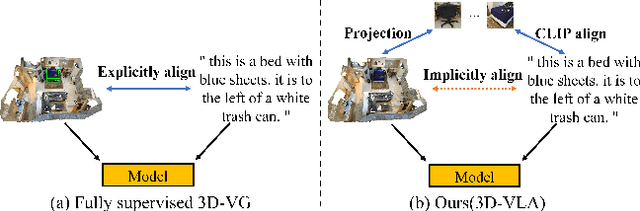
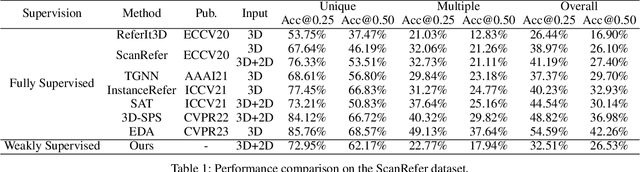
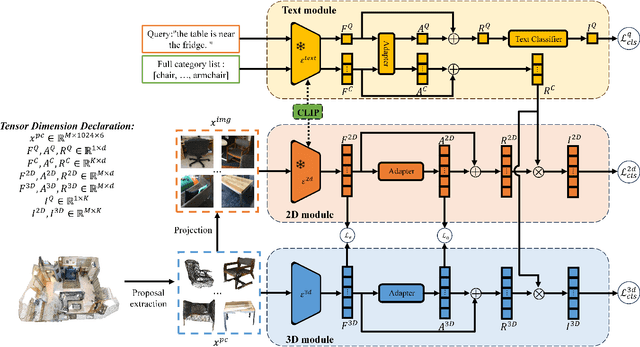
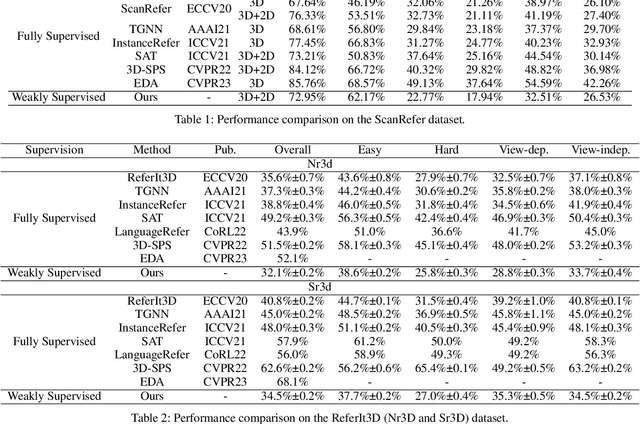
Learning to ground natural language queries to target objects or regions in 3D point clouds is quite essential for 3D scene understanding. Nevertheless, existing 3D visual grounding approaches require a substantial number of bounding box annotations for text queries, which is time-consuming and labor-intensive to obtain. In this paper, we propose \textbf{3D-VLA}, a weakly supervised approach for \textbf{3D} visual grounding based on \textbf{V}isual \textbf{L}inguistic \textbf{A}lignment. Our 3D-VLA exploits the superior ability of current large-scale vision-language models (VLMs) on aligning the semantics between texts and 2D images, as well as the naturally existing correspondences between 2D images and 3D point clouds, and thus implicitly constructs correspondences between texts and 3D point clouds with no need for fine-grained box annotations in the training procedure. During the inference stage, the learned text-3D correspondence will help us ground the text queries to the 3D target objects even without 2D images. To the best of our knowledge, this is the first work to investigate 3D visual grounding in a weakly supervised manner by involving large scale vision-language models, and extensive experiments on ReferIt3D and ScanRefer datasets demonstrate that our 3D-VLA achieves comparable and even superior results over the fully supervised methods.