 Add to Chrome
 Add to Firefox
 Add to Edge
KAI: A Kinematic-Aware Interface for Data-Efficient Articulated Object Manipulation
Jul 27, 2026
Articulated object manipulation requires an understanding of kinematic structure that is difficult and costly to learn from robot demonstrations alone. We introduce the Kinematic-Aware Articulation Interface (KAI), a structured intermediate representation that captures the kinematic structure of articulated objects. By embedding interpretable geometric and kinematic priors into policy learning, KAI provides a strong inductive bias aligned with the underlying structure of articulated motion. This design effectively improves sample efficiency, with gains particularly pronounced in low-data regimes: across six simulation tasks, our method achieves an average success rate of 82.9%, matching or surpassing baseline performance while using only half the demonstration data. Our method also exhibits robust generalization to unseen backgrounds and visual distractors, transferring from a single clean training environment to cluttered real-world scenes. KAI's action-agnostic design further enables co-training with human interaction videos to enhance real-world robustness: under diverse visual distractions, our method with video co-training achieves over 70% average success rate.

InternVLA-A1.5: Unifying Understanding, Latent Foresight, and Action for Compositional Generalization
Jul 06, 2026Unified models for robot manipulation aim to equip one policy with both the semantic priors of pretrained VLMs and the physical dynamics learned through future prediction. In practice, existing designs tend to erode the semantics of the pretrained backbone, suffer interference among heterogeneous objectives, and learn future prediction from scratch in pixel space, leaving the dynamics priors of pretrained video generators unexploited. We present InternVLA-A1.5, which builds the policy on a native VLM backbone that keeps training on VQA and subtask prediction, and attaches a lightweight unified expert for continuous action generation. Future prediction is recast as a latent-querying problem, where a small set of learnable foresight tokens condenses the task-relevant future into a compact latent code under the supervision of a frozen pretrained video generation model, so the policy inherits world-model dynamics priors without ever learning pixel-level generation. The video branch is discarded at inference, keeping real-time control. Pretrained on 1.2M robot episodes and 3M multimodal samples, InternVLA-A1.5 achieves the best overall results on all six simulation benchmarks. In the real world, the preserved semantics deliver the strongest compositional generalization on held-out instruction bindings, and the two designs together sustain long-horizon execution.
UMI-Bench 1.0: An Open and Reproducible Real-World Benchmark for Tabletop Robotic Manipulation with UMI Data
Jun 09, 2026Real-robot evaluation is essential for understanding whether learned manipulation policies can operate reliably outside curated demonstrations. This need is particularly pressing for Universal Manipulation Interface (UMI)-style policies, whose performance depends on the coupling between wrist-view observations, action representation, data collection, and physical deployment. Existing real-world benchmarks have made important progress, but they are not designed around this UMI data-to-deployment setting. We present UMI-Bench 1.0, a local-first real-robot benchmark for standardized evaluation of UMI-style manipulation policies. To the best of our knowledge, this is the first benchmark dedicated to real-world evaluation of UMI-based manipulation models. UMI-Bench aligns data collection, scene reset, policy execution, result logging, and task-factor analysis within a unified protocol. By making the full evaluation process reproducible and auditable, UMI-Bench provides a practical testbed for measuring how UMI-trained policies generalize to real physical manipulation.
EgoAERO: Learning Dexterous Manipulation from a Single Egocentric Video without Object Assets
Jun 06, 2026Egocentric RGB-D videos offer a natural source of human dexterous manipulation demonstrations, but existing data is difficult to use for robot learning because object pose, geometry, and contact information are often missing or require pre-scanned object assets. We present EgoAERO, the first framework that learns dexterous manipulation from a single egocentric RGB-D human demonstration without object assets. EgoAERO reconstructs contact-consistent hand-object trajectories through asset-free object tracking and reconstruction, ego motion compensation, and adaptive contact optimization, then converts them into robot policies using two-stage residual learning. We further introduce an online quality assessment mechanism and construct EgoDex-R, a large-scale egocentric dataset with 4.3M RGB-D frames for dexterous policy learning. Simulation and real-world experiments show that EgoAERO enables single-demonstration dexterous manipulation and achieves downstream performance close to CAD-based reconstructions on HOI4D.
VISTA: Vision-Grounded and Physics-Validated Adaptation of UMI data for VLA Training
Jun 04, 2026Universal Manipulation Interface (UMI) enables scalable real-world robot data collection without hardware-specific teleoperation, yet leveraging UMI data to train large-scale Vision-Language-Action (VLA) models remains fundamentally challenging. We identify two critical mismatches: wrist-mounted fisheye views, with severe radial distortion and local gripper-centric perspectives, are out-of-distribution for pretrained VLMs; and human-collected trajectories frequently violate kinematic limits, incur collisions, or exceed controller bandwidth, teaching VLA policies physically infeasible actions. To address the challenges, we present VISTA, a framework that bridges this dual gap through three synergistic components. (i)~UMI-VQA, the first large-scale VQA dataset tailored to wrist-mounted fisheye observations, aligns VLM representations to the distorted visual regime via auxiliary vision-language supervision. (ii)~A systematic physical-validation pipeline performs a data-completeness pre-check and scores each valid trajectory for trajectory continuity, self-collision risk, and execution fidelity before it enters training. (iii)~A two-stage co-training recipe jointly learns vision-language grounding on UMI-VQA and action prediction on validated trajectories. Our experiments empirically show that incorporating UMI-VQA consistently improves downstream policy performance, and that physical-validation scores are strongly predictive of deployment success. On diverse simulation and real-world manipulation tasks, VISTA significantly outperforms strong baselines including $π_{0.5}$, LingBot-VLA, and Wall-X. We release the physical-validation pipeline, UMI-VQA, validated trajectory data, and the pre-trained model for the community.
ForceVLA2: Unleashing Hybrid Force-Position Control with Force Awareness for Contact-Rich Manipulation
Mar 16, 2026Embodied intelligence for contact-rich manipulation has predominantly relied on position control, while explicit awareness and regulation of interaction forces remain under-explored, limiting stability, precision, and robustness in real-world tasks. We propose ForceVLA2, an end-to-end vision-language-action framework that equips robots with hybrid force-position control and explicit force awareness. ForceVLA2 introduces force-based prompts into the VLM expert to construct force-aware task concepts across stages, and employs a Cross-Scale Mixture-of-Experts (MoE) in the action expert to adaptively fuse these concepts with real-time interaction forces for closed-loop hybrid force-position regulation. To support learning and evaluation, we construct ForceVLA2-Dataset, containing 1,000 trajectories over 5 contact-rich tasks, including wiping, pressing, and assembling, with multi-view images, task prompts, proprioceptive state, and force signals. Extensive experiments show that ForceVLA2 substantially improves success rates and reliability in contact-rich manipulation, outperforming pi0 and pi0.5 by 48.0% and 35.0%, respectively, across the 5 tasks, and mitigating common failure modes such as arm overload and unstable contact, thereby actively advancing force-aware interactive physical intelligence in VLAs. The project page is available at https://sites.google.com/view/force-vla2/home.
FastUMI-100K: Advancing Data-driven Robotic Manipulation with a Large-scale UMI-style Dataset
Oct 09, 2025Data-driven robotic manipulation learning depends on large-scale, high-quality expert demonstration datasets. However, existing datasets, which primarily rely on human teleoperated robot collection, are limited in terms of scalability, trajectory smoothness, and applicability across different robotic embodiments in real-world environments. In this paper, we present FastUMI-100K, a large-scale UMI-style multimodal demonstration dataset, designed to overcome these limitations and meet the growing complexity of real-world manipulation tasks. Collected by FastUMI, a novel robotic system featuring a modular, hardware-decoupled mechanical design and an integrated lightweight tracking system, FastUMI-100K offers a more scalable, flexible, and adaptable solution to fulfill the diverse requirements of real-world robot demonstration data. Specifically, FastUMI-100K contains over 100K+ demonstration trajectories collected across representative household environments, covering 54 tasks and hundreds of object types. Our dataset integrates multimodal streams, including end-effector states, multi-view wrist-mounted fisheye images and textual annotations. Each trajectory has a length ranging from 120 to 500 frames. Experimental results demonstrate that FastUMI-100K enables high policy success rates across various baseline algorithms, confirming its robustness, adaptability, and real-world applicability for solving complex, dynamic manipulation challenges. The source code and dataset will be released in this link https://github.com/MrKeee/FastUMI-100K.
Fast-UMI: A Scalable and Hardware-Independent Universal Manipulation Interface
Sep 29, 2024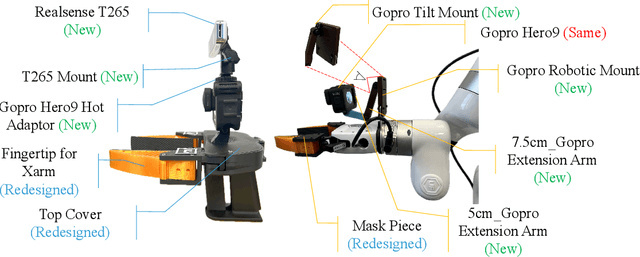
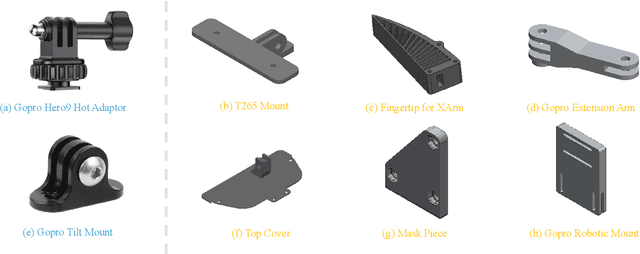
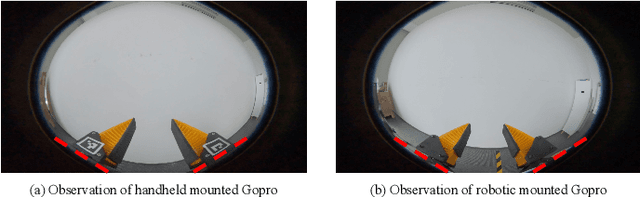
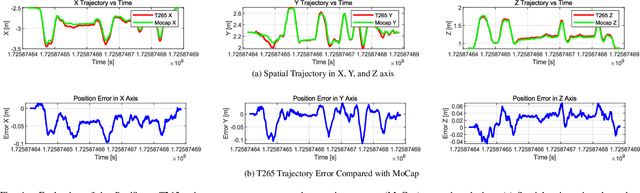
Collecting real-world manipulation trajectory data involving robotic arms is essential for developing general-purpose action policies in robotic manipulation, yet such data remains scarce. Existing methods face limitations such as high costs, labor intensity, hardware dependencies, and complex setup requirements involving SLAM algorithms. In this work, we introduce Fast-UMI, an interface-mediated manipulation system comprising two key components: a handheld device operated by humans for data collection and a robot-mounted device used during policy inference. Our approach employs a decoupled design compatible with a wide range of grippers while maintaining consistent observation perspectives, allowing models trained on handheld-collected data to be directly applied to real robots. By directly obtaining the end-effector pose using existing commercial hardware products, we eliminate the need for complex SLAM deployment and calibration, streamlining data processing. Fast-UMI provides supporting software tools for efficient robot learning data collection and conversion, facilitating rapid, plug-and-play functionality. This system offers an efficient and user-friendly tool for robotic learning data acquisition.
AlignBot: Aligning VLM-powered Customized Task Planning with User Reminders Through Fine-Tuning for Household Robots
Sep 18, 2024


This paper presents AlignBot, a novel framework designed to optimize VLM-powered customized task planning for household robots by effectively aligning with user reminders. In domestic settings, aligning task planning with user reminders poses significant challenges due to the limited quantity, diversity, and multimodal nature of the reminders. To address these challenges, AlignBot employs a fine-tuned LLaVA-7B model, functioning as an adapter for GPT-4o. This adapter model internalizes diverse forms of user reminders-such as personalized preferences, corrective guidance, and contextual assistance-into structured instruction-formatted cues that prompt GPT-4o in generating customized task plans. Additionally, AlignBot integrates a dynamic retrieval mechanism that selects task-relevant historical successes as prompts for GPT-4o, further enhancing task planning accuracy. To validate the effectiveness of AlignBot, experiments are conducted in real-world household environments, which are constructed within the laboratory to replicate typical household settings. A multimodal dataset with over 1,500 entries derived from volunteer reminders is used for training and evaluation. The results demonstrate that AlignBot significantly improves customized task planning, outperforming existing LLM- and VLM-powered planners by interpreting and aligning with user reminders, achieving 86.8% success rate compared to the vanilla GPT-4o baseline at 21.6%, reflecting a 65% improvement and over four times greater effectiveness. Supplementary materials are available at: https://yding25.com/AlignBot/