 Add to Chrome
 Add to Firefox
 Add to Edge
Information Density Principle for MLLM Benchmarks
Mar 13, 2025
With the emergence of Multimodal Large Language Models (MLLMs), hundreds of benchmarks have been developed to ensure the reliability of MLLMs in downstream tasks. However, the evaluation mechanism itself may not be reliable. For developers of MLLMs, questions remain about which benchmark to use and whether the test results meet their requirements. Therefore, we propose a critical principle of Information Density, which examines how much insight a benchmark can provide for the development of MLLMs. We characterize it from four key dimensions: (1) Fallacy, (2) Difficulty, (3) Redundancy, (4) Diversity. Through a comprehensive analysis of more than 10,000 samples, we measured the information density of 19 MLLM benchmarks. Experiments show that using the latest benchmarks in testing can provide more insight compared to previous ones, but there is still room for improvement in their information density. We hope this principle can promote the development and application of future MLLM benchmarks. Project page: https://github.com/lcysyzxdxc/bench4bench

GenDR: Lightning Generative Detail Restorator
Mar 09, 2025Recent research applying text-to-image (T2I) diffusion models to real-world super-resolution (SR) has achieved remarkable success. However, fundamental misalignments between T2I and SR targets result in a dilemma between inference speed and detail fidelity. Specifically, T2I tasks prioritize multi-step inversion to synthesize coherent outputs aligned with textual prompts and shrink the latent space to reduce generating complexity. Contrariwise, SR tasks preserve most information from low-resolution input while solely restoring high-frequency details, thus necessitating sufficient latent space and fewer inference steps. To bridge the gap, we present a one-step diffusion model for generative detail restoration, GenDR, distilled from a tailored diffusion model with larger latent space. In detail, we train a new SD2.1-VAE16 (0.9B) via representation alignment to expand latent space without enlarging the model size. Regarding step-distillation, we propose consistent score identity distillation (CiD) that incorporates SR task-specific loss into score distillation to leverage more SR priors and align the training target. Furthermore, we extend CiD with adversarial learning and representation alignment (CiDA) to enhance perceptual quality and accelerate training. We also polish the pipeline to achieve a more efficient inference. Experimental results demonstrate that GenDR achieves state-of-the-art performance in both quantitative metrics and visual fidelity.
Mask-DPO: Generalizable Fine-grained Factuality Alignment of LLMs
Mar 04, 2025Large language models (LLMs) exhibit hallucinations (i.e., unfaithful or nonsensical information) when serving as AI assistants in various domains. Since hallucinations always come with truthful content in the LLM responses, previous factuality alignment methods that conduct response-level preference learning inevitably introduced noises during training. Therefore, this paper proposes a fine-grained factuality alignment method based on Direct Preference Optimization (DPO), called Mask-DPO. Incorporating sentence-level factuality as mask signals, Mask-DPO only learns from factually correct sentences in the preferred samples and prevents the penalty on factual contents in the not preferred samples, which resolves the ambiguity in the preference learning. Extensive experimental results demonstrate that Mask-DPO can significantly improve the factuality of LLMs responses to questions from both in-domain and out-of-domain datasets, although these questions and their corresponding topics are unseen during training. Only trained on the ANAH train set, the score of Llama3.1-8B-Instruct on the ANAH test set is improved from 49.19% to 77.53%, even surpassing the score of Llama3.1-70B-Instruct (53.44%), while its FactScore on the out-of-domain Biography dataset is also improved from 30.29% to 39.39%. We further study the generalization property of Mask-DPO using different training sample scaling strategies and find that scaling the number of topics in the dataset is more effective than the number of questions. We provide a hypothesis of what factual alignment is doing with LLMs, on the implication of this phenomenon, and conduct proof-of-concept experiments to verify it. We hope the method and the findings pave the way for future research on scaling factuality alignment.
Sparse Meets Dense: Unified Generative Recommendations with Cascaded Sparse-Dense Representations
Mar 04, 2025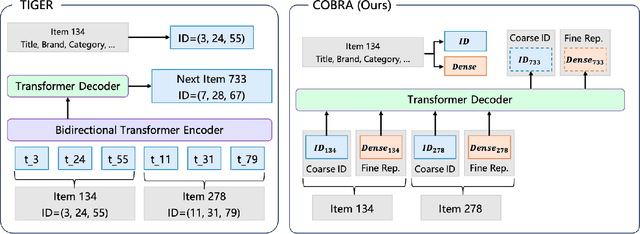
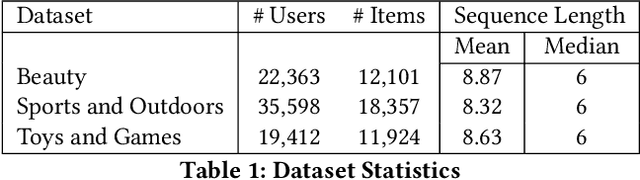
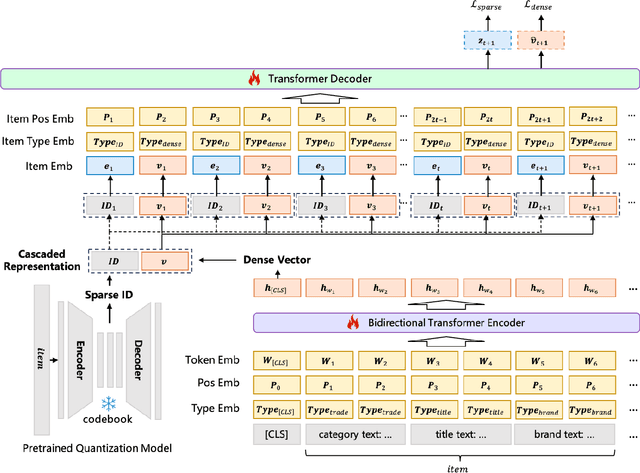
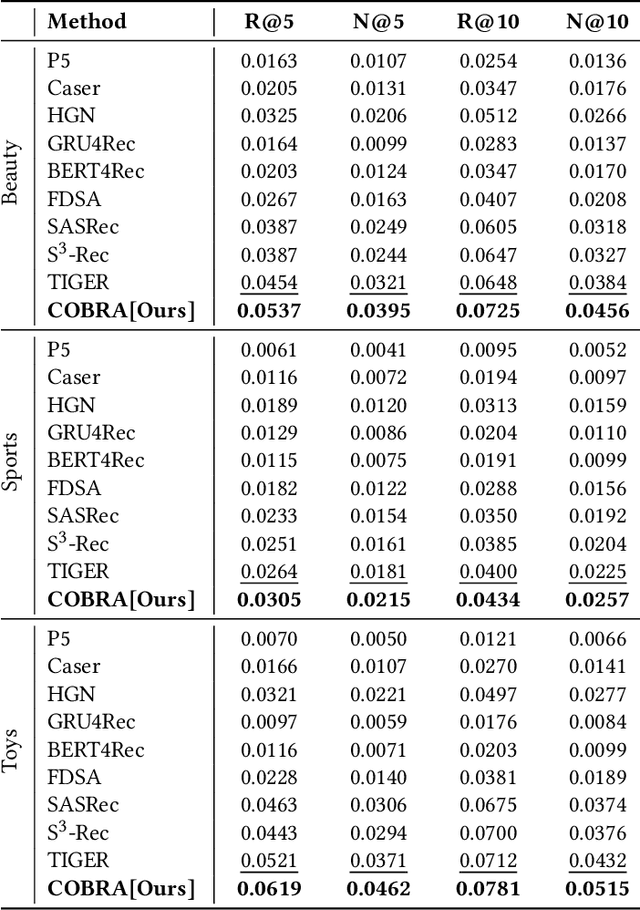
Generative models have recently gained attention in recommendation systems by directly predicting item identifiers from user interaction sequences. However, existing methods suffer from significant information loss due to the separation of stages such as quantization and sequence modeling, hindering their ability to achieve the modeling precision and accuracy of sequential dense retrieval techniques. Integrating generative and dense retrieval methods remains a critical challenge. To address this, we introduce the Cascaded Organized Bi-Represented generAtive retrieval (COBRA) framework, which innovatively integrates sparse semantic IDs and dense vectors through a cascading process. Our method alternates between generating these representations by first generating sparse IDs, which serve as conditions to aid in the generation of dense vectors. End-to-end training enables dynamic refinement of dense representations, capturing both semantic insights and collaborative signals from user-item interactions. During inference, COBRA employs a coarse-to-fine strategy, starting with sparse ID generation and refining them into dense vectors via the generative model. We further propose BeamFusion, an innovative approach combining beam search with nearest neighbor scores to enhance inference flexibility and recommendation diversity. Extensive experiments on public datasets and offline tests validate our method's robustness. Online A/B tests on a real-world advertising platform with over 200 million daily users demonstrate substantial improvements in key metrics, highlighting COBRA's practical advantages.
Interactive Navigation for Legged Manipulators with Learned Arm-Pushing Controller
Mar 03, 2025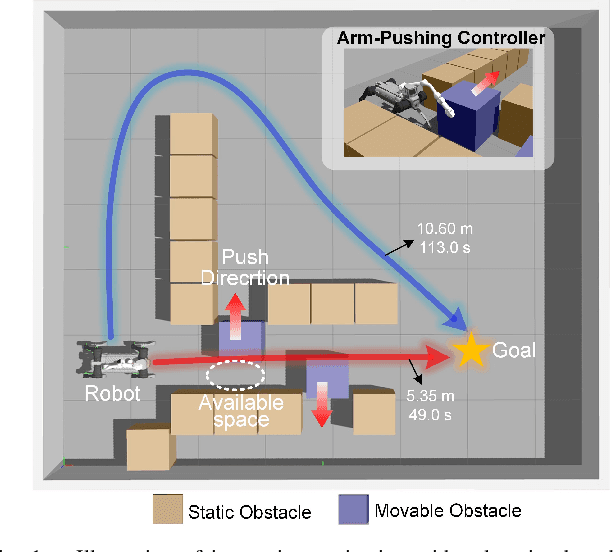


Interactive navigation is crucial in scenarios where proactively interacting with objects can yield shorter paths, thus significantly improving traversal efficiency. Existing methods primarily focus on using the robot body to relocate large obstacles (which could be comparable to the size of a robot). However, they prove ineffective in narrow or constrained spaces where the robot's dimensions restrict its manipulation capabilities. This paper introduces a novel interactive navigation framework for legged manipulators, featuring an active arm-pushing mechanism that enables the robot to reposition movable obstacles in space-constrained environments. To this end, we develop a reinforcement learning-based arm-pushing controller with a two-stage reward strategy for large-object manipulation. Specifically, this strategy first directs the manipulator to a designated pushing zone to achieve a kinematically feasible contact configuration. Then, the end effector is guided to maintain its position at appropriate contact points for stable object displacement while preventing toppling. The simulations validate the robustness of the arm-pushing controller, showing that the two-stage reward strategy improves policy convergence and long-term performance. Real-world experiments further demonstrate the effectiveness of the proposed navigation framework, which achieves shorter paths and reduced traversal time. The open-source project can be found at https://github.com/Zhihaibi/Interactive-Navigation-for-legged-manipulator.git.
CritiQ: Mining Data Quality Criteria from Human Preferences
Feb 26, 2025Language model heavily depends on high-quality data for optimal performance. Existing approaches rely on manually designed heuristics, the perplexity of existing models, training classifiers, or careful prompt engineering, which require significant expert experience and human annotation effort while introduce biases. We introduce CritiQ, a novel data selection method that automatically mines criteria from human preferences for data quality with only $\sim$30 human-annotated pairs and performs efficient data selection. The main component, CritiQ Flow, employs a manager agent to evolve quality criteria and worker agents to make pairwise judgments. We build a knowledge base that extracts quality criteria from previous work to boost CritiQ Flow. Compared to perplexity- and classifier- based methods, verbal criteria are more interpretable and possess reusable value. After deriving the criteria, we train the CritiQ Scorer to give quality scores and perform efficient data selection. We demonstrate the effectiveness of our method in the code, math, and logic domains, achieving high accuracy on human-annotated test sets. To validate the quality of the selected data, we continually train Llama 3.1 models and observe improved performance on downstream tasks compared to uniform sampling. Ablation studies validate the benefits of the knowledge base and the reflection process. We analyze how criteria evolve and the effectiveness of majority voting.
OmniAlign-V: Towards Enhanced Alignment of MLLMs with Human Preference
Feb 25, 2025Recent advancements in open-source multi-modal large language models (MLLMs) have primarily focused on enhancing foundational capabilities, leaving a significant gap in human preference alignment. This paper introduces OmniAlign-V, a comprehensive dataset of 200K high-quality training samples featuring diverse images, complex questions, and varied response formats to improve MLLMs' alignment with human preferences. We also present MM-AlignBench, a human-annotated benchmark specifically designed to evaluate MLLMs' alignment with human values. Experimental results show that finetuning MLLMs with OmniAlign-V, using Supervised Fine-Tuning (SFT) or Direct Preference Optimization (DPO), significantly enhances human preference alignment while maintaining or enhancing performance on standard VQA benchmarks, preserving their fundamental capabilities. Our datasets, benchmark, code and checkpoints have been released at https://github.com/PhoenixZ810/OmniAlign-V.
PPC-GPT: Federated Task-Specific Compression of Large Language Models via Pruning and Chain-of-Thought Distillation
Feb 21, 2025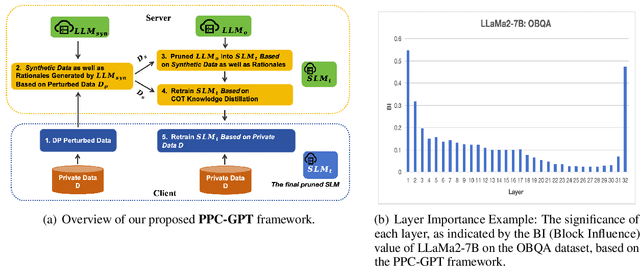
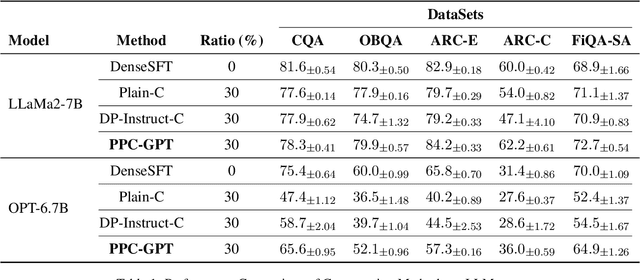
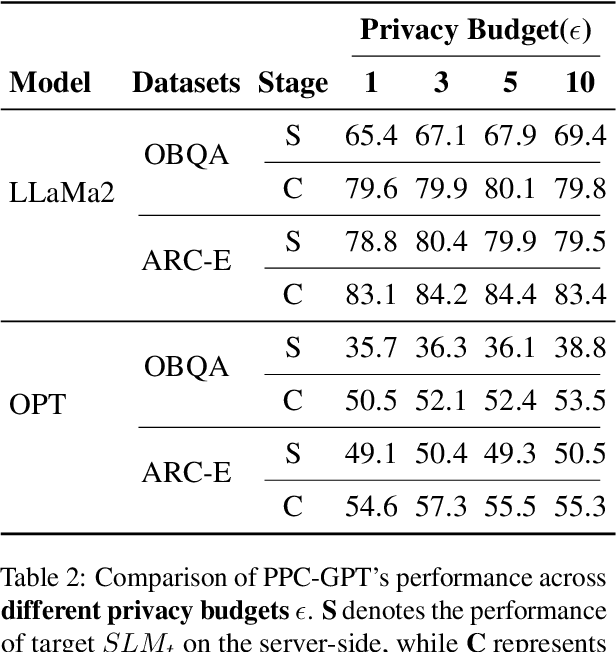
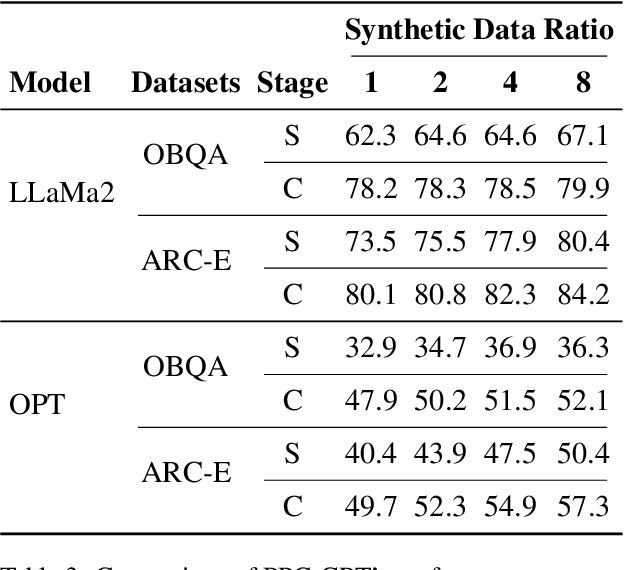
Compressing Large Language Models (LLMs) into task-specific Small Language Models (SLMs) encounters two significant challenges: safeguarding domain-specific knowledge privacy and managing limited resources. To tackle these challenges, we propose PPC-GPT, a innovative privacy-preserving federated framework specifically designed for compressing LLMs into task-specific SLMs via pruning and Chain-of-Thought (COT) distillation. PPC-GPT works on a server-client federated architecture, where the client sends differentially private (DP) perturbed task-specific data to the server's LLM. The LLM then generates synthetic data along with their corresponding rationales. This synthetic data is subsequently used for both LLM pruning and retraining processes. Additionally, we harness COT knowledge distillation, leveraging the synthetic data to further improve the retraining of structurally-pruned SLMs. Our experimental results demonstrate the effectiveness of PPC-GPT across various text generation tasks. By compressing LLMs into task-specific SLMs, PPC-GPT not only achieves competitive performance but also prioritizes data privacy protection.
DH-RAG: A Dynamic Historical Context-Powered Retrieval-Augmented Generation Method for Multi-Turn Dialogue
Feb 19, 2025Retrieval-Augmented Generation (RAG) systems have shown substantial benefits in applications such as question answering and multi-turn dialogue \citep{lewis2020retrieval}. However, traditional RAG methods, while leveraging static knowledge bases, often overlook the potential of dynamic historical information in ongoing conversations. To bridge this gap, we introduce DH-RAG, a Dynamic Historical Context-Powered Retrieval-Augmented Generation Method for Multi-Turn Dialogue. DH-RAG is inspired by human cognitive processes that utilize both long-term memory and immediate historical context in conversational responses \citep{stafford1987conversational}. DH-RAG is structured around two principal components: a History-Learning based Query Reconstruction Module, designed to generate effective queries by synthesizing current and prior interactions, and a Dynamic History Information Updating Module, which continually refreshes historical context throughout the dialogue. The center of DH-RAG is a Dynamic Historical Information database, which is further refined by three strategies within the Query Reconstruction Module: Historical Query Clustering, Hierarchical Matching, and Chain of Thought Tracking. Experimental evaluations show that DH-RAG significantly surpasses conventional models on several benchmarks, enhancing response relevance, coherence, and dialogue quality.
Corrupted but Not Broken: Rethinking the Impact of Corrupted Data in Visual Instruction Tuning
Feb 18, 2025Visual Instruction Tuning (VIT) enhances Multimodal Large Language Models (MLLMs) but it is hindered by corrupted datasets containing hallucinated content, incorrect responses, and poor OCR quality. While prior works focus on dataset refinement through high-quality data collection or rule-based filtering, they are costly or limited to specific types of corruption. To deeply understand how corrupted data affects MLLMs, in this paper, we systematically investigate this issue and find that while corrupted data degrades the performance of MLLMs, its effects are largely superficial in that the performance of MLLMs can be largely restored by either disabling a small subset of parameters or post-training with a small amount of clean data. Additionally, corrupted MLLMs exhibit improved ability to distinguish clean samples from corrupted ones, enabling the dataset cleaning without external help. Based on those insights, we propose a corruption-robust training paradigm combining self-validation and post-training, which significantly outperforms existing corruption mitigation strategies.