 Add to Chrome
 Add to Firefox
 Add to Edge
Beyond Mode Collapse: Distribution Matching for Diverse Reasoning
May 19, 2026
On-policy reinforcement learning methods like GRPO suffer from mode collapse: they exhibit reduced solution diversity, concentrating probability mass on a single solution once discovered and ceasing exploration of alternative strategies. We show this stems from reverse KL minimization's mode-seeking behavior, which reinforces the first high-reward trajectory found rather than maintaining a distribution over multiple diverse solutions. We propose DMPO (Distribution-Matching Policy Optimization), which prevents mode collapse through principled approximation of forward KL minimization. DMPO constructs a group level target distribution over sampled trajectories proportional to their rewards, then aligns the policy distribution to this target. This provides mode-covering behavior without requiring sampling from the intractable global target distribution, enabling sustained exploration throughout training. We validate DMPO on NP-hard combinatorial optimization, where exponentially many feasible solutions exist but only a few approach optimality, an ideal testbed for evaluating exploration. DMPO achieves 43.9% Quality Ratio on text-based NP-Bench (vs. GRPO's 40.1%) and 43.1% on vision-based NP-Bench (vs. 38.4%), demonstrating 9% and 12% relative improvements respectively. These gains generalize to mathematical reasoning (+2.0%) and out-of-domain tasks (+2.3%), showing that diversity-preserving training enhances general reasoning capabilities across modalities. Our work establishes distribution matching as a practical, principled approach to preventing mode collapse in on-policy RL, with consistent quality improvements demonstrating sustained exploration across diverse reasoning tasks.

WildClawBench: A Benchmark for Real-World, Long-Horizon Agent Evaluation
May 11, 2026Large language and vision-language models increasingly power agents that act on a user's behalf through command-line interface (CLI) harnesses. However, most agent benchmarks still rely on synthetic sandboxes, short-horizon tasks, mock-service APIs, and final-answer checks, leaving open whether agents can complete realistic long-horizon work in the runtimes where they are deployed. This work presents WildClawBench, a native-runtime benchmark of 60 human-authored, bilingual, multimodal tasks spanning six thematic categories. Each task averages roughly 8 minutes of wall-clock time and over 20 tool calls, and runs inside a reproducible Docker container hosting an actual CLI agent harness (OpenClaw, Claude Code, Codex, or Hermes Agent) with access to real tools rather than mock services. Grading is hybrid, combining deterministic rule-based checks, environment-state auditing of side effects, and an LLM/VLM judge for semantic verification. Across 19 frontier models, the best, Claude Opus 4.7, reaches only 62.2% overall under OpenClaw, while every other model stays below 60%, and switching harness alone shifts a single model by up to 18 points. These results show that long-horizon, native-runtime agent evaluation remains a far-from-resolved task for current frontier models. We release the tasks, code, and containerized tooling to support reproducible evaluation.
On the Role of Language Representations in Auto-Bidding: Findings and Implications
May 07, 2026Auto-bidding is a crucial task in real-time advertising markets, where policies must optimize long-horizon value under delivery constraints (e.g., budget and CPA). Existing methods for auto-bidding rely on compact numerical state representations: while they can implicitly capture delivery dynamics, they offer limited support for explicitly representing and controlling high-level intent, evolving feedback, and operator-style strategic guidance in real campaigns. Meanwhile, Large Language Models (LLMs) offer a powerful method for encoding semantic information, it remains unclear when LLMs help and how to integrate them without sacrificing numerical precision. Through systematic preliminary studies, we find that (1) LLM embeddings contain bidding-relevant cues yet cannot replace numerical features, and (2) gains emerge only with careful semantic--numeric integration rather than naive concatenation. Motivated by these findings, we propose \textit{SemBid}, a novel auto-bidding framework that injects LLM-encoded semantics into offline bidding trajectories at the token level. SemBid introduces three semantic inputs: \textit{Task}, \textit{History}, and \textit{Strategy}. It injects these semantics as tokens alongside numerical trajectory tokens and uses self-attention to integrate them, improving controllability and generalization across objectives. Across diverse scenarios and budget regimes, SemBid outperforms competitive baselines from offline RL and generative sequence modeling, with more consistent gains in overall performance, constraint satisfaction, and robustness. Our code is available at: \href{https://github.com/AlanYu04/SemBid-KDD2026}{\textcolor{blue}{here}}.
Introspective Diffusion Language Models
Apr 13, 2026Diffusion language models promise parallel generation, yet still lag behind autoregressive (AR) models in quality. We stem this gap to a failure of introspective consistency: AR models agree with their own generations, while DLMs often do not. We define the introspective acceptance rate, which measures whether a model accepts its previously generated tokens. This reveals why AR training has a structural advantage: causal masking and logit shifting implicitly enforce introspective consistency. Motivated by this observation, we introduce Introspective Diffusion Language Model (I-DLM), a paradigm that retains diffusion-style parallel decoding while inheriting the introspective consistency of AR training. I-DLM uses a novel introspective strided decoding (ISD) algorithm, which enables the model to verify previously generated tokens while advancing new ones in the same forward pass. From a systems standpoint, we build I-DLM inference engine on AR-inherited optimizations and further customize it with a stationary-batch scheduler. To the best of our knowledge, I-DLM is the first DLM to match the quality of its same-scale AR counterpart while outperforming prior DLMs in both model quality and practical serving efficiency across 15 benchmarks. It reaches 69.6 on AIME-24 and 45.7 on LiveCodeBench-v6, exceeding LLaDA-2.1-mini (16B) by more than 26 and 15 points, respectively. Beyond quality, I-DLM is designed for the growing demand of large-concurrency serving, delivering about 3x higher throughput than prior state-of-the-art DLMs.
Intern-S1-Pro: Scientific Multimodal Foundation Model at Trillion Scale
Mar 26, 2026We introduce Intern-S1-Pro, the first one-trillion-parameter scientific multimodal foundation model. Scaling to this unprecedented size, the model delivers a comprehensive enhancement across both general and scientific domains. Beyond stronger reasoning and image-text understanding capabilities, its intelligence is augmented with advanced agent capabilities. Simultaneously, its scientific expertise has been vastly expanded to master over 100 specialized tasks across critical science fields, including chemistry, materials, life sciences, and earth sciences. Achieving this massive scale is made possible by the robust infrastructure support of XTuner and LMDeploy, which facilitates highly efficient Reinforcement Learning (RL) training at the 1-trillion parameter level while ensuring strict precision consistency between training and inference. By seamlessly integrating these advancements, Intern-S1-Pro further fortifies the fusion of general and specialized intelligence, working as a Specializable Generalist, demonstrating its position in the top tier of open-source models for general capabilities, while outperforming proprietary models in the depth of specialized scientific tasks.
Visual-ERM: Reward Modeling for Visual Equivalence
Mar 13, 2026Vision-to-code tasks require models to reconstruct structured visual inputs, such as charts, tables, and SVGs, into executable or structured representations with high visual fidelity. While recent Large Vision Language Models (LVLMs) achieve strong results via supervised fine-tuning, reinforcement learning remains challenging due to misaligned reward signals. Existing rewards either rely on textual rules or coarse visual embedding similarity, both of which fail to capture fine-grained visual discrepancies and are vulnerable to reward hacking. We propose Visual Equivalence Reward Model (Visual-ERM), a multimodal generative reward model that provides fine-grained, interpretable, and task-agnostic feedback to evaluate vision-to-code quality directly in the rendered visual space. Integrated into RL, Visual-ERM improves Qwen3-VL-8B-Instruct by +8.4 on chart-to-code and yields consistent gains on table and SVG parsing (+2.7, +4.1 on average), and further strengthens test-time scaling via reflection and revision. We also introduce VisualCritic-RewardBench (VC-RewardBench), a benchmark for judging fine-grained image-to-image discrepancies on structured visual data, where Visual-ERM at 8B decisively outperforms Qwen3-VL-235B-Instruct and approaches leading closed-source models. Our results suggest that fine-grained visual reward supervision is both necessary and sufficient for vision-to-code RL, regardless of task specificity.
PhysicsMind: Sim and Real Mechanics Benchmarking for Physical Reasoning and Prediction in Foundational VLMs and World Models
Jan 22, 2026Modern foundational Multimodal Large Language Models (MLLMs) and video world models have advanced significantly in mathematical, common-sense, and visual reasoning, but their grasp of the underlying physics remains underexplored. Existing benchmarks attempting to measure this matter rely on synthetic, Visual Question Answer templates or focus on perceptual video quality that is tangential to measuring how well the video abides by physical laws. To address this fragmentation, we introduce PhysicsMind, a unified benchmark with both real and simulation environments that evaluates law-consistent reasoning and generation over three canonical principles: Center of Mass, Lever Equilibrium, and Newton's First Law. PhysicsMind comprises two main tasks: i) VQA tasks, testing whether models can reason and determine physical quantities and values from images or short videos, and ii) Video Generation(VG) tasks, evaluating if predicted motion trajectories obey the same center-of-mass, torque, and inertial constraints as the ground truth. A broad range of recent models and video generation models is evaluated on PhysicsMind and found to rely on appearance heuristics while often violating basic mechanics. These gaps indicate that current scaling and training are still insufficient for robust physical understanding, underscoring PhysicsMind as a focused testbed for physics-aware multimodal models. Our data will be released upon acceptance.
ATLAS: A High-Difficulty, Multidisciplinary Benchmark for Frontier Scientific Reasoning
Nov 18, 2025The rapid advancement of Large Language Models (LLMs) has led to performance saturation on many established benchmarks, questioning their ability to distinguish frontier models. Concurrently, existing high-difficulty benchmarks often suffer from narrow disciplinary focus, oversimplified answer formats, and vulnerability to data contamination, creating a fidelity gap with real-world scientific inquiry. To address these challenges, we introduce ATLAS (AGI-Oriented Testbed for Logical Application in Science), a large-scale, high-difficulty, and cross-disciplinary evaluation suite composed of approximately 800 original problems. Developed by domain experts (PhD-level and above), ATLAS spans seven core scientific fields: mathematics, physics, chemistry, biology, computer science, earth science, and materials science. Its key features include: (1) High Originality and Contamination Resistance, with all questions newly created or substantially adapted to prevent test data leakage; (2) Cross-Disciplinary Focus, designed to assess models' ability to integrate knowledge and reason across scientific domains; (3) High-Fidelity Answers, prioritizing complex, open-ended answers involving multi-step reasoning and LaTeX-formatted expressions over simple multiple-choice questions; and (4) Rigorous Quality Control, employing a multi-stage process of expert peer review and adversarial testing to ensure question difficulty, scientific value, and correctness. We also propose a robust evaluation paradigm using a panel of LLM judges for automated, nuanced assessment of complex answers. Preliminary results on leading models demonstrate ATLAS's effectiveness in differentiating their advanced scientific reasoning capabilities. We plan to develop ATLAS into a long-term, open, community-driven platform to provide a reliable "ruler" for progress toward Artificial General Intelligence.
OPT-BENCH: Evaluating LLM Agent on Large-Scale Search Spaces Optimization Problems
Jun 12, 2025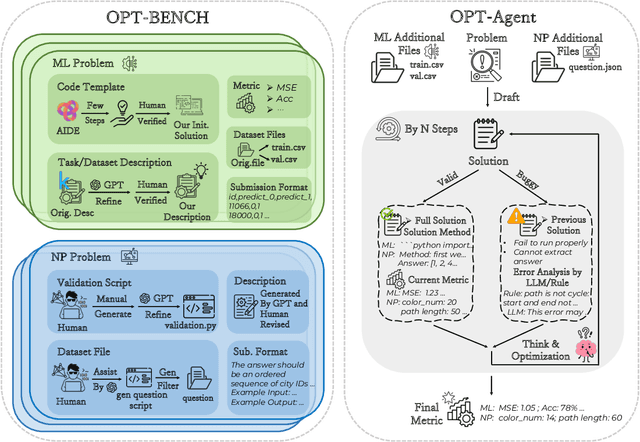
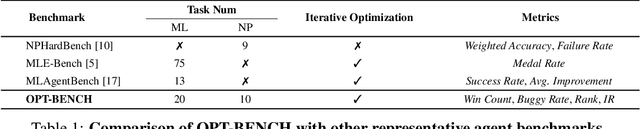
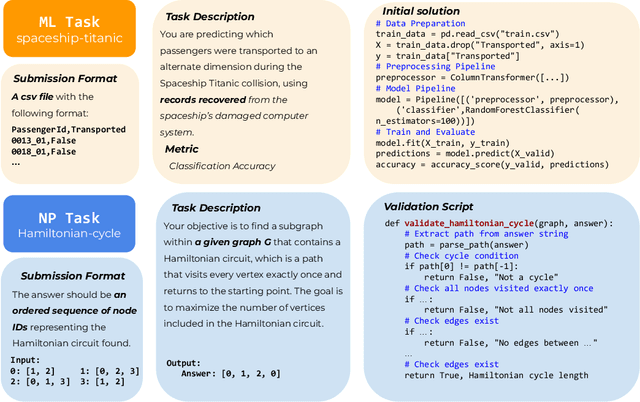
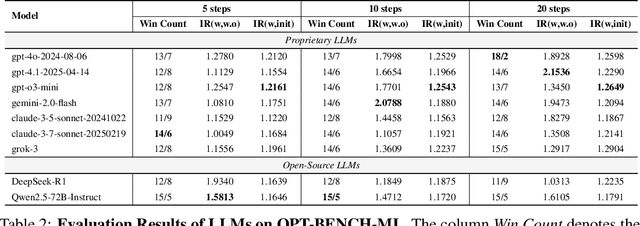
Large Language Models (LLMs) have shown remarkable capabilities in solving diverse tasks. However, their proficiency in iteratively optimizing complex solutions through learning from previous feedback remains insufficiently explored. To bridge this gap, we present OPT-BENCH, a comprehensive benchmark designed to evaluate LLM agents on large-scale search space optimization problems. OPT-BENCH includes 20 real-world machine learning tasks sourced from Kaggle and 10 classical NP problems, offering a diverse and challenging environment for assessing LLM agents on iterative reasoning and solution refinement. To enable rigorous evaluation, we introduce OPT-Agent, an end-to-end optimization framework that emulates human reasoning when tackling complex problems by generating, validating, and iteratively improving solutions through leveraging historical feedback. Through extensive experiments on 9 state-of-the-art LLMs from 6 model families, we analyze the effects of optimization iterations, temperature settings, and model architectures on solution quality and convergence. Our results demonstrate that incorporating historical context significantly enhances optimization performance across both ML and NP tasks. All datasets, code, and evaluation tools are open-sourced to promote further research in advancing LLM-driven optimization and iterative reasoning. Project page: \href{https://github.com/OliverLeeXZ/OPT-BENCH}{https://github.com/OliverLeeXZ/OPT-BENCH}.
Creation-MMBench: Assessing Context-Aware Creative Intelligence in MLLM
Mar 19, 2025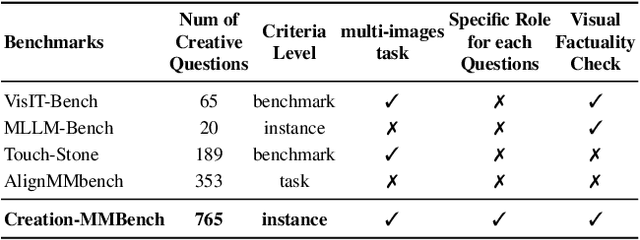
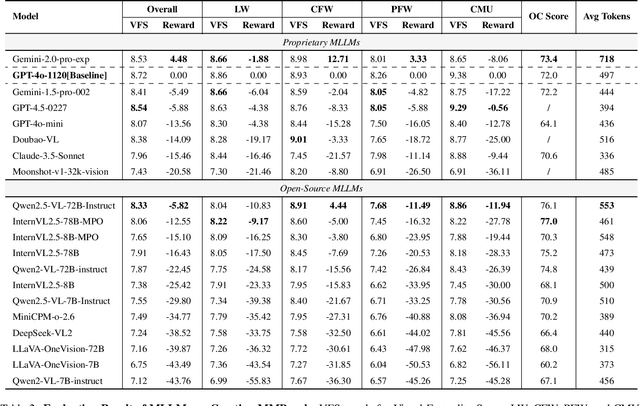
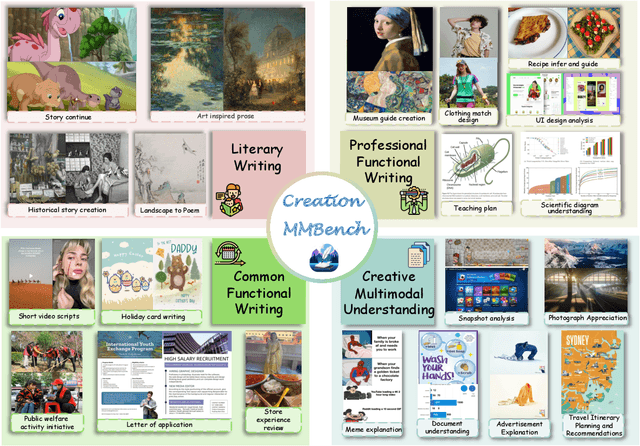
Creativity is a fundamental aspect of intelligence, involving the ability to generate novel and appropriate solutions across diverse contexts. While Large Language Models (LLMs) have been extensively evaluated for their creative capabilities, the assessment of Multimodal Large Language Models (MLLMs) in this domain remains largely unexplored. To address this gap, we introduce Creation-MMBench, a multimodal benchmark specifically designed to evaluate the creative capabilities of MLLMs in real-world, image-based tasks. The benchmark comprises 765 test cases spanning 51 fine-grained tasks. To ensure rigorous evaluation, we define instance-specific evaluation criteria for each test case, guiding the assessment of both general response quality and factual consistency with visual inputs. Experimental results reveal that current open-source MLLMs significantly underperform compared to proprietary models in creative tasks. Furthermore, our analysis demonstrates that visual fine-tuning can negatively impact the base LLM's creative abilities. Creation-MMBench provides valuable insights for advancing MLLM creativity and establishes a foundation for future improvements in multimodal generative intelligence. Full data and evaluation code is released on https://github.com/open-compass/Creation-MMBench.