 Add to Chrome
 Add to Firefox
 Add to Edge
FT-WBC: Learning Fault-Tolerant Whole-Body Control for Legged Loco-Manipulation
Jun 23, 2026
Legged manipulators combine the mobility of legged platforms with the manipulation capability of robotic arms. However, arm-induced Center-of-Mass shifts and dynamic disturbances make the system more prone to instability under actuator failures, potentially leading to falls, task failures, or safety risks. Existing fault-tolerant control methods mainly focus on locomotion alone, leaving the coupled problem of whole-body stability and arm reachability in fault-tolerant loco-manipulation largely unaddressed. To bridge this gap, we propose FT-WBC, a fault-tolerant loco-manipulation framework for robust whole-body control of legged manipulators under actuator failures. FT-WBC adopts a decoupled upper- and lower-body policy architecture and introduces two key modules: a Fault Estimator (FE) and a Posture Adaptation Module (PAM). The FE predicts faulty joints from lower-body proprioceptive histories, while the PAM uses this fault information to adapt the base posture plan generated by the arm policy, converting potentially unstable posture requests into safe and executable base posture commands. Through this fault-aware posture adaptation mechanism, FT-WBC synthesizes compensatory gaits under actuator failures and preserves as much arm workspace as possible while maintaining whole-body stability. Simulation and real-world experiments show that FT-WBC significantly improves survival rate and workspace under weakening or locked failures, and transfers zero-shot to a real legged manipulator in the real world.

GenHOI: Contact-Aware Humanoid-Object Interaction by Imitating Generated Videos without Task-Specific Training
Jun 11, 2026Humanoid-Object Interaction (HOI) is a fundamental capability for humanoid robots, yet it remains challenging due to the tight coupling between dynamic balance and stable interaction with diverse objects. Existing methods often require time-consuming task-specific policy training or rely on rigid trajectory replay, which limits their ability to accommodate novel interaction scenarios. In this work, we present \textit{GenHOI}, a simple yet effective framework that enables humanoid robots to perform diverse object-interaction tasks in a zero-shot manner by directly imitating a single generated video, without task-specific training or physical demonstration data. GenHOI first reconstructs the robot-object scene in simulation and renders a first-frame image, which, together with the language command, conditions the synthesis of a task-oriented interaction video. The generated video is then analyzed to identify interaction-relevant contact events and estimate hand-object contact regions, which are encoded as object-centric geometric constraints that convert visual interaction cues into physically grounded optimization priors. Guided by these priors, the reference motion recovered from the video is refined and smoothed to resolve the scale ambiguity inherent in 2D video generation, while adapting a single reference trajectory to unseen robot-object relative poses. The optimized trajectory is finally executed by a closed-loop tracking controller. We validate the proposed framework in extensive simulation and real-world experiments across diverse object-interaction tasks, including box grasping, asymmetric bimanual chair carrying, table lifting from below, and cylindrical-object enveloping.
Learning Terrain-Aware Whole-Body Control for Perceptive Legged Loco-Manipulation
May 29, 2026Legged manipulators integrate exceptional terrain adaptability along with mobile manipulation capabilities, which make them highly promising for deployment in human-centric environments. By coordinating the control of both legs and arms, a whole-body controller can significantly expand the operational workspace of legged manipulators. However, many existing whole-body controllers primarily depend on proprioception and do not incorporate the critical exteroception required for effective terrain topology perception. This limitation can hinder their ability to adapt to varying environmental conditions and navigate complex terrains effectively. In this paper, we introduce TA-WBC, a terrain-aware whole-body control framework for legged manipulators, which features a novel RL-based unified policy tailored to whole-body loco-manipulation tasks in various terrains. Specifically, we employ a hybrid exteroception encoder to extract terrain features, providing an essential basis for the robot to proactively adapt posture and footholds. Furthermore, to facilitate stable cross-terrain loco-manipulation, we propose a novel end-effector sampling method based on the foot contact plane, decoupling manipulation target from base fluctuations. Moreover, a dual-policy distillation module is introduced to integrate expansive whole-body motion with terrain adaptability without catastrophic forgetting. The simulation and real-world experiments validate the robustness of our proposed controller, which leads to a larger reachable space, less tracking error, and reduced unexpected stumbles. This unified policy highlights the promising capabilities of legged manipulators in performing loco-manipulation tasks across complex terrains.
Traffic Sign Recognition in Autonomous Driving: Dataset, Benchmark, and Field Experiment
Mar 24, 2026Traffic Sign Recognition (TSR) is a core perception capability for autonomous driving, where robustness to cross-region variation, long-tailed categories, and semantic ambiguity is essential for reliable real-world deployment. Despite steady progress in recognition accuracy, existing traffic sign datasets and benchmarks offer limited diagnostic insight into how different modeling paradigms behave under these practical challenges. We present TS-1M, a large-scale and globally diverse traffic sign dataset comprising over one million real-world images across 454 standardized categories, together with a diagnostic benchmark designed to analyze model capability boundaries. Beyond standard train-test evaluation, we provide a suite of challenge-oriented settings, including cross-region recognition, rare-class identification, low-clarity robustness, and semantic text understanding, enabling systematic and fine-grained assessment of modern TSR models. Using TS-1M, we conduct a unified benchmark across three representative learning paradigms: classical supervised models, self-supervised pretrained models, and multimodal vision-language models (VLMs). Our analysis reveals consistent paradigm-dependent behaviors, showing that semantic alignment is a key factor for cross-region generalization and rare-category recognition, while purely visual models remain sensitive to appearance shift and data imbalance. Finally, we validate the practical relevance of TS-1M through real-scene autonomous driving experiments, where traffic sign recognition is integrated with semantic reasoning and spatial localization to support map-level decision constraints. Overall, TS-1M establishes a reference-level diagnostic benchmark for TSR and provides principled insights into robust and semantic-aware traffic sign perception. Project page: https://guoyangzhao.github.io/projects/ts1m.
Dual-Quadruped Collaborative Transportation in Narrow Environments via Safe Reinforcement Learning
Feb 18, 2026Collaborative transportation, where multiple robots collaboratively transport a payload, has garnered significant attention in recent years. While ensuring safe and high-performance inter-robot collaboration is critical for effective task execution, it is difficult to pursue in narrow environments where the feasible region is extremely limited. To address this challenge, we propose a novel approach for dual-quadruped collaborative transportation via safe reinforcement learning (RL). Specifically, we model the task as a fully cooperative constrained Markov game, where collision avoidance is formulated as constraints. We introduce a cost-advantage decomposition method that enforces the sum of team constraints to remain below an upper bound, thereby guaranteeing task safety within an RL framework. Furthermore, we propose a constraint allocation method that assigns shared constraints to individual robots to maximize the overall task reward, encouraging autonomous task-assignment among robots, thereby improving collaborative task performance. Simulation and real-time experimental results demonstrate that the proposed approach achieves superior performance and a higher success rate in dual-quadruped collaborative transportation compared to existing methods.
ALORE: Autonomous Large-Object Rearrangement with a Legged Manipulator
Feb 04, 2026Endowing robots with the ability to rearrange various large and heavy objects, such as furniture, can substantially alleviate human workload. However, this task is extremely challenging due to the need to interact with diverse objects and efficiently rearrange multiple objects in complex environments while ensuring collision-free loco-manipulation. In this work, we present ALORE, an autonomous large-object rearrangement system for a legged manipulator that can rearrange various large objects across diverse scenarios. The proposed system is characterized by three main features: (i) a hierarchical reinforcement learning training pipeline for multi-object environment learning, where a high-level object velocity controller is trained on top of a low-level whole-body controller to achieve efficient and stable joint learning across multiple objects; (ii) two key modules, a unified interaction configuration representation and an object velocity estimator, that allow a single policy to regulate planar velocity of diverse objects accurately; and (iii) a task-and-motion planning framework that jointly optimizes object visitation order and object-to-target assignment, improving task efficiency while enabling online replanning. Comparisons against strong baselines show consistent superiority in policy generalization, object-velocity tracking accuracy, and multi-object rearrangement efficiency. Key modules are systematically evaluated, and extensive simulations and real-world experiments are conducted to validate the robustness and effectiveness of the entire system, which successfully completes 8 continuous loops to rearrange 32 chairs over nearly 40 minutes without a single failure, and executes long-distance autonomous rearrangement over an approximately 40 m route. The open-source packages are available at https://zhihaibi.github.io/Alore/.
Fast and Safe Trajectory Optimization for Mobile Manipulators With Neural Configuration Space Distance Field
Jan 27, 2026Mobile manipulators promise agile, long-horizon behavior by coordinating base and arm motion, yet whole-body trajectory optimization in cluttered, confined spaces remains difficult due to high-dimensional nonconvexity and the need for fast, accurate collision reasoning. Configuration Space Distance Fields (CDF) enable fixed-base manipulators to model collisions directly in configuration space via smooth, implicit distances. This representation holds strong potential to bypass the nonlinear configuration-to-workspace mapping while preserving accurate whole-body geometry and providing optimization-friendly collision costs. Yet, extending this capability to mobile manipulators is hindered by unbounded workspaces and tighter base-arm coupling. We lift this promise to mobile manipulation with Generalized Configuration Space Distance Fields (GCDF), extending CDF to robots with both translational and rotational joints in unbounded workspaces with tighter base-arm coupling. We prove that GCDF preserves Euclidean-like local distance structure and accurately encodes whole-body geometry in configuration space, and develop a data generation and training pipeline that yields continuous neural GCDFs with accurate values and gradients, supporting efficient GPU-batched queries. Building on this representation, we develop a high-performance sequential convex optimization framework centered on GCDF-based collision reasoning. The solver scales to large numbers of implicit constraints through (i) online specification of neural constraints, (ii) sparsity-aware active-set detection with parallel batched evaluation across thousands of constraints, and (iii) incremental constraint management for rapid replanning under scene changes.
Online Trajectory Optimization for Arbitrary-Shaped Mobile Robots via Polynomial Separating Hypersurfaces
Jan 14, 2026An emerging class of trajectory optimization methods enforces collision avoidance by jointly optimizing the robot's configuration and a separating hyperplane. However, as linear separators only apply to convex sets, these methods require convex approximations of both the robot and obstacles, which becomes an overly conservative assumption in cluttered and narrow environments. In this work, we unequivocally remove this limitation by introducing nonlinear separating hypersurfaces parameterized by polynomial functions. We first generalize the classical separating hyperplane theorem and prove that any two disjoint bounded closed sets in Euclidean space can be separated by a polynomial hypersurface, serving as the theoretical foundation for nonlinear separation of arbitrary geometries. Building on this result, we formulate a nonlinear programming (NLP) problem that jointly optimizes the robot's trajectory and the coefficients of the separating polynomials, enabling geometry-aware collision avoidance without conservative convex simplifications. The optimization remains efficiently solvable using standard NLP solvers. Simulation and real-world experiments with nonconvex robots demonstrate that our method achieves smooth, collision-free, and agile maneuvers in environments where convex-approximation baselines fail.
FLORES: A Reconfigured Wheel-Legged Robot for Enhanced Steering and Adaptability
Jul 30, 2025Wheel-legged robots integrate the agility of legs for navigating rough terrains while harnessing the efficiency of wheels for smooth surfaces. However, most existing designs do not fully capitalize on the benefits of both legged and wheeled structures, which limits overall system flexibility and efficiency. We present FLORES (reconfigured wheel-legged robot for enhanced steering and adaptability), a novel wheel-legged robot design featuring a distinctive front-leg configuration that sets it beyond standard design approaches. Specifically, FLORES replaces the conventional hip-roll degree of freedom (DoF) of the front leg with hip-yaw DoFs, and this allows for efficient movement on flat surfaces while ensuring adaptability when navigating complex terrains. This innovative design facilitates seamless transitions between different locomotion modes (i.e., legged locomotion and wheeled locomotion) and optimizes the performance across varied environments. To fully exploit FLORES's mechanical capabilities, we develop a tailored reinforcement learning (RL) controller that adapts the Hybrid Internal Model (HIM) with a customized reward structure optimized for our unique mechanical configuration. This framework enables the generation of adaptive, multi-modal locomotion strategies that facilitate smooth transitions between wheeled and legged movements. Furthermore, our distinctive joint design enables the robot to exhibit novel and highly efficient locomotion gaits that capitalize on the synergistic advantages of both locomotion modes. Through comprehensive experiments, we demonstrate FLORES's enhanced steering capabilities, improved navigation efficiency, and versatile locomotion across various terrains. The open-source project can be found at https://github.com/ZhichengSong6/FLORES-A-Reconfigured-Wheel-Legged-Robot-for-Enhanced-Steering-and-Adaptability.git.
Interactive Navigation for Legged Manipulators with Learned Arm-Pushing Controller
Mar 03, 2025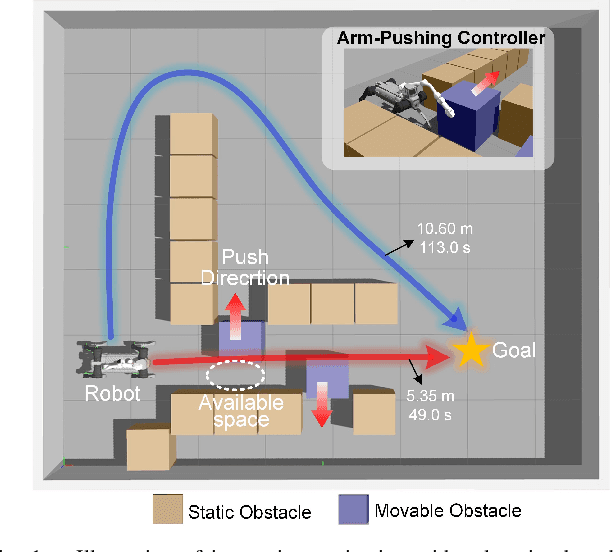


Interactive navigation is crucial in scenarios where proactively interacting with objects can yield shorter paths, thus significantly improving traversal efficiency. Existing methods primarily focus on using the robot body to relocate large obstacles (which could be comparable to the size of a robot). However, they prove ineffective in narrow or constrained spaces where the robot's dimensions restrict its manipulation capabilities. This paper introduces a novel interactive navigation framework for legged manipulators, featuring an active arm-pushing mechanism that enables the robot to reposition movable obstacles in space-constrained environments. To this end, we develop a reinforcement learning-based arm-pushing controller with a two-stage reward strategy for large-object manipulation. Specifically, this strategy first directs the manipulator to a designated pushing zone to achieve a kinematically feasible contact configuration. Then, the end effector is guided to maintain its position at appropriate contact points for stable object displacement while preventing toppling. The simulations validate the robustness of the arm-pushing controller, showing that the two-stage reward strategy improves policy convergence and long-term performance. Real-world experiments further demonstrate the effectiveness of the proposed navigation framework, which achieves shorter paths and reduced traversal time. The open-source project can be found at https://github.com/Zhihaibi/Interactive-Navigation-for-legged-manipulator.git.