 Add to Chrome
 Add to Firefox
 Add to Edge
Intern-S2-Mobius: Foundation Model with Decoupled Knowledge and Reasoning
Aug 14, 2026
We introduce Mobius-v0, an architecture that comprises a globally shared Memory (FFN) that stores knowledge vectors and multiple Reasoners (Self-Attn) that iteratively achieve compositional reasoning. Using hidden states as cache and carrier, reasoners repeatedly query memory for required knowledge-vectors, while the knowledge is transmitted back to reasoning operators. Through this knowledge-reasoning-separation architecture, Mobius achieves better knowledge compression and reasoning efficiency. Built upon Mobius-v0 architecture: 1) Our 7B model trained-from-scratch achieves similar downstream score as a 7B Transformer baseline with 62.6% of baseline's training data. 2) Our Intern-S2-Mobius, continually-pretrained from Qwen3.5-35B, achieves similar downstream score while delivering nearly 4x end-to-end inference speedup.

Intern-S2-Preview: Scientific Agentic Foundation Model
Aug 13, 2026Scientific discovery increasingly requires AI systems that can reason over scientific evidence of heterogeneous modalities, interact with scientific tools and environments, and sustain progress across long task horizons. We present Intern-S2-Preview, a series of scientific agentic foundation models designed to support multimodal scientific understanding, reasoning, generation, and long-horizon tasks. The training pipeline begins with scientific multimodal pre-training over rendered scientific documents, interleaved image-text data, and diverse scientific corpora. Starting from the pretrained checkpoint, we apply a unified post-training pipeline consisting of supervised fine-tuning, scalable multi-task reinforcement learning (RL), black- and white-box agentic RL, and on-policy distillation. This pipeline is supported by practical techniques that improve rollout and training stability and efficiency, including partial rollout with off-policy correction, adaptive length regularization, online speculative decoding, robust multi-task optimization, and trace-aware experience assembly for agentic tasks. At the architecture level, Intern-S2-Preview-397B extends time series modelling from efficient long-sequence understanding to numerical forecasting, while Memory Decoder is studied as a separate memory-augmented path for rapid scientific specialization without modifying the frozen 397B backbone. Evaluations across scientific, multimodal, agentic, and general-purpose benchmarks show that Intern-S2-Preview-397B achieves competitive or leading results in multiple settings. The time series modules improve scientific signal understanding and forecasting on SciTS, while the separate Intern-MemDec-4B extension improves the Biology-Instructions average score from 56.92 to 60.32 without modifying the frozen 397B backbone.
Scalable Visual Pretraining for Language Intelligence
Jul 10, 2026The rapid progress of large foundation models has been driven predominantly by pretraining on large-scale text corpora. However, many forms of knowledge are conveyed through visual representations, where figures, typeset equations, and page layouts carry rich information that cannot be faithfully or completely captured by text alone. Yet current pretraining approaches discard these visual cues by converting visually rich sources, such as documents and web pages, into plain text for learning language intelligence. This paper challenges the default assumption that language models must be trained on text-only representations and shows that Visual Pretraining is a scalable learner for foundation model intelligence. To this end, we conduct a systematic study of unsupervised visual pretraining paradigms that directly leverage visual documents without text extraction. Across multiple backbones and benchmarks, visual pretraining on the same underlying corpora consistently outperforms text-only pretraining, offering an efficient pathway to scalable language intelligence.
Intern-S1-Pro: Scientific Multimodal Foundation Model at Trillion Scale
Mar 26, 2026We introduce Intern-S1-Pro, the first one-trillion-parameter scientific multimodal foundation model. Scaling to this unprecedented size, the model delivers a comprehensive enhancement across both general and scientific domains. Beyond stronger reasoning and image-text understanding capabilities, its intelligence is augmented with advanced agent capabilities. Simultaneously, its scientific expertise has been vastly expanded to master over 100 specialized tasks across critical science fields, including chemistry, materials, life sciences, and earth sciences. Achieving this massive scale is made possible by the robust infrastructure support of XTuner and LMDeploy, which facilitates highly efficient Reinforcement Learning (RL) training at the 1-trillion parameter level while ensuring strict precision consistency between training and inference. By seamlessly integrating these advancements, Intern-S1-Pro further fortifies the fusion of general and specialized intelligence, working as a Specializable Generalist, demonstrating its position in the top tier of open-source models for general capabilities, while outperforming proprietary models in the depth of specialized scientific tasks.
Semi-off-Policy Reinforcement Learning for Vision-Language Slow-thinking Reasoning
Jul 22, 2025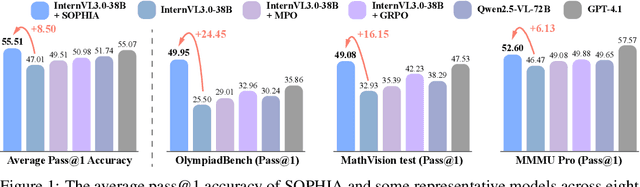
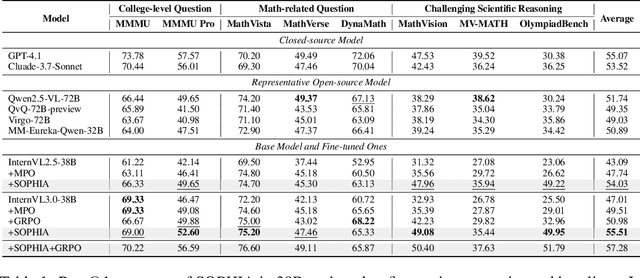
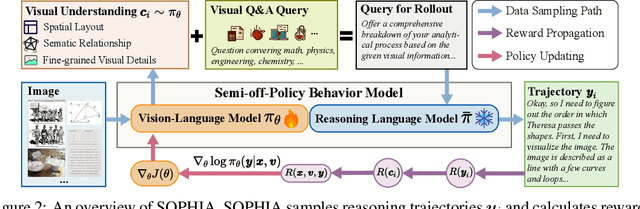
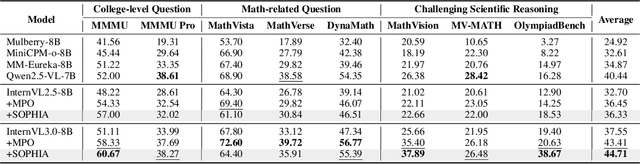
Enhancing large vision-language models (LVLMs) with visual slow-thinking reasoning is crucial for solving complex multimodal tasks. However, since LVLMs are mainly trained with vision-language alignment, it is difficult to adopt on-policy reinforcement learning (RL) to develop the slow thinking ability because the rollout space is restricted by its initial abilities. Off-policy RL offers a way to go beyond the current policy, but directly distilling trajectories from external models may cause visual hallucinations due to mismatched visual perception abilities across models. To address these issues, this paper proposes SOPHIA, a simple and scalable Semi-Off-Policy RL for vision-language slow-tHInking reAsoning. SOPHIA builds a semi-off-policy behavior model by combining on-policy visual understanding from a trainable LVLM with off-policy slow-thinking reasoning from a language model, assigns outcome-based rewards to reasoning, and propagates visual rewards backward. Then LVLM learns slow-thinking reasoning ability from the obtained reasoning trajectories using propagated rewards via off-policy RL algorithms. Extensive experiments with InternVL2.5 and InternVL3.0 with 8B and 38B sizes show the effectiveness of SOPHIA. Notably, SOPHIA improves InternVL3.0-38B by 8.50% in average, reaching state-of-the-art performance among open-source LVLMs on multiple multimodal reasoning benchmarks, and even outperforms some closed-source models (e.g., GPT-4.1) on the challenging MathVision and OlympiadBench, achieving 49.08% and 49.95% pass@1 accuracy, respectively. Analysis shows SOPHIA outperforms supervised fine-tuning and direct on-policy RL methods, offering a better policy initialization for further on-policy training.
RIG: Synergizing Reasoning and Imagination in End-to-End Generalist Policy
Mar 31, 2025Reasoning before action and imagining potential outcomes (i.e., world models) are essential for embodied agents operating in complex open-world environments. Yet, prior work either incorporates only one of these abilities in an end-to-end agent or integrates multiple specialized models into an agent system, limiting the learning efficiency and generalization of the policy. Thus, this paper makes the first attempt to synergize Reasoning and Imagination in an end-to-end Generalist policy, termed RIG. To train RIG in an end-to-end manner, we construct a data pipeline that progressively integrates and enriches the content of imagination and reasoning in the trajectories collected from existing agents. The joint learning of reasoning and next image generation explicitly models the inherent correlation between reasoning, action, and dynamics of environments, and thus exhibits more than $17\times$ sample efficiency improvements and generalization in comparison with previous works. During inference, RIG first reasons about the next action, produces potential action, and then predicts the action outcomes, which offers the agent a chance to review and self-correct based on the imagination before taking real actions. Experimental results show that the synergy of reasoning and imagination not only improves the robustness, generalization, and interoperability of generalist policy but also enables test-time scaling to enhance overall performance.
OmniAlign-V: Towards Enhanced Alignment of MLLMs with Human Preference
Feb 25, 2025Recent advancements in open-source multi-modal large language models (MLLMs) have primarily focused on enhancing foundational capabilities, leaving a significant gap in human preference alignment. This paper introduces OmniAlign-V, a comprehensive dataset of 200K high-quality training samples featuring diverse images, complex questions, and varied response formats to improve MLLMs' alignment with human preferences. We also present MM-AlignBench, a human-annotated benchmark specifically designed to evaluate MLLMs' alignment with human values. Experimental results show that finetuning MLLMs with OmniAlign-V, using Supervised Fine-Tuning (SFT) or Direct Preference Optimization (DPO), significantly enhances human preference alignment while maintaining or enhancing performance on standard VQA benchmarks, preserving their fundamental capabilities. Our datasets, benchmark, code and checkpoints have been released at https://github.com/PhoenixZ810/OmniAlign-V.
Exploring the Limit of Outcome Reward for Learning Mathematical Reasoning
Feb 10, 2025Reasoning abilities, especially those for solving complex math problems, are crucial components of general intelligence. Recent advances by proprietary companies, such as o-series models of OpenAI, have made remarkable progress on reasoning tasks. However, the complete technical details remain unrevealed, and the techniques that are believed certainly to be adopted are only reinforcement learning (RL) and the long chain of thoughts. This paper proposes a new RL framework, termed OREAL, to pursue the performance limit that can be achieved through \textbf{O}utcome \textbf{RE}w\textbf{A}rd-based reinforcement \textbf{L}earning for mathematical reasoning tasks, where only binary outcome rewards are easily accessible. We theoretically prove that behavior cloning on positive trajectories from best-of-N (BoN) sampling is sufficient to learn the KL-regularized optimal policy in binary feedback environments. This formulation further implies that the rewards of negative samples should be reshaped to ensure the gradient consistency between positive and negative samples. To alleviate the long-existing difficulties brought by sparse rewards in RL, which are even exacerbated by the partial correctness of the long chain of thought for reasoning tasks, we further apply a token-level reward model to sample important tokens in reasoning trajectories for learning. With OREAL, for the first time, a 7B model can obtain 94.0 pass@1 accuracy on MATH-500 through RL, being on par with 32B models. OREAL-32B also surpasses previous 32B models trained by distillation with 95.0 pass@1 accuracy on MATH-500. Our investigation also indicates the importance of initial policy models and training queries for RL. Code, models, and data will be released to benefit future research\footnote{https://github.com/InternLM/OREAL}.
InternVideo2.5: Empowering Video MLLMs with Long and Rich Context Modeling
Jan 21, 2025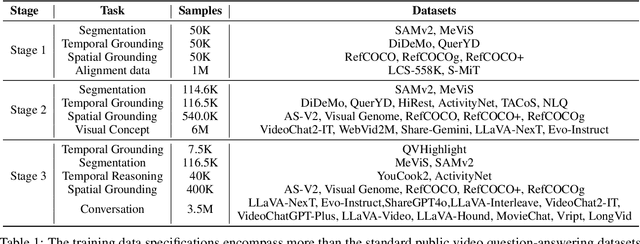
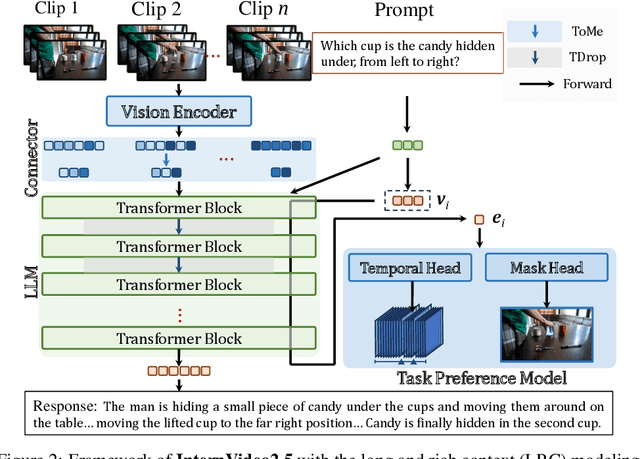
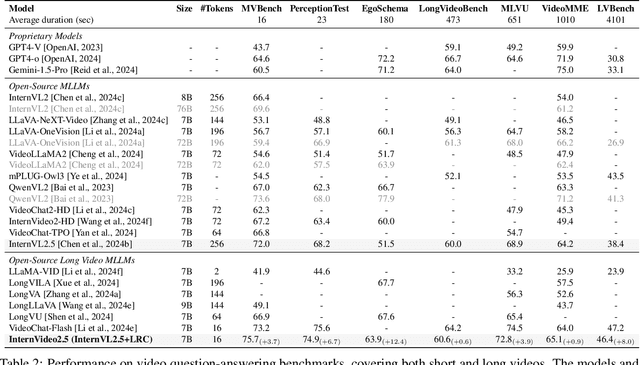
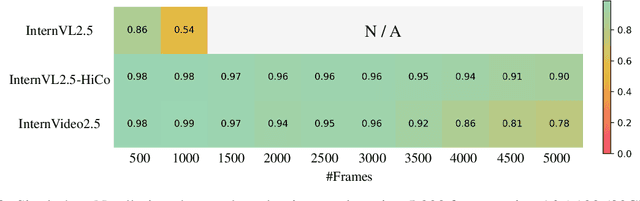
This paper aims to improve the performance of video multimodal large language models (MLLM) via long and rich context (LRC) modeling. As a result, we develop a new version of InternVideo2.5 with a focus on enhancing the original MLLMs' ability to perceive fine-grained details and capture long-form temporal structure in videos. Specifically, our approach incorporates dense vision task annotations into MLLMs using direct preference optimization and develops compact spatiotemporal representations through adaptive hierarchical token compression. Experimental results demonstrate this unique design of LRC greatly improves the results of video MLLM in mainstream video understanding benchmarks (short & long), enabling the MLLM to memorize significantly longer video inputs (at least 6x longer than the original), and master specialized vision capabilities like object tracking and segmentation. Our work highlights the importance of multimodal context richness (length and fineness) in empowering MLLM's innate abilites (focus and memory), providing new insights for future research on video MLLM. Code and models are available at https://github.com/OpenGVLab/InternVideo/tree/main/InternVideo2.5
VideoChat-Flash: Hierarchical Compression for Long-Context Video Modeling
Dec 31, 2024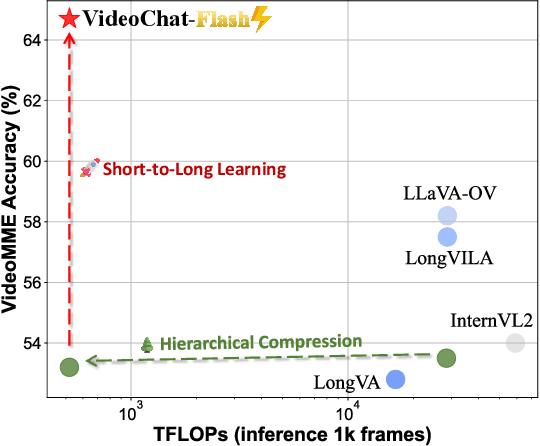
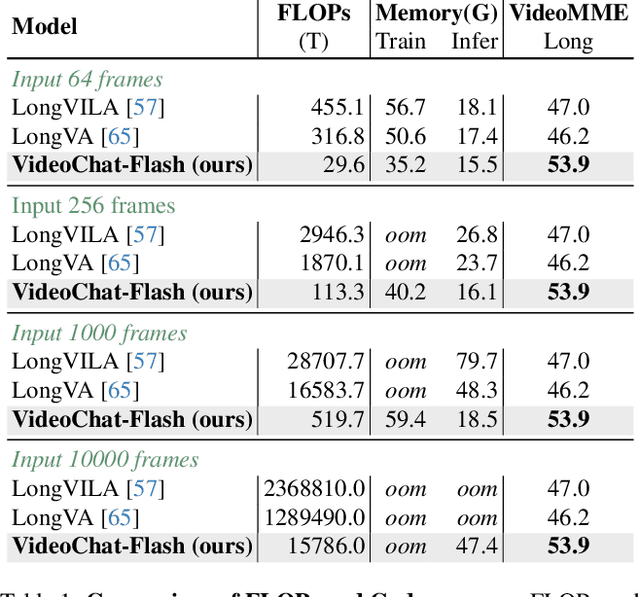

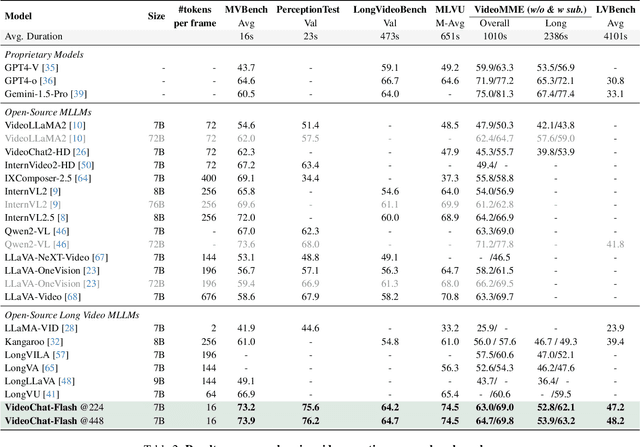
Long-context modeling is a critical capability for multimodal large language models (MLLMs), enabling them to process long-form contents with implicit memorization. Despite its advances, handling extremely long videos remains challenging due to the difficulty in maintaining crucial features over extended sequences. This paper introduces a Hierarchical visual token Compression (HiCo) method designed for high-fidelity representation and a practical context modeling system VideoChat-Flash tailored for multimodal long-sequence processing. HiCo capitalizes on the redundancy of visual information in long videos to compress long video context from the clip-level to the video-level, reducing the compute significantly while preserving essential details. VideoChat-Flash features a multi-stage short-to-long learning scheme, a rich dataset of real-world long videos named LongVid, and an upgraded "Needle-In-A-video-Haystack" (NIAH) for evaluating context capacities. In extensive experiments, VideoChat-Flash shows the leading performance on both mainstream long and short video benchmarks at the 7B model scale. It firstly gets 99.1% accuracy over 10,000 frames in NIAH among open-source models.