 Add to Chrome
 Add to Firefox
 Add to Edge
Beyond Mode Collapse: Distribution Matching for Diverse Reasoning
May 19, 2026
On-policy reinforcement learning methods like GRPO suffer from mode collapse: they exhibit reduced solution diversity, concentrating probability mass on a single solution once discovered and ceasing exploration of alternative strategies. We show this stems from reverse KL minimization's mode-seeking behavior, which reinforces the first high-reward trajectory found rather than maintaining a distribution over multiple diverse solutions. We propose DMPO (Distribution-Matching Policy Optimization), which prevents mode collapse through principled approximation of forward KL minimization. DMPO constructs a group level target distribution over sampled trajectories proportional to their rewards, then aligns the policy distribution to this target. This provides mode-covering behavior without requiring sampling from the intractable global target distribution, enabling sustained exploration throughout training. We validate DMPO on NP-hard combinatorial optimization, where exponentially many feasible solutions exist but only a few approach optimality, an ideal testbed for evaluating exploration. DMPO achieves 43.9% Quality Ratio on text-based NP-Bench (vs. GRPO's 40.1%) and 43.1% on vision-based NP-Bench (vs. 38.4%), demonstrating 9% and 12% relative improvements respectively. These gains generalize to mathematical reasoning (+2.0%) and out-of-domain tasks (+2.3%), showing that diversity-preserving training enhances general reasoning capabilities across modalities. Our work establishes distribution matching as a practical, principled approach to preventing mode collapse in on-policy RL, with consistent quality improvements demonstrating sustained exploration across diverse reasoning tasks.

SetCon: Towards Open-Ended Referring Segmentation via Set-Level Concept Prediction
May 19, 2026Referring segmentation grounds natural-language queries to pixel-level masks, but extending it to complex scenarios with multiple instances, cross-category groups, or open-ended target sets remains challenging. Previous Large Vision Language Model (LVLM)-based methods represent referred targets with one or more special tokens sequentially, treating multiple targets as separate outputs rather than a coherent set and offering little incentive to capture set-level properties such as completeness and mutual exclusivity. We reformulate open-ended referring segmentation as explicit set-level concept prediction and propose Set-Concept Segmentation (SetCon), which uses LVLM-generated natural-language concepts, instead of segmentation-specific tokens, as semantic conditions for joint mask-set decoding. A hierarchical semantic decomposition first predicts a shared set-level concept defining the target scope and then refines it into fine-grained concept groups aligned with target subsets. To support this, a two-stage annotation pipeline augments existing reasoning segmentation datasets with hierarchical semantic supervision (236k samples, 784k concept phrases). SetCon achieves state-of-the-art results on image benchmarks (+3.3 gIoU on gRefCOCO, +12.1 gIoU on MUSE), with margins that grow as the number of referred targets increases. The concept interface also transfers to video under a detect-and-track setting, yielding new state-of-the-art results on seven referring video benchmarks, including +10.9 J&F on MeViS and +12.4 J&F on Ref-SeCVOS.
WildClawBench: A Benchmark for Real-World, Long-Horizon Agent Evaluation
May 11, 2026Large language and vision-language models increasingly power agents that act on a user's behalf through command-line interface (CLI) harnesses. However, most agent benchmarks still rely on synthetic sandboxes, short-horizon tasks, mock-service APIs, and final-answer checks, leaving open whether agents can complete realistic long-horizon work in the runtimes where they are deployed. This work presents WildClawBench, a native-runtime benchmark of 60 human-authored, bilingual, multimodal tasks spanning six thematic categories. Each task averages roughly 8 minutes of wall-clock time and over 20 tool calls, and runs inside a reproducible Docker container hosting an actual CLI agent harness (OpenClaw, Claude Code, Codex, or Hermes Agent) with access to real tools rather than mock services. Grading is hybrid, combining deterministic rule-based checks, environment-state auditing of side effects, and an LLM/VLM judge for semantic verification. Across 19 frontier models, the best, Claude Opus 4.7, reaches only 62.2% overall under OpenClaw, while every other model stays below 60%, and switching harness alone shifts a single model by up to 18 points. These results show that long-horizon, native-runtime agent evaluation remains a far-from-resolved task for current frontier models. We release the tasks, code, and containerized tooling to support reproducible evaluation.
ClawMark: A Living-World Benchmark for Multi-Turn, Multi-Day, Multimodal Coworker Agents
Apr 26, 2026Language-model agents are increasingly used as persistent coworkers that assist users across multiple working days. During such workflows, the surrounding environment may change independently of the agent: new emails arrive, calendar entries shift, knowledge-base records are updated, and evidence appears across images, scanned PDFs, audio, video, and spreadsheets. Existing benchmarks do not adequately evaluate this setting because they typically run within a single static episode and remain largely text-centric. We introduce \bench{}, a benchmark for coworker agents built around multi-turn multi-day tasks, a stateful sandboxed service environment whose state evolves between turns, and rule-based verification. The current release contains 100 tasks across 13 professional scenarios, executed against five stateful sandboxed services (filesystem, email, calendar, knowledge base, spreadsheet) and scored by 1537 deterministic Python checkers over post-execution service state; no LLM-as-judge is invoked during scoring. We benchmark seven frontier agent systems. The strongest model reaches 75.8 weighted score, but the best strict Task Success is only 20.0\%, indicating that partial progress is common while complete end-to-end workflow completion remains rare. Turn-level analysis shows that performance drops after the first exogenous environment update, highlighting adaptation to changing state as a key open challenge. We release the benchmark, evaluation harness, and construction pipeline to support reproducible coworker-agent evaluation.
Intern-S1-Pro: Scientific Multimodal Foundation Model at Trillion Scale
Mar 26, 2026We introduce Intern-S1-Pro, the first one-trillion-parameter scientific multimodal foundation model. Scaling to this unprecedented size, the model delivers a comprehensive enhancement across both general and scientific domains. Beyond stronger reasoning and image-text understanding capabilities, its intelligence is augmented with advanced agent capabilities. Simultaneously, its scientific expertise has been vastly expanded to master over 100 specialized tasks across critical science fields, including chemistry, materials, life sciences, and earth sciences. Achieving this massive scale is made possible by the robust infrastructure support of XTuner and LMDeploy, which facilitates highly efficient Reinforcement Learning (RL) training at the 1-trillion parameter level while ensuring strict precision consistency between training and inference. By seamlessly integrating these advancements, Intern-S1-Pro further fortifies the fusion of general and specialized intelligence, working as a Specializable Generalist, demonstrating its position in the top tier of open-source models for general capabilities, while outperforming proprietary models in the depth of specialized scientific tasks.
Reliable Reasoning in SVG-LLMs via Multi-Task Multi-Reward Reinforcement Learning
Mar 17, 2026With the rapid advancement of vision-language models, an increasing number of studies have explored their potential for SVG generation tasks. Although existing approaches improve performance by constructing large-scale SVG datasets and introducing SVG-specific tokens, they still suffer from limited generalization, redundant paths in code outputs, and a lack of explicit reasoning. In this work, we present CTRL-S (Chain-of-Thought Reinforcement Learning for SVG), a unified framework that introduces a chain-of-thought mechanism to explicitly expose the model's reasoning process during SVG generation. To support this structured reasoning, we construct SVG-Sophia, a high-quality dataset containing 145K samples across SVG code refinement, Text-to-SVG, and Image-to-SVG tasks. By training the model to generate group-level structured SVG code, CTRL-S significantly improves structural coherence and visual fidelity. Furthermore, we adopt the GRPO algorithm and design a multi-reward optimization framework, incorporating DINO, image-text similarity, format, and code efficiency rewards. Through joint multi-reward optimization and multi-task training, our approach systematically enhances overall generation capabilities. Extensive experiments show that CTRL-S outperforms existing methods, achieving higher task success rates, superior SVG code quality, and exceptional visual fidelity.
Visual-ERM: Reward Modeling for Visual Equivalence
Mar 13, 2026Vision-to-code tasks require models to reconstruct structured visual inputs, such as charts, tables, and SVGs, into executable or structured representations with high visual fidelity. While recent Large Vision Language Models (LVLMs) achieve strong results via supervised fine-tuning, reinforcement learning remains challenging due to misaligned reward signals. Existing rewards either rely on textual rules or coarse visual embedding similarity, both of which fail to capture fine-grained visual discrepancies and are vulnerable to reward hacking. We propose Visual Equivalence Reward Model (Visual-ERM), a multimodal generative reward model that provides fine-grained, interpretable, and task-agnostic feedback to evaluate vision-to-code quality directly in the rendered visual space. Integrated into RL, Visual-ERM improves Qwen3-VL-8B-Instruct by +8.4 on chart-to-code and yields consistent gains on table and SVG parsing (+2.7, +4.1 on average), and further strengthens test-time scaling via reflection and revision. We also introduce VisualCritic-RewardBench (VC-RewardBench), a benchmark for judging fine-grained image-to-image discrepancies on structured visual data, where Visual-ERM at 8B decisively outperforms Qwen3-VL-235B-Instruct and approaches leading closed-source models. Our results suggest that fine-grained visual reward supervision is both necessary and sufficient for vision-to-code RL, regardless of task specificity.
Trust Your Critic: Robust Reward Modeling and Reinforcement Learning for Faithful Image Editing and Generation
Mar 12, 2026Reinforcement learning (RL) has emerged as a promising paradigm for enhancing image editing and text-to-image (T2I) generation. However, current reward models, which act as critics during RL, often suffer from hallucinations and assign noisy scores, inherently misguiding the optimization process. In this paper, we present FIRM (Faithful Image Reward Modeling), a comprehensive framework that develops robust reward models to provide accurate and reliable guidance for faithful image generation and editing. First, we design tailored data curation pipelines to construct high-quality scoring datasets. Specifically, we evaluate editing using both execution and consistency, while generation is primarily assessed via instruction following. Using these pipelines, we collect the FIRM-Edit-370K and FIRM-Gen-293K datasets, and train specialized reward models (FIRM-Edit-8B and FIRM-Gen-8B) that accurately reflect these criteria. Second, we introduce FIRM-Bench, a comprehensive benchmark specifically designed for editing and generation critics. Evaluations demonstrate that our models achieve superior alignment with human judgment compared to existing metrics. Furthermore, to seamlessly integrate these critics into the RL pipeline, we formulate a novel "Base-and-Bonus" reward strategy that balances competing objectives: Consistency-Modulated Execution (CME) for editing and Quality-Modulated Alignment (QMA) for generation. Empowered by this framework, our resulting models FIRM-Qwen-Edit and FIRM-SD3.5 achieve substantial performance breakthroughs. Comprehensive experiments demonstrate that FIRM mitigates hallucinations, establishing a new standard for fidelity and instruction adherence over existing general models. All of our datasets, models, and code have been publicly available at https://firm-reward.github.io.
DeepGen 1.0: A Lightweight Unified Multimodal Model for Advancing Image Generation and Editing
Feb 13, 2026Current unified multimodal models for image generation and editing typically rely on massive parameter scales (e.g., >10B), entailing prohibitive training costs and deployment footprints. In this work, we present DeepGen 1.0, a lightweight 5B unified model that achieves comprehensive capabilities competitive with or surpassing much larger counterparts. To overcome the limitations of compact models in semantic understanding and fine-grained control, we introduce Stacked Channel Bridging (SCB), a deep alignment framework that extracts hierarchical features from multiple VLM layers and fuses them with learnable 'think tokens' to provide the generative backbone with structured, reasoning-rich guidance. We further design a data-centric training strategy spanning three progressive stages: (1) Alignment Pre-training on large-scale image-text pairs and editing triplets to synchronize VLM and DiT representations, (2) Joint Supervised Fine-tuning on a high-quality mixture of generation, editing, and reasoning tasks to foster omni-capabilities, and (3) Reinforcement Learning with MR-GRPO, which leverages a mixture of reward functions and supervision signals, resulting in substantial gains in generation quality and alignment with human preferences, while maintaining stable training progress and avoiding visual artifacts. Despite being trained on only ~50M samples, DeepGen 1.0 achieves leading performance across diverse benchmarks, surpassing the 80B HunyuanImage by 28% on WISE and the 27B Qwen-Image-Edit by 37% on UniREditBench. By open-sourcing our training code, weights, and datasets, we provide an efficient, high-performance alternative to democratize unified multimodal research.
SPARK: Synergistic Policy And Reward Co-Evolving Framework
Sep 26, 2025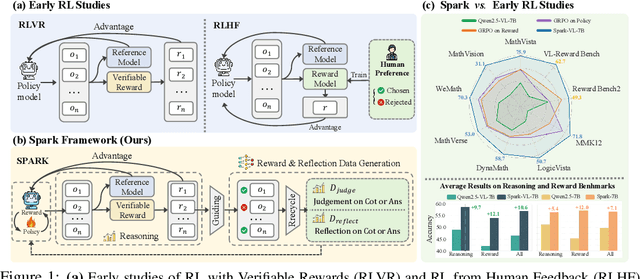
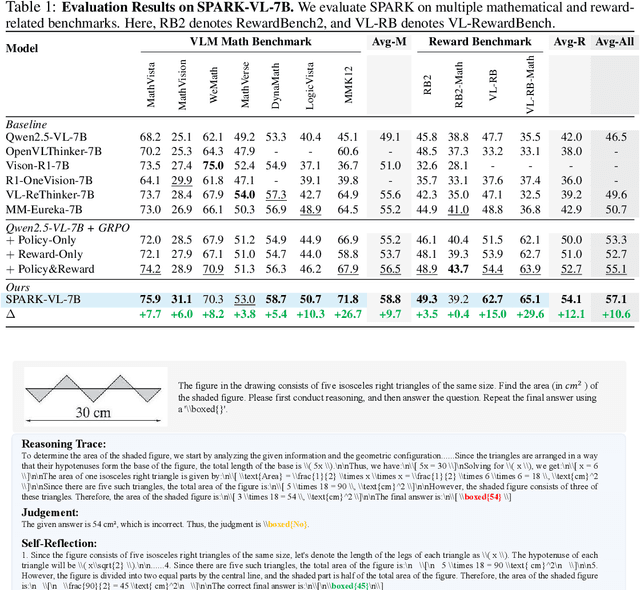
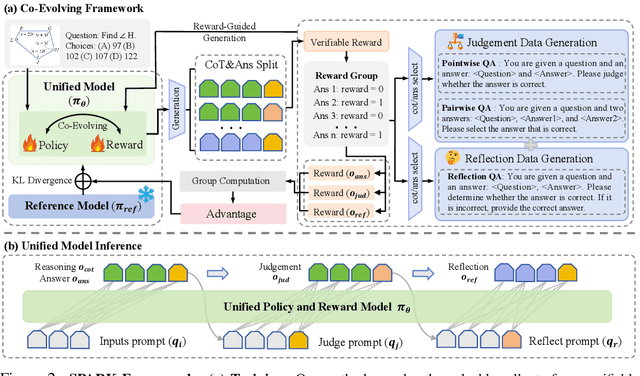
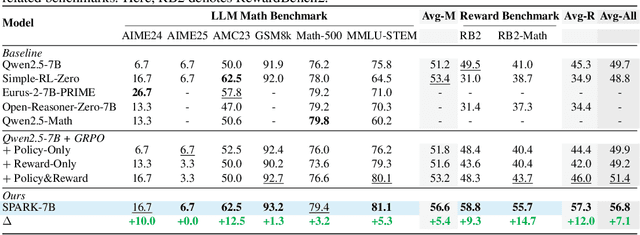
Recent Large Language Models (LLMs) and Large Vision-Language Models (LVLMs) increasingly use Reinforcement Learning (RL) for post-pretraining, such as RL with Verifiable Rewards (RLVR) for objective tasks and RL from Human Feedback (RLHF) for subjective tasks. However, RLHF incurs high costs and potential reward-policy mismatch due to reliance on human preferences, while RLVR still wastes supervision by discarding rollouts and correctness signals after each update. To address these challenges, we introduce the Synergistic Policy And Reward Co-Evolving Framework (SPARK), an efficient, on-policy, and stable method that builds on RLVR. Instead of discarding rollouts and correctness data, SPARK recycles this valuable information to simultaneously train the model itself as a generative reward model. This auxiliary training uses a mix of objectives, such as pointwise reward score, pairwise comparison, and evaluation conditioned on further-reflection responses, to teach the model to evaluate and improve its own responses. Our process eliminates the need for a separate reward model and costly human preference data. SPARK creates a positive co-evolving feedback loop: improved reward accuracy yields better policy gradients, which in turn produce higher-quality rollouts that further refine the reward model. Our unified framework supports test-time scaling via self-reflection without external reward models and their associated costs. We show that SPARK achieves significant performance gains on multiple LLM and LVLM models and multiple reasoning, reward models, and general benchmarks. For example, SPARK-VL-7B achieves an average 9.7% gain on 7 reasoning benchmarks, 12.1% on 2 reward benchmarks, and 1.5% on 8 general benchmarks over the baselines, demonstrating robustness and broad generalization.