 Add to Chrome
 Add to Firefox
 Add to Edge
DriVerse: Navigation World Model for Driving Simulation via Multimodal Trajectory Prompting and Motion Alignment
Apr 22, 2025
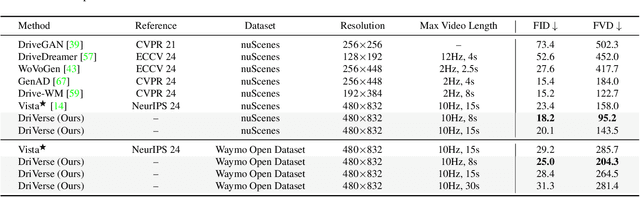
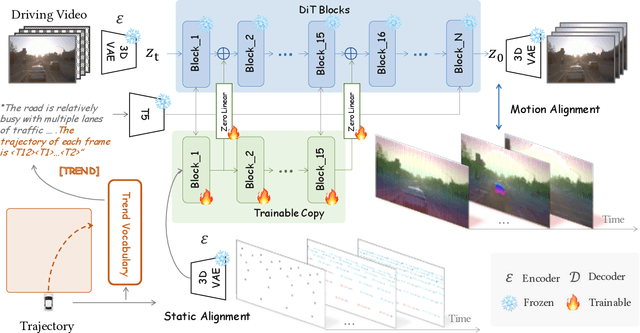
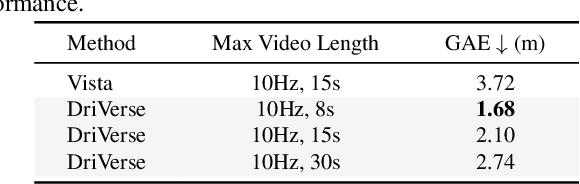
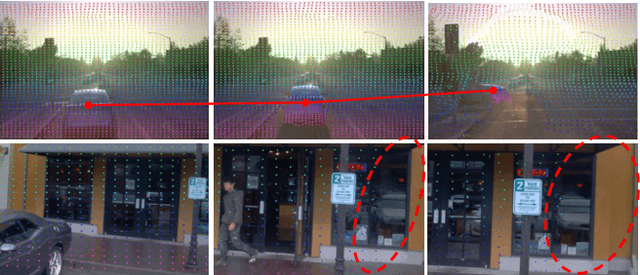
This paper presents DriVerse, a generative model for simulating navigation-driven driving scenes from a single image and a future trajectory. Previous autonomous driving world models either directly feed the trajectory or discrete control signals into the generation pipeline, leading to poor alignment between the control inputs and the implicit features of the 2D base generative model, which results in low-fidelity video outputs. Some methods use coarse textual commands or discrete vehicle control signals, which lack the precision to guide fine-grained, trajectory-specific video generation, making them unsuitable for evaluating actual autonomous driving algorithms. DriVerse introduces explicit trajectory guidance in two complementary forms: it tokenizes trajectories into textual prompts using a predefined trend vocabulary for seamless language integration, and converts 3D trajectories into 2D spatial motion priors to enhance control over static content within the driving scene. To better handle dynamic objects, we further introduce a lightweight motion alignment module, which focuses on the inter-frame consistency of dynamic pixels, significantly enhancing the temporal coherence of moving elements over long sequences. With minimal training and no need for additional data, DriVerse outperforms specialized models on future video generation tasks across both the nuScenes and Waymo datasets. The code and models will be released to the public.

NTIRE 2025 Challenge on Real-World Face Restoration: Methods and Results
Apr 20, 2025This paper provides a review of the NTIRE 2025 challenge on real-world face restoration, highlighting the proposed solutions and the resulting outcomes. The challenge focuses on generating natural, realistic outputs while maintaining identity consistency. Its goal is to advance state-of-the-art solutions for perceptual quality and realism, without imposing constraints on computational resources or training data. The track of the challenge evaluates performance using a weighted image quality assessment (IQA) score and employs the AdaFace model as an identity checker. The competition attracted 141 registrants, with 13 teams submitting valid models, and ultimately, 10 teams achieved a valid score in the final ranking. This collaborative effort advances the performance of real-world face restoration while offering an in-depth overview of the latest trends in the field.
ViMo: A Generative Visual GUI World Model for App Agent
Apr 15, 2025App agents, which autonomously operate mobile Apps through Graphical User Interfaces (GUIs), have gained significant interest in real-world applications. Yet, they often struggle with long-horizon planning, failing to find the optimal actions for complex tasks with longer steps. To address this, world models are used to predict the next GUI observation based on user actions, enabling more effective agent planning. However, existing world models primarily focus on generating only textual descriptions, lacking essential visual details. To fill this gap, we propose ViMo, the first visual world model designed to generate future App observations as images. For the challenge of generating text in image patches, where even minor pixel errors can distort readability, we decompose GUI generation into graphic and text content generation. We propose a novel data representation, the Symbolic Text Representation~(STR) to overlay text content with symbolic placeholders while preserving graphics. With this design, ViMo employs a STR Predictor to predict future GUIs' graphics and a GUI-text Predictor for generating the corresponding text. Moreover, we deploy ViMo to enhance agent-focused tasks by predicting the outcome of different action options. Experiments show ViMo's ability to generate visually plausible and functionally effective GUIs that enable App agents to make more informed decisions.
AutoStyle-TTS: Retrieval-Augmented Generation based Automatic Style Matching Text-to-Speech Synthesis
Apr 14, 2025With the advancement of speech synthesis technology, users have higher expectations for the naturalness and expressiveness of synthesized speech. But previous research ignores the importance of prompt selection. This study proposes a text-to-speech (TTS) framework based on Retrieval-Augmented Generation (RAG) technology, which can dynamically adjust the speech style according to the text content to achieve more natural and vivid communication effects. We have constructed a speech style knowledge database containing high-quality speech samples in various contexts and developed a style matching scheme. This scheme uses embeddings, extracted by Llama, PER-LLM-Embedder,and Moka, to match with samples in the knowledge database, selecting the most appropriate speech style for synthesis. Furthermore, our empirical research validates the effectiveness of the proposed method. Our demo can be viewed at: https://thuhcsi.github.io/icme2025-AutoStyle-TTS
MSL: Not All Tokens Are What You Need for Tuning LLM as a Recommender
Apr 05, 2025Large language models (LLMs), known for their comprehension capabilities and extensive knowledge, have been increasingly applied to recommendation systems (RS). Given the fundamental gap between the mechanism of LLMs and the requirement of RS, researchers have focused on fine-tuning LLMs with recommendation-specific data to enhance their performance. Language Modeling Loss (LML), originally designed for language generation tasks, is commonly adopted. However, we identify two critical limitations of LML: 1) it exhibits significant divergence from the recommendation objective; 2) it erroneously treats all fictitious item descriptions as negative samples, introducing misleading training signals. To address these limitations, we propose a novel Masked Softmax Loss (MSL) tailored for fine-tuning LLMs on recommendation. MSL improves LML by identifying and masking invalid tokens that could lead to fictitious item descriptions during loss computation. This strategy can effectively avoid the interference from erroneous negative signals and ensure well alignment with the recommendation objective supported by theoretical guarantees. During implementation, we identify a potential challenge related to gradient vanishing of MSL. To overcome this, we further introduce the temperature coefficient and propose an Adaptive Temperature Strategy (ATS) that adaptively adjusts the temperature without requiring extensive hyperparameter tuning. Extensive experiments conducted on four public datasets further validate the effectiveness of MSL, achieving an average improvement of 42.24% in NDCG@10. The code is available at https://github.com/WANGBohaO-jpg/MSL.
Optimizing Case-Based Reasoning System for Functional Test Script Generation with Large Language Models
Mar 26, 2025In this work, we explore the potential of large language models (LLMs) for generating functional test scripts, which necessitates understanding the dynamically evolving code structure of the target software. To achieve this, we propose a case-based reasoning (CBR) system utilizing a 4R cycle (i.e., retrieve, reuse, revise, and retain), which maintains and leverages a case bank of test intent descriptions and corresponding test scripts to facilitate LLMs for test script generation. To improve user experience further, we introduce Re4, an optimization method for the CBR system, comprising reranking-based retrieval finetuning and reinforced reuse finetuning. Specifically, we first identify positive examples with high semantic and script similarity, providing reliable pseudo-labels for finetuning the retriever model without costly labeling. Then, we apply supervised finetuning, followed by a reinforcement learning finetuning stage, to align LLMs with our production scenarios, ensuring the faithful reuse of retrieved cases. Extensive experimental results on two product development units from Huawei Datacom demonstrate the superiority of the proposed CBR+Re4. Notably, we also show that the proposed Re4 method can help alleviate the repetitive generation issues with LLMs.
OThink-MR1: Stimulating multimodal generalized reasoning capabilities through dynamic reinforcement learning
Mar 20, 2025Multimodal Language Models have gained significant traction for their ability to process diverse input data types and generate coherent, contextually relevant outputs across various applications. While supervised fine-tuning (SFT) has been the predominant approach to enhance MLLM capabilities in task-specific optimization, it often falls short in fostering crucial generalized reasoning abilities. Despite the potential of reinforcement learning (RL) to address these limitations, it faces two issues: (1) its generalized capabilities in multimodal tasks remain underexplored. (2) its training constraints such as constant Kullback-Leibler or clamp strategy easily lead to suboptimal bottleneck. To adress these issues, we introduce OThink-MR1, a framework that extends RL to MLLMs, enabling them to achieve deeper understanding and reasoning across multimodal tasks. We design a dynamic Kullback-Leibler strategy that significantly enhances RL performance, surpassing SFT in same-task evaluations. Also, we are the first to reveal that RL exhibits remarkable cross-task generalization capabilities, which shows that models post-trained with RL on one multimodal task can be effectively transfered to another tasks. Finally, extensive experiments demonstrate the great reasoning ability of our proposed OThink-MR1.
PLM: Efficient Peripheral Language Models Hardware-Co-Designed for Ubiquitous Computing
Mar 15, 2025

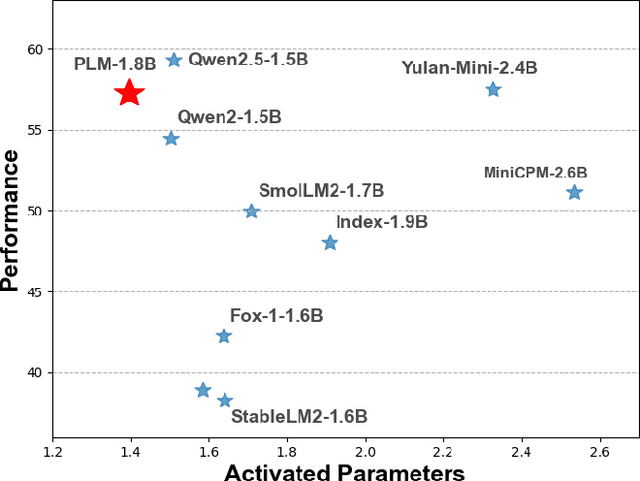

While scaling laws have been continuously validated in large language models (LLMs) with increasing model parameters, the inherent tension between the inference demands of LLMs and the limited resources of edge devices poses a critical challenge to the development of edge intelligence. Recently, numerous small language models have emerged, aiming to distill the capabilities of LLMs into smaller footprints. However, these models often retain the fundamental architectural principles of their larger counterparts, still imposing considerable strain on the storage and bandwidth capacities of edge devices. In this paper, we introduce the PLM, a Peripheral Language Model, developed through a co-design process that jointly optimizes model architecture and edge system constraints. The PLM utilizes a Multi-head Latent Attention mechanism and employs the squared ReLU activation function to encourage sparsity, thereby reducing peak memory footprint during inference. During training, we collect and reorganize open-source datasets, implement a multi-phase training strategy, and empirically investigate the Warmup-Stable-Decay-Constant (WSDC) learning rate scheduler. Additionally, we incorporate Reinforcement Learning from Human Feedback (RLHF) by adopting the ARIES preference learning approach. Following a two-phase SFT process, this method yields performance gains of 2% in general tasks, 9% in the GSM8K task, and 11% in coding tasks. In addition to its novel architecture, evaluation results demonstrate that PLM outperforms existing small language models trained on publicly available data while maintaining the lowest number of activated parameters. Furthermore, deployment across various edge devices, including consumer-grade GPUs, mobile phones, and Raspberry Pis, validates PLM's suitability for peripheral applications. The PLM series models are publicly available at https://github.com/plm-team/PLM.
ST-FlowNet: An Efficient Spiking Neural Network for Event-Based Optical Flow Estimation
Mar 13, 2025Spiking Neural Networks (SNNs) have emerged as a promising tool for event-based optical flow estimation tasks due to their ability to leverage spatio-temporal information and low-power capabilities. However, the performance of SNN models is often constrained, limiting their application in real-world scenarios. In this work, we address this gap by proposing a novel neural network architecture, ST-FlowNet, specifically tailored for optical flow estimation from event-based data. The ST-FlowNet architecture integrates ConvGRU modules to facilitate cross-modal feature augmentation and temporal alignment of the predicted optical flow, improving the network's ability to capture complex motion dynamics. Additionally, to overcome the challenges associated with training SNNs, we introduce a novel approach to derive SNN models from pre-trained artificial neural networks (ANNs) through ANN-to-SNN conversion or our proposed BISNN method. Notably, the BISNN method alleviates the complexities involved in biological parameter selection, further enhancing the robustness of SNNs in optical flow estimation tasks. Extensive evaluations on three benchmark event-based datasets demonstrate that the SNN-based ST-FlowNet model outperforms state-of-the-art methods, delivering superior performance in accurate optical flow estimation across a diverse range of dynamic visual scenes. Furthermore, the inherent energy efficiency of SNN models is highlighted, establishing a compelling advantage for their practical deployment. Overall, our work presents a novel framework for optical flow estimation using SNNs and event-based data, contributing to the advancement of neuromorphic vision applications.
ReMA: Learning to Meta-think for LLMs with Multi-Agent Reinforcement Learning
Mar 12, 2025Recent research on Reasoning of Large Language Models (LLMs) has sought to further enhance their performance by integrating meta-thinking -- enabling models to monitor, evaluate, and control their reasoning processes for more adaptive and effective problem-solving. However, current single-agent work lacks a specialized design for acquiring meta-thinking, resulting in low efficacy. To address this challenge, we introduce Reinforced Meta-thinking Agents (ReMA), a novel framework that leverages Multi-Agent Reinforcement Learning (MARL) to elicit meta-thinking behaviors, encouraging LLMs to think about thinking. ReMA decouples the reasoning process into two hierarchical agents: a high-level meta-thinking agent responsible for generating strategic oversight and plans, and a low-level reasoning agent for detailed executions. Through iterative reinforcement learning with aligned objectives, these agents explore and learn collaboration, leading to improved generalization and robustness. Experimental results demonstrate that ReMA outperforms single-agent RL baselines on complex reasoning tasks, including competitive-level mathematical benchmarks and LLM-as-a-Judge benchmarks. Comprehensive ablation studies further illustrate the evolving dynamics of each distinct agent, providing valuable insights into how the meta-thinking reasoning process enhances the reasoning capabilities of LLMs.