 Add to Chrome
 Add to Firefox
 Add to Edge
Hardware Co-Design Scaling Laws via Roofline Modelling for On-Device LLMs
Feb 10, 2026
Vision-Language-Action Models (VLAs) have emerged as a key paradigm of Physical AI and are increasingly deployed in autonomous vehicles, robots, and smart spaces. In these resource-constrained on-device settings, selecting an appropriate large language model (LLM) backbone is a critical challenge: models must balance accuracy with strict inference latency and hardware efficiency constraints. This makes hardware-software co-design a game-changing requirement for on-device LLM deployment, where each hardware platform demands a tailored architectural solution. We propose a hardware co-design law that jointly captures model accuracy and inference performance. Specifically, we model training loss as an explicit function of architectural hyperparameters and characterise inference latency via roofline modelling. We empirically evaluate 1,942 candidate architectures on NVIDIA Jetson Orin, training 170 selected models for 10B tokens each to fit a scaling law relating architecture to training loss. By coupling this scaling law with latency modelling, we establish a direct accuracy-latency correspondence and identify the Pareto frontier for hardware co-designed LLMs. We further formulate architecture search as a joint optimisation over precision and performance, deriving feasible design regions under industrial hardware and application budgets. Our approach reduces architecture selection from months to days. At the same latency as Qwen2.5-0.5B on the target hardware, our co-designed architecture achieves 19.42% lower perplexity on WikiText-2. To our knowledge, this is the first principled and operational framework for hardware co-design scaling laws in on-device LLM deployment. We will make the code and related checkpoints publicly available.

PLM: Efficient Peripheral Language Models Hardware-Co-Designed for Ubiquitous Computing
Mar 15, 2025

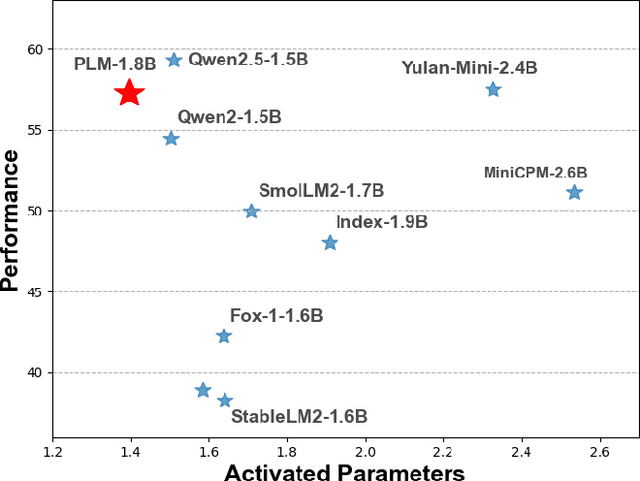

While scaling laws have been continuously validated in large language models (LLMs) with increasing model parameters, the inherent tension between the inference demands of LLMs and the limited resources of edge devices poses a critical challenge to the development of edge intelligence. Recently, numerous small language models have emerged, aiming to distill the capabilities of LLMs into smaller footprints. However, these models often retain the fundamental architectural principles of their larger counterparts, still imposing considerable strain on the storage and bandwidth capacities of edge devices. In this paper, we introduce the PLM, a Peripheral Language Model, developed through a co-design process that jointly optimizes model architecture and edge system constraints. The PLM utilizes a Multi-head Latent Attention mechanism and employs the squared ReLU activation function to encourage sparsity, thereby reducing peak memory footprint during inference. During training, we collect and reorganize open-source datasets, implement a multi-phase training strategy, and empirically investigate the Warmup-Stable-Decay-Constant (WSDC) learning rate scheduler. Additionally, we incorporate Reinforcement Learning from Human Feedback (RLHF) by adopting the ARIES preference learning approach. Following a two-phase SFT process, this method yields performance gains of 2% in general tasks, 9% in the GSM8K task, and 11% in coding tasks. In addition to its novel architecture, evaluation results demonstrate that PLM outperforms existing small language models trained on publicly available data while maintaining the lowest number of activated parameters. Furthermore, deployment across various edge devices, including consumer-grade GPUs, mobile phones, and Raspberry Pis, validates PLM's suitability for peripheral applications. The PLM series models are publicly available at https://github.com/plm-team/PLM.