 Add to Chrome
 Add to Firefox
 Add to Edge
DB-VIO: Dual-Branch Visual Inertial Odometry with Enhanced Visual-Inertial Representation
Jul 24, 2026
Visual inertial odometry (VIO) is essential for accurate 6-DoF motion estimation in mobile robotic systems. Recent learning-based VIO methods have shown promising progress, but they often rely on unified visual--inertial representations and a single temporal model for full-pose estimation, limiting their ability to capture the heterogeneous dynamics of rotation and translation. Moreover, monocular visual features often lack explicit geometric structure, while raw inertial encoding leaves the underlying rotational kinematics implicit, weakening the rotation-related cues in IMU features. To address these issues, we propose DB-VIO, a dual-branch visual inertial odometry framework with enhanced visual--inertial representation. DB-VIO incorporates depth cues to improve monocular visual perception, injects an explicit integrated-attitude prior to strengthen rotation-aware inertial representation, and decouples pose estimation into dedicated rotational and translational branches for motion-specific temporal modeling. Experiments on autonomous driving and aerial robot benchmarks show that DB-VIO achieves state-of-the-art performance, improving the corresponding baselines by 20\% on KITTI and 33\% on EuRoC. Notably, under the more agile motion patterns of EuRoC, DB-VIO improves the rotational metric by 65.7\% over prior methods. These results demonstrate the effectiveness and generalization of DB-VIO across different platforms and motion scenarios.

OPSD-V: On-Policy Self-Distillation for Post-Training Few-Step Autoregressive Video Generators
Jul 09, 2026We propose OPSD-V, an on-policy self-distillation paradigm for post-training few-step autoregressive (AR) video diffusion models. Existing few-step AR video generators can produce long videos with low latency, but still suffer from error accumulation and weakened motion dynamics during long autoregressive rollout. OPSD-V reduces long-horizon degradation while preserving the original few-step inference path. The key idea is to introduce real long-video data as temporal context during training and use it to provide dense trajectory-level supervision. Specifically, the student follows the exact inference-time rollout, generating each chunk conditioned on its own previously generated KV cache. In parallel, the teacher is evaluated at the same student-visited denoising states, but uses a cleaner AR-consistent temporal cache in which older history can be replaced by real-video context. This provides dense denoising-level corrective targets under on-policy AR cache dynamics, without changing the sampler, number of denoising steps, or inference-time cache mechanism. We apply OPSD-V to representative few-step AR video models, including Self-Forcing and LongLive. Experiments show consistent improvements in visual quality, motion dynamics, and VBenchLong scores. A user study with 10 participants comparing 20 video pairs shows that OPSD-V is preferred over the base models in 66.0% of overall-preference judgments (82.5% excluding ties).
EdgeBench: Unveiling Scaling Laws of Learning from Real-World Environments
Jul 06, 2026Pretraining scaling laws reveal that model capability improves predictably with data and compute. But learning from real world environments after deployment remains far less understood. Analyzing roughly 38,000 hours of agent interaction with the environment across 134 real world tasks, we find, to the best of our knowledge, the first evidence that overall performance during environment learning follows a log-sigmoid scaling law with remarkably high precision, reaching R^2 = 0.998. Across model generations, we also find that agent learning speed roughly doubles every three months. This discovery stems from EdgeBench, a suite of 134 real world tasks with ultra-long horizons, spanning scientific discovery, software engineering, combinatorial optimization, professional knowledge work, formal mathematics, and interactive games. Each task sustains at least 12 hours of continuous agent operation under rich, multilevel feedback, and is built through substantial expert effort. We publicly release 51 tasks and our full evaluation framework to accelerate the study of how agents learn from real world experience.
Lens: Rethinking Training Efficiency for Foundational Text-to-Image Models
May 20, 2026We introduce Lens, a 3.8B-parameter T2I model that achieves performance competitive with, and in several cases surpassing, state-of-the-art models with more than 6B parameters across various benchmarks, while requiring significantly less training compute. For example, Lens requires only about 19.3% of the training compute used by Z-Image. The training efficiency of Lens stems from two key strategies beyond its compact model size. First, we maximize data information density per training batch by (i) training on Lens-800M, a dataset of 800M densely captioned image-text pairs whose captions are generated by GPT-4.1 and contain approximately 109 words on average, providing richer semantic supervision than conventional short captions, and (ii) constructing each batch from images with multiple resolutions and diverse aspect ratios, thereby enlarging the effective visual coverage of each optimization step. Second, we improve convergence speed through careful architectural choices, including adopting a semantic VAE that provides better latent representations and employing a strong language encoder that accelerates optimization while enabling multilingual generalization from English-only training data. After pre-training, we apply RL with taxonomy-driven prompts (Lens-RL-8K) and structured reward rubrics to suppress artifacts and improve visual quality, a reasoner module with training-free system prompt search to better align user requests with the model, and distillation-based acceleration for 4-step inference. Through efficient training and systematic optimization, Lens generalizes to arbitrary aspect ratios from 1:2 to 2:1 and resolutions up to 1440^2, and supports prompts in several commonly used languages. Thanks to its compact size, Lens generates a 1024^2 image in 3.15 seconds on a single NVIDIA H100 GPU, while its distilled turbo version performs 4-step generation in 0.84 seconds.
AvatarPointillist: AutoRegressive 4D Gaussian Avatarization
Apr 06, 2026We introduce AvatarPointillist, a novel framework for generating dynamic 4D Gaussian avatars from a single portrait image. At the core of our method is a decoder-only Transformer that autoregressively generates a point cloud for 3D Gaussian Splatting. This sequential approach allows for precise, adaptive construction, dynamically adjusting point density and the total number of points based on the subject's complexity. During point generation, the AR model also jointly predicts per-point binding information, enabling realistic animation. After generation, a dedicated Gaussian decoder converts the points into complete, renderable Gaussian attributes. We demonstrate that conditioning the decoder on the latent features from the AR generator enables effective interaction between stages and markedly improves fidelity. Extensive experiments validate that AvatarPointillist produces high-quality, photorealistic, and controllable avatars. We believe this autoregressive formulation represents a new paradigm for avatar generation, and we will release our code inspire future research.
LACON: Training Text-to-Image Model from Uncurated Data
Mar 27, 2026The success of modern text-to-image generation is largely attributed to massive, high-quality datasets. Currently, these datasets are curated through a filter-first paradigm that aggressively discards low-quality raw data based on the assumption that it is detrimental to model performance. Is the discarded bad data truly useless, or does it hold untapped potential? In this work, we critically re-examine this question. We propose LACON (Labeling-and-Conditioning), a novel training framework that exploits the underlying uncurated data distribution. Instead of filtering, LACON re-purposes quality signals, such as aesthetic scores and watermark probabilities as explicit, quantitative condition labels. The generative model is then trained to learn the full spectrum of data quality, from bad to good. By learning the explicit boundary between high- and low-quality content, LACON achieves superior generation quality compared to baselines trained only on filtered data using the same compute budget, proving the significant value of uncurated data.
MAGIC: A Co-Evolving Attacker-Defender Adversarial Game for Robust LLM Safety
Feb 02, 2026Ensuring robust safety alignment is crucial for Large Language Models (LLMs), yet existing defenses often lag behind evolving adversarial attacks due to their \textbf{reliance on static, pre-collected data distributions}. In this paper, we introduce \textbf{MAGIC}, a novel multi-turn multi-agent reinforcement learning framework that formulates LLM safety alignment as an adversarial asymmetric game. Specifically, an attacker agent learns to iteratively rewrite original queries into deceptive prompts, while a defender agent simultaneously optimizes its policy to recognize and refuse such inputs. This dynamic process triggers a \textbf{co-evolution}, where the attacker's ever-changing strategies continuously uncover long-tail vulnerabilities, driving the defender to generalize to unseen attack patterns. Remarkably, we observe that the attacker, endowed with initial reasoning ability, evolves \textbf{novel, previously unseen combinatorial strategies} through iterative RL training, underscoring our method's substantial potential. Theoretically, we provide insights into a more robust game equilibrium and derive safety guarantees. Extensive experiments validate our framework's effectiveness, demonstrating superior defense success rates without compromising the helpfulness of the model. Our code is available at https://github.com/BattleWen/MAGIC.
MorphoSim: An Interactive, Controllable, and Editable Language-guided 4D World Simulator
Oct 05, 2025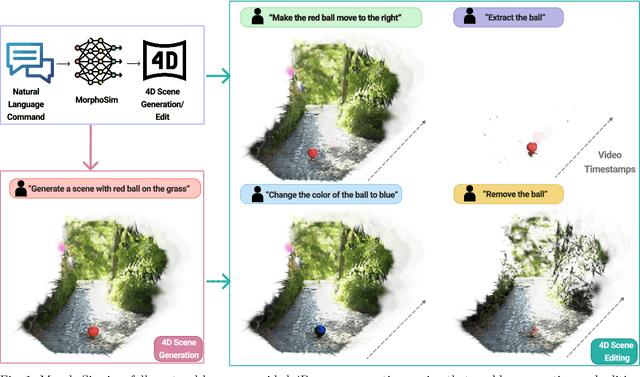
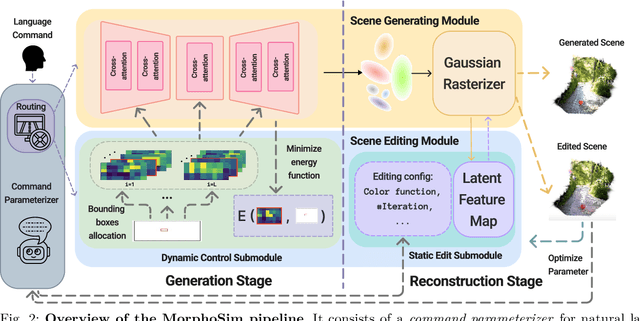
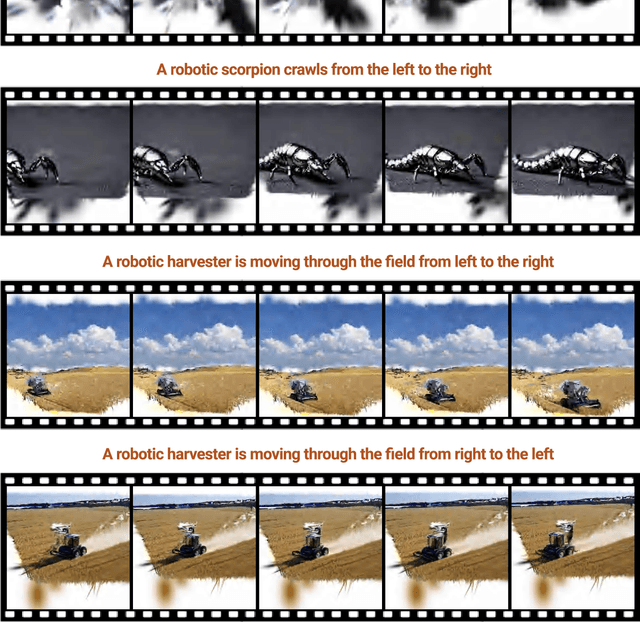
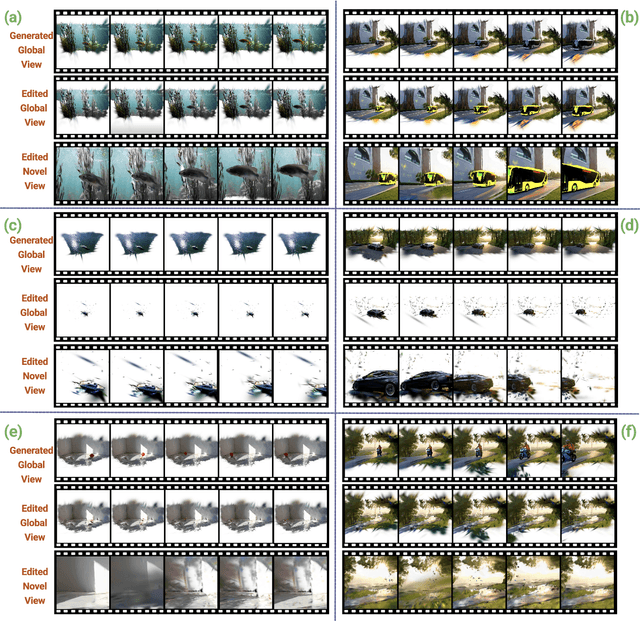
World models that support controllable and editable spatiotemporal environments are valuable for robotics, enabling scalable training data, repro ducible evaluation, and flexible task design. While recent text-to-video models generate realistic dynam ics, they are constrained to 2D views and offer limited interaction. We introduce MorphoSim, a language guided framework that generates 4D scenes with multi-view consistency and object-level controls. From natural language instructions, MorphoSim produces dynamic environments where objects can be directed, recolored, or removed, and scenes can be observed from arbitrary viewpoints. The framework integrates trajectory-guided generation with feature field dis tillation, allowing edits to be applied interactively without full re-generation. Experiments show that Mor phoSim maintains high scene fidelity while enabling controllability and editability. The code is available at https://github.com/eric-ai-lab/Morph4D.
AvatarArtist: Open-Domain 4D Avatarization
Mar 26, 2025This work focuses on open-domain 4D avatarization, with the purpose of creating a 4D avatar from a portrait image in an arbitrary style. We select parametric triplanes as the intermediate 4D representation and propose a practical training paradigm that takes advantage of both generative adversarial networks (GANs) and diffusion models. Our design stems from the observation that 4D GANs excel at bridging images and triplanes without supervision yet usually face challenges in handling diverse data distributions. A robust 2D diffusion prior emerges as the solution, assisting the GAN in transferring its expertise across various domains. The synergy between these experts permits the construction of a multi-domain image-triplane dataset, which drives the development of a general 4D avatar creator. Extensive experiments suggest that our model, AvatarArtist, is capable of producing high-quality 4D avatars with strong robustness to various source image domains. The code, the data, and the models will be made publicly available to facilitate future studies.
ReMA: Learning to Meta-think for LLMs with Multi-Agent Reinforcement Learning
Mar 12, 2025Recent research on Reasoning of Large Language Models (LLMs) has sought to further enhance their performance by integrating meta-thinking -- enabling models to monitor, evaluate, and control their reasoning processes for more adaptive and effective problem-solving. However, current single-agent work lacks a specialized design for acquiring meta-thinking, resulting in low efficacy. To address this challenge, we introduce Reinforced Meta-thinking Agents (ReMA), a novel framework that leverages Multi-Agent Reinforcement Learning (MARL) to elicit meta-thinking behaviors, encouraging LLMs to think about thinking. ReMA decouples the reasoning process into two hierarchical agents: a high-level meta-thinking agent responsible for generating strategic oversight and plans, and a low-level reasoning agent for detailed executions. Through iterative reinforcement learning with aligned objectives, these agents explore and learn collaboration, leading to improved generalization and robustness. Experimental results demonstrate that ReMA outperforms single-agent RL baselines on complex reasoning tasks, including competitive-level mathematical benchmarks and LLM-as-a-Judge benchmarks. Comprehensive ablation studies further illustrate the evolving dynamics of each distinct agent, providing valuable insights into how the meta-thinking reasoning process enhances the reasoning capabilities of LLMs.