 Add to Chrome
 Add to Firefox
 Add to Edge
FAST: A Framework for Aligned Sampling and Training in Parallel Reinforcement Learning for Autonomous Driving
Jun 19, 2026
Deep reinforcement learning is pivotal for closed-loop autonomous driving yet remains constrained by severe bottlenecks in sampling efficiency. Standard parallel sampling mitigates this but suffers from the straggler effect, where the premature termination of a single environment necessitates a synchronized batch re-initialization, leading to suboptimal sample utilization and prohibitive re-initialization latency. To address this, we propose FAST, a synchronous parallel framework tailored for closed-loop simulation. Specifically, FAST employs Dynamic Parallel Sampling Alignment (DPSA) to maintain vectorization synchronization by extending terminated episodes via virtual continuation, thereby decoupling the sampling loop from individual terminations. By dynamically triggering global truncation based on the termination rate of parallel clips, FAST effectively eliminates the bottleneck of premature resets without sacrificing data diversity. Furthermore, to strictly preserve theoretical consistency, we incorporate a Scaled Mask-Padding Optimization (SMPO) that leverages validity masking and adaptive loss normalization to nullify the bias from auxiliary padding data. Empirical evaluations demonstrate that FAST achieves at least a 1.78 times wall-clock speedup over the single-clip baseline while preserving statistical unbiasedness.

PLM: Efficient Peripheral Language Models Hardware-Co-Designed for Ubiquitous Computing
Mar 15, 2025

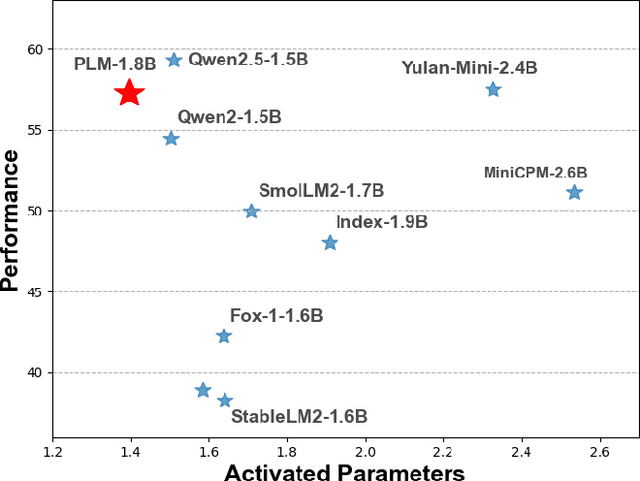

While scaling laws have been continuously validated in large language models (LLMs) with increasing model parameters, the inherent tension between the inference demands of LLMs and the limited resources of edge devices poses a critical challenge to the development of edge intelligence. Recently, numerous small language models have emerged, aiming to distill the capabilities of LLMs into smaller footprints. However, these models often retain the fundamental architectural principles of their larger counterparts, still imposing considerable strain on the storage and bandwidth capacities of edge devices. In this paper, we introduce the PLM, a Peripheral Language Model, developed through a co-design process that jointly optimizes model architecture and edge system constraints. The PLM utilizes a Multi-head Latent Attention mechanism and employs the squared ReLU activation function to encourage sparsity, thereby reducing peak memory footprint during inference. During training, we collect and reorganize open-source datasets, implement a multi-phase training strategy, and empirically investigate the Warmup-Stable-Decay-Constant (WSDC) learning rate scheduler. Additionally, we incorporate Reinforcement Learning from Human Feedback (RLHF) by adopting the ARIES preference learning approach. Following a two-phase SFT process, this method yields performance gains of 2% in general tasks, 9% in the GSM8K task, and 11% in coding tasks. In addition to its novel architecture, evaluation results demonstrate that PLM outperforms existing small language models trained on publicly available data while maintaining the lowest number of activated parameters. Furthermore, deployment across various edge devices, including consumer-grade GPUs, mobile phones, and Raspberry Pis, validates PLM's suitability for peripheral applications. The PLM series models are publicly available at https://github.com/plm-team/PLM.
AOTree: Aspect Order Tree-based Model for Explainable Recommendation
Jul 29, 2024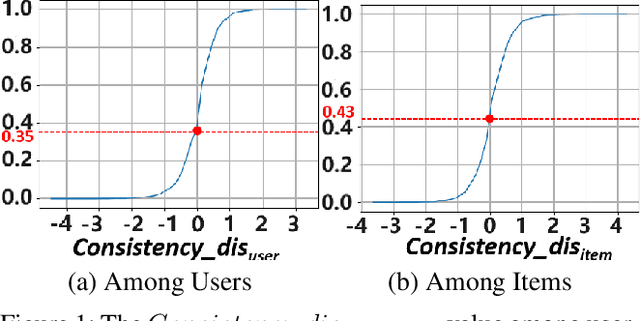

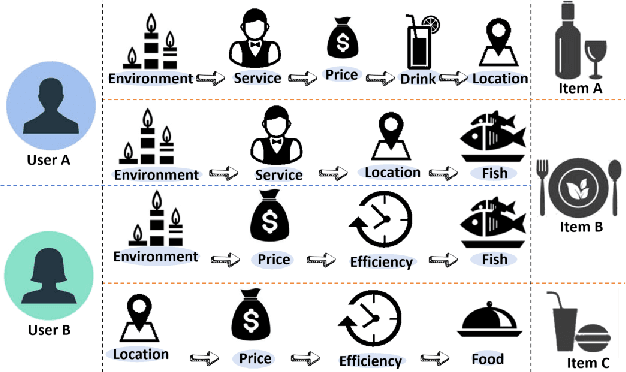
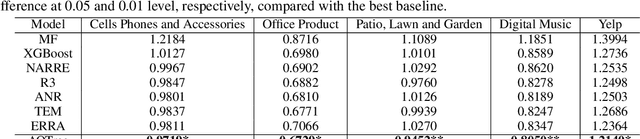
Recent recommender systems aim to provide not only accurate recommendations but also explanations that help users understand them better. However, most existing explainable recommendations only consider the importance of content in reviews, such as words or aspects, and ignore the ordering relationship among them. This oversight neglects crucial ordering dimensions in the human decision-making process, leading to suboptimal performance. Therefore, in this paper, we propose Aspect Order Tree-based (AOTree) explainable recommendation method, inspired by the Order Effects Theory from cognitive and decision psychology, in order to capture the dependency relationships among decisive factors. We first validate the theory in the recommendation scenario by analyzing the reviews of the users. Then, according to the theory, the proposed AOTree expands the construction of the decision tree to capture aspect orders in users' decision-making processes, and use attention mechanisms to make predictions based on the aspect orders. Extensive experiments demonstrate our method's effectiveness on rating predictions, and our approach aligns more consistently with the user' s decision-making process by displaying explanations in a particular order, thereby enhancing interpretability.
A Closed-loop Brain-Machine Interface SoC Featuring a 0.2$μ$J/class Multiplexer Based Neural Network
Jan 07, 2024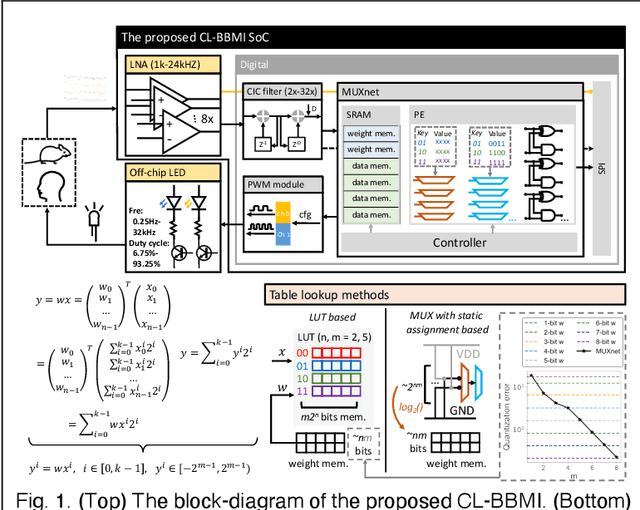
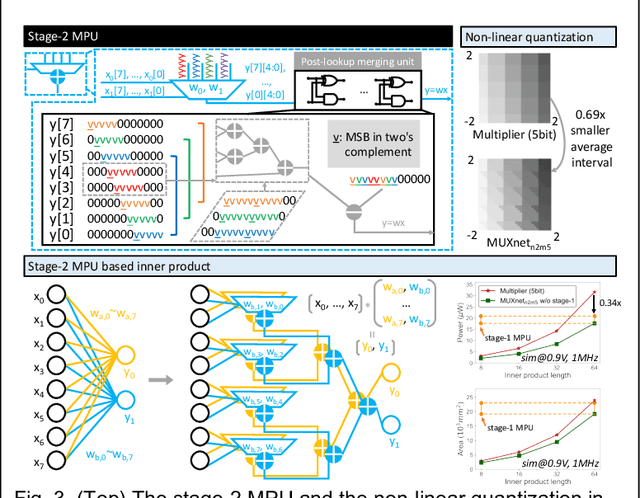
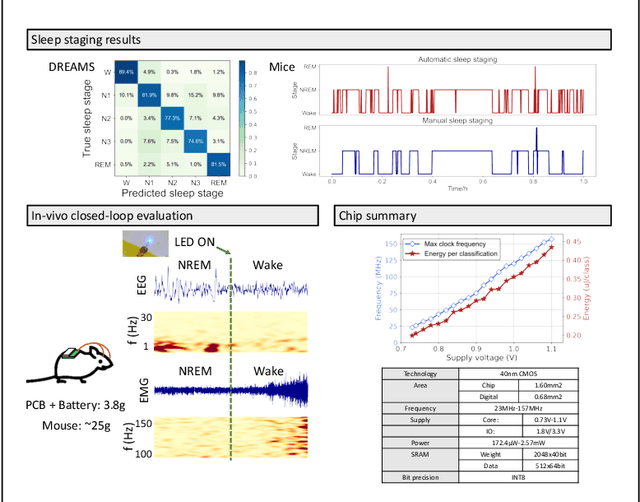
This work presents the first fabricated electrophysiology-optogenetic closed-loop bidirectional brain-machine interface (CL-BBMI) system-on-chip (SoC) with electrical neural signal recording, on-chip sleep staging and optogenetic stimulation. The first multiplexer with static assignment based table lookup solution (MUXnet) for multiplier-free NN processor was proposed. A state-of-the-art average accuracy of 82.4% was achieved with an energy consumption of only 0.2$\mu$J/class in sleep staging task.