 Add to Chrome
 Add to Firefox
 Add to Edge
LiteVSR: Lightweight Adaptation of Frozen Diffusion Transformers for Video Super-Resolution
Jun 08, 2026
Adapting large-scale pre-trained video generators for Video Super-Resolution (VSR) in novel domains remains computationally prohibitive. Methods that reformulate generation as direct Low-Quality to High-Quality mappings deviate from the original generative formulation, demanding extensive fine-tuning. ControlNet-style adapters lose their efficiency under modern Diffusion Transformers since the absence of encoder-decoder hierarchy forces duplication of the entire backbone. We observe that flow matching offers a principled alternative for cross-domain VSR adaptation. By predicting a constant velocity field across all timesteps, the adaptation task reduces to learning a fixed injection pattern rather than time-varying transformations. Building on this insight, we propose LiteVSR, a minimalist framework that performs VSR using a completely frozen Diffusion Transformer with a lightweight State-Aware Adapter. The adapter employs a dual-stream architecture that extracts static structural cues from the LQ input and dynamic cues from intermediate denoising states, aligning them through time-dependent cross-attention to enable adaptive transition from structural alignment to texture refinement as denoising proceeds. LiteVSR achieves competitive restoration quality with only 11.25% trainable parameters and 12 GPU-hours of training on a single A100, while maintaining fast sampling (down to a single step) compatibility.

Grounding Video Reasoning in Physical Signals
Apr 23, 2026Physical video understanding requires more than naming an event correctly. A model can answer a question about pouring, sliding, or collision from textual regularities while still failing to localize the event in time or space. We introduce a grounded benchmark for physical video understanding that extends the what--when--where evaluation structure of V-STaR to four video sources, six physics domains, three prompt families (physics, vstar_like, and neutral_rstr), and four input conditions (original, shuffled, ablated, and frame-masked). The benchmark contains 1,560 base video clips from SSV2, YouCook2, HoloAssist, and Roundabout-TAU. Each clip is first converted into a shared grounded event record, and the three query families are derived from that record. Temporal and spatial targets are shared across prompt families, while the non-physics families use deterministic family-appropriate semantic a_what targets derived from the same record. Across models and prompt families, physics remains the strongest regime overall, vstar_like is the clearest non-physics semantic comparison, and neutral_rstr behaves as a harder templated control. Prompt-family robustness is selective rather than universal, perturbation gains cluster in weak original cases, and spatial grounding is the weakest across settings. These results suggest that video Q&A reasoning benchmarks shall report physically grounded, prompt-aware, and perturbation-aware diagnostics alongside aggregate accuracy.
CycleCap: Improving VLMs Captioning Performance via Self-Supervised Cycle Consistency Fine-Tuning
Mar 18, 2026Visual-Language Models (VLMs) have achieved remarkable progress in image captioning, visual question answering, and visual reasoning. Yet they remain prone to vision-language misalignment, often producing overly generic or hallucinated descriptions. Existing approaches address this via instruction tuning-requiring costly, large-scale annotated datasets or via complex test-time frameworks for caption refinement. In this work, we revisit image-text alignment through the lens of cycle consistency: given an image and a caption generated by an image-to-text model, the backward mapping through a text-to-image model should reconstruct an image that closely matches the original. In our setup, a VLM serves as the image-to-text component, while a pre-trained text-to-image model closes the loop by reconstructing the image from the generated caption. Building on this, we introduce CycleCap, a fine-tuning scheme to improve image captioning using Group Relative Policy Optimization (GRPO) with a reward based on the similarity between the original and reconstructed images, computed on-the-fly. Unlike previous work that uses cycle consistency loss for preference dataset construction, our method leverages cycle consistency directly as a self-supervised training signal. This enables the use of raw images alone, eliminating the need for curated image-text datasets, while steering the VLM to produce more accurate and grounded text descriptions. Applied to four VLMs ranging from 1B to 7B parameters, CycleCap yields consistent improvements across captioning and hallucination benchmarks, surpassing state-of-the-art methods that rely on supervised cycle consistency training.
LatSearch: Latent Reward-Guided Search for Faster Inference-Time Scaling in Video Diffusion
Mar 15, 2026The recent success of inference-time scaling in large language models has inspired similar explorations in video diffusion. In particular, motivated by the existence of "golden noise" that enhances video quality, prior work has attempted to improve inference by optimising or searching for better initial noise. However, these approaches have notable limitations: they either rely on priors imposed at the beginning of noise sampling or on rewards evaluated only on the denoised and decoded videos. This leads to error accumulation, delayed and sparse reward signals, and prohibitive computational cost, which prevents the use of stronger search algorithms. Crucially, stronger search algorithms are precisely what could unlock substantial gains in controllability, sample efficiency and generation quality for video diffusion, provided their computational cost can be reduced. To fill in this gap, we enable efficient inference-time scaling for video diffusion through latent reward guidance, which provides intermediate, informative and efficient feedback along the denoising trajectory. We introduce a latent reward model that scores partially denoised latents at arbitrary timesteps with respect to visual quality, motion quality, and text alignment. Building on this model, we propose LatSearch, a novel inference-time search mechanism that performs Reward-Guided Resampling and Pruning (RGRP). In the resampling stage, candidates are sampled according to reward-normalised probabilities to reduce over-reliance on the reward model. In the pruning stage, applied at the final scheduled step, only the candidate with the highest cumulative reward is retained, improving both quality and efficiency. We evaluate LatSearch on the VBench-2.0 benchmark and demonstrate that it consistently improves video generation across multiple evaluation dimensions compared to the baseline Wan2.1 model.
GraphThinker: Reinforcing Video Reasoning with Event Graph Thinking
Feb 19, 2026Video reasoning requires understanding the causal relationships between events in a video. However, such relationships are often implicit and costly to annotate manually. While existing multimodal large language models (MLLMs) often infer event relations through dense captions or video summaries for video reasoning, such modeling still lacks causal understanding. Without explicit causal structure modeling within and across video events, these models suffer from hallucinations during the video reasoning. In this work, we propose GraphThinker, a reinforcement finetuning-based method that constructs structural event-level scene graphs and enhances visual grounding to jointly reduce hallucinations in video reasoning. Specifically, we first employ an MLLM to construct an event-based video scene graph (EVSG) that explicitly models both intra- and inter-event relations, and incorporate these formed scene graphs into the MLLM as an intermediate thinking process. We also introduce a visual attention reward during reinforcement finetuning, which strengthens video grounding and further mitigates hallucinations. We evaluate GraphThinker on two datasets, RexTime and VidHalluc, where it shows superior ability to capture object and event relations with more precise event localization, reducing hallucinations in video reasoning compared to prior methods.
OpenUS: A Fully Open-Source Foundation Model for Ultrasound Image Analysis via Self-Adaptive Masked Contrastive Learning
Nov 14, 2025Ultrasound (US) is one of the most widely used medical imaging modalities, thanks to its low cost, portability, real-time feedback, and absence of ionizing radiation. However, US image interpretation remains highly operator-dependent and varies significantly across anatomical regions, acquisition protocols, and device types. These variations, along with unique challenges such as speckle, low contrast, and limited standardized annotations, hinder the development of generalizable, label-efficient ultrasound AI models. In this paper, we propose OpenUS, the first reproducible, open-source ultrasound foundation model built on a large collection of public data. OpenUS employs a vision Mamba backbone, capturing both local and global long-range dependencies across the image. To extract rich features during pre-training, we introduce a novel self-adaptive masking framework that combines contrastive learning with masked image modeling. This strategy integrates the teacher's attention map with student reconstruction loss, adaptively refining clinically-relevant masking to enhance pre-training effectiveness. OpenUS also applies a dynamic learning schedule to progressively adjust the difficulty of the pre-training process. To develop the foundation model, we compile the largest to-date public ultrasound dataset comprising over 308K images from 42 publicly available datasets, covering diverse anatomical regions, institutions, imaging devices, and disease types. Our pre-trained OpenUS model can be easily adapted to specific downstream tasks by serving as a backbone for label-efficient fine-tuning. Code is available at https://github.com/XZheng0427/OpenUS.
Uncertainty-quantified Rollout Policy Adaptation for Unlabelled Cross-domain Temporal Grounding
Aug 08, 2025Video Temporal Grounding (TG) aims to temporally locate video segments matching a natural language description (a query) in a long video. While Vision-Language Models (VLMs) are effective at holistic semantic matching, they often struggle with fine-grained temporal localisation. Recently, Group Relative Policy Optimisation (GRPO) reformulates the inference process as a reinforcement learning task, enabling fine-grained grounding and achieving strong in-domain performance. However, GRPO relies on labelled data, making it unsuitable in unlabelled domains. Moreover, because videos are large and expensive to store and process, performing full-scale adaptation introduces prohibitive latency and computational overhead, making it impractical for real-time deployment. To overcome both problems, we introduce a Data-Efficient Unlabelled Cross-domain Temporal Grounding method, from which a model is first trained on a labelled source domain, then adapted to a target domain using only a small number of unlabelled videos from the target domain. This approach eliminates the need for target annotation and keeps both computational and storage overhead low enough to run in real time. Specifically, we introduce. Uncertainty-quantified Rollout Policy Adaptation (URPA) for cross-domain knowledge transfer in learning video temporal grounding without target labels. URPA generates multiple candidate predictions using GRPO rollouts, averages them to form a pseudo label, and estimates confidence from the variance across these rollouts. This confidence then weights the training rewards, guiding the model to focus on reliable supervision. Experiments on three datasets across six cross-domain settings show that URPA generalises well using only a few unlabelled target videos. Codes will be released once published.
ViSMaP: Unsupervised Hour-long Video Summarisation by Meta-Prompting
Apr 22, 2025We introduce ViSMap: Unsupervised Video Summarisation by Meta Prompting, a system to summarise hour long videos with no-supervision. Most existing video understanding models work well on short videos of pre-segmented events, yet they struggle to summarise longer videos where relevant events are sparsely distributed and not pre-segmented. Moreover, long-form video understanding often relies on supervised hierarchical training that needs extensive annotations which are costly, slow and prone to inconsistency. With ViSMaP we bridge the gap between short videos (where annotated data is plentiful) and long ones (where it's not). We rely on LLMs to create optimised pseudo-summaries of long videos using segment descriptions from short ones. These pseudo-summaries are used as training data for a model that generates long-form video summaries, bypassing the need for expensive annotations of long videos. Specifically, we adopt a meta-prompting strategy to iteratively generate and refine creating pseudo-summaries of long videos. The strategy leverages short clip descriptions obtained from a supervised short video model to guide the summary. Each iteration uses three LLMs working in sequence: one to generate the pseudo-summary from clip descriptions, another to evaluate it, and a third to optimise the prompt of the generator. This iteration is necessary because the quality of the pseudo-summaries is highly dependent on the generator prompt, and varies widely among videos. We evaluate our summaries extensively on multiple datasets; our results show that ViSMaP achieves performance comparable to fully supervised state-of-the-art models while generalising across domains without sacrificing performance. Code will be released upon publication.
ViMo: A Generative Visual GUI World Model for App Agent
Apr 15, 2025App agents, which autonomously operate mobile Apps through Graphical User Interfaces (GUIs), have gained significant interest in real-world applications. Yet, they often struggle with long-horizon planning, failing to find the optimal actions for complex tasks with longer steps. To address this, world models are used to predict the next GUI observation based on user actions, enabling more effective agent planning. However, existing world models primarily focus on generating only textual descriptions, lacking essential visual details. To fill this gap, we propose ViMo, the first visual world model designed to generate future App observations as images. For the challenge of generating text in image patches, where even minor pixel errors can distort readability, we decompose GUI generation into graphic and text content generation. We propose a novel data representation, the Symbolic Text Representation~(STR) to overlay text content with symbolic placeholders while preserving graphics. With this design, ViMo employs a STR Predictor to predict future GUIs' graphics and a GUI-text Predictor for generating the corresponding text. Moreover, we deploy ViMo to enhance agent-focused tasks by predicting the outcome of different action options. Experiments show ViMo's ability to generate visually plausible and functionally effective GUIs that enable App agents to make more informed decisions.
Multi-modal Multi-platform Person Re-Identification: Benchmark and Method
Mar 21, 2025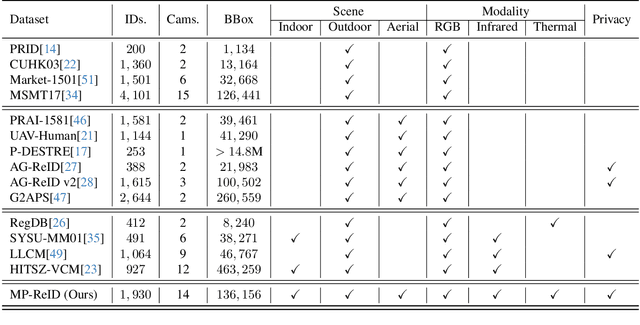
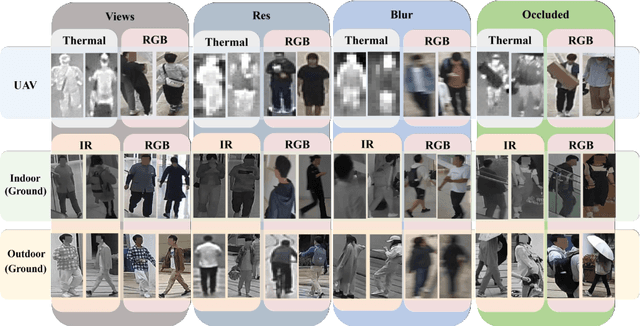
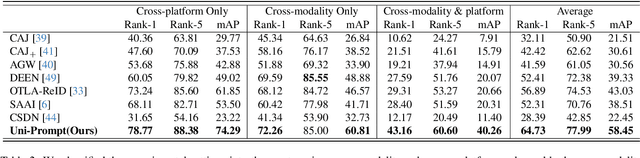
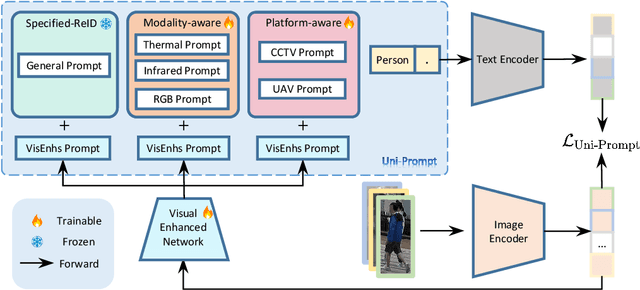
Conventional person re-identification (ReID) research is often limited to single-modality sensor data from static cameras, which fails to address the complexities of real-world scenarios where multi-modal signals are increasingly prevalent. For instance, consider an urban ReID system integrating stationary RGB cameras, nighttime infrared sensors, and UAVs equipped with dynamic tracking capabilities. Such systems face significant challenges due to variations in camera perspectives, lighting conditions, and sensor modalities, hindering effective person ReID. To address these challenges, we introduce the MP-ReID benchmark, a novel dataset designed specifically for multi-modality and multi-platform ReID. This benchmark uniquely compiles data from 1,930 identities across diverse modalities, including RGB, infrared, and thermal imaging, captured by both UAVs and ground-based cameras in indoor and outdoor environments. Building on this benchmark, we introduce Uni-Prompt ReID, a framework with specific-designed prompts, tailored for cross-modality and cross-platform scenarios. Our method consistently outperforms state-of-the-art approaches, establishing a robust foundation for future research in complex and dynamic ReID environments. Our dataset are available at:https://mp-reid.github.io/.