 Add to Chrome
 Add to Firefox
 Add to Edge
Predictive Relative-Velocity Steering for Safe Robotic Manipulator Teleoperation in Dynamic Environments
Aug 13, 2026
Recent advances in teleoperation have enabled robotic manipulators to perform dexterous, human-arm-like motions. However, human operators may fail to avoid suddenly appearing obstacles promptly and effectively, particularly under network latency or limited attention, thereby creating safety risks. To address this issue, we propose a lightweight and modular framework for proactive collision avoidance, operating directly at the end-effector velocity-command level. After preprocessing the point cloud, the framework first predicts potential collisions based on time-to-collision (TTC) with integrated overshoot protection, and subsequently rotates the relative-velocity vector using Rodrigues' rotation formula. The deflection changes only the direction of the relative velocity while preserving its magnitude, thereby mitigating the deadlock problem commonly encountered by conventional artificial potential field (APF) methods. The prediction module compensates for point-cloud processing latency introduced by complex teleoperation pipelines, while the lightweight design enables the high-frequency control required for teleoperation. Simulations across diverse scenarios show that the proposed method achieves a higher end-effector collision avoidance rate than the baseline methods. Experiments on a physical robotic system further validate its collision-avoidance effectiveness.

Audio-Visual Exchange-Aware Token Pruning for Efficient Audio-Visual Captioning
Jun 09, 2026Audio-visual captioning generates natural language descriptions from video and audio content. Multimodal LLMs have advanced this task, but both modalities contribute many tokens to the LLM input, where prefill self-attention scales quadratically. Existing token-pruning methods usually retain tokens by attention, saliency, or cross-entropy loss, yet the hard threshold selection makes it difficult to retain tokens that are truly valuable, especially for high-confusing tokens near the decision boundary. To this end, we propose a AVEX-Prune, an RL-based audio-visual dynamic token pruning method in this work. In our AVEX-Prune, an audio-visual token exchange strategy is proposed to select truly valuable tokens by replacing low-confidence retained tokens with high-confidence candidate tokens from the same or the other modality, and measuring the differences in caption generation from token swaps. AVEX-Prune preserves full-token quality at a 40% retention ratio on both VILA 1.5-8B (54.5 vs. 54.6) and VideoLLaMA 2 (57.0 vs. 56.8).
InspecSafe-V1: A Multimodal Benchmark for Safety Assessment in Industrial Inspection Scenarios
Jan 29, 2026With the rapid development of industrial intelligence and unmanned inspection, reliable perception and safety assessment for AI systems in complex and dynamic industrial sites has become a key bottleneck for deploying predictive maintenance and autonomous inspection. Most public datasets remain limited by simulated data sources, single-modality sensing, or the absence of fine-grained object-level annotations, which prevents robust scene understanding and multimodal safety reasoning for industrial foundation models. To address these limitations, InspecSafe-V1 is released as the first multimodal benchmark dataset for industrial inspection safety assessment that is collected from routine operations of real inspection robots in real-world environments. InspecSafe-V1 covers five representative industrial scenarios, including tunnels, power facilities, sintering equipment, oil and gas petrochemical plants, and coal conveyor trestles. The dataset is constructed from 41 wheeled and rail-mounted inspection robots operating at 2,239 valid inspection sites, yielding 5,013 inspection instances. For each instance, pixel-level segmentation annotations are provided for key objects in visible-spectrum images. In addition, a semantic scene description and a corresponding safety level label are provided according to practical inspection tasks. Seven synchronized sensing modalities are further included, including infrared video, audio, depth point clouds, radar point clouds, gas measurements, temperature, and humidity, to support multimodal anomaly recognition, cross-modal fusion, and comprehensive safety assessment in industrial environments.
VLSA: Vision-Language-Action Models with Plug-and-Play Safety Constraint Layer
Dec 09, 2025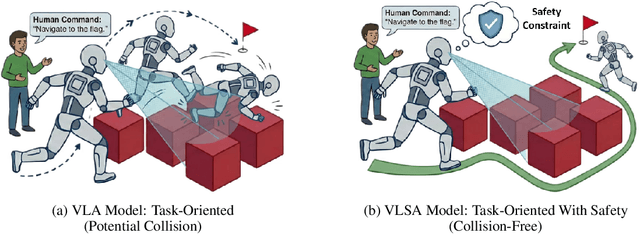
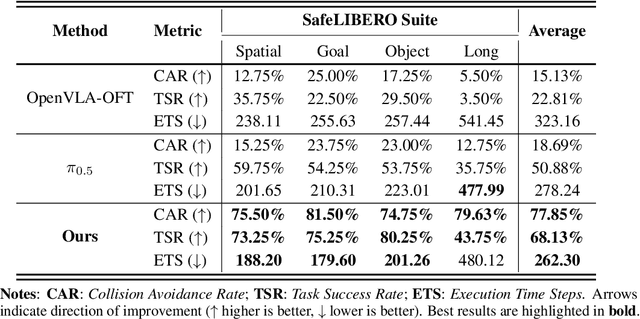
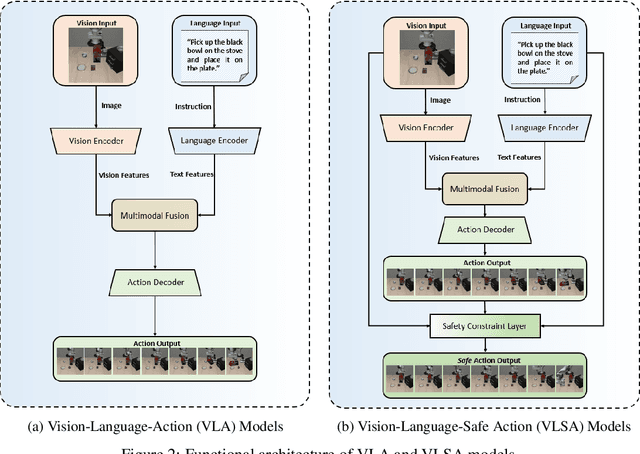
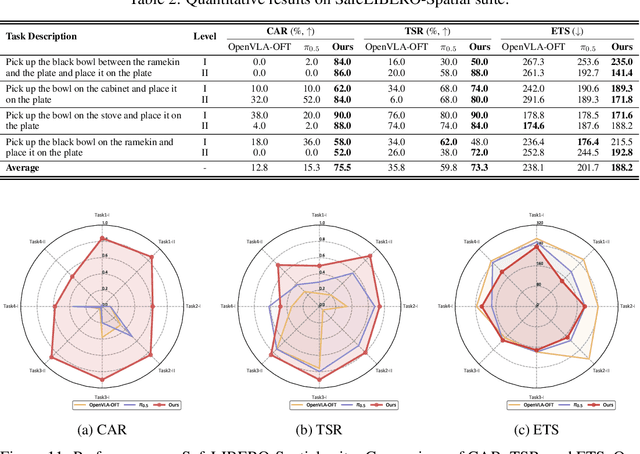
Vision-Language-Action (VLA) models have demonstrated remarkable capabilities in generalizing across diverse robotic manipulation tasks. However, deploying these models in unstructured environments remains challenging due to the critical need for simultaneous task compliance and safety assurance, particularly in preventing potential collisions during physical interactions. In this work, we introduce a Vision-Language-Safe Action (VLSA) architecture, named AEGIS, which contains a plug-and-play safety constraint (SC) layer formulated via control barrier functions. AEGIS integrates directly with existing VLA models to improve safety with theoretical guarantees, while maintaining their original instruction-following performance. To evaluate the efficacy of our architecture, we construct a comprehensive safety-critical benchmark SafeLIBERO, spanning distinct manipulation scenarios characterized by varying degrees of spatial complexity and obstacle intervention. Extensive experiments demonstrate the superiority of our method over state-of-the-art baselines. Notably, AEGIS achieves a 59.16% improvement in obstacle avoidance rate while substantially increasing the task execution success rate by 17.25%. To facilitate reproducibility and future research, we make our code, models, and the benchmark datasets publicly available at https://vlsa-aegis.github.io/.
Towards Accurate and Efficient Sub-8-Bit Integer Training
Nov 17, 2024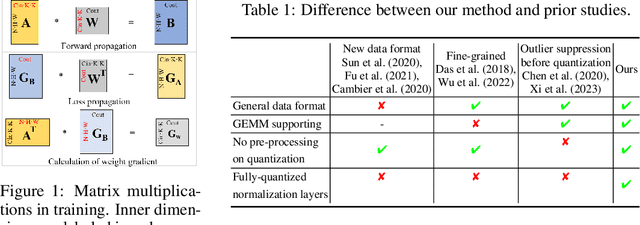
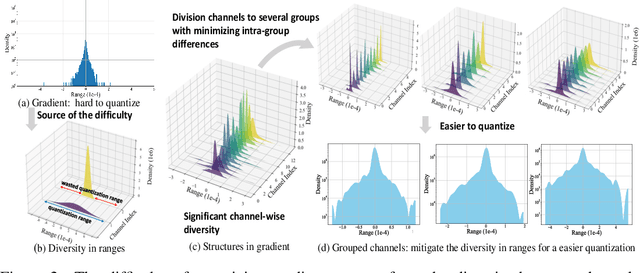
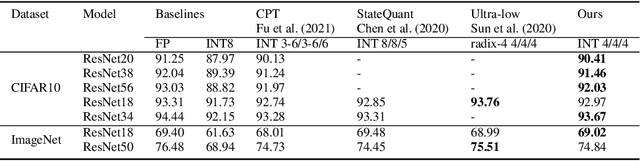
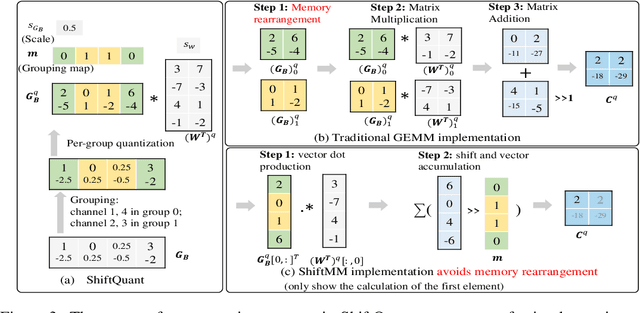
Neural network training is a memory- and compute-intensive task. Quantization, which enables low-bitwidth formats in training, can significantly mitigate the workload. To reduce quantization error, recent methods have developed new data formats and additional pre-processing operations on quantizers. However, it remains quite challenging to achieve high accuracy and efficiency simultaneously. In this paper, we explore sub-8-bit integer training from its essence of gradient descent optimization. Our integer training framework includes two components: ShiftQuant to realize accurate gradient estimation, and L1 normalization to smoothen the loss landscape. ShiftQuant attains performance that approaches the theoretical upper bound of group quantization. Furthermore, it liberates group quantization from inefficient memory rearrangement. The L1 normalization facilitates the implementation of fully quantized normalization layers with impressive convergence accuracy. Our method frees sub-8-bit integer training from pre-processing and supports general devices. This framework achieves negligible accuracy loss across various neural networks and tasks ($0.92\%$ on 4-bit ResNets, $0.61\%$ on 6-bit Transformers). The prototypical implementation of ShiftQuant achieves more than $1.85\times/15.3\%$ performance improvement on CPU/GPU compared to its FP16 counterparts, and $33.9\%$ resource consumption reduction on FPGA than the FP16 counterparts. The proposed fully-quantized L1 normalization layers achieve more than $35.54\%$ improvement in throughout on CPU compared to traditional L2 normalization layers. Moreover, theoretical analysis verifies the advancement of our method.