 Add to Chrome
 Add to Firefox
 Add to Edge
RynnWorld-Teleop: An Action-Conditioned World Model for Digital Teleoperation
Jul 07, 2026
Scaling robot learning requires massive, diverse trajectory data, yet collection is currently bottlenecked by physical teleoperation, where every demonstration binds operator time to specific hardware and workspaces. We introduce digital teleoperation, a paradigm that decouples data collection from physical constraints by replacing the real robot with a generative world model. In this framework, an operator's hand-pose stream drives a robot-centric generative world model to synthesize high-fidelity egocentric videos from a single reference image. The recorded pose stream serves as an embodiment-agnostic action label transferable to any target robot via standard retargeting, yielding complete state-action trajectories for imitation learning independent of physical hardware. We instantiate this paradigm in RynnWorld-Teleop, a system that integrates depth-aware skeletal conditioning, progressive human-to-robot training on a video Diffusion Transformer, and streaming autoregressive distillation. This pipeline compresses the generative process into a single-pass inference, enabling 40+ FPS, real-time interactive generation on a single H100 GPU. Policies trained exclusively on RynnWorld-Teleop-generated data achieve effective zero-shot Sim2Real transfer across dexterous and diverse bimanual tasks. Moreover, augmenting real-world datasets with our digitally teleoperated data consistently improves success rates, demonstrating that RynnWorld-Teleop serves as a high-fidelity, scalable data engine for the next generation of robotic agents.

RynnWorld-4D: 4D Embodied World Models for Robotic Manipulation
Jul 07, 2026Robotic manipulation in the open world requires not only recognizing what a scene looks like, but also anticipating how its 3D structure moves under interaction. We argue that synchronized RGB, depth, and optical flow, namely RGB-DF, provide a physically grounded representation that captures the underlying 4D dynamics of a scene. Compared to 2D pixel videos, this multi-modal synergy aligns visual appearance with geometric structure and temporal motion, creating a representation space significantly closer to the low-level end-effector actions demanded by robotic systems, thereby narrowing the gap between world prediction and policy learning. Building on this insight, we introduce RynnWorld-4D, a generative model that co-produces future RGB frames, depth maps, and optical flow from a single RGB-D image and a language instruction within one unified diffusion process. This 4D world model features a tri-branch architecture that integrates cross-modal attention with frame-wise 3D RoPE, ensuring that appearance, geometry, and motion evolve consistently. To supply training data at scale, we curate Rynn4DDataset 1.0, a massive dataset of over 254.4 million frames across egocentric human and robotic manipulation videos with high-quality pseudo-labels for depth and optical flow. We further propose RynnWorld-4D-Policy, an inverse dynamics head that consumes the internal 4D representations of RynnWorld-4D in a single forward pass, bypassing expensive multi-step denoising, to output robot actions in a closed-loop manner. Experiments show that RynnWorld-4D produces temporally and spatially coherent 4D predictions, and that RynnWorld-4D-Policy achieves state-of-the-art performance on real-world dexterous bimanual manipulation tasks, particularly excelling in tasks demanding spatial precision and temporal coordination.
Shift-Dependent Asymmetry: Orthogonal Inverse Low-Rank Adaptation for Federated Medical Segmentation
Jun 07, 2026Low-Rank Adaptation (LoRA) enables efficient federated fine-tuning of segmentation foundation models for medical imaging. However, most federated LoRA methods adopt a uniform aggregation rule, which breaks under the encoder-decoder asymmetry in medical segmentation: the encoder is dominated by appearance shifts, while the decoder is dominated by supervision variations. This mismatch entangles shared anatomy with site-specific biases and harms generalization. To address this, we propose Inverse Asymmetric Tuning (IAT). IAT aligns adaptation with heterogeneity sources by personalizing module-specific components in the encoder to absorb appearance shifts and in the decoder to accommodate site-dependent supervision, while retaining a shared pathway for transferable consensus. However, structural separation alone is insufficient under LoRA's bilinear parameterization, where multiplicative coupling can still cause site-specific updates to leak into the shared direction. We therefore introduce a Subspace Orthogonality Regularizer that penalizes shared-local collinearity in the effective update space, mitigating leakage without extra communication. Experiments show consistent improvements over strong federated LoRA and parameter-efficient FL baselines.
Project Imaging-X: A Survey of 1000+ Open-Access Medical Imaging Datasets for Foundation Model Development
Mar 29, 2026Foundation models have demonstrated remarkable success across diverse domains and tasks, primarily due to the thrive of large-scale, diverse, and high-quality datasets. However, in the field of medical imaging, the curation and assembling of such medical datasets are highly challenging due to the reliance on clinical expertise and strict ethical and privacy constraints, resulting in a scarcity of large-scale unified medical datasets and hindering the development of powerful medical foundation models. In this work, we present the largest survey to date of medical image datasets, covering over 1,000 open-access datasets with a systematic catalog of their modalities, tasks, anatomies, annotations, limitations, and potential for integration. Our analysis exposes a landscape that is modest in scale, fragmented across narrowly scoped tasks, and unevenly distributed across organs and modalities, which in turn limits the utility of existing medical image datasets for developing versatile and robust medical foundation models. To turn fragmentation into scale, we propose a metadata-driven fusion paradigm (MDFP) that integrates public datasets with shared modalities or tasks, thereby transforming multiple small data silos into larger, more coherent resources. Building on MDFP, we release an interactive discovery portal that enables end-to-end, automated medical image dataset integration, and compile all surveyed datasets into a unified, structured table that clearly summarizes their key characteristics and provides reference links, offering the community an accessible and comprehensive repository. By charting the current terrain and offering a principled path to dataset consolidation, our survey provides a practical roadmap for scaling medical imaging corpora, supporting faster data discovery, more principled dataset creation, and more capable medical foundation models.
Articulat3D: Reconstructing Articulated Digital Twins From Monocular Videos with Geometric and Motion Constraints
Mar 12, 2026Building high-fidelity digital twins of articulated objects from visual data remains a central challenge. Existing approaches depend on multi-view captures of the object in discrete, static states, which severely constrains their real-world scalability. In this paper, we introduce Articulat3D, a novel framework that constructs such digital twins from casually captured monocular videos by jointly enforcing explicit 3D geometric and motion constraints. We first propose Motion Prior-Driven Initialization, which leverages 3D point tracks to exploit the low-dimensional structure of articulated motion. By modeling scene dynamics with a compact set of motion bases, we facilitate soft decomposition of the scene into multiple rigidly-moving groups. Building on this initialization, we introduce Geometric and Motion Constraints Refinement, which enforces physically plausible articulation through learnable kinematic primitives parameterized by a joint axis, a pivot point, and per-frame motion scalars, yielding reconstructions that are both geometrically accurate and temporally coherent. Extensive experiments demonstrate that Articulat3D achieves state-of-the-art performance on synthetic benchmarks and real-world casually captured monocular videos, significantly advancing the feasibility of digital twin creation under uncontrolled real-world conditions. Our project page is at https://maxwell-zhao.github.io/Articulat3D.
Divide, Conquer and Unite: Hierarchical Style-Recalibrated Prototype Alignment for Federated Medical Image Segmentation
Nov 14, 2025Federated learning enables multiple medical institutions to train a global model without sharing data, yet feature heterogeneity from diverse scanners or protocols remains a major challenge. Many existing works attempt to address this issue by leveraging model representations (e.g., mean feature vectors) to correct local training; however, they often face two key limitations: 1) Incomplete Contextual Representation Learning: Current approaches primarily focus on final-layer features, overlooking critical multi-level cues and thus diluting essential context for accurate segmentation. 2) Layerwise Style Bias Accumulation: Although utilizing representations can partially align global features, these methods neglect domain-specific biases within intermediate layers, allowing style discrepancies to build up and reduce model robustness. To address these challenges, we propose FedBCS to bridge feature representation gaps via domain-invariant contextual prototypes alignment. Specifically, we introduce a frequency-domain adaptive style recalibration into prototype construction that not only decouples content-style representations but also learns optimal style parameters, enabling more robust domain-invariant prototypes. Furthermore, we design a context-aware dual-level prototype alignment method that extracts domain-invariant prototypes from different layers of both encoder and decoder and fuses them with contextual information for finer-grained representation alignment. Extensive experiments on two public datasets demonstrate that our method exhibits remarkable performance.
pFedSAM: Personalized Federated Learning of Segment Anything Model for Medical Image Segmentation
Sep 19, 2025Medical image segmentation is crucial for computer-aided diagnosis, yet privacy constraints hinder data sharing across institutions. Federated learning addresses this limitation, but existing approaches often rely on lightweight architectures that struggle with complex, heterogeneous data. Recently, the Segment Anything Model (SAM) has shown outstanding segmentation capabilities; however, its massive encoder poses significant challenges in federated settings. In this work, we present the first personalized federated SAM framework tailored for heterogeneous data scenarios in medical image segmentation. Our framework integrates two key innovations: (1) a personalized strategy that aggregates only the global parameters to capture cross-client commonalities while retaining the designed L-MoE (Localized Mixture-of-Experts) component to preserve domain-specific features; and (2) a decoupled global-local fine-tuning mechanism that leverages a teacher-student paradigm via knowledge distillation to bridge the gap between the global shared model and the personalized local models, thereby mitigating overgeneralization. Extensive experiments on two public datasets validate that our approach significantly improves segmentation performance, achieves robust cross-domain adaptation, and reduces communication overhead.
Towards Affordance-Aware Robotic Dexterous Grasping with Human-like Priors
Aug 12, 2025A dexterous hand capable of generalizable grasping objects is fundamental for the development of general-purpose embodied AI. However, previous methods focus narrowly on low-level grasp stability metrics, neglecting affordance-aware positioning and human-like poses which are crucial for downstream manipulation. To address these limitations, we propose AffordDex, a novel framework with two-stage training that learns a universal grasping policy with an inherent understanding of both motion priors and object affordances. In the first stage, a trajectory imitator is pre-trained on a large corpus of human hand motions to instill a strong prior for natural movement. In the second stage, a residual module is trained to adapt these general human-like motions to specific object instances. This refinement is critically guided by two components: our Negative Affordance-aware Segmentation (NAA) module, which identifies functionally inappropriate contact regions, and a privileged teacher-student distillation process that ensures the final vision-based policy is highly successful. Extensive experiments demonstrate that AffordDex not only achieves universal dexterous grasping but also remains remarkably human-like in posture and functionally appropriate in contact location. As a result, AffordDex significantly outperforms state-of-the-art baselines across seen objects, unseen instances, and even entirely novel categories.
ActiveSSF: An Active-Learning-Guided Self-Supervised Framework for Long-Tailed Megakaryocyte Classification
Feb 12, 2025Precise classification of megakaryocytes is crucial for diagnosing myelodysplastic syndromes. Although self-supervised learning has shown promise in medical image analysis, its application to classifying megakaryocytes in stained slides faces three main challenges: (1) pervasive background noise that obscures cellular details, (2) a long-tailed distribution that limits data for rare subtypes, and (3) complex morphological variations leading to high intra-class variability. To address these issues, we propose the ActiveSSF framework, which integrates active learning with self-supervised pretraining. Specifically, our approach employs Gaussian filtering combined with K-means clustering and HSV analysis (augmented by clinical prior knowledge) for accurate region-of-interest extraction; an adaptive sample selection mechanism that dynamically adjusts similarity thresholds to mitigate class imbalance; and prototype clustering on labeled samples to overcome morphological complexity. Experimental results on clinical megakaryocyte datasets demonstrate that ActiveSSF not only achieves state-of-the-art performance but also significantly improves recognition accuracy for rare subtypes. Moreover, the integration of these advanced techniques further underscores the practical potential of ActiveSSF in clinical settings. To foster further research, the code and datasets will be publicly released in the future.
Automated 3D Physical Simulation of Open-world Scene with Gaussian Splatting
Nov 19, 2024
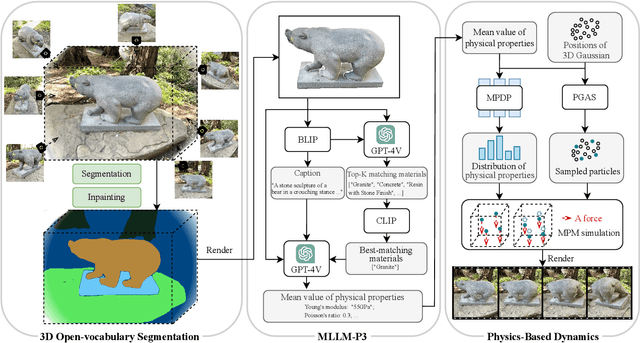


Recent advancements in 3D generation models have opened new possibilities for simulating dynamic 3D object movements and customizing behaviors, yet creating this content remains challenging. Current methods often require manual assignment of precise physical properties for simulations or rely on video generation models to predict them, which is computationally intensive. In this paper, we rethink the usage of multi-modal large language model (MLLM) in physics-based simulation, and present Sim Anything, a physics-based approach that endows static 3D objects with interactive dynamics. We begin with detailed scene reconstruction and object-level 3D open-vocabulary segmentation, progressing to multi-view image in-painting. Inspired by human visual reasoning, we propose MLLM-based Physical Property Perception (MLLM-P3) to predict mean physical properties of objects in a zero-shot manner. Based on the mean values and the object's geometry, the Material Property Distribution Prediction model (MPDP) model then estimates the full distribution, reformulating the problem as probability distribution estimation to reduce computational costs. Finally, we simulate objects in an open-world scene with particles sampled via the Physical-Geometric Adaptive Sampling (PGAS) strategy, efficiently capturing complex deformations and significantly reducing computational costs. Extensive experiments and user studies demonstrate our Sim Anything achieves more realistic motion than state-of-the-art methods within 2 minutes on a single GPU.