 Add to Chrome
 Add to Firefox
 Add to Edge
FlexComposer: Unified Video Compositing from Images to Dynamic Footage with Flexible Trajectory Control
Jul 31, 2026
Generative video compositing, which involves inserting external assets seamlessly into existing video sequences, is essential for content creation and visual effects. However, existing approaches suffer from a control-fidelity trade-off: they either hallucinate motion from static images, failing to preserve the dynamics of pre-animated assets, or lack fine-grained spatial control for precise asset placement along user-defined trajectories. We propose FlexComposer, a unified framework that standardizes video compositing as a trajectory-guided conditional generation task, enabling the seamless integration of both static images and dynamic footage. Our approach introduces three key designs: (1) a Unified Canonical Foreground Representation that decouples an object's intrinsic motion from its global displacement, standardizing heterogeneous inputs into a stabilized, centered latent space; (2) a Spatial-Aware Latent Injection strategy that exploits the translation equivariance of VAE latent spaces to transport canonical features onto target trajectories via a parameter-free mechanism; and (3) a Hybrid Dataset and Synthetic-to-Real Curriculum that synergizes procedural simulation, real-world cinematic footage, and generative data to implicitly learn physically plausible illumination and shadow harmonization. This unified design handles diverse inputs from product photos to dynamic subjects achieving high-fidelity motion control and environmental integration without the need for explicit 3D reconstruction or auxiliary learnable adapters. Extensive experiments demonstrate that FlexComposer outperforms state-of-the-art methods in visual quality, temporal consistency, and trajectory adherence.

Discovering Physical Directions in Weight Space: Composing Neural PDE Experts
May 14, 2026Recent advances in neural operators have made partial differential equation (PDE) surrogate modeling increasingly scalable and transferable through large-scale pretraining and in-context adaptation. However, after a shared operator is fine-tuned to multiple regimes within a continuous physical family, it remains unclear whether the resulting weight-space updates merely form isolated regime experts or reveal reusable physical structure. Starting from a shared family anchor, we fine-tune low- and high-regime endpoint experts and show that their updates can be separated into a family-shared adaptation and a direction aligned with the underlying physical parameter. This separation reinterprets endpoint experts as finite-difference probes of a local physical direction in weight space, explaining why static averaging can interpolate between regimes but attenuates endpoint-specific physics. Building on this perspective, we propose Calibration-Conditioned Merge (CCM), a post-hoc coordinate readout method for composing neural PDE experts along this physical direction. Given physical metadata, a calibrated coordinate mapping, or a short observed rollout prefix, CCM infers the target composition coordinate and deploys a single merged checkpoint for the remaining rollout. We evaluate CCM on the reaction--diffusion system, viscosity-parameterized two-dimensional Navier--Stokes equations, and radial dam-break dynamics. Across these benchmarks, CCM achieves its strongest gains in extrapolative regimes, reducing out-of-distribution rollout error relative to the family anchor by 54.2%, 42.8%, and 13.8%, respectively. Further experiments across FNO scales, a DPOT-style backbone, and ablations confirm that endpoint fine-tuning is not arbitrary checkpoint drift, but reveals a calibratable physical direction for training-free transfer across PDE regimes.
PDEAgent-Bench: A Multi-Metric, Multi-Library Benchmark for PDE Solver Generation
May 10, 2026PDE-to-solver code generation aims to automatically synthesize executable numerical solvers from partial differential equation (PDE) specifications. This task requires not only understanding the mathematical structure of PDEs, but also selecting appropriate discretization schemes and solver configurations, and correctly implementing the resulting formulations in finite-element method (FEM) libraries. Existing code generation benchmarks mainly evaluate syntactic correctness, or success on predefined test cases. To our knowledge, there is currently no publicly available benchmark specifically for PDE-to-solver code generation, and general-purpose code benchmarks do not fully capture the unique challenges of numerical PDE solution, such as ensuring solver accuracy, efficiency, and compatibility with professional FEM libraries. We introduce PDEAgent-Bench, to the best of our knowledge, the first multi-metric, multi-library benchmark for PDE-to-solver code generation. PDEAgent-Bench contains 645 instances across 6 mathematical categories and 11 PDE families, with common FEM libraries for DOLFINx, Firedrake, and deal.II. Each instance provides an agent-facing problem specification, a reference solution on a prescribed evaluation grid, and case-specific accuracy and runtime targets. PDEAgent-Bench adopts a staged evaluation framework in which generated solvers must sequentially pass executability, numerical accuracy, and computational efficiency checks. Experiments with representative LLMs and code agents show that models can often produce runnable code, but their pass rate drops substantially once accuracy and efficiency requirements are enforced. These results indicate that current agents remain limited in producing numerically reliable and efficient PDE solvers, and that PDEAgent-Bench provides a reproducible testbed grounded in the practical requirements of numerical PDE solving.
NTIRE 2026 Challenge on Single Image Reflection Removal in the Wild: Datasets, Results, and Methods
Apr 11, 2026In this paper, we review the NTIRE 2026 challenge on single-image reflection removal (SIRR) in the Wild. SIRR is a fundamental task in image restoration. Despite progress in academic research, most methods are tested on synthetic images or limited real-world images, creating a gap in real-world applications. In this challenge, we provide participants with the OpenRR-5k dataset, which requires them to process real-world images that cover a range of reflection scenarios and intensities, with the goal of generating clean images without reflections. The challenge attracted more than 100 registrations, with 11 of them participating in the final testing phase. The top-ranked methods advanced the state-of-the-art reflection removal performance and earned unanimous recognition from the five experts in the field. The proposed OpenRR-5k dataset is available at https://huggingface.co/datasets/qiuzhangTiTi/OpenRR-5k, and the homepage of this challenge is at https://github.com/caijie0620/OpenRR-5k. Due to page limitations, this article only presents partial content; the full report and detailed analyses are available in the extended arXiv version.
LumosX: Relate Any Identities with Their Attributes for Personalized Video Generation
Mar 20, 2026Recent advances in diffusion models have significantly improved text-to-video generation, enabling personalized content creation with fine-grained control over both foreground and background elements. However, precise face-attribute alignment across subjects remains challenging, as existing methods lack explicit mechanisms to ensure intra-group consistency. Addressing this gap requires both explicit modeling strategies and face-attribute-aware data resources. We therefore propose LumosX, a framework that advances both data and model design. On the data side, a tailored collection pipeline orchestrates captions and visual cues from independent videos, while multimodal large language models (MLLMs) infer and assign subject-specific dependencies. These extracted relational priors impose a finer-grained structure that amplifies the expressive control of personalized video generation and enables the construction of a comprehensive benchmark. On the modeling side, Relational Self-Attention and Relational Cross-Attention intertwine position-aware embeddings with refined attention dynamics to inscribe explicit subject-attribute dependencies, enforcing disciplined intra-group cohesion and amplifying the separation between distinct subject clusters. Comprehensive evaluations on our benchmark demonstrate that LumosX achieves state-of-the-art performance in fine-grained, identity-consistent, and semantically aligned personalized multi-subject video generation. Code and models are available at https://jiazheng-xing.github.io/lumosx-home/.
SAMora: Enhancing SAM through Hierarchical Self-Supervised Pre-Training for Medical Images
Nov 09, 2025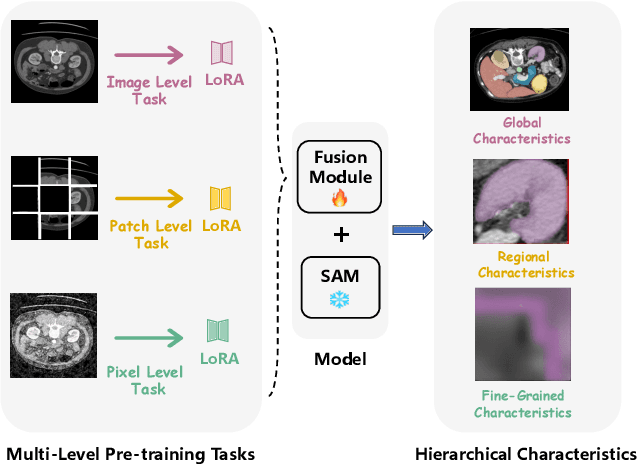
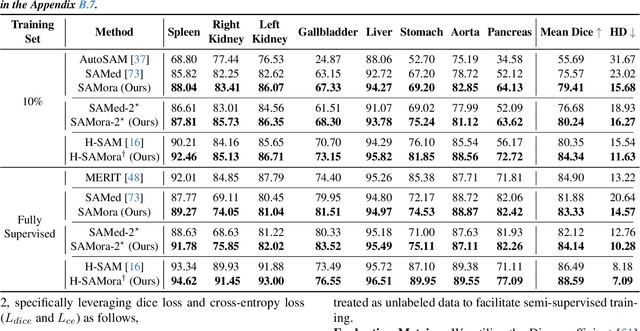
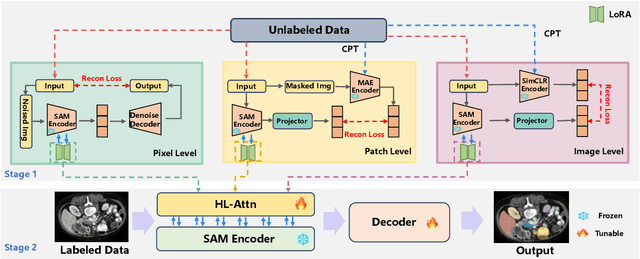
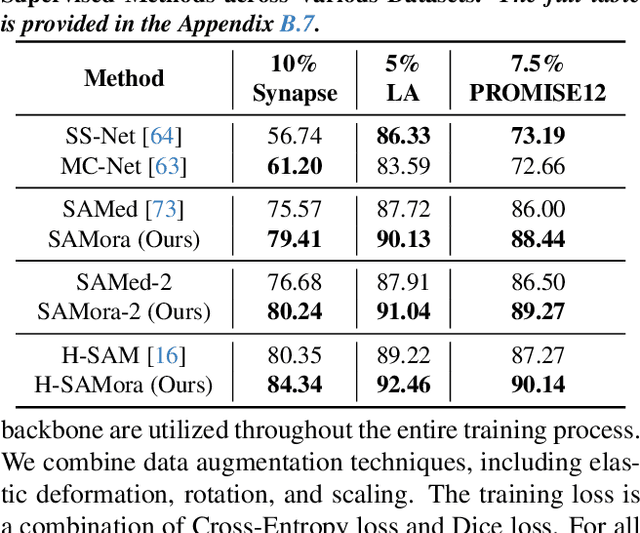
The Segment Anything Model (SAM) has demonstrated significant potential in medical image segmentation. Yet, its performance is limited when only a small amount of labeled data is available, while there is abundant valuable yet often overlooked hierarchical information in medical data. To address this limitation, we draw inspiration from self-supervised learning and propose SAMora, an innovative framework that captures hierarchical medical knowledge by applying complementary self-supervised learning objectives at the image, patch, and pixel levels. To fully exploit the complementarity of hierarchical knowledge within LoRAs, we introduce HL-Attn, a hierarchical fusion module that integrates multi-scale features while maintaining their distinct characteristics. SAMora is compatible with various SAM variants, including SAM2, SAMed, and H-SAM. Experimental results on the Synapse, LA, and PROMISE12 datasets demonstrate that SAMora outperforms existing SAM variants. It achieves state-of-the-art performance in both few-shot and fully supervised settings while reducing fine-tuning epochs by 90%. The code is available at https://github.com/ShChen233/SAMora.
SpatialCrafter: Unleashing the Imagination of Video Diffusion Models for Scene Reconstruction from Limited Observations
May 17, 2025Novel view synthesis (NVS) boosts immersive experiences in computer vision and graphics. Existing techniques, though progressed, rely on dense multi-view observations, restricting their application. This work takes on the challenge of reconstructing photorealistic 3D scenes from sparse or single-view inputs. We introduce SpatialCrafter, a framework that leverages the rich knowledge in video diffusion models to generate plausible additional observations, thereby alleviating reconstruction ambiguity. Through a trainable camera encoder and an epipolar attention mechanism for explicit geometric constraints, we achieve precise camera control and 3D consistency, further reinforced by a unified scale estimation strategy to handle scale discrepancies across datasets. Furthermore, by integrating monocular depth priors with semantic features in the video latent space, our framework directly regresses 3D Gaussian primitives and efficiently processes long-sequence features using a hybrid network structure. Extensive experiments show our method enhances sparse view reconstruction and restores the realistic appearance of 3D scenes.
NTIRE 2025 Challenge on Image Super-Resolution ($\times$4): Methods and Results
Apr 20, 2025This paper presents the NTIRE 2025 image super-resolution ($\times$4) challenge, one of the associated competitions of the 10th NTIRE Workshop at CVPR 2025. The challenge aims to recover high-resolution (HR) images from low-resolution (LR) counterparts generated through bicubic downsampling with a $\times$4 scaling factor. The objective is to develop effective network designs or solutions that achieve state-of-the-art SR performance. To reflect the dual objectives of image SR research, the challenge includes two sub-tracks: (1) a restoration track, emphasizes pixel-wise accuracy and ranks submissions based on PSNR; (2) a perceptual track, focuses on visual realism and ranks results by a perceptual score. A total of 286 participants registered for the competition, with 25 teams submitting valid entries. This report summarizes the challenge design, datasets, evaluation protocol, the main results, and methods of each team. The challenge serves as a benchmark to advance the state of the art and foster progress in image SR.
MathFlow: Enhancing the Perceptual Flow of MLLMs for Visual Mathematical Problems
Mar 19, 2025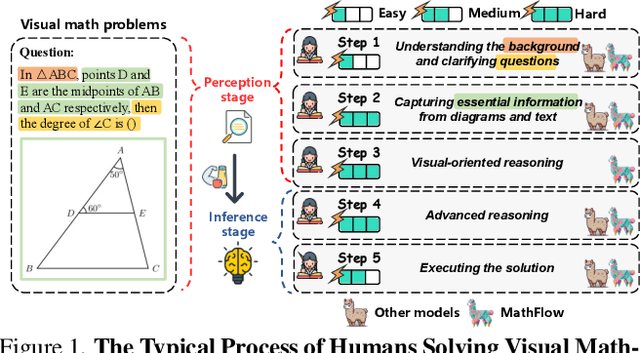
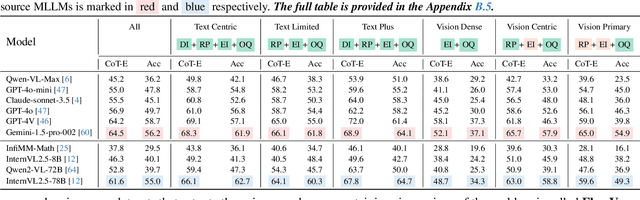
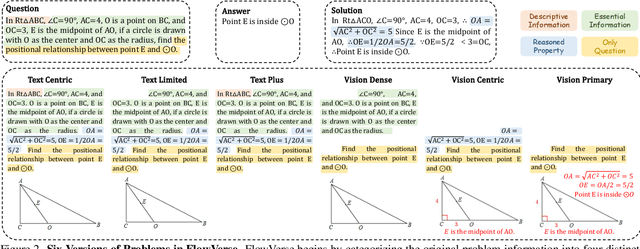

Despite impressive performance across diverse tasks, Multimodal Large Language Models (MLLMs) have yet to fully demonstrate their potential in visual mathematical problem-solving, particularly in accurately perceiving and interpreting diagrams. Inspired by typical processes of humans, we hypothesize that the perception capabilities to extract meaningful information from diagrams is crucial, as it directly impacts subsequent inference processes. To validate this hypothesis, we developed FlowVerse, a comprehensive benchmark that categorizes all information used during problem-solving into four components, which are then combined into six problem versions for evaluation. Our preliminary results on FlowVerse reveal that existing MLLMs exhibit substantial limitations when extracting essential information and reasoned property from diagrams and performing complex reasoning based on these visual inputs. In response, we introduce MathFlow, a modular problem-solving pipeline that decouples perception and inference into distinct stages, thereby optimizing each independently. Given the perceptual limitations observed in current MLLMs, we trained MathFlow-P-7B as a dedicated perception model. Experimental results indicate that MathFlow-P-7B yields substantial performance gains when integrated with various closed-source and open-source inference models. This demonstrates the effectiveness of the MathFlow pipeline and its compatibility to diverse inference frameworks. The FlowVerse benchmark and code are available at https://github.com/MathFlow-zju/MathFlow.
PAPM: A Physics-aware Proxy Model for Process Systems
Jul 07, 2024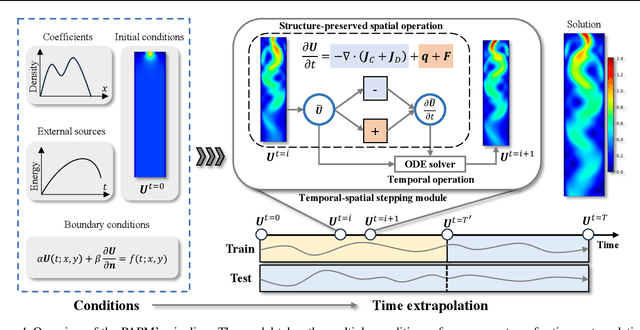
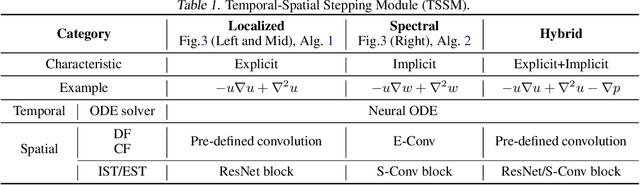
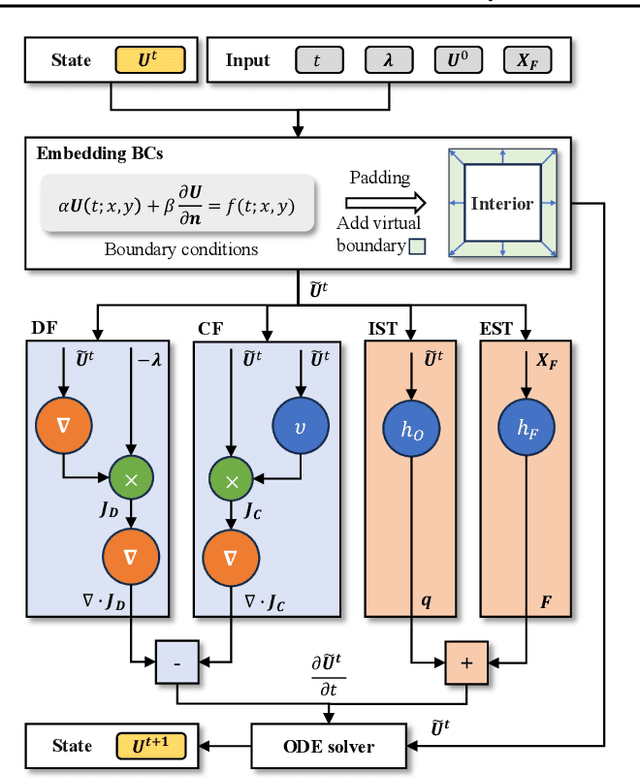
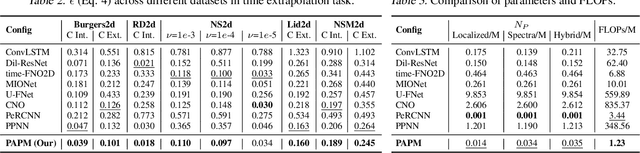
In the context of proxy modeling for process systems, traditional data-driven deep learning approaches frequently encounter significant challenges, such as substantial training costs induced by large amounts of data, and limited generalization capabilities. As a promising alternative, physics-aware models incorporate partial physics knowledge to ameliorate these challenges. Although demonstrating efficacy, they fall short in terms of exploration depth and universality. To address these shortcomings, we introduce a physics-aware proxy model (PAPM) that fully incorporates partial prior physics of process systems, which includes multiple input conditions and the general form of conservation relations, resulting in better out-of-sample generalization. Additionally, PAPM contains a holistic temporal-spatial stepping module for flexible adaptation across various process systems. Through systematic comparisons with state-of-the-art pure data-driven and physics-aware models across five two-dimensional benchmarks in nine generalization tasks, PAPM notably achieves an average performance improvement of 6.7%, while requiring fewer FLOPs, and just 1% of the parameters compared to the prior leading method. The code is available at https://github.com/pengwei07/PAPM.