 Add to Chrome
 Add to Firefox
 Add to Edge
Add-SD: Rational Generation without Manual Reference
Jul 30, 2024

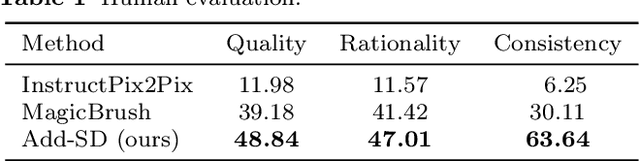

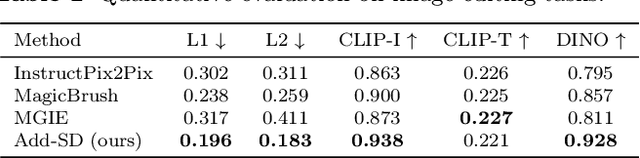
Diffusion models have exhibited remarkable prowess in visual generalization. Building on this success, we introduce an instruction-based object addition pipeline, named Add-SD, which automatically inserts objects into realistic scenes with rational sizes and positions. Different from layout-conditioned methods, Add-SD is solely conditioned on simple text prompts rather than any other human-costly references like bounding boxes. Our work contributes in three aspects: proposing a dataset containing numerous instructed image pairs; fine-tuning a diffusion model for rational generation; and generating synthetic data to boost downstream tasks. The first aspect involves creating a RemovalDataset consisting of original-edited image pairs with textual instructions, where an object has been removed from the original image while maintaining strong pixel consistency in the background. These data pairs are then used for fine-tuning the Stable Diffusion (SD) model. Subsequently, the pretrained Add-SD model allows for the insertion of expected objects into an image with good rationale. Additionally, we generate synthetic instances for downstream task datasets at scale, particularly for tail classes, to alleviate the long-tailed problem. Downstream tasks benefit from the enriched dataset with enhanced diversity and rationale. Experiments on LVIS val demonstrate that Add-SD yields an improvement of 4.3 mAP on rare classes over the baseline. Code and models are available at https://github.com/ylingfeng/Add-SD.

LION: Linear Group RNN for 3D Object Detection in Point Clouds
Jul 25, 2024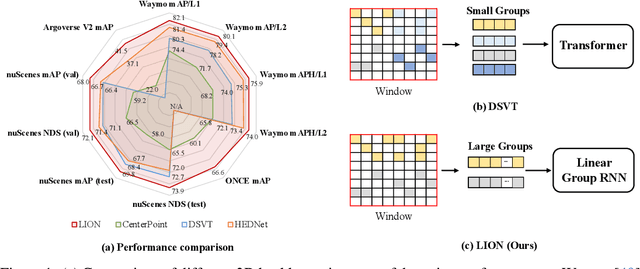
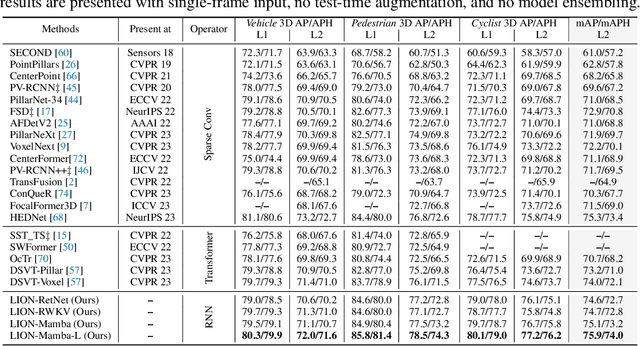

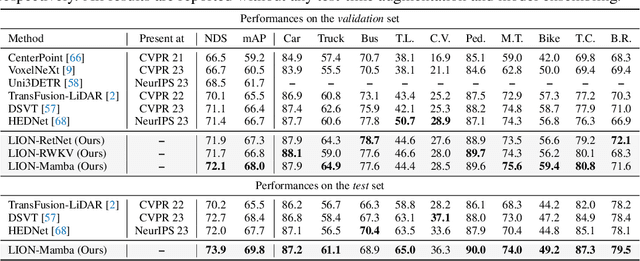
The benefit of transformers in large-scale 3D point cloud perception tasks, such as 3D object detection, is limited by their quadratic computation cost when modeling long-range relationships. In contrast, linear RNNs have low computational complexity and are suitable for long-range modeling. Toward this goal, we propose a simple and effective window-based framework built on LInear grOup RNN (i.e., perform linear RNN for grouped features) for accurate 3D object detection, called LION. The key property is to allow sufficient feature interaction in a much larger group than transformer-based methods. However, effectively applying linear group RNN to 3D object detection in highly sparse point clouds is not trivial due to its limitation in handling spatial modeling. To tackle this problem, we simply introduce a 3D spatial feature descriptor and integrate it into the linear group RNN operators to enhance their spatial features rather than blindly increasing the number of scanning orders for voxel features. To further address the challenge in highly sparse point clouds, we propose a 3D voxel generation strategy to densify foreground features thanks to linear group RNN as a natural property of auto-regressive models. Extensive experiments verify the effectiveness of the proposed components and the generalization of our LION on different linear group RNN operators including Mamba, RWKV, and RetNet. Furthermore, it is worth mentioning that our LION-Mamba achieves state-of-the-art on Waymo, nuScenes, Argoverse V2, and ONCE dataset. Last but not least, our method supports kinds of advanced linear RNN operators (e.g., RetNet, RWKV, Mamba, xLSTM and TTT) on small but popular KITTI dataset for a quick experience with our linear RNN-based framework.
Surfel-based Gaussian Inverse Rendering for Fast and Relightable Dynamic Human Reconstruction from Monocular Video
Jul 23, 2024


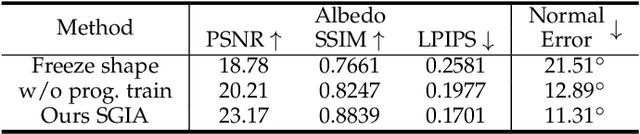
Efficient and accurate reconstruction of a relightable, dynamic clothed human avatar from a monocular video is crucial for the entertainment industry. This paper introduces the Surfel-based Gaussian Inverse Avatar (SGIA) method, which introduces efficient training and rendering for relightable dynamic human reconstruction. SGIA advances previous Gaussian Avatar methods by comprehensively modeling Physically-Based Rendering (PBR) properties for clothed human avatars, allowing for the manipulation of avatars into novel poses under diverse lighting conditions. Specifically, our approach integrates pre-integration and image-based lighting for fast light calculations that surpass the performance of existing implicit-based techniques. To address challenges related to material lighting disentanglement and accurate geometry reconstruction, we propose an innovative occlusion approximation strategy and a progressive training approach. Extensive experiments demonstrate that SGIA not only achieves highly accurate physical properties but also significantly enhances the realistic relighting of dynamic human avatars, providing a substantial speed advantage. We exhibit more results in our project page: https://GS-IA.github.io.
Explore the LiDAR-Camera Dynamic Adjustment Fusion for 3D Object Detection
Jul 22, 2024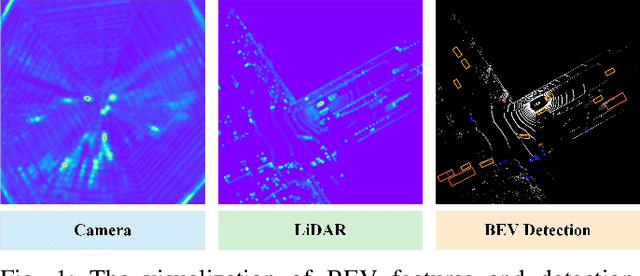
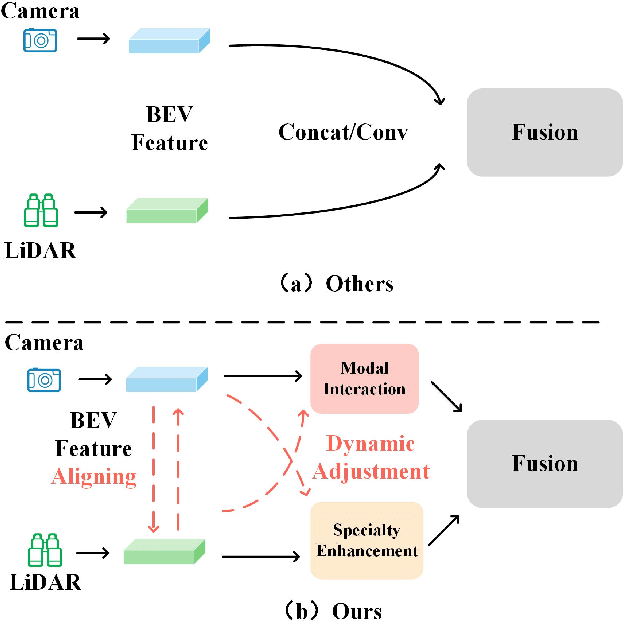
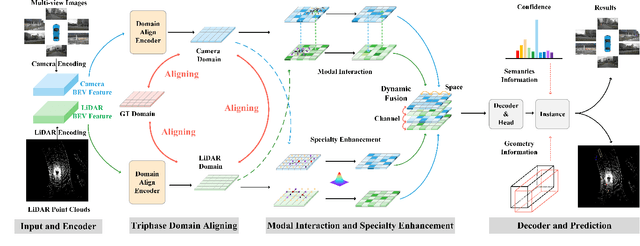
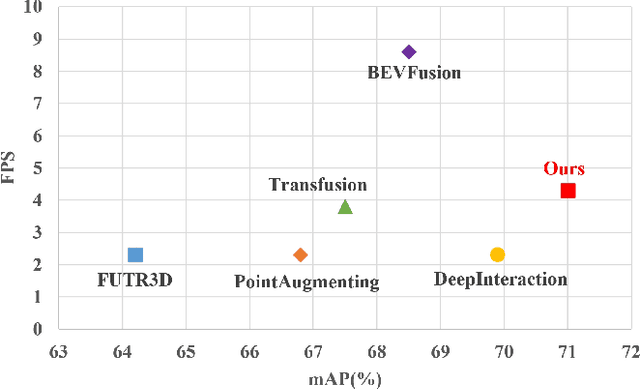
Camera and LiDAR serve as informative sensors for accurate and robust autonomous driving systems. However, these sensors often exhibit heterogeneous natures, resulting in distributional modality gaps that present significant challenges for fusion. To address this, a robust fusion technique is crucial, particularly for enhancing 3D object detection. In this paper, we introduce a dynamic adjustment technology aimed at aligning modal distributions and learning effective modality representations to enhance the fusion process. Specifically, we propose a triphase domain aligning module. This module adjusts the feature distributions from both the camera and LiDAR, bringing them closer to the ground truth domain and minimizing differences. Additionally, we explore improved representation acquisition methods for dynamic fusion, which includes modal interaction and specialty enhancement. Finally, an adaptive learning technique that merges the semantics and geometry information for dynamical instance optimization. Extensive experiments in the nuScenes dataset present competitive performance with state-of-the-art approaches. Our code will be released in the future.
LaMI-DETR: Open-Vocabulary Detection with Language Model Instruction
Jul 16, 2024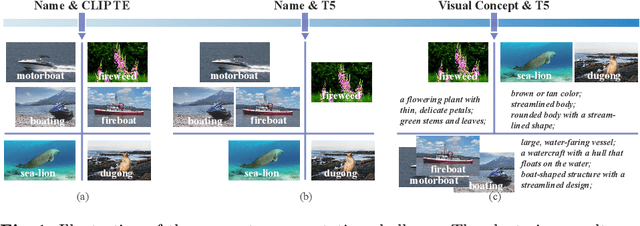
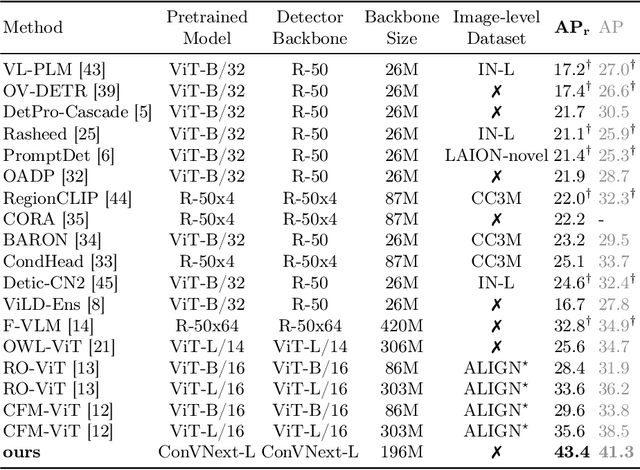

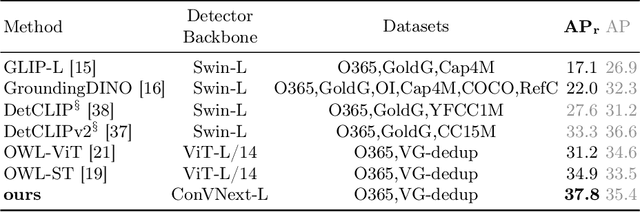
Existing methods enhance open-vocabulary object detection by leveraging the robust open-vocabulary recognition capabilities of Vision-Language Models (VLMs), such as CLIP.However, two main challenges emerge:(1) A deficiency in concept representation, where the category names in CLIP's text space lack textual and visual knowledge.(2) An overfitting tendency towards base categories, with the open vocabulary knowledge biased towards base categories during the transfer from VLMs to detectors.To address these challenges, we propose the Language Model Instruction (LaMI) strategy, which leverages the relationships between visual concepts and applies them within a simple yet effective DETR-like detector, termed LaMI-DETR.LaMI utilizes GPT to construct visual concepts and employs T5 to investigate visual similarities across categories.These inter-category relationships refine concept representation and avoid overfitting to base categories.Comprehensive experiments validate our approach's superior performance over existing methods in the same rigorous setting without reliance on external training resources.LaMI-DETR achieves a rare box AP of 43.4 on OV-LVIS, surpassing the previous best by 7.8 rare box AP.
OPEN: Object-wise Position Embedding for Multi-view 3D Object Detection
Jul 15, 2024
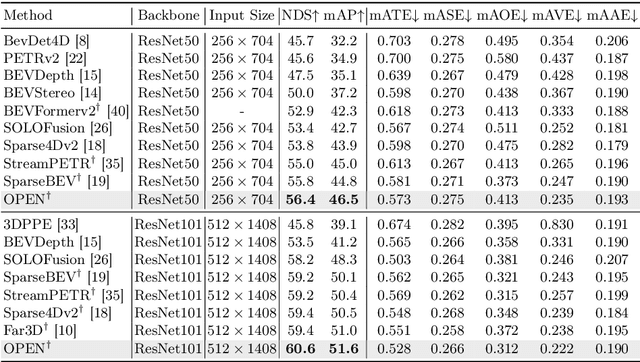
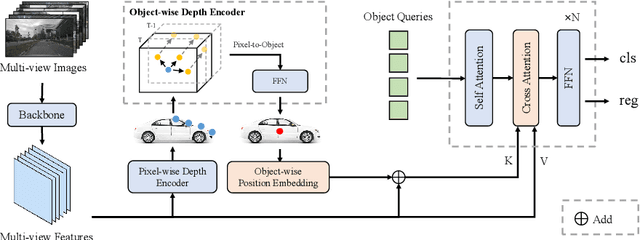
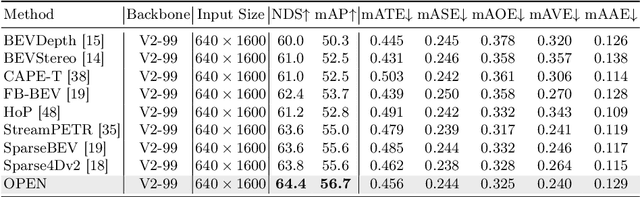
Accurate depth information is crucial for enhancing the performance of multi-view 3D object detection. Despite the success of some existing multi-view 3D detectors utilizing pixel-wise depth supervision, they overlook two significant phenomena: 1) the depth supervision obtained from LiDAR points is usually distributed on the surface of the object, which is not so friendly to existing DETR-based 3D detectors due to the lack of the depth of 3D object center; 2) for distant objects, fine-grained depth estimation of the whole object is more challenging. Therefore, we argue that the object-wise depth (or 3D center of the object) is essential for accurate detection. In this paper, we propose a new multi-view 3D object detector named OPEN, whose main idea is to effectively inject object-wise depth information into the network through our proposed object-wise position embedding. Specifically, we first employ an object-wise depth encoder, which takes the pixel-wise depth map as a prior, to accurately estimate the object-wise depth. Then, we utilize the proposed object-wise position embedding to encode the object-wise depth information into the transformer decoder, thereby producing 3D object-aware features for final detection. Extensive experiments verify the effectiveness of our proposed method. Furthermore, OPEN achieves a new state-of-the-art performance with 64.4% NDS and 56.7% mAP on the nuScenes test benchmark.
SEED: A Simple and Effective 3D DETR in Point Clouds
Jul 15, 2024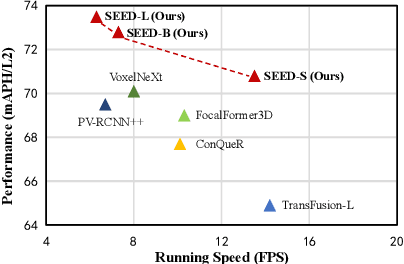
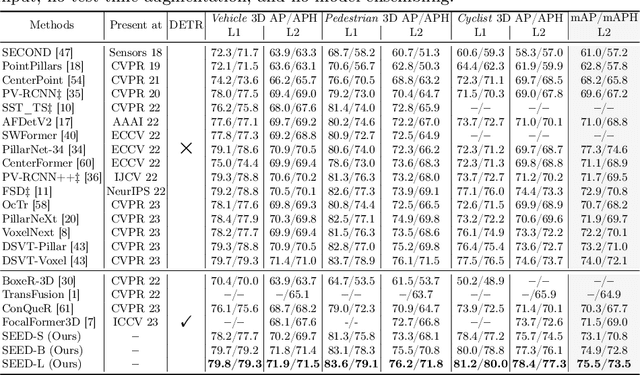

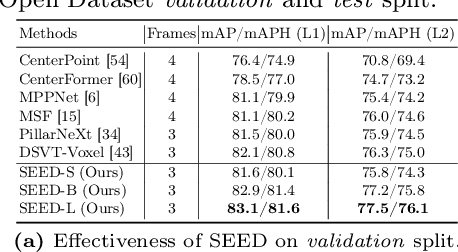
Recently, detection transformers (DETRs) have gradually taken a dominant position in 2D detection thanks to their elegant framework. However, DETR-based detectors for 3D point clouds are still difficult to achieve satisfactory performance. We argue that the main challenges are twofold: 1) How to obtain the appropriate object queries is challenging due to the high sparsity and uneven distribution of point clouds; 2) How to implement an effective query interaction by exploiting the rich geometric structure of point clouds is not fully explored. To this end, we propose a simple and effective 3D DETR method (SEED) for detecting 3D objects from point clouds, which involves a dual query selection (DQS) module and a deformable grid attention (DGA) module. More concretely, to obtain appropriate queries, DQS first ensures a high recall to retain a large number of queries by the predicted confidence scores and then further picks out high-quality queries according to the estimated quality scores. DGA uniformly divides each reference box into grids as the reference points and then utilizes the predicted offsets to achieve a flexible receptive field, allowing the network to focus on relevant regions and capture more informative features. Extensive ablation studies on DQS and DGA demonstrate its effectiveness. Furthermore, our SEED achieves state-of-the-art detection performance on both the large-scale Waymo and nuScenes datasets, illustrating the superiority of our proposed method. The code is available at https://github.com/happinesslz/SEED
OVLW-DETR: Open-Vocabulary Light-Weighted Detection Transformer
Jul 15, 2024
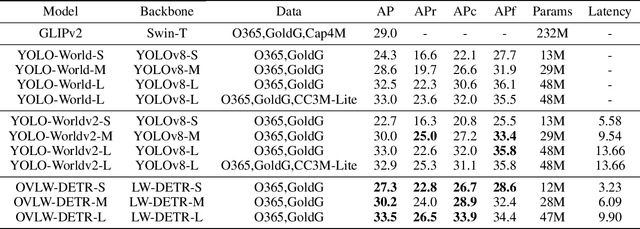
Open-vocabulary object detection focusing on detecting novel categories guided by natural language. In this report, we propose Open-Vocabulary Light-Weighted Detection Transformer (OVLW-DETR), a deployment friendly open-vocabulary detector with strong performance and low latency. Building upon OVLW-DETR, we provide an end-to-end training recipe that transferring knowledge from vision-language model (VLM) to object detector with simple alignment. We align detector with the text encoder from VLM by replacing the fixed classification layer weights in detector with the class-name embeddings extracted from the text encoder. Without additional fusing module, OVLW-DETR is flexible and deployment friendly, making it easier to implement and modulate. improving the efficiency of interleaved attention computation. Experimental results demonstrate that the proposed approach is superior over existing real-time open-vocabulary detectors on standard Zero-Shot LVIS benchmark. Source code and pre-trained models are available at [https://github.com/Atten4Vis/LW-DETR].
Timestep-Aware Correction for Quantized Diffusion Models
Jul 04, 2024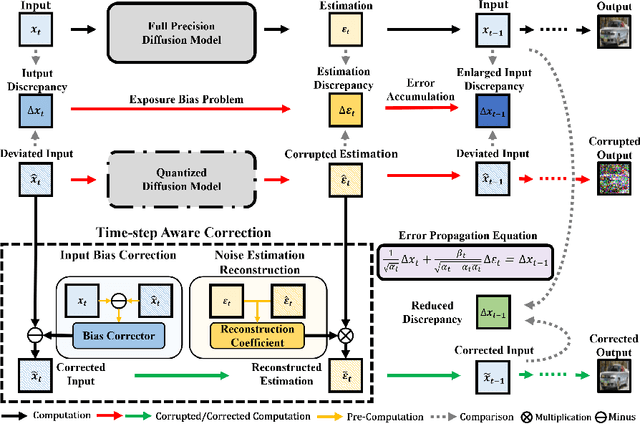
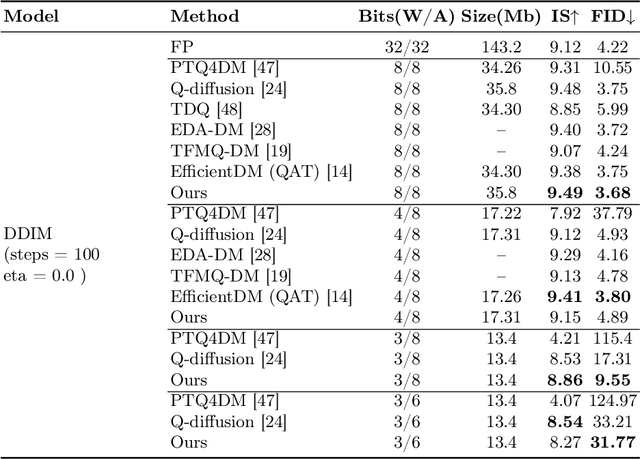
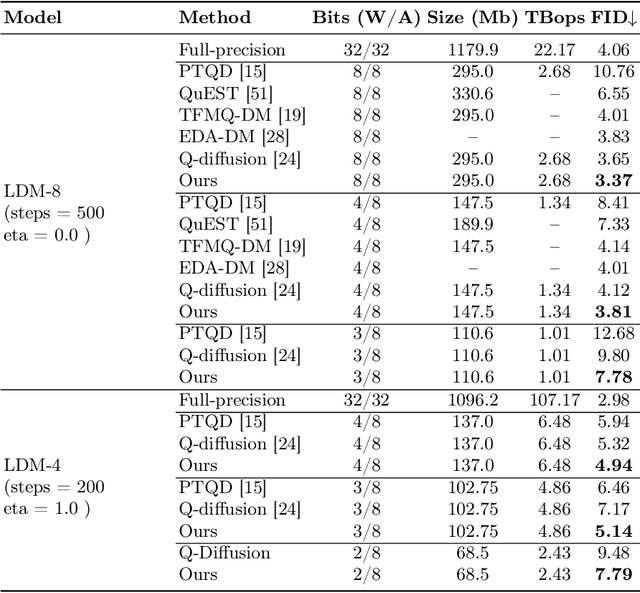
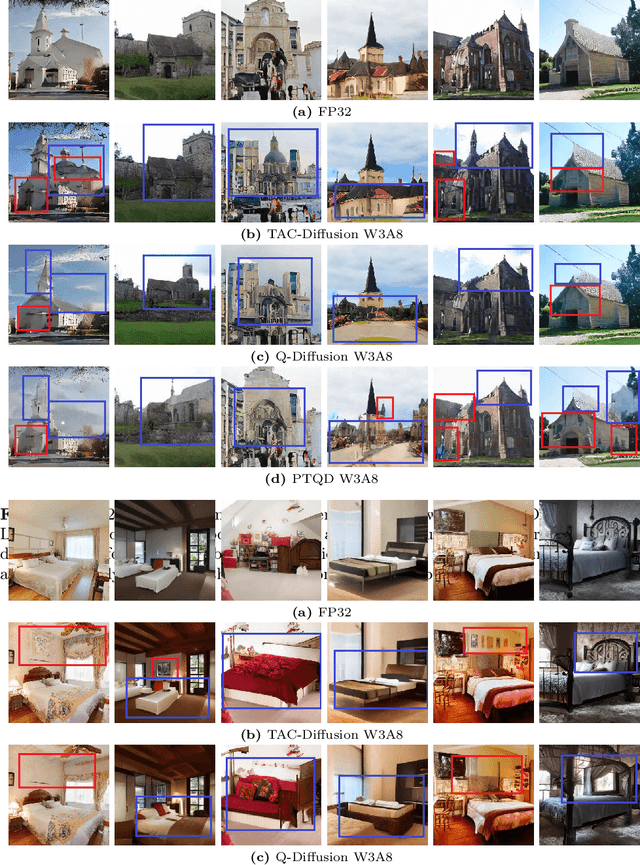
Diffusion models have marked a significant breakthrough in the synthesis of semantically coherent images. However, their extensive noise estimation networks and the iterative generation process limit their wider application, particularly on resource-constrained platforms like mobile devices. Existing post-training quantization (PTQ) methods have managed to compress diffusion models to low precision. Nevertheless, due to the iterative nature of diffusion models, quantization errors tend to accumulate throughout the generation process. This accumulation of error becomes particularly problematic in low-precision scenarios, leading to significant distortions in the generated images. We attribute this accumulation issue to two main causes: error propagation and exposure bias. To address these problems, we propose a timestep-aware correction method for quantized diffusion model, which dynamically corrects the quantization error. By leveraging the proposed method in low-precision diffusion models, substantial enhancement of output quality could be achieved with only negligible computation overhead. Extensive experiments underscore our method's effectiveness and generalizability. By employing the proposed correction strategy, we achieve state-of-the-art (SOTA) results on low-precision models.
Evaluation of Text-to-Video Generation Models: A Dynamics Perspective
Jul 01, 2024Comprehensive and constructive evaluation protocols play an important role in the development of sophisticated text-to-video (T2V) generation models. Existing evaluation protocols primarily focus on temporal consistency and content continuity, yet largely ignore the dynamics of video content. Dynamics are an essential dimension for measuring the visual vividness and the honesty of video content to text prompts. In this study, we propose an effective evaluation protocol, termed DEVIL, which centers on the dynamics dimension to evaluate T2V models. For this purpose, we establish a new benchmark comprising text prompts that fully reflect multiple dynamics grades, and define a set of dynamics scores corresponding to various temporal granularities to comprehensively evaluate the dynamics of each generated video. Based on the new benchmark and the dynamics scores, we assess T2V models with the design of three metrics: dynamics range, dynamics controllability, and dynamics-based quality. Experiments show that DEVIL achieves a Pearson correlation exceeding 90% with human ratings, demonstrating its potential to advance T2V generation models. Code is available at https://github.com/MingXiangL/DEVIL.