 Add to Chrome
 Add to Firefox
 Add to Edge
AceTone: Bridging Words and Colors for Conditional Image Grading
Apr 01, 2026
Color affects how we interpret image style and emotion. Previous color grading methods rely on patch-wise recoloring or fixed filter banks, struggling to generalize across creative intents or align with human aesthetic preferences. In this study, we propose AceTone, the first approach that supports multimodal conditioned color grading within a unified framework. AceTone formulates grading as a generative color transformation task, where a model directly produces 3D-LUTs conditioned on text prompts or reference images. We develop a VQ-VAE based tokenizer which compresses a $3\times32^3$ LUT vector to 64 discrete tokens with $ΔE<2$ fidelity. We further build a large-scale dataset, AceTone-800K, and train a vision-language model to predict LUT tokens, followed by reinforcement learning to align outputs with perceptual fidelity and aesthetics. Experiments show that AceTone achieves state-of-the-art performance on both text-guided and reference-guided grading tasks, improving LPIPS by up to 50% over existing methods. Human evaluations confirm that AceTone's results are visually pleasing and stylistically coherent, demonstrating a new pathway toward language-driven, aesthetic-aligned color grading.

Evaluation of Text-to-Video Generation Models: A Dynamics Perspective
Jul 01, 2024Comprehensive and constructive evaluation protocols play an important role in the development of sophisticated text-to-video (T2V) generation models. Existing evaluation protocols primarily focus on temporal consistency and content continuity, yet largely ignore the dynamics of video content. Dynamics are an essential dimension for measuring the visual vividness and the honesty of video content to text prompts. In this study, we propose an effective evaluation protocol, termed DEVIL, which centers on the dynamics dimension to evaluate T2V models. For this purpose, we establish a new benchmark comprising text prompts that fully reflect multiple dynamics grades, and define a set of dynamics scores corresponding to various temporal granularities to comprehensively evaluate the dynamics of each generated video. Based on the new benchmark and the dynamics scores, we assess T2V models with the design of three metrics: dynamics range, dynamics controllability, and dynamics-based quality. Experiments show that DEVIL achieves a Pearson correlation exceeding 90% with human ratings, demonstrating its potential to advance T2V generation models. Code is available at https://github.com/MingXiangL/DEVIL.
DynRefer: Delving into Region-level Multi-modality Tasks via Dynamic Resolution
May 25, 2024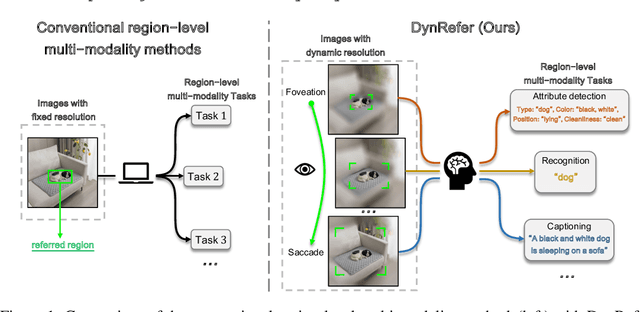

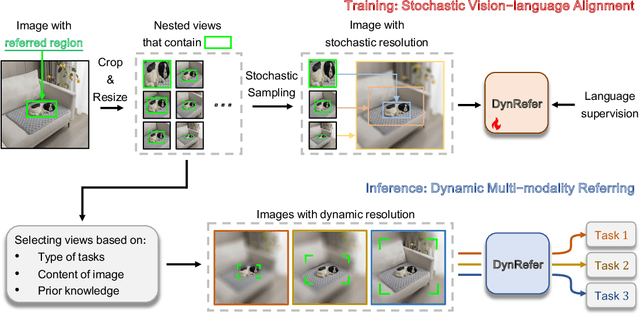

Region-level multi-modality methods can translate referred image regions to human preferred language descriptions. Unfortunately, most of existing methods using fixed visual inputs remain lacking the resolution adaptability to find out precise language descriptions. In this study, we propose a dynamic resolution approach, referred to as DynRefer, to pursue high-accuracy region-level referring through mimicking the resolution adaptability of human visual cognition. DynRefer first implements stochastic vision-language alignment. It aligns desired language descriptions of multi-modality tasks with images of stochastic resolution, which are constructed by nesting a set of views around the referred region. DynRefer then implements dynamic multi-modality referring, which is realized by selecting views based on image and language priors. This allows the visual information used for referring to better match human preferences, thereby improving the representational adaptability of region-level multi-modality models. Extensive experiments show that DynRefer brings mutual improvement upon tasks including region-level captioning, open-vocabulary region recognition and attribute detection. Last but not least, DynRefer achieves new state-of-the-art on multiple region-level multi-modality tasks using a single model. Code is available at https://github.com/callsys/DynRefer.